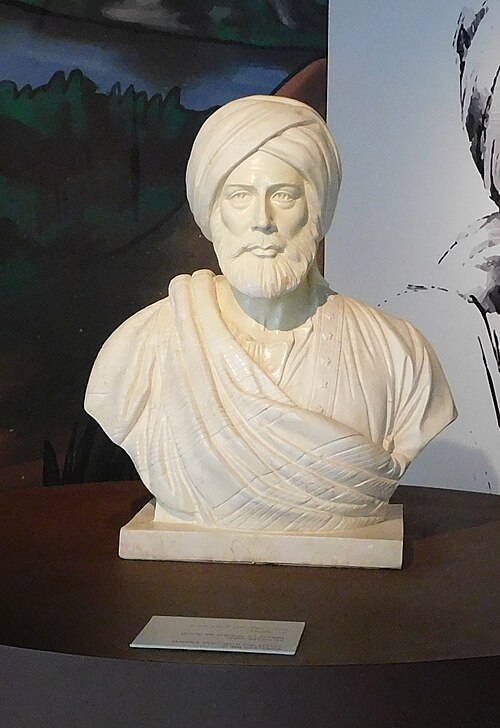
Start at the top for an easy introduction. Go further down for more detail and scholarship.
- Easy
- Intermediate
- Advanced
For young readers
In 1325 a young man of twenty-one left his home in Tangier, a port city in Morocco at the northern tip of Africa. His name was Ibn Battuta. He was going to Mecca, the holy city of Islam, on pilgrimage. He planned to be away for perhaps a year or two. He did not come home for twenty-four years.
Ibn Battuta loved to travel. He wanted to see new places, meet famous people and learn from holy men and scholars. He rode camels across deserts, sailed on ships across the Indian Ocean, and crossed icy grasslands on wagons. He went to Egypt, Syria, Iraq, Iran, Arabia, East Africa, Turkey, Central Asia, India, the Maldives, Sri Lanka, Southeast Asia and China.
How did he pay for all this? He was trained in Islamic law, and in many Muslim lands rulers were happy to welcome a learned man. Kings gave him gifts, horses and money. In India the sultan of Delhi made him a judge. On the Maldive Islands he became a judge too, and married there.
His journeys were not always easy. He was robbed by bandits, nearly drowned in a shipwreck, lost all his belongings more than once, and fell seriously ill. On his way home he passed through lands where a terrible disease, the Black Death, was killing many people.
When he finally returned to Morocco, the sultan asked him to tell his story. A young writer named Ibn Juzayy wrote it down and polished it into a book. It is called the Rihla, which means “journey”. Today it helps us imagine what the world looked like about 700 years ago.
At a glance
- Born
- 24 February 1304, Tangier, Morocco (Marinid sultanate)
- Died
- 1368 or 1369 (some sources give later dates), in Morocco; burial place uncertain
- Background
- Berber family of the Lawata tribe, with a tradition of legal scholarship; trained in Maliki law
- Travels
- 1325–1354: North and East Africa, the Middle East, Anatolia, the Golden Horde, Central Asia, India, the Maldives, Sri Lanka, Southeast Asia, China, al-Andalus and Mali
- Distance
- Often estimated at about 117,000 km (73,000 miles), though parts of his itinerary are uncertain
- Book
- Tuhfat al-nuzzar fi ghara’ib al-amsar wa-‘aja’ib al-asfar, known as the Rihla; completed with Ibn Juzayy in 1355–56
- Language
- Classical Arabic
- Significance
- The most extensive travel account of the medieval Islamic world and a key source for the fourteenth century
Easy
Who was Ibn Battuta?
Abu Abdallah Muhammad ibn Battuta was born in Tangier in 1304, when Morocco was ruled by the Marinid dynasty. His family belonged to the Lawata, a Berber tribe that had long been Arabic-speaking and Muslim, and several of his relatives served as qadis, judges of Islamic law. He received the education of a young scholar: the Qur’an, Arabic, and the law of the Maliki school, which prevailed in North Africa.
In June 1325, aged twenty-one, he left home alone to perform the hajj, the pilgrimage to Mecca. What began as a religious journey turned into a life of travel. Over the next three decades he crossed much of the Afro-Eurasian world, returning to Morocco only in 1349 and making two further journeys, to al-Andalus and to the Mali Empire, before settling down in 1354.
He was not an explorer in the modern sense. Most of the places he visited were part of, or connected to, the Dar al-Islam, the world of Muslim societies. Everywhere he went he found mosques, law courts, Sufi lodges and fellow scholars who shared his language of learning, Arabic. This network made it possible for a trained jurist to be welcomed, employed and rewarded from Morocco to India.
His book, the Rihla (“journey”), is one of the great works of travel literature. It is an indispensable source for historians of the fourteenth century, though, as we shall see, it must be read with care.
Easy
The journeys, step by step
Pilgrim (1325–1327). Ibn Battuta travelled overland across North Africa to Alexandria and Cairo, went up the Nile, then turned back and went through Palestine and Syria to Damascus. He joined the pilgrim caravan to Medina and Mecca, completing the hajj in late 1326. Instead of going home, he went with a caravan to Iraq and made a detour into Iran, visiting Isfahan and Shiraz, then Baghdad and Tabriz, before returning to Mecca.
The Red Sea, East Africa and Anatolia (c. 1328–1333). After a period in Mecca (its length is debated), he sailed down the Red Sea to Yemen and along the Swahili coast of East Africa, visiting Mogadishu, Mombasa and Kilwa, which he praised as one of the most beautiful towns. He returned by way of Oman and the Persian Gulf. Later he crossed to Anatolia, a patchwork of small Turkish principalities, and then over the Black Sea to the steppe lands of the Golden Horde, the Mongol state ruled by Özbeg Khan. He says he accompanied one of the khan’s wives, a Byzantine princess, to Constantinople.
India (1333–1341). Crossing Central Asia and Afghanistan, he reached the Indus and went on to Delhi, capital of the sultan Muhammad bin Tughluq, famous both for his generosity and for his cruelty. The sultan made him a qadi with a large salary. Ibn Battuta spent about eight years in India, piling up debts and at one point falling out of favour.
The Indian Ocean and China (1341–1347). In 1341 the sultan appointed him ambassador to the Mongol Yuan emperor of China. The embassy was wrecked off the coast at Calicut, and Ibn Battuta lost everything. Afraid to return to Delhi, he went to the Maldives, where he served as a judge and married, then to Sri Lanka, where he climbed Adam’s Peak, and to Bengal. He sailed on through Southeast Asia, stopping at Samudra Pasai in Sumatra, and says he reached the Chinese port of Quanzhou, called Zaytun, around 1345–46.
Home, al-Andalus and Mali (1347–1354). Returning west, he passed through Syria and Egypt as the Black Death spread in 1348, and learned that his mother had died of the plague. He reached Fez in 1349. He then visited Granada in al-Andalus, and in 1352 crossed the Sahara to the Mali Empire, where he spent months at the court of Mansa Sulayman and visited Timbuktu and Gao, before being called home by the sultan of Morocco in 1354.
Easy
The world he travelled through
Ibn Battuta travelled during a period of unusual connection across Afro-Eurasia. The Mongol conquests of the thirteenth century had created successor states across Asia, the Ilkhanate in Iran, the Golden Horde in the western steppe, the Chagatai Khanate in Central Asia and the Yuan dynasty in China, and several of their rulers had converted to Islam. Sea routes across the Indian Ocean linked East Africa, Arabia, India, Southeast Asia and China through trade in spices, textiles, horses and porcelain.
Within the Islamic world, shared institutions eased travel. The hajj brought Muslims from everywhere to Mecca every year. Madrasas (colleges), Sufi lodges called zawiyas or khanqahs, and charitable endowments offered hospitality to travellers. Legal and religious scholars could find work far from home because Islamic law and Arabic learning were recognised across many states.
It was also a dangerous and changing world. Ibn Battuta describes bandits, storms, wars, and the violent politics of the Delhi sultanate. By the time he returned home, the Black Death had devastated societies from China to Europe, the Ilkhanate had collapsed, and the Yuan dynasty was weakening. His book is thus a portrait of an interconnected world on the eve of great upheaval.
Intermediate
The Rihla: how the book was made
Back in Fez, Ibn Battuta told his stories at the court of the Marinid sultan Abu Inan Faris. The sultan ordered that they be written down and appointed as editor Muhammad ibn Juzayy, a young scholar and secretary originally from Granada. Ibn Battuta dictated his recollections, and Ibn Juzayy shaped them into a literary work, completed at the end of 1355 or early 1356. Ibn Juzayy died soon afterwards.
The full title is Tuhfat al-nuzzar fi ghara’ib al-amsar wa-‘aja’ib al-asfar, often translated as “A Gift to Those Who Contemplate the Wonders of Cities and the Marvels of Travelling”. It belongs to the Arabic genre of the rihla, the travel account, which often grew out of journeys for pilgrimage or study. One of the most famous earlier examples was the Rihla of the Andalusian Ibn Jubayr, who made the pilgrimage in 1183–85.
Ibn Juzayy did more than take dictation. He added poems, polished the prose, and in several places inserted passages drawn from earlier writers, above all descriptions of Damascus, Medina and Mecca taken from Ibn Jubayr, sometimes with acknowledgement. He also comments occasionally in his own voice. The result is a book in which it is often hard to tell what Ibn Battuta saw, what he remembered years later, what he heard from others, and what his editor contributed.
Ibn Battuta says he lost his notes when he was robbed, so the Rihla was composed largely from memory, decades after some of the events. This helps explain confusions of chronology and geography, but his memory for people, customs and places was also remarkably detailed.
Intermediate
What the Rihla describes
The Rihla is organised as a continuous narrative, but its real interest lies in its descriptions. Ibn Battuta notes the size and beauty of cities, their mosques, markets and gardens; the customs of courts; food, dress and marriage; the scholars and holy men he met; and the fruits, animals and goods of each land. He describes, for example, the coconut palms and cowrie shells of the Maldives, the paper money and porcelain of China, and the gold and salt trade of Mali.
He is also a sharp and sometimes judgmental observer. As a strict Maliki jurist, he disapproved of practices he thought un-Islamic: in the Maldives he tried to make women cover themselves more fully, and in Mali he was shocked that women mixed freely with men and that servant girls went unclothed, even as he praised the Malians’ devotion to prayer and the safety of travel in their land. His opinions reveal as much about his own values as about the people he describes.
The book is rich in personal drama: his marriages and divorces, his children left behind in various places, his generosity and debts, his fear of Muhammad bin Tughluq, the shipwreck at Calicut, his capture by bandits in India, his illnesses. This personal voice is one reason the Rihla remains readable today.
Intermediate
Reception and rediscovery
In his own time, not everyone believed Ibn Battuta. The historian Ibn Khaldun, who was at the Marinid court in Fez in the 1350s, recorded in his Muqaddima that people at the Marinid court whispered that the traveller was a liar, while a vizier defended him, saying that one should not reject reports simply because one has not seen such things oneself. The Rihla circulated in manuscript and in abridged versions in the Maghrib, but it was not widely known elsewhere.
European scholars learned of it in the early nineteenth century through abridgements acquired by travellers such as Ulrich Jasper Seetzen and Johann Ludwig Burckhardt. Samuel Lee published an English translation of an abridgement in 1829. After the French conquest of Algeria, complete manuscripts reached Paris, and Charles Defrémery and Beniamino Sanguinetti published the Arabic text with a French translation in four volumes (1853–1858), which became the standard edition.
The authoritative English translation was begun by H. A. R. Gibb for the Hakluyt Society, with volumes appearing from 1958, and completed by C. F. Beckingham, who published the fourth volume in 1994. In the twentieth century Ibn Battuta became a national hero in Morocco and a symbol of a cosmopolitan Islamic past. A crater on the Moon, many schools and a large shopping mall in Dubai are named after him.
Intermediate
A closer look: the journey to Mali
Ibn Battuta’s last great journey, to the Mali Empire in 1352–54, shows the Rihla at its most valuable and most revealing. He crossed the Sahara from Sijilmasa with a merchant caravan, stopping at Taghaza, where houses and a mosque were built of blocks of salt, and reached Walata, Mali’s northern trading post. From there he travelled to the capital of Mansa Sulayman, the brother of Mansa Musa, whose exact location is still debated by historians.
His description of Sulayman’s court is the most detailed eyewitness account of Mali that survives from the period. He describes audiences under a great tree or in a pavilion, the ruler’s interpreter and griots, the ceremonies of the Muslim festivals, and the way subjects sprinkled dust on their heads before the king. He praises the Malians for their regular attendance at Friday prayer, their zeal in memorising the Qur’an and the security of the roads, but he complains bitterly about the modest gift the mansa gave him.
On his way home he visited Timbuktu and Gao on the Niger, and the copper-producing town of Takedda, before receiving the sultan of Morocco’s order to return. Because the Arabic sources on Mali written by al-Umari and Ibn Khaldun relied on informants, Ibn Battuta’s personal observations are indispensable, even when his judgments reflect the prejudices of a North African visitor.
Intermediate
Later life and significance
After completing the Rihla, Ibn Battuta appears to have served as a qadi in a Moroccan town. Almost nothing else is known of his last years. Later biographical sources place his death in 1368 or 1369, though other dates have also been proposed. A tomb in the old city of Tangier is traditionally identified as his, but this is not certain.
For historians, the Rihla is often the only or the most detailed outside account of places such as the Maldives, the Swahili coast and the Mali Empire in the fourteenth century. It records rulers, officials, festivals, prices, goods and customs that appear in no other source. It is especially valuable for Muslim communities along the Indian Ocean and in the steppe, and for the Delhi sultanate under Muhammad bin Tughluq.
Ibn Battuta is often compared with the Venetian Marco Polo, who travelled in Asia a generation earlier. Both books were dictated to collaborators and mix observation with hearsay. But whereas Marco Polo travelled mainly as an outsider in Mongol service, Ibn Battuta moved within a shared Islamic civilisation, and his book shows how that civilisation connected distant lands.
Advanced
Debate: how reliable is the Rihla?
Scholars broadly accept that Ibn Battuta travelled very widely and that much of the Rihla rests on first-hand experience; the descriptions of India, the Maldives, East Africa, Anatolia and Mali contain precise details that fit other evidence. But several sections are problematic. The chronology is often inconsistent: for example, the dates he gives for his stay in Mecca and his East African journey cannot all be right, and historians have proposed different reconstructions, placing the East African voyage in 1328 or around 1330.
Some journeys may never have happened. His account of a side trip from the Golden Horde to the city of Bulghar on the Volga, and his remarks about lands further north, have been doubted since the early twentieth century; the scholar Stephen Janicsek argued in 1929 that this excursion was fabricated. His description of China is the most debated. His account of Quanzhou and the south Chinese coast is plausible, but his claimed journey inland to Khanbaliq (Beijing) is vague, includes events that do not match Chinese history, and may be based on hearsay. Some scholars doubt he went beyond the southern ports at all; others accept a shorter journey.
The borrowings from Ibn Jubayr and other earlier works show that the text is a composite. Ross Dunn and other historians argue that we should not treat the Rihla as a diary but as a literary work produced by a traveller and an editor in the Marinid court, shaped by the conventions of the genre and by the desire to entertain and edify the sultan. Within that framework, questions of “truth” become questions about sources: which passages are observation, which are memory, which are reports and which are literary insertion.
Advanced
Reading the Rihla as a historical source
Historians test the Rihla against independent evidence. Coins, inscriptions and Chinese, Persian, Indian and Arabic chronicles can confirm or contradict the names of rulers and the dates of events. For instance, Indian sources confirm many details of Muhammad bin Tughluq’s court, including his abrupt policies and harsh punishments. Archaeology at Kilwa, in the Maldives and in West Africa can be compared with his descriptions of buildings and trade goods.
The text itself survives in a number of manuscripts, the most important of which are in Paris; one fragment has been identified by some scholars as possibly in Ibn Juzayy’s own hand. Comparison of manuscripts, study of the editor’s interventions, and identification of borrowed passages allow scholars to peel back layers of the text. The Defrémery–Sanguinetti edition remains the basis of most translations, although scholars have called for a new critical edition.
Finally, historians read the Rihla for what it reveals about mentalities: how a fourteenth-century Maghribi jurist understood the Islamic world, what he considered proper and improper, and how he represented other peoples, especially women, non-Muslims and Africans south of the Sahara. His often condescending remarks about Malians, for example, must be weighed against his genuine admiration for aspects of their society. Such a critical reading makes the Rihla more, not less, valuable.
Key ideas
- Rihla
- An Arabic genre of travel writing, usually tied to pilgrimage or study; Ibn Battuta’s book is its most famous example.
- Dar al-Islam
- The world of Muslim societies, whose shared law, language and institutions made his long travels possible.
- Scholar as traveller
- As a trained jurist, Ibn Battuta could find hospitality, patrons and jobs as a judge across many states.
- Afro-Eurasian connection
- His journeys show the links created by Mongol successor states, Indian Ocean trade and the hajj.
- Author and editor
- The Rihla was dictated from memory and shaped by Ibn Juzayy, who added poems and borrowed passages.
- Critical reading
- Historians accept much of the book but doubt parts, such as the Volga and inland China journeys, and test it against other evidence.
- Observer’s perspective
- His judgments about customs, women and non-Muslims reveal the values of a fourteenth-century Maliki jurist.
Records
- 1304 — Ibn Battuta is born in Tangier on 24 February.
- 1325 — He leaves Tangier in June to make the pilgrimage to Mecca.
- 1326 — He completes his first hajj, then travels to Iraq and Iran.
- c. 1330 — He sails down the Red Sea and along the East African coast to Mogadishu and Kilwa (date debated: 1328 or c. 1330).
- c. 1333 — After Anatolia, the Golden Horde and Central Asia, he reaches the Indus and goes on to Delhi, where he becomes a qadi.
- 1341 — Muhammad bin Tughluq sends him as ambassador to China; the embassy is shipwrecked at Calicut.
- c. 1343 — He serves as a judge in the Maldives, then visits Sri Lanka and Bengal.
- c. 1345 — He reaches Sumatra and, by his account, the Chinese port of Quanzhou (Zaytun).
- 1349 — He returns to Fez after passing through lands struck by the Black Death.
- 1352 — He crosses the Sahara to the Mali Empire and visits Timbuktu (returns 1354).
- 1355 — The Rihla is completed with Ibn Juzayy at the Marinid court (late 1355 or early 1356).
- c. 1368 — Ibn Battuta dies in Morocco (1368 or 1369).
Glossary
- Hajj
- The pilgrimage to Mecca, a religious duty for Muslims who are able to make it.
- Qadi
- A judge who applies Islamic law.
- Maliki school
- One of the four Sunni schools of law, dominant in North and West Africa.
- Marinids
- The Berber dynasty ruling Morocco from the thirteenth to the fifteenth century, with its capital at Fez.
- Golden Horde
- The Mongol successor state in the western Eurasian steppe, whose rulers converted to Islam.
- Delhi Sultanate
- The Muslim state ruling much of northern India from the thirteenth to the sixteenth century.
- Zawiya
- A Sufi lodge that often gave hospitality to travellers.
- Zaytun
- The Arabic name for Quanzhou, a great trading port in southern China.
- Swahili coast
- The East African coast from Somalia to Mozambique, home to Muslim trading towns such as Kilwa.
Questions and answers
Why did Ibn Battuta travel so far?
He began with the pilgrimage to Mecca, but he loved seeing new lands and meeting scholars and holy men. As a trained judge, he could earn money and gifts from rulers along the way.
Did he travel farther than Marco Polo?
By most estimates, yes: about 117,000 km, several times the distance usually credited to Marco Polo, though some of his claimed journeys are doubted.
Did he write the book himself?
No. He dictated his memories to Ibn Juzayy, a scholar at the Moroccan court, who edited and polished them, adding poems and passages from earlier writers.
Did he really go to China?
Many scholars accept that he reached the southern port of Quanzhou, but his account of travelling inland to Beijing is doubtful and may be based on hearsay.
What happened to his family?
He married several times during his travels, and some of his children were left behind in places such as India and the Maldives. His mother died of the Black Death before he returned home.
How should historians use the Rihla?
As a valuable but composite source, testing each passage against other evidence and recognising the roles of memory, hearsay, genre conventions and editorial additions.
Which edition and translation do scholars use?
The Arabic edition with French translation by Defrémery and Sanguinetti (1853–58) and the English translation by H. A. R. Gibb and C. F. Beckingham for the Hakluyt Society (1958–1994).
Sources and further reading
- Ibn Battuta. Wikipedia
- Rihla. Wikipedia
- Ibn Jubayr. Wikipedia
- Muhammad bin Tughluq. Wikipedia
- Mali Empire. Wikipedia
- Ross E. Dunn, The Adventures of Ibn Battuta: A Muslim Traveler of the 14th Century. University of California Press, 1986
- H. A. R. Gibb and C. F. Beckingham (trans.), The Travels of Ibn Battuta, A.D. 1325–1354 (4 vols.). Hakluyt Society, 1958–1994
Related
- Mansa MusaRuler of the Mali Empire remembered for its wealth, his pilgrimage to Mecca and support for Islamic learning.
- Ibn KhaldunNorth African historian and thinker whose Muqaddimah examines how societies and states change.
- HafezPersian lyric poet especially known for ghazals of love, longing and spiritual ambiguity.
- One Thousand and One NightsA collection of tales that developed over centuries from several storytelling traditions.
- Genghis KhanFounder of the Mongol Empire, proclaimed supreme ruler in 1206.
Written with AI assistance from the published sources listed above, and revised as new research appears.