Start at the top for an easy introduction. Go further down for more detail and scholarship.
- Easy
- Intermediate
- Advanced
For young readers
Imagine a town at the edge of the biggest hot desert in the world, the Sahara. To the north there is sand for weeks of travel. To the south, a short walk away, there is a great river called the Niger. That town is Timbuktu, in the country we now call Mali.
Long ago, camel caravans crossed the desert carrying big slabs of salt. Boats on the river brought gold, grain and other goods. Timbuktu was the meeting place where desert people and river people traded. That made the town rich.
The people of Timbuktu loved books. Scholars came from far away to teach and study, and families copied and collected books by hand for hundreds of years. Some of these books are about religion and law, but others are about stars, medicine, poetry and history.
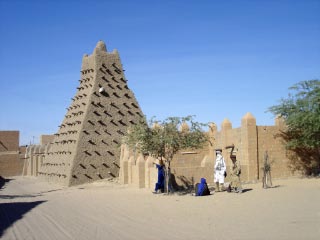
The town’s great mosques are built mostly of mud mixed with straw, with wooden beams poking out of the walls. Every year the people help put fresh mud on the walls so that the rain does not wash them away. It is a bit like giving the building a new coat of skin.
In 2012 armed groups took over the town and broke some old tombs of holy men. Brave librarians and families secretly carried hundreds of thousands of old books to safety in metal boxes. Later, local builders rebuilt the tombs.
In some countries people say “from here to Timbuktu” to mean “very, very far away.” But for the people who live there, Timbuktu is not a fairy-tale place. It is a real city with a long and proud history.
At a glance
- Location
- Northern Mali, on the southern edge of the Sahara, about 15–20 km north of the main channel of the Niger River; its river port is Kabara
- Origins
- A seasonal camp said by the 17th-century Tarikh al-Sudan to have been founded by Maghsharan Tuareg around 1100 CE; it became a permanent town in the 12th–14th centuries (exact date debated)
- Golden age
- 14th–16th centuries, under the Mali Empire (from c. 1324) and the Songhai Empire (1468–1591)
- Great mosques
- Djinguereber (attributed to Mansa Musa, c. 1325–1327), Sankoré (14th–15th century) and Sidi Yahya (begun c. 1400, completed c. 1440)
- Building style
- Sudano-Sahelian earthen architecture of mud brick and plaster over wooden beams, renewed by regular community replastering
- Manuscripts
- Hundreds of thousands of manuscripts, mostly in Arabic and some in African languages written in Arabic script (Ajami), dating from the late 13th to the early 20th century
- World Heritage
- Inscribed by UNESCO in 1988 (three mosques and sixteen mausoleums and cemeteries); on the List of World Heritage in Danger 1990–2005 and again since 2012
- Languages today
- Mainly Koyra Chiini (a Songhay language); also Tamasheq, Hassaniya Arabic and Bambara; Arabic has long been the language of scholarship
Easy
What is Timbuktu?
Timbuktu is a city in northern Mali, West Africa. It lies where the Sahara Desert meets the floodlands of the Niger River, about fifteen to twenty kilometres from the river’s main channel. Today it is the capital of the Tombouctou Region and home to tens of thousands of people, most of whom speak Koyra Chiini, a language of the Songhay family.
For about three centuries, from the 1300s to the late 1500s, Timbuktu was one of the most important cities in Africa. Caravans of camels crossed the desert to it, boats came up the river to its port, and scholars travelled there to teach, copy books and argue about law and faith. Its three historic mosques and many shrines of respected scholars and holy men make up the site that UNESCO listed as World Heritage in 1988.
Timbuktu is also a word with a second life. In English and other European languages it came to stand for any unimaginably distant place. That image says more about how little Europeans knew of Africa than about the city itself, which for West Africans has often been compared to what Athens means to Europe: a city of learning.
Easy
A town between desert and river
The secret of Timbuktu’s importance was its location. The Niger River makes a great bend northwards into the Sahara, and Timbuktu sits near the top of that bend. It was the place where the camel, the animal of the desert, met the canoe, the vehicle of the river. Goods had to change hands there, and people who handle goods make money.
From the north came salt. People need salt to live, and in the forests and savannas of West Africa it was scarce, while in the Sahara there were mines of rock salt, such as Taghaza and later Taoudenni. Great caravans, called azalai, carried slabs of salt south. From the south, along the river, came gold, grain, ivory and other goods. Enslaved people were also traded across the desert, a painful part of this commerce that the sources make clear.
Until the second half of the twentieth century, huge salt caravans of thousands of camels still left Timbuktu twice a year for Taoudenni, some 660 kilometres to the north. The journey took about three weeks each way. Today trucks carry most of the salt, but slabs of rock salt still reach the town and travel on by boat.
Life by the river also depended on the yearly flood. The Niger rises with rains far to the south-west, and the flood reaches Timbuktu slowly, peaking around the end of December. When the water is high, boats can come right up to the port of Kabara through a canal. Farmers around the town grow rice, including African rice that grows taller as the floodwater rises.
Easy
How to “read” the mud mosques
Timbuktu’s three great mosques, Djinguereber, Sankoré and Sidi Yahya, are built in what historians call the Sudano-Sahelian style. The name comes from the Sahel, the dry belt south of the Sahara, and the old Arabic name for the lands of Black Africa, Bilad al-Sudan. The main material is earth: mud bricks and mud plaster mixed with straw and other plant fibres, laid over frames of wooden beams.
When you look at these buildings, notice three things. First, the walls slope and look soft and rounded, because mud is shaped by hand. Second, wooden sticks stick out of the walls in rows. They strengthen the walls and act as permanent scaffolding for people climbing up to repair them. Third, there are tall, cone-like towers. At Sankoré the minaret rises like a stepped pyramid.
Djinguereber, the oldest and largest, has three inner courtyards, two minarets and twenty-five rows of pillars running east to west, with room for about 2,000 worshippers. Except for a small part of the northern front and the minaret, which use limestone blocks, it is made entirely of earth and organic materials. Sankoré was the mosque most linked to teaching, and its courtyard was rebuilt in the late sixteenth century to match the measurements of the Kaaba in Mecca. Sidi Yahya is named after its first imam, a scholar later honoured as a saint, whose tomb lies in the building.
Mud buildings need care. Rain softens the plaster and wind brings sand. So the people of Timbuktu have long replastered their mosques together, a community event led by master masons. Heritage specialists count this living maintenance tradition as part of what makes the site important: the buildings survive because a community keeps making them.
Intermediate
Origins: from camp to town
The main local account of Timbuktu’s beginnings comes from the Tarikh al-Sudan, a chronicle written in Arabic around 1655 by the Timbuktu scholar and official Abd al-Rahman al-Sa‘di. He dated the town’s foundation as a seasonal camp to “the end of the fifth century of the hijra,” roughly 1100 CE, and named Maghsharan Tuareg as its founders: their summer camp became a store for their goods and then a meeting place for travellers. He also told a story that the place was named after a woman who looked after the camp.
Modern scholars treat this as tradition rather than a precise date. Thick layers of sand make digging inside the town very difficult, and archaeologists have not yet found remains inside the modern town that clearly date to the eleventh or twelfth century. What is clear from surveys nearby is that the region was settled long before: an Iron Age mound complex about nine kilometres south-east of the town, excavated between 2008 and 2010 by Yale University and the Mission Culturelle de Tombouctou, was first occupied around the fifth century BCE and declined in the late tenth or early eleventh century CE.
The meaning of the name is also debated. Suggested origins include Songhay words meaning “hole” or “hollow,” a Berber phrase meaning “place of small dunes,” al-Sa‘di’s story of a woman with a “lump,” and a Berber root meaning “distant” or “hidden.” Which explanation is right depends partly on who founded the town, which is itself uncertain. Timbuktu is not mentioned by the early Arab geographers al-Bakri and al-Idrisi, unlike nearby Gao, which suggests it was still a small place in the eleventh and twelfth centuries.
Intermediate
The Mali Empire and Mansa Musa
Timbuktu became part of the Mali Empire in the early fourteenth century. According to the local chronicles, the famous ruler Mansa Musa annexed the town peacefully on his way home from his pilgrimage to Mecca in 1324–1325 and ordered a royal palace to be built. Both the Tarikh al-Sudan and the Tarikh al-fattash credit him with building the Djinguereber Mosque, traditionally dated to around 1325–1327.
Tradition says the mosque was designed by Abu Ishaq al-Sahili, a poet from Granada in al-Andalus who returned with Mansa Musa. Modern historians doubt this. The Arabic sources firmly connect al-Sahili only with a royal audience hall in the Malian capital, and the style of West African mosques grew mainly out of Saharan building traditions and local African architecture rather than from Andalusian models. Scholars now often call al-Sahili’s role as the “inventor” of this architecture a myth.
Timbuktu’s rise was also linked to the decline of Walata, an older caravan town to the west in what is now Mauritania. Scholars and merchants moved from Walata to Timbuktu. When the Moroccan traveller Ibn Battuta passed through in 1353, on his way back from the Malian capital, he noted that most inhabitants were Massufa, a Sanhaja Berber group, and he did not describe it as a centre of learning. By 1375, however, the town appeared on the Catalan Atlas made in Majorca, a sign that European mapmakers now knew its name.
Intermediate
Tuareg rule, the Songhai Empire and the golden age
As Mali weakened in the early fifteenth century, Tuareg groups took control of Timbuktu, and around 1433 the Tuareg leader Akil gave authority in the town to local officials. The Sidi Yahya Mosque was begun in this period, in about 1400, and finished around 1440. In 1468 or 1469 the rising Songhai Empire, ruled from Gao by Sunni Ali, absorbed the town. Sunni Ali was in serious conflict with Timbuktu’s scholars, and many fled to Walata.
Under the Askia dynasty that followed, especially Askia Muhammad I (ruled 1493–1528), Timbuktu enjoyed its golden age. It was not the capital, which remained Gao, but it had considerable self-government through its judges (qadis) and scholarly families. Merchants from Ghadames, Awjila and other North African towns came to buy gold and slaves in exchange for Saharan salt, North African cloth and horses.
The chief judge al-Aqib ibn Mahmud rebuilt the Djinguereber Mosque on a larger scale from 1570 and restored Sankoré between 1578 and 1582. The Andalusi-born traveller known in Europe as Leo Africanus visited around 1512 and later wrote that the king kept many learned men at his own expense and that manuscripts brought from North Africa sold for more money than any other merchandise. His book, published in Italian in 1550, shaped European ideas of Timbuktu for centuries.
Intermediate
A city of scholars: how learning worked
People sometimes speak of the “University of Timbuktu” or the “University of Sankoré.” That phrase is useful but can mislead. There was no central institution with a rector, registers or degrees in the European sense. Instead, individual scholars (ulama) taught their own students in the mosques or in their homes. A student often stayed with a single teacher for up to ten years, in something like an apprenticeship, and received a licence (ijaza) to teach particular texts.
Learning was organised by families. Lineages such as the Aqit, from whom many chief judges came, held scholarship across generations and sometimes housed students. By the sixteenth century there may have been 150 to 180 Qur’anic schools teaching basic reading and recitation to thousands of children, while a much smaller group, perhaps a few hundred, went on to advanced study of Arabic grammar, Maliki law, theology, rhetoric, logic, arithmetic and astronomy. These figures are estimates and vary between sources.
Books were central. Scholars bought manuscripts from North Africa and Egypt and had them copied locally; students earned a living as copyists. Some scholars built private libraries of well over a thousand volumes. Local authors also wrote their own works, and some circulated widely. The most famous Timbuktu scholar, Ahmad Baba (1556–1627), wrote a biographical dictionary of Maliki jurists, the Nayl al-ibtihaj, that became popular across the Maghreb.
Ahmad Baba’s writings show how learned debate engaged hard questions of his time. In a legal opinion of 1615 he argued that Muslims from Muslim lands must not be enslaved and rejected the idea that dark skin in itself marked someone as a slave. Yet he did not oppose slavery as such: he accepted the enslavement of non-Muslims. Historians read his work as both a challenge to racial slavery and a defence of religious slavery, a reminder that Timbuktu’s scholarship belonged to its own world and values.
Intermediate
The manuscripts of Timbuktu
“Timbuktu manuscripts” is a blanket name for the huge number of handwritten documents kept for centuries in the town’s family houses and libraries. Most are written in Arabic, but some use the Arabic script to write African languages, a practice called Ajami, including Fula, Songhay, Tamasheq, Bambara and Soninke. They date from roughly the late thirteenth century to the early twentieth.
The subjects are wide. There are copies of the Qur’an and works of law, theology and Sufism; grammars and dictionaries; history and poetry; astronomy for fixing prayer times and calendars; medicine and the healing uses of desert plants; and everyday documents such as letters, contracts and legal rulings. One chronicle describes a spectacular meteor shower in August 1583. Others discuss marriage, moneylending and slavery, and some deal with astrology and divination.
Estimates of their number vary widely, from about 300,000 to 700,000 in the region, spread across dozens of public and private libraries. The largest include the government-run Ahmed Baba Institute (set up with UNESCO backing in the 1970s and named after the scholar), the Mamma Haidara Library, the Fondo Kati and several other family collections. Many manuscripts survived the city’s decline because families hid them in chests, cellars or even walls. Most have still not been fully catalogued or studied.
Two famous chronicles, the Tarikh al-Sudan and the work long known as the Tarikh al-fattash, are the key written sources for the history of Songhai and Timbuktu. They were published in French translation by Octave Houdas and Maurice Delafosse in the early twentieth century, after copies had reached Paris during the colonial period.
Intermediate
Conquest, decline and the European myth
In 1591 an army sent by the Saadian sultan of Morocco, Ahmad al-Mansur, and led by Judar Pasha, crossed the Sahara with firearms and defeated the Songhai at the Battle of Tondibi. Timbuktu was occupied on 30 May 1591. In 1593–1594 the Moroccan authorities arrested many of the city’s scholars on charges of disloyalty; some were killed and others, including Ahmad Baba, were deported to Morocco with their books. Ahmad Baba was allowed to return only in 1608.
The Moroccan soldiers and their descendants, called the Arma, became a local ruling class who were practically independent of Morocco after 1612. Over the following centuries Tuareg, Bambara, Kunta and other groups contested control, the Massina state ruled from 1826, and the Toucouleur Empire displaced it in the 1860s. At the same time, Atlantic shipping drew trade toward the coast. Timbuktu’s wealth and political weight fell, though scholarship and book culture continued.
In Europe, meanwhile, Leo Africanus’s descriptions of gold and learning turned Timbuktu into a legend. The African Association, founded in London in 1788, sent explorers to find it. The Paris Société de Géographie offered a prize to the first non-Muslim to visit and return. The Scot Alexander Gordon Laing reached the city in August 1826 but was killed soon after leaving. The Frenchman René Caillié, travelling in disguise, arrived in 1828, returned safely, and described “a mass of ill-looking houses built of earth.” His disappointment helped shift the legend from “city of gold” to “the ends of the earth.”
On 15 December 1893 French troops occupied Timbuktu, which became part of the colony of French Sudan. It remained under French rule until the Republic of Mali became independent in 1960. Under colonial rule, Arabic education declined, and many families sold or neglected manuscripts.
Intermediate
2012–2013: destruction, rescue and justice
In April 2012, during a rebellion and military crisis in Mali, Timbuktu was captured by the Tuareg separatist MNLA and the Islamist group Ansar Dine, which soon took control. Ansar Dine regarded the veneration of saints’ tombs as idolatry. In May and again from late June to July 2012, its members attacked the town’s mausoleums with pickaxes and hoes, destroying tombs including two at the Djinguereber Mosque and damaging part of the Sidi Yahya Mosque. UNESCO returned Timbuktu to the List of World Heritage in Danger in 2012.
As French and Malian troops approached in January 2013, the militants set fire to manuscripts at the new building of the Ahmed Baba Institute; reports speak of about 4,200 manuscripts burned or stolen. But the great majority had already been moved. Led by Abdel Kader Haidara of the Mamma Haidara Library and the local association SAVAMA-DCI, families and couriers secretly packed manuscripts into metal trunks and carried some 350,000 of them south to Bamako. Around 300,000 were still there in 2022, where damp became a new danger.
Afterwards, local masons rebuilt the destroyed mausoleums with UNESCO support, using traditional methods. In 2016 the International Criminal Court convicted Ahmad al-Faqi al-Mahdi, who had led the Ansar Dine “morality brigade,” of the war crime of attacking religious and historical buildings in Timbuktu. It was the first ICC case to treat the destruction of cultural heritage as the central crime. He pleaded guilty, expressed remorse and was sentenced to nine years; the court later ordered reparations for the community.
Insecurity has continued. Since 2023 the city has suffered a blockade by an al-Qaeda-linked group, causing hunger and flight. For Timbuktu’s residents, the heritage question is inseparable from safety, food and livelihoods.
Advanced
Sources and their problems
The history of Timbuktu rests on a small number of written sources, each with its own angle. External Arabic writers such as Ibn Battuta (1353) and Ibn Khaldun give brief glimpses. Leo Africanus, who visited around 1512, wrote for an Italian audience decades later, and parts of his account are rhetorical; historians use him with caution. The most important internal sources are the seventeenth-century Timbuktu Chronicles, written in Arabic by local scholars, and a mid-eighteenth-century biographical dictionary of the Moroccan pashas, the Tadhkirat al-nisyan.
The Tarikh al-Sudan of al-Sa‘di (born 1594) was written around 1655 by a man who served the Arma administration. For earlier periods he relied largely on oral tradition and rarely named his sources; from about 1610 he wrote as an eyewitness. His perspective is that of Timbuktu’s scholarly elite, which shapes his portraits of rulers: Sunni Ali, who clashed with the scholars, appears as a tyrant, while Askia Muhammad appears as a pious reformer.
The so-called Tarikh al-fattash is more complicated still. The 1913 French edition by Houdas and Delafosse combined two different texts. One is a seventeenth-century chronicle by Ibn al-Mukhtar, a grandson of the scholar Mahmud Kati. The other, which carries the title Tarikh al-fattash, is an early nineteenth-century reworking by Nuh ibn al-Tahir that inserted passages supporting the political claims of the Massina state and presented Kati as the author. Using this text as a straightforward sixteenth-century source is therefore risky; scholars such as Nobili and Mathee have studied the manipulation in detail.
Advanced
Debates: archaeology, “universities” and heritage politics
Archaeology challenges a purely trade-driven story. Surveys by Susan and Roderick McIntosh in 1984 and later excavations near the Wadi el-Ahmar showed long-lived Iron Age settlements, and researchers such as J. Cameron Monroe have argued that Timbuktu grew out of an urban–rural relationship with its immediate hinterland and older exchange networks linking the Middle Niger with towns like Djenné-Djenno and Dia, rather than appearing suddenly as a Saharan caravan stop. Because the town itself lies under metres of wind-blown sand, however, direct evidence for its earliest phases remains thin.
The word “university” is contested. Popular accounts, including some encyclopaedias, give figures such as 25,000 students. Specialists stress that Timbuktu’s system was a network of teachers and circles without central administration and that large numbers are unverified. Comparing Sankoré with Bologna or Paris can honour Timbuktu’s achievement, but it can also impose a European model on a different, family-based and mosque-centred tradition. Population figures for the city at its height, often given as 50,000 to 100,000, are likewise estimates.
The manuscripts raise questions of ownership and access. Many families prefer to keep their collections rather than hand them to state institutions, and digitisation projects since the 1990s, including efforts by the University of Oslo, the University of Cape Town, the Hill Museum & Manuscript Library and the British Library’s Endangered Archives Programme, have had to balance preservation, open access and the rights of private owners. The al-Mahdi case, meanwhile, prompted debate about whether international law should treat attacks on heritage as crimes against a local community, against humanity as a whole, or both. The ICC’s reparations order tried to address both levels.
Key ideas
- Desert port
- Timbuktu prospered as the point where Saharan camel caravans met Niger River boats, exchanging salt from the north for gold and grain from the south.
- Sudano-Sahelian architecture
- Earthen buildings of mud brick and plaster over wooden frames, with projecting beams and cone-like towers, kept alive by communal replastering.
- Scholarship without a campus
- Learning was organised around individual teachers, scholarly families and mosques rather than a single formal university.
- Book culture
- Buying, copying, writing and preserving manuscripts was central to the city’s prestige, and private families kept collections for centuries.
- Living heritage
- The mosques and saints’ tombs are not only monuments but places of worship and pilgrimage cared for by the community.
- Myth versus city
- European legends of Timbuktu as a lost city of gold or the end of the world obscured a real, well-connected African city.
- Heritage and justice
- The 2012 destruction and the ICC’s 2016 conviction made Timbuktu a landmark for treating attacks on cultural heritage as crimes.
Records
- c. 1100 — Traditional date given by the Tarikh al-Sudan for the founding of a seasonal Tuareg camp at Timbuktu.
- c. 1325 — Mansa Musa of Mali annexes Timbuktu on his return from Mecca; the Djinguereber Mosque is built in the following years.
- 1353 — Ibn Battuta visits Timbuktu on his way home from the Malian capital.
- 1468 — Sunni Ali’s Songhai Empire takes Timbuktu (1468 or 1469); many scholars flee to Walata.
- 1493 — Askia Muhammad I comes to power in Songhai, opening Timbuktu’s golden age.
- 1591 — After the Battle of Tondibi, a Moroccan army occupies Timbuktu on 30 May.
- 1594 — Leading scholars, including Ahmad Baba, are deported to Morocco (arrests began in 1593).
- 1828 — René Caillié reaches Timbuktu and returns to Europe; Gordon Laing had been killed after his visit in 1826.
- 1893 — French troops occupy Timbuktu on 15 December; it becomes part of French Sudan.
- 1988 — UNESCO inscribes Timbuktu’s mosques and mausoleums as World Heritage.
- 2012 — Ansar Dine occupies the city and destroys mausoleums; Timbuktu returns to the List of World Heritage in Danger.
- 2016 — The International Criminal Court convicts Ahmad al-Faqi al-Mahdi for attacks on Timbuktu’s heritage.
Glossary
- Sahel
- The semi-dry belt of land along the southern edge of the Sahara, stretching across Africa.
- Azalai
- The great salt caravans of camels that travelled between Timbuktu and the Saharan salt mines.
- Madrasa
- A place of Islamic higher learning; in Timbuktu, teaching centred on mosques and scholars’ homes.
- Ulama
- Muslim scholars trained in religious law, theology and related sciences.
- Qadi
- An Islamic judge; Timbuktu’s chief qadis were powerful civic leaders.
- Ajami
- Writing African languages in the Arabic script.
- Mausoleum
- A building housing a tomb; Timbuktu’s mausoleums honour revered scholars and saints.
- Arma
- Descendants of the Moroccan soldiers who conquered Timbuktu in 1591 and became its ruling class.
- Tarikh
- Arabic for “history” or “chronicle,” as in the Tarikh al-Sudan.
- Sudano-Sahelian
- The earthen architectural style of the West African Sahel and savanna.
Questions and answers
Is Timbuktu a real place?
Yes. It is a city in northern Mali with tens of thousands of inhabitants. Its use in English to mean “the middle of nowhere” comes from old European legends, not from the city’s actual importance.
Why are the mosques made of mud?
Earth was the local building material, it keeps interiors cool in the desert heat, and it can be repaired by the community. Regular replastering is part of the tradition.
Did Timbuktu have a university?
Not in the modern sense. It had many scholars who taught students in mosques such as Sankoré and in their homes. People call this network the “University of Timbuktu,” but there was no central institution or degree system.
How many manuscripts are there?
Nobody knows exactly. Estimates range from about 300,000 to 700,000 in Timbuktu and its region, and many remain uncatalogued.
What happened to the manuscripts in 2012–2013?
About 4,200 were burned or stolen, but local librarians and families smuggled hundreds of thousands to Bamako. Their long-term care and eventual return remain challenges.
Who actually built the Djinguereber Mosque?
The chronicles credit Mansa Musa. The tradition that the Andalusi poet al-Sahili designed it is doubted by modern historians, who see the style as rooted in Saharan and West African building traditions. It has also been rebuilt several times, notably from 1570.
How reliable are the Timbuktu Chronicles?
They are invaluable but partisan and partly based on oral tradition. The Tarikh al-fattash as published in 1913 mixes a seventeenth-century chronicle with a nineteenth-century reworking, so historians must separate the layers.
Sources and further reading
- Timbuktu. Wikipedia
- History of Timbuktu. Wikipedia
- Timbuktu Manuscripts. Wikipedia
- Djinguereber Mosque. Wikipedia
- Sankoré Madrasah. Wikipedia
- Sidi Yahya Mosque. Wikipedia
- Tarikh al-Sudan. Wikipedia
- Tarikh al-fattash. Wikipedia
- Ahmad Baba al-Timbukti. Wikipedia
- Ahmad al-Faqi al-Mahdi. Wikipedia
Related
- Mansa MusaRuler of the Mali Empire remembered for its wealth, his pilgrimage to Mecca and support for Islamic learning.
- Ibn BattutaMoroccan traveler whose account describes journeys across Africa, Asia and parts of Europe.
- Great Mosque of DjennéThe world’s largest mud-brick building, rebuilt in 1906–1907 by Djenné’s masons on the site of a mosque founded, by tradition, in the thirteenth century.
- Ibn KhaldunNorth African historian and thinker whose Muqaddimah examines how societies and states change.
- Kilwa KisiwaniIsland capital of the Kilwa Sultanate, the richest Swahili city-state of the medieval East African coast, whose coral-stone mosque, palaces and forts survive as ruins.
- Usman dan FodioFulani Muslim scholar, preacher and poet whose reform movement in the Hausa kingdoms became the jihad of 1804 and founded the Sokoto Caliphate.
Written with AI assistance from the published sources listed above, and revised as new research appears.