Start at the top for an easy introduction. Go further down for more detail and scholarship.
- Easy
- Intermediate
- Advanced
For young readers
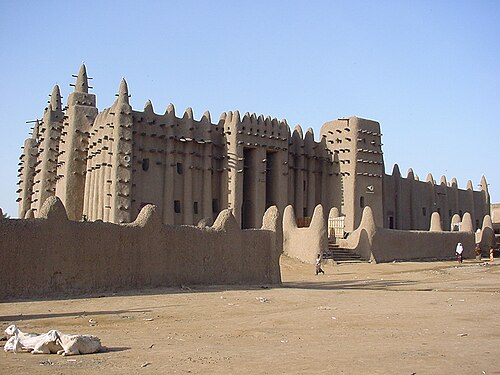
Imagine a building as big as a football field, with tall towers and spiky walls, made almost entirely of mud. That is the Great Mosque of Djenné, in the West African country of Mali.
Djenné is an old town that sits between two big rivers, the Niger and the Bani. Every year the rivers flood, and for a few months the town becomes an island. So the mosque stands on a high platform, like a stage, to keep its feet dry.
The walls are made of bricks of river mud mixed with straw, dried in the sun, and then covered with smooth mud plaster. Sticks of palm wood poke out of the walls like the spines of a hedgehog. They look like decoration, but they are also a ladder that stays in the wall all the time.
Rain slowly washes mud away. So once a year the whole town holds a festival to repair the mosque. Children stir big pits of mud plaster, women and girls carry water, men climb the walls with baskets of mud and smear it on, and the master builders tell everyone what to do. Elders sit in the market square and watch.
There has been a mosque on this spot for about 700 years or more, but the building you see today was finished in 1907. The first mosque, people say, was made when a king of Djenné became a Muslim and turned his palace into a mosque.
Today the mosque is the symbol of Djenné and of Mali. It is on Mali’s coat of arms, and together with the old town it is a UNESCO World Heritage Site.
At a glance
- Location
- Djenné, on the floodplain of the Bani River in the Inland Niger Delta, Mopti Region, central Mali
- Current building
- Rebuilt 1906–1907 under master mason Ismaila Traoré, on the site of earlier mosques
- First mosque
- Traditionally founded when the ruler Koi Konboro converted to Islam; dates proposed range from about 1200 to 1330
- Materials
- Sun-dried earth bricks (ferey), earth mortar and earth plaster; rônier-palm beams and projecting sticks (toron)
- Size
- Raised platform about 75 × 75 m, 3 m above the market square; central qibla tower about 16 m high; prayer hall supported by about 90 earthen pillars
- Style
- Sudano-Sahelian earthen architecture
- Heritage status
- Part of the UNESCO World Heritage Site “Old Towns of Djenné” (1988); List of World Heritage in Danger since 2016
- Maintenance
- Annual community re-plastering festival (crépissage) directed by the masons’ guild
Easy
What is the Great Mosque of Djenné?
The Great Mosque of Djenné is the Friday mosque of Djenné, a small but very old town in central Mali. It is used every week for communal prayers and is the heart of the town’s religious life. It is also one of the most famous buildings in Africa: its tall earthen towers and bristling walls appear on postcards, in films and games, and on Mali’s national coat of arms.
It is often called the largest mud-brick (adobe) building in the world. Almost everything in it, from the platform to the roof, is made of earth taken from the surrounding floodplain, together with palm wood. Because earth is soft and rain is strong, the building survives only because people repair it every year. This makes the mosque not just a monument but a living tradition.
The building we see today was completed in 1907, but it stands on a site where mosques have stood for many centuries. Its story connects medieval West African kingdoms, Islamic scholarship, a nineteenth-century reform movement, French colonial rule and the challenges of protecting heritage today.
Easy
How to “read” the building
Start from outside, on the market square to the east. You see the qibla wall, the wall that faces Mecca and that Muslims face when they pray. Three huge box-shaped towers rise from it; the central one is about 16 metres high. Each tower ends in cone-shaped pinnacles topped with ostrich eggs, and between them eighteen buttresses, each with its own pinnacle, give the wall a rhythm like a row of pillars.
The whole mosque stands on a raised platform about 75 metres square and 3 metres high, reached by six sets of stairs. The platform protects it when the Bani River floods. The outline of the building is not a perfect square: its walls are slightly out of line, giving it a trapezoid shape.
Inside, the eastern half is a covered prayer hall about 26 by 50 metres. Its heavy earthen roof is carried by nine parallel walls pierced by pointed arches, which together form a “forest” of about ninety thick rectangular pillars. Only a little light enters through small windows, so the hall is dim and cool. Vents in the roof are covered by pottery lids that can be lifted to let hot air escape.
The western half is an open courtyard surrounded on three sides by arcaded galleries; the western gallery is reserved for women. In the central tower of the qibla wall is the main mihrab, the niche where the imam leads prayer, and beside it the minbar, the pulpit for the Friday sermon.
Easy
Building with earth
Djenné’s buildings are made of earth from the river plain, mixed with chopped straw and shaped into bricks that dry in the sun. Traditionally, masons in Djenné used rounded, hand-shaped bricks called djenné-ferey; rectangular bricks made in wooden moulds became common in the twentieth century. The bricks are laid in earth mortar and then covered with plaster made of earth mixed with materials such as rice husks.
The bundles of rônier-palm sticks that project from the walls, called toron, do several jobs at once. They decorate the surface, they help the thick walls cope with cracking, and they act as permanent scaffolding for workers. Clay pipes stick out from the roofline to throw rainwater away from the walls.
Earth is a clever material in a hot climate. Thick mud walls stay cool during the day and release warmth at night. But earth also dissolves in heavy rain, so an earthen building is never “finished.” It must be looked after like a garden.
Easy
The yearly re-plastering festival
Each year, before the rains, the people of Djenné hold a festival to re-plaster the mosque, often called by its French name, the crépissage. In the days before, plaster is prepared in pits and left to cure; it has to be stirred regularly, a job that usually falls to boys, who happily play in the mud.
On the day of the festival a race decides who will be first to bring plaster to the mosque. Men climb the walls using the toron and palm-wood ladders and smear fresh plaster over the surface, while others carry plaster from the pits. Women and girls bring water. Members of the masons’ guild direct the work, and elders who have taken part many times watch from places of honour in the market square.
The festival repairs damage from the previous rainy season, but it does much more: it renews the bond between the building and the community, passes on skills from one generation to the next, and turns heritage conservation into a shared celebration with music and food.
Intermediate
Djenné: a very old city of trade and learning
Djenné lies on the floodplain between the Niger and Bani rivers, at the southern end of the Inland Niger Delta. During the annual flood, from about July to October, the town becomes an island reached by causeways. This watery landscape supported rice farming, fishing and river trade.
About three kilometres from the modern town lies Djenné-Djeno (“old Djenné”), excavated by Susan and Roderick McIntosh from 1977. Their work showed that people lived there from around 250 BCE, that the settlement had a city wall and many thousands of inhabitants by the late first millennium CE, and that it traded over long distances before the arrival of Arab traders from North Africa. This overturned the older idea that West African cities were created by outside contact. The old site was gradually abandoned by about 1400, while the present town, first settled after about 1000 CE, flourished.
Between the fifteenth and seventeenth centuries Djenné was a key link in trans-Saharan trade. Salt from Taghaza in the Sahara and gold from the forest zone to the south, as well as enslaved people, passed through Djenné and Timbuktu. The Songhay ruler Sonni Ali took the town in 1471 after a long siege. The chronicler al-Saʿdi, writing in the seventeenth century, called Djenné “one of the great markets of the Muslims.” Djenné and Timbuktu were also centres of Islamic learning, with many Qur’an schools.
Intermediate
The first mosques: a palace turned into a place of prayer
The earliest written account of the mosque is in al-Saʿdi’s Tārīkh al-Sūdān, completed in the mid-seventeenth century and presumably based on oral tradition. It says that Sultan Kunburu (Koi Konboro) became a Muslim, had his palace pulled down and turned the site into a mosque, and built himself a new palace nearby. His successor added the towers and the next ruler the surrounding wall.
No one knows exactly when this happened. Suggested dates range from about 1200 to 1330; the French-language tradition often gives 1238. Because the story comes from a chronicle written centuries later, historians treat it as a foundation tradition rather than a precise record.
The architectural historian Labelle Prussin proposed a more complicated history in which the mosque was rebuilt several times, under later Djenné rulers, by the Songhay ruler Askia Muhammad around 1500, and again after the Moroccan invasion of the 1590s. What is clear is that by the nineteenth century a large, very old earthen mosque stood on the site.
Intermediate
Reform, ruin and conquest in the nineteenth century
In about 1818–1819 the Fulani reformer Seku Amadu (Ahmadu Lobbo), founder of the Massina state and inspired by Usman dan Fodio’s jihad in Hausaland, took Djenné. He regarded the old mosque, a converted palace richly decorated, as too sumptuous for the austere Islam he preached. He let it fall into ruin, closed the small neighbourhood mosques, and in the 1830s built a large, low new mosque without towers on another part of the site.
When the French explorer René Caillié visited Djenné in 1828, disguised as a Muslim traveller, he described an earthen mosque with two massive towers, “rudely constructed, though very large,” abandoned to thousands of swallows. Djenné later passed to the Toucouleur empire of al-Hajj Umar Tal (1861), and in April 1893 French forces under Louis Archinard occupied it.
The French journalist Félix Dubois visited soon after and described the ruins of the old mosque, whose interior was then used as a cemetery. His book Tombouctou la mystérieuse (1897), with a reconstructed plan and drawing, made Djenné famous in Europe and America.
Intermediate
The rebuilding of 1906–1907
In 1906 the town arranged for the old mosque to be rebuilt on its original site and for a school (madrasa) to replace Seku Amadu’s mosque. According to French-language accounts, the colonial governor William Ponty approved the project at the request of a local religious leader. The work was completed in 1907 under Ismaila Traoré, head of Djenné’s guild of masons, who was famous throughout the region. The colonial administration supported it administratively and financially, and forced labour was used.
Old photographs suggest that at least some outer walls follow the lines of the earlier mosque, but it is unclear whether the interior pillars kept the old arrangement. What was almost certainly new was the symmetrical group of three large towers in the qibla wall.
Since 1907 the design has changed only a little. The mihrab tower once had a pair of large recesses; the walls originally had far fewer toron, and two extra rows were added in the early 1990s. In 1930 the French army built an inexact cement copy, the Missiri mosque, at Fréjus in southern France for West African colonial soldiers.
Intermediate
Religious and civic meaning
For the people of Djenné the mosque is first of all a place of worship and the centre of an Islamic community with a long scholarly tradition. The terrace in front of the eastern wall holds two tombs, including that of Almany Ismaïla, an important eighteenth-century imam. The market held every week on the square in front of the mosque ties religious and economic life together, as it has for centuries.
The mosque has also become a national symbol. It appears on the coat of arms of Mali and is widely used as an emblem of Malian and West African culture. Its form influenced other mosques in the region, such as the Great Mosque of Mopti (1935), and a wider “neo-Sudanese” style.
Local people have repeatedly defended their own idea of the mosque. They resisted modernisations that changed other Malian mosques, such as tiling over the walls, even as a loudspeaker system was installed. According to French-language sources, the mosque was closed to non-Muslims after a fashion photographer’s shoot inside and on the roof was considered to have broken an agreement with local authorities.
Intermediate
Conservation, conflict and heritage in danger
In 1988 UNESCO inscribed the “Old Towns of Djenné” on the World Heritage List. The property includes the historic town, with its mosque and nearly two thousand traditional houses built on low mounds (toguere) above the flood, and the archaeological sites of Djenné-Djeno, Hambarketolo, Kaniana and Tonomba.
Conservation has not always been smooth. In January 2006 the sight of workers inspecting the roof for a restoration project funded by the Aga Khan Trust for Culture sparked a riot in the town, in which one person died. In November 2009 the upper part of the southern qibla tower collapsed after heavy rain; the Aga Khan Trust funded its rebuilding.
In July 2016 the World Heritage Committee placed the Old Towns of Djenné on the List of World Heritage in Danger. It cited insecurity in the region, which was preventing protection work, as well as deterioration of building materials, urbanisation and erosion of the archaeological sites. The armed conflict in central Mali has also cut tourism, an important source of income for the town.
Advanced
Authenticity, sources and living heritage
The Great Mosque challenges Western heritage ideas that prize original fabric. Almost none of its surface is more than a few years old, yet its authenticity lies in continuity of form, material, skill and community ritual. The anthropologist Trevor Marchand, who trained with Djenné’s masons, has shown how knowledge passes through apprenticeship and the guild, and how the annual festival reproduces social relationships as well as walls.
Heritage status has had mixed effects. A survey of the town in 1984 identified 134 architecturally important two-storey houses, but by 1995 about 30 percent of them had been demolished and replaced, despite World Heritage restrictions. A Dutch-funded project from 1996 to 2003 restored around one hundred older houses, sometimes by complete rebuilding. Residents have sometimes resented rules that limit how they may modernise their own homes.
For the early history, the key written sources are the seventeenth-century Timbuktu chronicles, especially al-Saʿdi’s Tārīkh al-Sūdān (translated by John Hunwick), and they disagree about Djenné’s relationship with the Mali empire: one claims Mali attacked Djenné ninety-nine times without success, while the Tārīkh al-fattāsh presents Djenné’s ruler as a vassal. European testimony begins only with Antonio Malfante (1447), Portuguese writers and, for the building itself, Caillié (1828) and Dubois (1890s). Archaeological work in the town and at Djenné-Djeno remains the main independent check on these narratives.
Key ideas
- Earthen architecture
- Building with sun-dried mud brick and earth plaster, well suited to hot, dry climates but dependent on constant maintenance.
- Maintenance as tradition
- The mosque survives because the community re-plasters it every year; the ritual is as much part of the heritage as the building.
- Sudano-Sahelian style
- A West African architectural tradition of earthen walls, buttresses, pinnacles and projecting wooden beams, seen from Djenné to Timbuktu and beyond.
- Palace to mosque
- According to tradition, the first mosque was founded when a converted ruler gave up his palace, a story linking kingship and Islam in Djenné.
- Colonial versus local authorship
- Scholars debate how far the 1907 design reflects French colonial taste or the traditions of Djenné’s masons.
- Living heritage
- Authenticity understood as continuity of skill, use and community rather than preservation of original material.
- Heritage in danger
- Insecurity, urbanisation and erosion have put the Old Towns of Djenné on UNESCO’s danger list since 2016.
Records
- c. 250 BCE — Djenné-Djeno, the predecessor city near modern Djenné, is first permanently settled.
- c. 1250 — According to tradition, the ruler Koi Konboro converts to Islam and turns his palace into a mosque (proposed dates c. 1200–1330).
- 1471 — Songhay ruler Sonni Ali captures Djenné after a long siege.
- c. 1655 — Al-Saʿdi’s Tārīkh al-Sūdān records the founding story of the mosque and praises Djenné as a great market.
- c. 1818 — Seku Amadu of Massina takes Djenné and lets the old mosque fall into ruin.
- 1828 — René Caillié visits and describes the neglected old mosque.
- c. 1834 — Seku Amadu builds a new, austere mosque on another part of the site.
- 1893 — French forces under Louis Archinard occupy Djenné.
- 1907 — The present mosque is completed under master mason Ismaila Traoré (work begun in 1906).
- 1988 — The Old Towns of Djenné are inscribed on the UNESCO World Heritage List.
- 2009 — Heavy rain brings down the upper part of the southern qibla tower; it is rebuilt.
- 2016 — The Old Towns of Djenné are placed on the List of World Heritage in Danger.
Glossary
- Adobe (banco)
- Sun-dried earth used as a building material; in Mali often called banco.
- Ferey
- Earth bricks; djenné-ferey are the traditional rounded, hand-shaped bricks of Djenné.
- Toron
- Bundles of rônier-palm sticks projecting from earthen walls, used as decoration and permanent scaffolding.
- Crépissage
- French for “plastering”; the name commonly used for Djenné’s annual festival of re-plastering the mosque.
- Qibla
- The direction of Mecca, which Muslims face in prayer; the qibla wall is the wall facing that direction.
- Mihrab
- A niche in the qibla wall showing the direction of prayer, where the imam stands.
- Minbar
- The pulpit from which the Friday sermon is preached.
- Inland Niger Delta
- A vast seasonal wetland in central Mali where the Niger and Bani rivers spread out each year.
- Tārīkh al-Sūdān
- “History of the Sudan,” a seventeenth-century Arabic chronicle by al-Saʿdi of Timbuktu.
- Toguere
- Low mounds on which houses in the Djenné region are built to stay above the flood.
Questions and answers
Is the whole mosque really made of mud?
Almost. The walls, platform, pillars and plaster are earth, with palm wood for roof beams and the sticks in the walls. Some modern additions, like a loudspeaker system, have been installed.
Why doesn’t the mosque melt in the rain?
Rain does wash some of it away. That is why the town re-plasters it every year. The platform keeps it above floods, and clay pipes carry rainwater off the roof.
How old is it?
The present building dates from 1906–1907, but there has been a mosque on the site since sometime between about 1200 and 1330, according to tradition.
Who designed the present mosque?
The work was directed by Ismaila Traoré, head of Djenné’s masons’ guild. How much French colonial officials influenced the design is debated: some writers see it as largely African, others stress French guidance.
Can visitors go inside?
Non-Muslims have not been allowed inside for years; French-language sources link this to a controversial photo shoot. Rules can change, so visitors should follow local guidance.
Why is Djenné on UNESCO’s danger list?
In 2016 the World Heritage Committee cited insecurity in central Mali, which prevented protection work, along with decaying building materials, urbanisation and erosion of the archaeological sites.
What makes Djenné-Djeno important for historians?
Excavations there showed that a large walled town with long-distance trade existed from the last centuries BCE, before North African traders arrived, changing how historians understand the origins of West African cities.
Sources and further reading
- Great Mosque of Djenné. Wikipedia
- Grande mosquée de Djenné. Wikipédia (French)
- Djenné. Wikipedia
- Djenné-Djenno. Wikipedia
- Sudano-Sahelian architecture. Wikipedia
- Mali site added to List of World Heritage in Danger – UNESCO. UN News, 2016
- Jean-Louis Bourgeois, The History of the Great Mosques of Djenné. African Arts 20 (3), 1987
- John O. Hunwick, Timbuktu and the Songhay Empire: Al-Saʿdi’s Taʾrīkh al-Sūdān down to 1613 and Other Contemporary Documents. Brill, 1999
- Trevor H. J. Marchand, The Masons of Djenné. Indiana University Press, 2009
- Rogier Bedaux, Boubacar Diaby and Pierre Maas (eds.), L’architecture de Djenné (Mali): la pérennité d’un patrimoine mondial. Rijksmuseum voor Volkenkunde, Leiden, 2003
Related
- TimbuktuDesert-edge city near the Niger River that became West Africa’s great centre of trans-Saharan trade and Islamic scholarship, known for its earthen mosques and manuscripts.
- Mansa MusaRuler of the Mali Empire remembered for its wealth, his pilgrimage to Mecca and support for Islamic learning.
- Usman dan FodioFulani Muslim scholar, preacher and poet whose reform movement in the Hausa kingdoms became the jihad of 1804 and founded the Sokoto Caliphate.
- Ibn BattutaMoroccan traveler whose account describes journeys across Africa, Asia and parts of Europe.
- Great ZimbabweRemains of a major southern African city built and occupied by ancestors of the Shona people.
Written with AI assistance from the published sources listed above, and revised as new research appears.