Start at the top for an easy introduction. Go further down for more detail and scholarship.
- Easy
- Intermediate
- Advanced
For young readers
Azul means “blue” in Spanish. The book is named after the colour of the sky and the sea, and for its author blue was the colour of dreams and of art.
The writer was Rubén Darío, a young man from Nicaragua in Central America. When he was 19 he sailed all the way to Chile, in South America, hoping to make his name. He was poor and worked for newspapers and at the port of Valparaíso, but he wrote every chance he got.
In 1888, when he was 21, he gathered some of his stories and poems into one slim book. There are fairy-tale stories with nymphs, gnomes, satyrs and a fairy queen who gives artists a magic veil of dreams. There are also sad stories about poor people, like a boy who works at the docks. And there are poems that follow the four seasons of the year.
What made the book special was the way it sounded. Darío chose words like a painter chooses colours and arranged sentences like music. Many readers had never heard Spanish written like that.
At first only a few people noticed. Then a famous writer in Spain praised it in a newspaper, and soon young writers all over Latin America and Spain were copying Darío’s style. That is why people say this little blue book helped open a new chapter in Spanish-language literature.
At a glance
- Author
- Rubén Darío (pen name of Félix Rubén García Sarmiento, 1867–1916), Nicaraguan poet
- First edition
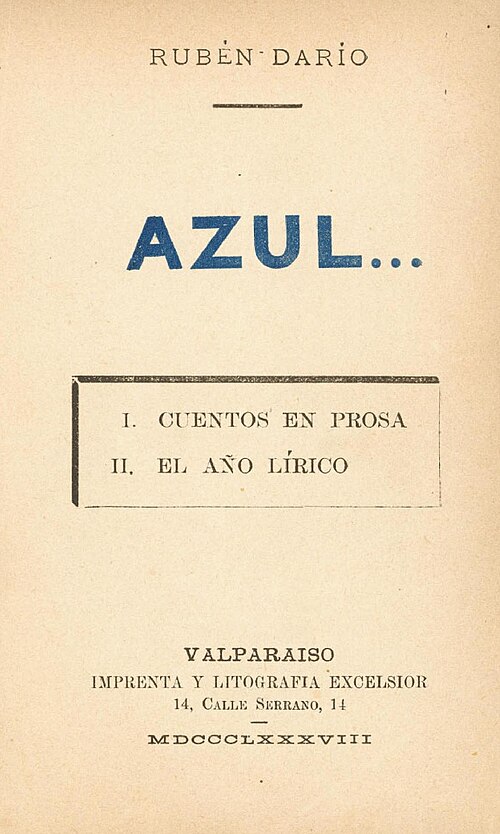
- Valparaíso, Chile, 1888 (printed by the Imprenta y Litografía Excelsior; printing finished at the end of July)
- Second edition
- Guatemala City, 1890, revised and enlarged with new stories, sonnets, poems in French and author’s notes
- Form
- Mixed collection: short stories in prose, prose sketches (“En Chile”) and poems (“El año lírico”, later also sonnets)
- Language
- Spanish, strongly influenced by contemporary French literature
- Movement
- Widely regarded as a founding book of Spanish American modernismo
- Famous reader
- Spanish novelist and critic Juan Valera, who reviewed it in two public letters in Madrid’s El Imparcial in October 1888
Easy
What is Azul...?
Azul... is a collection of short stories, prose sketches and poems by Rubén Darío, first published in Valparaíso, Chile, in 1888. It was not a thick book, and it was printed in a provincial port city by a writer almost nobody knew. Yet it is now seen as one of the turning points in the history of literature written in Spanish.
The title means “Blue...”, with three dots that suggest a thought drifting off into a dream. Darío later explained that for him blue was “the colour of dreams, the colour of art, a Hellenic and Homeric colour”. The colour promises an escape from grey everyday life into a world of beauty.
The book is best known for its style. Darío wanted Spanish prose and verse to be as colourful, musical and refined as the best French writing of his time. He used rare and precious words, bright images of gems, flowers, swans and marble, surprising adjectives, and carefully balanced rhythms. Critics soon described this style as modernismo, the name of the movement it helped to launch.
Easy
What is inside the book?
The first edition opened with a dedication to Federico Varela, a wealthy Chilean patron of literature, and a long prologue by the Chilean poet Eduardo de la Barra. It then had three parts. The first, “Cuentos en prosa” (Stories in prose), contained nine short stories. The second, “En Chile”, was a set of short prose pictures of Valparaíso and Santiago, divided into a “Valparaíso album” and a “Santiago album”, somewhere between stories and prose poems. The third, “El año lírico” (The lyrical year), was a group of poems arranged around the seasons, including “Primaveral” (spring), “Estival” (summer) and “Invernal” (winter).
Some of the stories are fantasies. In “El velo de la reina Mab” (Queen Mab’s veil), four poor artists, a sculptor, a painter, a musician and a poet, complain about their fate, and the tiny fairy queen covers them with a veil of dreams so that they will always hope. In “El rubí” (The ruby), gnomes react with scorn to the news that a chemist in Paris has made an artificial ruby. In “El palacio del sol” (The palace of the sun), a pale, sad girl is cured by a magical experience of love.
Other stories are sharp and realistic. “El rey burgués” (The bourgeois king) tells of a starving poet who is taken into the palace of a rich king who loves luxury but not art; the poet is ordered to turn the handle of a music box in the garden and freezes to death in the snow. “El fardo” (The bale) describes an old dockworker in Valparaíso whose son is crushed by a heavy bale while unloading a ship. “La canción del oro” (The song of gold) is an ironic hymn sung by a beggar-poet outside the mansions of the rich.
Even the realistic stories are written in the same polished, musical style, which gives them a strange double effect: beauty of language set against poverty, cruelty and injustice.
Intermediate
Historical context: Chile, markets and the writer
In the 1880s Chile was growing rich from exports of nitrate and copper, especially after its victory over Peru and Bolivia in the War of the Pacific (1879–1884). Valparaíso was one of the busiest ports on the Pacific, full of ships, foreign merchants and European goods. Santiago’s elite looked to Paris for fashion, furniture and books. This atmosphere of wealth and imported luxury appears everywhere in Azul..., both admired and criticized.
It was also a time when writing was becoming a job. Poets could no longer count on aristocratic patrons, and most earned their living as journalists. Many of Darío’s pieces in Azul... first appeared in newspapers between late 1886 and mid-1888. The conflict between the artist and a society that values only money is one of the book’s main themes, most famously in “El rey burgués”, which is subtitled “Cuento alegre” (A cheerful tale) with bitter irony.
Across Spanish America other writers were also looking for a new literary language. José Martí’s poems Ismaelillo (1882) and Manuel Gutiérrez Nájera’s Cuentos frágiles (1883) are often named as forerunners of modernismo. Azul... did not invent the movement single-handedly, but it gathered its tendencies in an especially striking and influential form.
Intermediate
Style and technique: writing Spanish “in French”
Darío later described Azul... as a Parnassian and therefore French book, in which the “Parisian tale”, French-style adjectives and French turns of phrase appeared in Spanish for the first time. The Parnassians were French poets, such as Leconte de Lisle and Théodore de Banville, who prized perfect form, sculptural images and art for art’s sake. Darío also admired Catulle Mendès, Théophile Gautier and the prose of the Goncourt brothers.
His prose borrowed techniques from painting and music. Descriptions are built from colours, textures and precious materials: ivory, porcelain, pearls, marble, lilies. Sentences are rhythmic, with repetitions and carefully placed pauses, so that the prose often feels like poetry. In an article published in April 1888, shortly before Azul..., Darío defended the French writers accused of “decadence” and argued that the writer should use all the sonorities of the language, even trying to paint “the colour of a sound”.
The mythological stories draw on ancient Greece, fairy tales and Shakespeare (Queen Mab comes from Romeo and Juliet). Yet the book also includes modern cities, docks, newspapers and scientific news. This mixture of the ancient and the modern, the exotic and the local, the dreamlike and the social, is typical of Spanish American modernismo.
In verse, Darío experimented with metres rarely used in Spanish. The second edition introduced sonnets written in alexandrines, fourteen-syllable lines modelled on French poetry, instead of the traditional Spanish eleven-syllable line. This innovation had a long influence on Spanish-language poetry.
Intermediate
Main themes
The artist in a hostile world. Again and again, poets and artists are poor, misunderstood or destroyed by a society obsessed with money. The bourgeois king buys art as decoration; the poet in “El pájaro azul”, a young man in Paris who says he has a blue bird in his brain, ends by opening its cage in the most tragic way. Beauty is precious precisely because the world does not value it.
Beauty and dream as refuge. Blue skies, fairy gifts, nymphs and satyrs offer escape from the ordinary. But the book is not simply escapist: its dreams are often shadowed by irony, loss or death, and the veil of Queen Mab is a gift of hope that may also be an illusion.
Love and the body. Several stories and poems celebrate erotic love and the beauty of the body in a frank, pagan spirit, as in “Palomas blancas y garzas morenas” (White doves and brown herons), about a young man’s first loves. Darío wrote in his autobiography that at this time the ascetic in him had disappeared and “the pagan” remained.
Social injustice. “El fardo” and “La canción del oro” show the poor, the workers and the hungry. These stories show that modernismo, often accused of living in an ivory tower, could also look hard at the society around it.
Intermediate
Reception: Juan Valera’s letters
Azul... sold modestly in Chile. Its fortunes changed when a copy reached Juan Valera in Madrid, one of the most respected Spanish novelists and critics and a member of the Royal Spanish Academy. Darío’s copy was delivered through Valera’s relative Antonio Alcalá Galiano, then a diplomat in Valparaíso.
Valera discussed the book in two of his “Cartas americanas” (American letters), published in the Monday literary supplement of the Madrid newspaper El Imparcial on 22 and 29 October 1888. He admitted that the title had first put him off, because it reminded him of Victor Hugo’s saying that “art is azure” and made him fear that Darío was just another imitator of Hugo. After reading, he praised the book’s talent, its cosmopolitan settings and its mastery of style.
Valera also warned against what he called Darío’s “mental Gallicism”, his habit of thinking and writing like a Frenchman. This mixture of praise and criticism, from Spain’s literary establishment, made Darío famous. He reprinted Valera’s letters as the prologue of the second edition, and they have accompanied the book in many editions ever since.
Intermediate
How the book was made and changed: 1888, 1890, 1905
The first edition was printed in Valparaíso by the Imprenta y Litografía Excelsior and finished at the end of July 1888; the Chilean National Library’s Memoria Chilena portal now offers a digital copy. Most of the texts had appeared earlier in Chilean newspapers between December 1886 (“El pájaro azul”) and June 1888 (“Palomas blancas y garzas morenas”). Descriptions of the first edition differ slightly in how they count the items, but it contained nine stories, the “En Chile” sketches and a small group of poems.
Darío left Chile in early 1889. After a period in El Salvador, where political violence forced him to flee in 1890, he settled in Guatemala, and there a second, revised and enlarged edition appeared in 1890. It added three stories (“La muerte de la emperatriz de la China”, “El sátiro sordo” and “A una estrella”), a set of “golden sonnets” including “Caupolicán”, about the Mapuche war leader of Chile’s epic tradition, and “Venus”, six “Medallones” (sonnet portraits of poets such as Leconte de Lisle, Catulle Mendès and Walt Whitman), three poems in French and 34 notes by the author. Valera’s letters became the prologue and de la Barra’s prologue became an epilogue.
Later editions changed the book again. An edition published in 1905 by the Buenos Aires newspaper La Nación removed the dedication, de la Barra’s prologue, the French poems and the notes. Modern critical editions therefore have to choose which version to reproduce, and most follow the expanded text of 1890 or later, which means that many readers today know a somewhat different book from the one first printed in Valparaíso.
Intermediate
Influence and legacy
Azul... made Darío the leading voice of a new literary generation. His later books, Prosas profanas (Buenos Aires, 1896) and Cantos de vida y esperanza (Madrid, 1905), consolidated modernismo, and as a correspondent of La Nación he travelled widely in the Americas and Europe, spreading his influence personally.
Modernismo was one of the first literary movements born in Latin America that went on to change literature in Spain itself. Darío’s visits to Spain in 1892 and after 1898 inspired Spanish poets and writers such as Ramón del Valle-Inclán, the brothers Manuel and Antonio Machado and Juan Ramón Jiménez. Critics sometimes describe this as a reversal of the colonial pattern, with literary innovation now travelling from the Americas to Spain.
Spanish American modernismo should not be confused with the later English-language “modernism” of writers such as T. S. Eliot and Virginia Woolf, or with Catalan modernisme in architecture. It is a movement of roughly 1880 to 1915 focused on renewing the language, rhythm and imagery of literature in Spanish.
In Nicaragua, Darío is a national hero, and his birthplace bears his name. Stories such as “El rey burgués” and “El velo de la reina Mab” are still widely read in schools across the Spanish-speaking world.
Advanced
Scholarly debates
Did Azul... begin modernismo? Many critics, including Octavio Paz and Ángel Rama, and Darío himself, treated the book as the starting point of the movement. Others stress the earlier work of José Martí, Manuel Gutiérrez Nájera, Julián del Casal and José Asunción Silva, and prefer to see modernismo as a network of writers rather than the achievement of one book or one genius. The date 1888 has become symbolic, but most historians now describe a gradual emergence in the 1880s.
Imitation or appropriation? Valera’s charge of “mental Gallicism” began a long debate about whether modernismo was a dependent copy of French literature. Later critics argued that Darío was not imitating but appropriating: taking European forms and making something new with them from a Spanish American position, combining French, Spanish, classical and American material. This debate connects to broader questions about cultural dependency and originality in Latin America.
Ivory tower or social critique? An older view saw modernismo as escapist art for art’s sake, detached from reality. Ángel Rama’s influential study Rubén Darío y el modernismo (1970) instead read it as a response to the modernization of Latin American economies, in which the writer became a professional selling work in a market. From this perspective, stories such as “El rey burgués” and “El fardo” are central, not marginal, to the book.
Which text? Because Darío revised and reorganized the book in 1890 and again later, and because many pieces first appeared in newspapers, textual scholars study the press versions, the 1888 and 1890 editions and later reprints, asking which version best represents Darío’s intentions at a given moment. Raúl Silva Castro’s study of the genesis of Azul... (1958) was a pioneering work in this area.
Advanced
Sources and methods
The main primary sources are the book itself in its first two editions, the newspaper versions of individual texts in Chilean papers such as La Época and El Heraldo, and Darío’s correspondence. Digitized copies of the 1888 edition in the Chilean National Library make close comparison possible.
Darío’s own later accounts, especially his Autobiografía and the essay Historia de mis libros, are vital but must be read critically. Written decades later, when he was famous, they shape the story of his youth to fit the legend of the lone genius who renewed the Spanish language.
Valera’s Cartas americanas are a key reception document, showing how the Spanish literary establishment viewed Spanish American writing at the time. Modern scholarship also uses Chilean press archives to reconstruct the circle of friends and patrons who supported Darío in Santiago and Valparaíso, including Pedro Balmaceda Toro, Eduardo de la Barra and Eduardo Poirier.
Key ideas
- Modernismo
- A Spanish-language literary movement (about 1880–1915) that renewed poetry and prose through musical rhythm, rich imagery and cosmopolitan themes.
- Blue (azul)
- For Darío, the colour of dreams, art and the classical world; the title announces a turn toward beauty and imagination.
- The artist versus the bourgeois
- A central conflict of the book: the poet’s devotion to beauty against a society that values only money and utility.
- Cosmopolitanism
- Settings and references from ancient Greece, Paris, China and Chile mixed together, making Spanish American literature part of a wider world.
- Parnassian influence
- The French ideal of perfect, sculptural form and “art for art’s sake”, which Darío adapted into Spanish.
- Prose poetry
- Prose written with the rhythm, imagery and intensity of verse, a technique that Azul... helped to spread.
- Metrical renewal
- The use of new or revived verse forms in Spanish, such as the alexandrine sonnet introduced in the 1890 edition.
Records
- 1867 — Félix Rubén García Sarmiento (Rubén Darío) is born on 18 January in Metapa, Nicaragua.
- 1882 — José Martí publishes Ismaelillo, often seen as an early sign of modernismo.
- 1886 — Darío arrives in Valparaíso, Chile, in June, and begins writing for Chilean newspapers.
- 1887 — Darío publishes Abrojos in Santiago and shares a prize in a Chilean poetry competition sponsored by Federico Varela.
- 1888 — Azul... is printed in Valparaíso (July); Juan Valera reviews it in El Imparcial, Madrid (October).
- 1889 — Darío leaves Chile and begins writing for the Buenos Aires newspaper La Nación.
- 1890 — Second, enlarged edition of Azul... published in Guatemala, with Valera’s letters as prologue.
- 1896 — Prosas profanas appears in Buenos Aires, marking the high point of modernismo.
- 1905 — Cantos de vida y esperanza is published in Madrid; La Nación issues a revised edition of Azul....
- 1916 — Darío dies on 6 February in León, Nicaragua.
Glossary
- Modernismo
- The Spanish American literary movement of about 1880–1915; not the same as English-language modernism.
- Parnassianism
- A French poetic movement of the later nineteenth century that valued perfect form, objectivity and art for art’s sake.
- Symbolism
- A French movement that sought to suggest moods and hidden meanings through images and the music of words.
- Alexandrine
- A long line of verse, twelve syllables in French and usually fourteen in Spanish counting, divided in two halves.
- Sonnet
- A poem of fourteen lines with a fixed rhyme scheme.
- Prologue
- An introduction at the beginning of a book, often by another writer.
- Gallicism
- A word, phrase or way of thinking borrowed from French.
- Chronicle (crónica)
- A newspaper genre mixing reporting, essay and literary prose, central to the careers of modernista writers.
Questions and answers
What does “Azul” mean?
It means “blue” in Spanish. Darío said that for him blue was the colour of dreams, of art and of ancient Greece.
Why is a Nicaraguan book published in Chile?
Darío moved to Chile in 1886 at the age of 19 to find work and a literary career. He wrote the book there and published it in Valparaíso in 1888.
Is Azul... poetry or prose?
Both. It contains short stories, prose sketches and poems. Even the prose is written with the rhythm and imagery of poetry.
What is the most famous story in the book?
“El rey burgués” (The bourgeois king), about a poet who freezes to death in the garden of a king who does not care about art, is one of the most widely read.
Is modernismo the same as modernism?
No. Spanish American modernismo (about 1880–1915) focused on renewing the language and music of Spanish literature. English-language modernism is a later, different movement.
Why are there different versions of the book?
Darío revised it for a second edition in Guatemala in 1890, adding stories, sonnets, poems in French and notes, and later editions made further cuts. Scholars compare these versions carefully.
Did Azul... really start modernismo?
It is often called the founding book, but critics also point to earlier writers such as José Martí and Manuel Gutiérrez Nájera. Most see the movement as emerging gradually in the 1880s, with Azul... as a landmark.
Sources and further reading
- Azul…. Wikipedia (Spanish)
- Azul.... Wikipedia
- Rubén Darío. Wikipedia
- Modernismo. Wikipedia
- Azul de Rubén Darío. Memoria Chilena, Biblioteca Nacional de Chile
- Azul... (Valparaíso: Imprenta y Litografía Excelsior, 1888), digital copy. Memoria Chilena, Biblioteca Nacional de Chile
- Rubén Darío; ed. Arturo Ramoneda, Azul... Edición de Arturo Ramoneda (introduction, sample chapter). Alianza Editorial, 2022
- Ángel Rama, Rubén Darío y el modernismo, 1970
Related
- Don QuixoteMiguel de Cervantes’s two-part novel follows a man who takes chivalric romances for reality and sets out with Sancho Panza. Its shifting viewpoints helped shape the modern novel.
- FiccionesJorge Luis Borges’s collection of stories explores imagined books, labyrinths, chance and the limits of knowledge.
- HomerThe poet tradition credits with the Iliad and the Odyssey, the founding epics of Greek literature. Whether one person composed both is debated.
- The Starry NightVincent van Gogh’s 1889 painting presents a night sky in sweeping, rhythmic strokes above a village.
- Eiffel TowerIron tower built for the 1889 Paris exposition and later adopted as a symbol of the city.
Written with AI assistance from the published sources listed above, and revised as new research appears.