Start at the top for an easy introduction. Go further down for more detail and scholarship.
- Easy
- Intermediate
- Advanced
For young readers
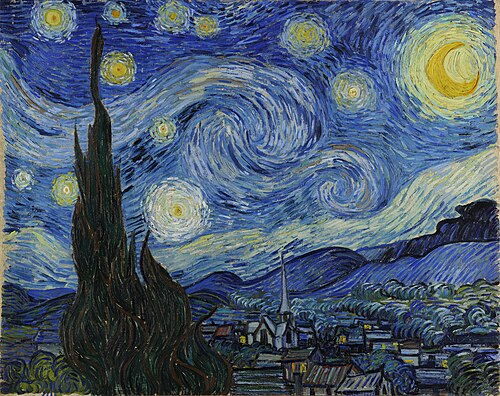
Look at the sky in this painting. It is not still and flat like a real night sky in a photograph. It swirls and rolls like waves in the sea. The stars are big glowing balls with rings of light around them, and the moon is a bright yellow crescent.
Down below is a little sleeping village with a church spire pointing up. On the left, a tall dark cypress tree rises like a flame, reaching from the ground toward the stars.
The painter, Vincent van Gogh, was from the Netherlands. He had been very ill, with frightening attacks that confused his mind, so in 1889 he chose to stay at a hospital in a small town called Saint-Rémy in the south of France. From his bedroom window he could see fields and hills, and early one morning he watched a very bright “morning star” before sunrise.
He was not allowed to paint in his bedroom, so he made the picture in a studio room downstairs, using what he remembered and his sketches. He even added a village that he could not really see from his window.
Van Gogh painted with thick paint and short, strong brushstrokes that you can almost feel. He himself was not sure the painting was good. Today it hangs in a museum in New York, and millions of people come to see it.
At a glance
- Artist
- Vincent van Gogh (1853–1890), Dutch painter
- Date
- Mid-June 1889; mentioned as finished in a letter of about 18 June 1889
- Place made
- Saint-Paul-de-Mausole asylum, near Saint-Rémy-de-Provence, France
- Medium and size
- Oil on canvas, 73.7 × 92.1 cm
- Location
- Museum of Modern Art (MoMA), New York, since 1941 (Lillie P. Bliss Bequest)
- Catalogue numbers
- F612 (de la Faille), JH1731 (Hulsker)
- Subject
- View toward the east from Van Gogh’s bedroom window before dawn, with the morning star (Venus), a crescent moon, a cypress and an imagined village
- Style
- Post-Impressionism; expressive brushwork and colour
Easy
What is The Starry Night?
The Starry Night is an oil painting by the Dutch artist Vincent van Gogh, made in June 1889 while he was a patient at the Saint-Paul-de-Mausole asylum near the town of Saint-Rémy-de-Provence in southern France. It is fairly small, about 74 by 92 centimetres, roughly the size of a large poster.
It shows a night sky filled with swirling currents of light, eleven glowing stars, a bright crescent moon, rolling hills, a small village with a church spire, and a dark cypress tree rising in the foreground. The sky takes up most of the picture and seems to move, while the village below lies quiet.
Since 1941 the painting has belonged to the Museum of Modern Art in New York, which acquired it through the bequest of the collector Lillie P. Bliss. It is now one of the most recognized images in the history of art, reproduced on posters, mugs, clothes and screens around the world.
Easy
How to look at the painting
Start with the sky. Van Gogh painted it with short, thick strokes of blue, white and yellow laid side by side. In the middle, two great curling shapes seem to roll into each other like a wave or a whirlwind. Around each star and the moon are rings of light, as if the light were pulsing.
Now look at the cypress on the left. It is painted in dark greens and browns with flickering, flame-like strokes. It is the tallest thing in the picture, linking the earth to the sky. On the right, the brightest star, low above the hills, is the planet Venus, which people call the morning star.
Then look down at the village. Its houses are drawn with straight lines and small squares of yellow light in the windows. The church spire is tall and thin, more like a church in the Netherlands, where Van Gogh grew up, than the churches of Provence. The calm, straight lines of the village contrast with the curving energy of the sky.
Finally, notice the paint itself. It is often thick enough to stand up from the canvas, a technique called impasto. Every stroke has a direction, and together the strokes create a feeling of movement across the whole picture.
Easy
Who was Vincent van Gogh?
Vincent van Gogh was born in 1853 in Zundert, in the south of the Netherlands, the son of a pastor. Before becoming an artist he worked for an art dealer, as a teacher and as a lay preacher among poor coal miners in Belgium. He decided to become a painter only around the age of 27 and was largely self-taught.
His early paintings, such as The Potato Eaters (1885), are dark and earthy. In 1886 he moved to Paris to live with his younger brother Theo, an art dealer who supported him with money and encouragement all his life. There he discovered the bright colours of the Impressionists and the bold designs of Japanese woodblock prints, which he collected and copied.
In 1888 he moved to Arles in the south of France, hoping to found an artists’ community. The painter Paul Gauguin joined him for two months, but in December 1888 Van Gogh suffered a mental crisis during which he cut off part of his left ear. After more attacks, he voluntarily entered the asylum at Saint-Rémy on 8 May 1889.
He painted around 150 works during his year there. In May 1890 he moved to Auvers-sur-Oise near Paris, where he died on 29 July 1890, two days after a gunshot wound that is generally believed to have been self-inflicted. He had sold very little in his lifetime. Theo died six months later, and Theo’s widow, Jo van Gogh-Bonger, worked tirelessly to make Vincent’s art and letters known.
Intermediate
How and where it was painted
Saint-Paul-de-Mausole was a former monastery used as a private asylum. It was less than half full when Van Gogh arrived, so he was given a bedroom on the upper floor and a ground-floor room to use as a studio. His bedroom window, fitted with iron bars, faced east over a walled wheat field toward the low Alpilles hills. He painted this view about twenty times, in different seasons and weather, and The Starry Night is the only one set at night.
The hospital did not allow him to paint in his bedroom, but he could draw there. The Starry Night was therefore painted during the day in his studio, based on what he had observed from the window, on drawings and on his imagination. The village comes from a separate sketch of Saint-Rémy made from a hillside, and the cypresses may have been moved closer or enlarged to strengthen the composition.
Around the beginning of June he wrote to Theo that he had seen the countryside from his window “a long time before sunrise with nothing but the morning star, which looked very big”. Astronomers have confirmed that Venus was very bright in the dawn sky of Provence at that time. In a letter of about 18 June he reported, “At last I have a landscape with olive trees, and also a new study of a starry sky.”
Analysis of the paint by scientists at MoMA and the Rochester Institute of Technology has identified ultramarine and cobalt blue in the sky, and the rare pigment Indian yellow together with zinc yellow in the stars and moon.
Intermediate
Composition and colour
The picture is built on a few strong lines. The rolling hills of the Alpilles enter diagonally from the right, as they do in almost all of Van Gogh’s views from his window. Two tall vertical forms, the cypress on the left and the church spire in the centre, cut across the horizontal band of the village and tie the earth to the sky. Above them the great swirl runs horizontally across the middle of the sky, balancing the dark mass of the cypress.
Colour does as much work as line. Van Gogh had studied colour theory, especially the ideas associated with Eugène Delacroix and the critic Charles Blanc, about how complementary colours such as blue and orange, or violet and yellow, intensify each other when placed side by side. In The Starry Night the deep blues of the sky make the yellows of the stars, moon and windows glow more brightly, and the lighter blue band above the hills may suggest the first light of dawn.
His experience of Japanese woodblock prints also shaped his approach. From them he learned to use bold outlines, flat areas of colour and decorative rhythms rather than realistic shading. In The Starry Night the outlined hills, the patterned sky and the flame-like cypress show how he combined these lessons with his own thick, energetic brushwork.
Shortly after finishing the painting, Van Gogh also made a reed-pen drawing based on it, Cypresses in Starry Night, which translates the swirling sky into lines and dots. The drawing, formerly in the Kunsthalle Bremen, went missing at the end of the Second World War and is now part of the disputed Baldin Collection in Russia.
Intermediate
Stars before The Starry Night
Van Gogh had wanted to paint a starry sky for a long time. Soon after arriving in Arles in 1888, he wrote that he needed “a starry night with cypresses or perhaps above a field of ripe wheat”. That September he painted Café Terrace at Night, with stars above a lit street, and Starry Night Over the Rhône, with the Great Bear constellation above the river at Arles.
The night sky also carried deep personal meaning for him. In a letter to Theo in July 1888 he wrote that the sight of the stars always made him dream, and that “just as we take the train to go to Tarascon or Rouen, we take death to go to a star”. He had given up the strict religion of his youth, but he seems to have kept a hope in some kind of life beyond death, which he connected with the stars.
After painting Starry Night Over the Rhône, he wrote of a “tremendous need for, shall I say the word — for religion — so I go outside at night to paint the stars”. Yet in 1889 he also insisted that his night painting was “not a return to the romantic or to religious ideas”. The Starry Night thus comes out of a long, complex relationship with the night sky, nature and belief.
Intermediate
What Van Gogh thought of it
Van Gogh said surprisingly little about The Starry Night. In September 1889 he listed it among paintings to send to Theo, calling it simply a “night study”, and he added that most of that batch said nothing to him. When he decided to hold back a few paintings to save on postage, it was one of those he kept, though he sent it at the end of September.
Theo, who received it in Paris, wrote in October 1889 that he could sense what was preoccupying Vincent in the new canvases, like the village in the moonlight, but felt that “the search for style takes away the real sentiment of things”. Vincent replied that he did feel driven to seek style, meaning a more deliberate kind of drawing.
In a letter to the painter Émile Bernard in late November 1889 he was more critical. He explained that when Gauguin was with him in Arles he had allowed himself to be led into “abstraction”, painting from imagination rather than from nature, and that it had been a mistake. “Once again I’m allowing myself to do stars too big”, he wrote, calling it a new setback. Many scholars read this as a reference to The Starry Night.
The painting therefore sits at the centre of a debate Van Gogh had with himself and his friends: should an artist paint what is in front of him, or what he imagines? The Starry Night mixes both.
Intermediate
From a brother’s house to world fame
After Vincent’s death in 1890 and Theo’s in 1891, the painting passed to Theo’s widow, Jo van Gogh-Bonger. She sold it in 1900 to the poet Julien Leclercq, who sold it in 1901 to the painter Émile Schuffenecker, a friend of Gauguin. Jo bought it back and in 1906 sold it through a Rotterdam gallery to Georgette P. van Stolk, who owned it until 1938.
The Paris and New York dealer Paul Rosenberg then acquired it, and in 1941 the Museum of Modern Art obtained it through an exchange funded by the Lillie P. Bliss Bequest. MoMA’s ownership, at a time when New York was becoming the centre of the modern art world, helped turn the painting into an icon.
Its fame grew with the twentieth-century legend of Van Gogh as the tormented, misunderstood genius, spread by novels, films and exhibitions. Don McLean’s 1971 song “Vincent” begins with the words “Starry, starry night”, and the French composer Henri Dutilleux wrote an orchestral work inspired by the painting. Today it is one of the most reproduced images in the world.
Advanced
Interpretations: vision, religion or observation?
Religious and symbolic readings. The art historian Meyer Schapiro called the painting a visionary work created under the “pressure of feeling” and proposed a hidden reference to the Book of Revelation, with its woman crowned with stars. Sven Loevgren suggested a link to the eleven stars in Joseph’s dream in Genesis and stressed the cypress as a Mediterranean tree of death. Lauren Soth argued that the picture is a disguised religious subject, pointing to Van Gogh’s admiration for Delacroix’s use of Prussian blue and citron yellow in paintings of Christ. These readings have been criticized for relying on symbols that Van Gogh never mentioned.
Astronomical readings. Albert Boime argued that the painting records the real sky: Venus in the correct position, and possibly the constellation Aries. He suggested that the central swirl might be inspired by images of spiral nebulae (as galaxies were then called) or comets published by popular astronomers such as Camille Flammarion. The astronomer Charles Whitney, working independently, agreed about Venus but was less sure about Aries; he connected the swirl with Lord Rosse’s famous 1845 drawing of the spiral nebula now known as the Whirlpool Galaxy, and also suggested it could represent the mistral wind.
Formal readings. Ronald Pickvance described the picture as a deliberate “abstraction”, an arbitrary collage of separate motifs, and saw the steeple as a memory of the Netherlands. Others argue that the cypresses really were visible from the window and that Van Gogh “telescoped” the view to intensify it.
Psychological readings. Many popular accounts treat the swirling sky as a direct picture of mental illness. Biographers Steven Naifeh and Gregory White Smith discussed the painting in the context of what they considered temporal lobe epilepsy. Most scholars caution against this: Van Gogh painted The Starry Night during a period of lucidity, carefully and deliberately, and his illness prevented him from working during attacks.
Advanced
Science, materials and methods
Modern conservation science studies The Starry Night with non-invasive imaging and pigment analysis. Research using multispectral imaging at MoMA has mapped where different pigments were used, helping to understand how the colours have changed over time. Some pigments Van Gogh used, especially certain reds and yellows, are known to fade or darken, so the painting may not look exactly as it did in 1889.
Physicists have also studied the painting’s swirls. Several studies have measured patterns of brightness in The Starry Night and other late works and compared them with the mathematical description of turbulence in fluids developed by Andrey Kolmogorov. Some found a striking resemblance; others argue that such comparisons say more about statistical methods than about Van Gogh’s intentions. The question remains open and popular.
For historians, the most important evidence remains Van Gogh’s letters, now fully edited and annotated online by the Van Gogh Museum and the Huygens Institute. They allow the painting to be dated almost to the day, connect it with related works such as Wheat Field with Cypresses and the olive tree paintings, and show how Van Gogh himself discussed art, nature and imagination. Careful reading of the letters, together with comparison of the dozens of views from his window, is the basis of most modern interpretations.
Advanced
Place in art history
Van Gogh belongs to the generation after the Impressionists, often called Post-Impressionists, together with Cézanne, Gauguin and Seurat. Unlike the Impressionists, who tried to capture fleeting effects of light as they saw them, these artists used colour, line and composition more freely to express structure, emotion or ideas.
The Starry Night’s expressive distortion, visible brushwork and intense colour influenced the German Expressionists and the Fauves in the early twentieth century, and it anticipates later painters who treated the act of painting itself as a record of energy. Critics often call it a “touchstone of modern art”.
At the same time, the painting is rooted in close observation of a particular place at a particular time: a window facing east, a planet rising before dawn, the hills of the Alpilles, the cypresses of Provence. Much of its power comes from this meeting of the real and the imagined, and from the story of the man who painted it at one of the most difficult moments of his life.
Key ideas
- Post-Impressionism
- Art after Impressionism that used colour and form more freely to express feeling and structure; Van Gogh is a leading example.
- Expressive brushwork
- Visible, directional strokes of thick paint that convey movement and emotion.
- Observation and imagination
- The painting combines a real view from a window with invented elements such as the village and the swirls.
- The night sky as meaning
- For Van Gogh the stars were linked with dreams, hope and life beyond death.
- Series painting
- He painted the view from his window many times; The Starry Night is its only night version.
- Myth of the tormented genius
- The popular image of Van Gogh as a mad, misunderstood artist, which shapes, and sometimes distorts, how the painting is seen.
- Complementary colours
- Pairs such as blue and orange or violet and yellow that make each other look more intense; Van Gogh used them to make his stars glow.
Records
- 1853 — Vincent van Gogh is born on 30 March in Zundert, the Netherlands.
- 1886 — Van Gogh moves to Paris and discovers Impressionism and Japanese prints.
- 1888 — In Arles he paints Café Terrace at Night and Starry Night Over the Rhône (September); in December he suffers a crisis and injures his ear.
- 1889 — Enters the Saint-Paul-de-Mausole asylum (8 May); paints The Starry Night (mid-June); sends it to Theo (28 September).
- 1890 — Van Gogh dies on 29 July in Auvers-sur-Oise.
- 1891 — Theo van Gogh dies; the painting passes to Jo van Gogh-Bonger.
- 1900 — Jo sells the painting to the poet Julien Leclercq.
- 1906 — The painting enters the collection of Georgette P. van Stolk in Rotterdam (until 1938).
- 1941 — The Museum of Modern Art in New York acquires The Starry Night.
- 1971 — Don McLean releases the song “Vincent” (“Starry, starry night”).
Glossary
- Impasto
- Paint applied so thickly that brush or knife marks stand out from the surface.
- Post-Impressionism
- A term for artists such as Van Gogh, Gauguin, Cézanne and Seurat who moved beyond Impressionism in the 1880s–1890s.
- Nocturne
- A painting of a night scene.
- Asylum
- In the nineteenth century, a hospital for people with mental illness.
- Cypress
- A tall, narrow evergreen tree common in the Mediterranean, often planted in cemeteries.
- Morning star
- The planet Venus when it shines brightly in the east before sunrise.
- Provenance
- The history of who has owned a work of art.
- Pigment
- A coloured powder mixed with oil or another binder to make paint.
- Japonisme
- The fashion for Japanese art, especially woodblock prints, in nineteenth-century Europe.
Questions and answers
Where can I see The Starry Night?
At the Museum of Modern Art (MoMA) in New York, which has owned it since 1941.
Did Van Gogh paint it outside at night?
No. He painted it during the day in his studio at the asylum, based on the view from his bedroom window, sketches and imagination.
Is the village real?
Not as shown. It was not visible from his window; it is based on a sketch of Saint-Rémy, and its tall spire looks more like a Dutch church.
Which is the brightest star?
The bright “star” just to the right of the cypress is the planet Venus, the morning star, which was very bright in June 1889.
Did Van Gogh like the painting?
Not much. He called it a “night study” and later wrote to Émile Bernard that doing “stars too big” had been another setback.
Does the swirling sky show his illness?
Many people think so, but most scholars disagree: he painted it carefully during a calm period, and he could not work during his attacks.
Is the swirl a galaxy?
Some scholars think Van Gogh may have been inspired by published pictures of spiral nebulae, such as Lord Rosse’s drawing of the Whirlpool Galaxy; others see wind or pure imagination. There is no direct proof.
Sources and further reading
- The Starry Night. Wikipedia
- Vincent van Gogh, The Starry Night, Saint Rémy, June 1889. The Museum of Modern Art
- Vincent van Gogh. Wikipedia
- Starry Night Over the Rhône. Wikipedia
- Letter 638: Vincent van Gogh to Theo van Gogh, Arles, 9 or 10 July 1888. Van Gogh Museum & Huygens ING, Vincent van Gogh – The Letters
- Letter 777: Vincent van Gogh to Theo van Gogh, Saint-Rémy, c. 31 May–6 June 1889. Van Gogh Museum & Huygens ING, Vincent van Gogh – The Letters
- Letter 782: Vincent van Gogh to Theo van Gogh, Saint-Rémy, c. 18 June 1889. Van Gogh Museum & Huygens ING, Vincent van Gogh – The Letters
- Letter 822: Vincent van Gogh to Émile Bernard, Saint-Rémy, c. 26 November 1889. Van Gogh Museum & Huygens ING, Vincent van Gogh – The Letters
- Steven Naifeh and Gregory White Smith, Van Gogh: The Life. Random House, 2011
Related
- The Great Wave off KanagawaHokusai’s woodblock print sets a towering wave above boats, with Mount Fuji small in the distance.
- Mona LisaPortrait by Leonardo da Vinci, generally identified as Lisa Gherardini.
- GuernicaPablo Picasso’s large 1937 painting responds to the bombing of the Basque town of Gernika during the Spanish Civil War.
- Frida KahloMexican painter known for self-portraits that explore the body, identity, relationships and personal experience.
- Eiffel TowerIron tower built for the 1889 Paris exposition and later adopted as a symbol of the city.
Written with AI assistance from the published sources listed above, and revised as new research appears.