Start at the top for an easy introduction. Go further down for more detail and scholarship.
- Easy
- Intermediate
- Advanced
For young readers
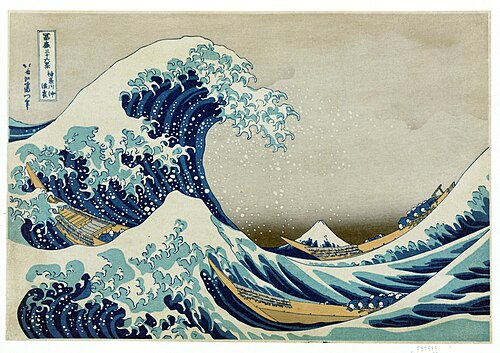
Look at the picture: a huge blue wave rises up like a claw, with white foam at its tip that looks like fingers. Underneath, three long boats full of rowers are being tossed about. Far in the back, small and calm, is Mount Fuji, Japan’s tallest mountain, with snow on top. Some people notice that one little wave in front even looks like a tiny Mount Fuji.
The picture was made by Katsushika Hokusai, a Japanese artist who was about 71 years old at the time and had already been drawing for more than sixty years. It is not a painting. It is a print, made by carving pictures into blocks of wood, putting ink on them and pressing paper on top, like a very fancy stamp.
Because it is a print, many copies could be made. In Hokusai’s time a copy cost about as much as a bowl of noodles, so ordinary people in the big city of Edo (today’s Tokyo) could buy one. Today the surviving early copies are treasures kept in museums around the world.
Hokusai made this picture as part of a set called Thirty-six Views of Mount Fuji. Each picture shows the famous mountain from a different place, in a different season or with people doing different things.
Later, when artists in Europe saw Hokusai’s prints, they were amazed. The painter Vincent van Gogh wrote about this wave, and the composer Claude Debussy put it on the cover of his music about the sea. Today it may be the most famous Japanese picture in the world.
At a glance
- Artist
- Katsushika Hokusai (1760–1849), signing as “Hokusai aratame Iitsu hitsu” (“from the brush of Hokusai, changing his name to Iitsu”)
- Date
- About 1830–1832; usually dated c. 1831
- Series
- Thirty-six Views of Mount Fuji (Fugaku sanjūrokkei), eventually 46 prints
- Publisher
- Nishimuraya Yohachi (Eijudō), Edo
- Medium
- Polychrome woodblock print (nishiki-e), ink and colour on paper; horizontal ōban format, about 25 × 37 cm
- Key pigment
- Prussian blue, a synthetic pigment newly available in Japan, alongside traditional indigo
- Where to see it
- Early impressions in many collections, including the British Museum, the Metropolitan Museum of Art, the Museum of Fine Arts Boston and museums in Japan and Europe
- Significance
- One of the most reproduced images in art history; a key work of ukiyo-e landscape and of Japonisme
Easy
What is The Great Wave?
The Great Wave off Kanagawa is a colour woodblock print by the Japanese artist Katsushika Hokusai, published in Edo (present-day Tokyo) around 1831. Its Japanese title, Kanagawa-oki nami ura, means roughly “Under the Wave off Kanagawa” or “Behind the Wave off Kanagawa”. Kanagawa was a post town on the Tōkaidō highway, on the western shore of what is now Tokyo Bay.
The print is the most famous sheet from Hokusai’s series Thirty-six Views of Mount Fuji. It is a small, affordable object, about the size of a large sheet of writing paper, made to be sold in shops, not a unique painting commissioned by a rich patron. Its fame comes from the power of its design: a single wave filling most of the picture, three boats caught beneath it, and Mount Fuji, Japan’s sacred mountain, tiny in the distance.
Since the late nineteenth century the image has travelled far beyond Japan. It has influenced painters, composers and designers, and today it appears on everything from posters and T-shirts to Japan’s new 1,000-yen banknote, issued in 2024.
Easy
How to look at the picture
Start with the wave. It rises from the left and curls over the centre, its crest breaking into claw-like fingers of foam. The deep blue of its inside contrasts with the white spray, and small drops of foam fall like snow. The wave is so tall that it frames Mount Fuji inside its hollow.
Now look at the boats. They are long, narrow oshiokuri-bune, fast boats used to carry fresh fish to the markets of Edo. The rowers crouch low, holding on as their boats slide down the slope of the water. We do not know whether they survive; the picture freezes the moment before the wave breaks.
Finally, look at Mount Fuji. It sits low in the middle distance, blue with a white snowcap, calm and still, while the sea is wild. Many viewers notice that a smaller wave in the foreground echoes the shape of the mountain. The picture sets the permanent mountain against the moving sea, and the enormous forces of nature against the small, brave figures of working people.
Japanese pictures and books are traditionally read from right to left. Some scholars suggest that a Japanese viewer would first see the boats and then the wave rising ahead of them, which makes the scene even more frightening; Western viewers, reading from left to right, tend to see the wave first.
Easy
Who was Hokusai?
Katsushika Hokusai was born in Edo in 1760 and died there in 1849. He trained in the workshop of the print designer Katsukawa Shunshō and worked for about seventy years, producing paintings, prints, book illustrations and thousands of drawings. He changed his artistic name many times, using more than thirty names in his career; at the time of The Great Wave he signed as Iitsu.
Hokusai was restless and endlessly curious. His sketchbooks, the Hokusai Manga, first published in 1814, show people, animals, plants, gods and everyday objects in every possible pose. He was famously poor, moved house very often, and is said to have called himself an “old man mad about painting”.
In a postscript to his later book One Hundred Views of Mount Fuji (from 1834), Hokusai wrote that nothing he drew before the age of seventy was worth noticing, and hoped that by the age of 110 every dot and line he made would be alive. The Great Wave, made when he was about 71, belongs to the start of this late period of astonishing creativity. His daughter Ōi, herself a talented painter, worked with him in his last years.
Intermediate
Thirty-six Views of Mount Fuji and the Edo world
The series Thirty-six Views of Mount Fuji was published by Nishimuraya Yohachi, whose shop was called Eijudō. The publisher advertised the series in 1831, and it was issued over the next few years. It was so successful that ten more prints were added, making 46 in all. The first 36 are usually outlined in Prussian blue, while the extra ten are outlined in black.
Each print shows Fuji from a different viewpoint and in a different setting: seen through the frame of a barrel being built by a cooper, reflected in a lake, behind a thunderstorm, or glowing red in the early morning (the print known as Red Fuji or Fine Wind, Clear Morning). People are often shown working: carpenters, farmers, travellers, porters and fishermen. The series is as much about everyday life under the mountain as about the mountain itself.
Mount Fuji held deep religious meaning in Edo Japan. Groups of worshippers called Fuji-kō organized pilgrimages to climb the mountain, and some neighbourhoods in Edo built small model Fujis for those who could not make the journey. At the same time, domestic travel for pleasure and pilgrimage was booming, and publishers found a huge market for pictures of famous places. Hokusai’s series, and soon after Utagawa Hiroshige’s travel prints, made the landscape print a major genre of ukiyo-e.
Ukiyo-e, “pictures of the floating world”, had grown up in the seventeenth and eighteenth centuries around the entertainment districts of Edo, showing actors, courtesans and fashionable life. Landscape prints like The Great Wave took this popular art in a new direction.
The success of the series also shaped Hokusai’s rivals and successors. Utagawa Hiroshige, a younger artist, answered with The Fifty-three Stations of the Tōkaidō (from 1833) and, near the end of his life, his own Thirty-six Views of Mount Fuji, while Utagawa Kuniyoshi and others created dramatic seascapes with towering waves. Within Japan, then, The Great Wave was part of a lively, competitive market for landscape prints rather than an isolated masterpiece.
Intermediate
How the print was made
A Japanese woodblock print was a team effort organized by the publisher. The designer, here Hokusai, drew the image in ink on thin paper. A carver pasted this drawing face down on a block of fine-grained cherry wood and cut away everything except the lines, destroying the original drawing in the process. This first block, the keyblock, printed the outlines.
From proofs of the keyblock, Hokusai indicated the colours, and the carver cut a separate block for each colour area. A printer then laid damp paper on each inked block in turn and rubbed the back with a flat pad called a baren. Small guide marks called kentō, cut into each block, kept the paper in exactly the same position so that the colours lined up. Subtle effects, such as the gradation of colour in the sky, were achieved by wiping the ink by hand on the block, a technique called bokashi.
The Great Wave was one of the first prints to make bold use of Prussian blue, a synthetic pigment invented in Berlin in the early eighteenth century. It began reaching Japan in larger quantities, through Dutch and Chinese traders, in the 1820s, and was cheaper, more stable and brighter than traditional blues. Its deep, lasting colour is a large part of the print’s impact.
The first printing probably ran to a few hundred or perhaps about a thousand sheets, and the blocks were used again and again as long as demand lasted. As the blocks wore down and cracked, later impressions show broken lines, simplified colours and changed skies. Experts use these small differences to tell early impressions from later ones.
Intermediate
East meets West in one picture
Although The Great Wave looks thoroughly Japanese, it also reflects Hokusai’s long interest in European art. Japan in this period restricted foreign contact, but Dutch traders in Nagasaki brought books and prints, and Japanese artists such as Shiba Kōkan studied Western linear perspective and shading. Hokusai experimented with these ideas from the 1790s onward.
In The Great Wave, the low horizon and the dramatic difference in size between the near wave and the distant mountain create a strong sense of depth, an effect influenced by Western perspective. At the same time, the flat areas of colour, the bold outlines and the decorative patterns of foam come from Japanese traditions of painting and printmaking.
Hokusai had drawn great waves before. Earlier prints from around 1800–1805 show boats beneath waves off Kanagawa and Honmoku, but the waves are smaller and more rounded. Comparing them with The Great Wave shows how, over some thirty years, he turned a scene into a concentrated, almost abstract composition. Later, in One Hundred Views of Mount Fuji, he drew Fuji at sea with a wave whose spray turns into flying birds.
Intermediate
The wave reaches Europe: Japonisme
After Japan opened its ports to Western trade in the 1850s, Japanese prints, fans, ceramics and textiles poured into Europe and America. Collectors and artists in Paris especially fell in love with them. This fashion for Japanese art is called Japonisme. Hokusai was among the most admired artists; the French writer Edmond de Goncourt published a book about him in 1896.
The Great Wave inspired many. In a letter to his brother Theo in 1888, Vincent van Gogh praised Hokusai’s waves, saying that they were like claws and that one could feel the boat caught in them. Claude Debussy kept a copy of the print, and the cover of the first edition of his orchestral work La Mer (1905) used a detail of the wave. The sculptor Camille Claudel created The Wave, with small bathers under a curling green onyx wave, and the French printmaker Henri Rivière made his Thirty-six Views of the Eiffel Tower (1902) in homage to Hokusai.
Japonisme influenced the flat colours, bold outlines and unusual viewpoints of Impressionist and Post-Impressionist painting and of Art Nouveau design. It was also a two-way exchange shaped by power: Western collectors often valued Japanese prints as “exotic” decorative art while many Japanese elites of the Meiji era looked down on ukiyo-e as popular entertainment. Many of the finest impressions left Japan in this period, which is one reason why so many are now in Western museums.
Intermediate
A global icon
In the twentieth and twenty-first centuries The Great Wave became one of the most recognized images on earth. It appears in advertising, comics, surf culture, tattoos, protest posters and parodies, and the wave emoji used on phones resembles it. In Japan it was chosen for the new passport design introduced in 2020, which uses prints from the Thirty-six Views, and for the back of the 1,000-yen note first issued in 2024.
Early impressions are now rare and valuable. Major museums on several continents hold copies, often from nineteenth-century collectors; the Metropolitan Museum’s impression came with the H. O. Havemeyer collection in 1929. In recent years good impressions have sold at auction for well over a million US dollars. Because the prints are sensitive to light, museums show them only for limited periods, rotating different impressions.
Contemporary artists continue to answer the print. Japanese and international artists have remade the wave in manga, street art and digital media, and after the 2011 Great East Japan Earthquake and tsunami some reworkings used it to express grief or solidarity, even though the original does not depict a tsunami. Such uses show how an image made for Edo shoppers has become a shared visual language for talking about the sea, danger and Japan.
The Sumida Hokusai Museum, opened in 2016 in the district of Tokyo where Hokusai was born and lived much of his life, is dedicated to his work and helps connect his global fame with his local roots.
Advanced
Dating, impressions and connoisseurship
No document records the exact day The Great Wave was published. Scholars date the series from the publisher’s advertisement of 1831, which announced the Thirty-six Views and mentioned the use of Prussian blue, and from Hokusai’s signature: he used the name Iitsu roughly from 1820 to 1834. The usual date is therefore given as c. 1830–1832 or c. 1831. The order in which the prints were issued is not fully certain.
How many impressions were made is also debated. Estimates that the blocks produced several thousand impressions, perhaps as many as 5,000–8,000 over their working life, are based on the typical durability of cherry blocks and the known popularity of the series, not on surviving sales records. Researchers have tried to catalogue surviving impressions in public collections worldwide, and counts of around a hundred or more are commonly cited; the numbers depend on how impressions are identified and on private holdings that are hard to survey.
Connoisseurs distinguish early from late impressions by the sharpness of the keyblock lines, cracks and breaks in the blocks, the presence or absence of a pink tone in the clouds, the colour of the sky, and changes in the cartouche. Fading is another problem: some blues and pinks fade with light exposure, so two impressions of the same state can look very different. For these reasons, museum catalogues often describe their impression in detail, and comparisons across collections, including digital images, have become an important research method.
Advanced
Interpretations: danger, nationalism and a “global icon”
Interpretations of the image vary. Some read it as a picture of nature’s overwhelming power and human fragility, perhaps echoing Buddhist ideas of impermanence. Others stress the skill and courage of the rowers, who are not fleeing but working with the sea, and see the calm mountain as a symbol of permanence or of Japan itself. Some scholars caution against over-reading: the print was also a commercial product meant to thrill buyers with a dramatic view.
The wave is often wrongly called a tsunami. It is better understood as a very large storm wave or rogue wave on the open sea; oceanographers have tried to estimate its height from the size of the boats, reaching figures of around ten metres, though such calculations rely on Hokusai’s artistic exaggeration being measurable. The title’s ura, “under” or “behind”, has also been discussed: it may refer to the view from beneath the wave, or from behind it relative to the viewer’s position on shore.
Christine Guth, in Hokusai’s Great Wave: Biography of a Global Icon (2015), traces how the print’s meanings changed as it moved across the world: from an Edo commercial product, to a treasure of Western collectors, to a symbol of Japanese national culture, to a global brand free of its origin. Her study is part of a wider scholarly shift from treating the print only as a masterpiece to studying its circulation, reproduction and reuse. The British Museum exhibition Hokusai: Beyond the Great Wave (2017), with its catalogue edited by Timothy Clark, similarly tried to show Hokusai’s late work as a whole rather than one famous image.
These approaches raise questions about who owns the meaning of an image. Japanese viewers, Western collectors, commercial designers and artists who parody the wave to make points about climate change or disaster all use it differently. The print’s history is therefore also a history of globalization and of how art from one culture becomes part of another.
Key ideas
- Ukiyo-e
- “Pictures of the floating world”: Japanese popular prints and paintings of the Edo period, originally of actors and pleasure districts, later of landscapes.
- Meisho-e (pictures of famous places)
- Images of celebrated sites, a genre that boomed with travel and pilgrimage in Edo Japan; the Fuji series belongs to it.
- Mount Fuji as a sacred mountain
- Fuji was worshipped as a holy mountain, and pilgrim groups (Fuji-kō) made it central to popular religion in Edo.
- Prussian blue
- A synthetic blue pigment from Europe whose arrival in Japan made possible the intense blues of Hokusai’s landscapes.
- Western perspective in Japanese art
- Techniques of linear perspective learned through Dutch prints and books, combined with Japanese flat colour and line.
- Japonisme
- The influence of Japanese art on European and American art and design from the 1860s onward.
- Multiples and impressions
- A print exists in many copies; each impression differs slightly depending on when and how it was printed.
Records
- 1760 — Katsushika Hokusai born in Edo.
- 1779 — Publishes his first prints under the name Shunrō as a pupil of Katsukawa Shunshō.
- c. 1803 — Earlier prints of boats under waves off Kanagawa and Honmoku show his first experiments with the theme.
- 1814 — First volume of the Hokusai Manga sketchbooks published.
- c. 1831 — Publisher Eijudō advertises the Thirty-six Views of Mount Fuji; The Great Wave is issued around this time.
- 1834 — First volume of One Hundred Views of Mount Fuji published.
- 1849 — Hokusai dies in Edo.
- 1854 — Convention of Kanagawa begins the opening of Japan to Western trade, leading to the export of prints.
- 1888 — Van Gogh praises Hokusai’s wave in a letter to his brother Theo.
- 1905 — Debussy’s La Mer published with a detail of the wave on its cover.
- 2016 — Sumida Hokusai Museum opens in Tokyo.
- 2024 — Japan issues a new 1,000-yen note with The Great Wave on the reverse.
Glossary
- Woodblock print
- An image printed from carved wooden blocks; in Japan, colour prints used a separate block for each colour.
- Keyblock
- The block carrying the main outlines, printed first and used as a guide for the colour blocks.
- Ōban
- The standard large size of Japanese prints, about 25 × 37 cm.
- Nishiki-e
- “Brocade pictures”: full-colour woodblock prints, developed in the 1760s.
- Oshiokuri-bune
- Fast rowing boats used to carry fresh fish to the Edo market.
- Bokashi
- Gradation of colour made by wiping ink on the block by hand before printing.
- Hanmoto
- The publisher who financed, organized and sold prints, coordinating designer, carver and printer.
- Impression
- A single printed sheet taken from the blocks; early impressions are usually sharper and more valued.
Questions and answers
Is the wave a tsunami?
No. It is best understood as a huge wave in a rough sea, not a tsunami caused by an earthquake. People often call it a tsunami by mistake.
Is The Great Wave a painting?
No, it is a woodblock print. Many copies were printed from the same carved blocks, so several museums each own one.
How much did it cost when it was new?
It was an inexpensive popular print; it is often compared to the price of a simple meal such as a bowl of noodles, though exact prices are not recorded for this sheet.
How old was Hokusai when he made it?
About 70 to 72. He did much of his most famous work late in life.
Why is the Japanese title “under the wave”?
The word ura can mean under, behind or inside; it probably refers to the view from under the curling wave. Scholars discuss the exact nuance.
How do experts tell an early impression from a late one?
By the sharpness of the lines, breaks in the woodblocks, the colours in the sky and clouds, and other small changes that appeared as the blocks wore out.
Why are so many copies outside Japan?
Many were bought and exported by Western collectors from the 1860s onward, when prints were cheap in Japan and fashionable in Europe and America.
Sources and further reading
- The Great Wave off Kanagawa. Wikipedia
- Thirty-six Views of Mount Fuji. Wikipedia
- Hokusai. Wikipedia
- Prussian blue. Wikipedia
- Japonisme. Wikipedia
- Sumida Hokusai Museum. Sumida Hokusai Museum, Tokyo
- Christine M. E. Guth, Hokusai’s Great Wave: Biography of a Global Icon. University of Hawai‘i Press, 2015
- Timothy Clark (ed.), Hokusai: Beyond the Great Wave. Thames & Hudson / British Museum, 2017
Related
- The Starry NightVincent van Gogh’s 1889 painting presents a night sky in sweeping, rhythmic strokes above a village.
- Oku no HosomichiMatsuo Bashō’s prose-and-verse account of a journey through northern Japan, shaped through years of revision after the journey itself.
- Meiji RestorationThe political transfer of authority to the Meiji emperor in 1868 began a far-reaching transformation of Japan’s government and society.
- Eiffel TowerIron tower built for the 1889 Paris exposition and later adopted as a symbol of the city.
- Mona LisaPortrait by Leonardo da Vinci, generally identified as Lisa Gherardini.
Written with AI assistance from the published sources listed above, and revised as new research appears.