Start at the top for an easy introduction. Go further down for more detail and scholarship.
- Easy
- Intermediate
- Advanced
For young readers
Almost two hundred years ago, in the United States, women could not vote in elections. In many places a married woman could not keep the money she earned or own things in her own name. Most colleges and many jobs were closed to girls and women.
In the summer of 1848, five women sat down for tea in a house in the town of Waterloo, New York. One of them, Elizabeth Cady Stanton, told her friends how unfair all of this felt. Instead of just complaining, they decided to do something: they would hold a big public meeting about women’s rights—in just ten days!
They put a small notice in the local newspaper. On July 19, 1848, people arrived at a church in the nearby town of Seneca Falls. The doors were locked, so a little boy climbed in through a window to open them from inside. About three hundred people came over two days, women and men.
The women had written a special paper called the Declaration of Sentiments. It copied the famous American Declaration of Independence, but with a big change: it said “all men and women are created equal.” Then it listed the ways women were treated unfairly.
The hardest question was voting. Some people thought asking for the vote would make everyone laugh at them. But Frederick Douglass, a famous speaker who had escaped from slavery, stood up and said women deserved the vote just as much as men. The idea was kept. One hundred people signed the Declaration.
Many newspapers made fun of the meeting. But more meetings followed, and the fight went on for seventy-two years. American women finally won the right to vote in 1920. Only one of the signers, Charlotte Woodward, was still alive by then. Today the church in Seneca Falls is part of a national park that remembers this story.
At a glance
- Date
- July 19–20, 1848
- Place
- Wesleyan Methodist Chapel, Seneca Falls, Seneca County, New York, United States
- Organizers
- Elizabeth Cady Stanton, Lucretia Mott, Martha Coffin Wright, Mary Ann M’Clintock and Jane Hunt, with members of the M’Clintock family
- Attendance
- About 300 people, including roughly 40 men on the first day and more on the second
- Main document
- The Declaration of Sentiments, modelled on the 1776 Declaration of Independence, with a list of grievances and (finally) twelve resolutions
- Signers
- 100 people: 68 women and 32 men
- Most debated point
- The ninth resolution, calling on women to secure “their sacred right to the elective franchise” (the vote); it passed after Frederick Douglass spoke for it
- Remembered at
- Women’s Rights National Historical Park, established by Congress in 1980
Easy
What happened at Seneca Falls?
The Seneca Falls Convention is usually called the first women’s rights convention in the United States. Its organizers advertised it in a local newspaper as “a convention to discuss the social, civil, and religious condition and rights of woman.” It took place on July 19 and 20, 1848, in the Wesleyan Methodist Chapel, a brick church in the mill town of Seneca Falls in western New York.
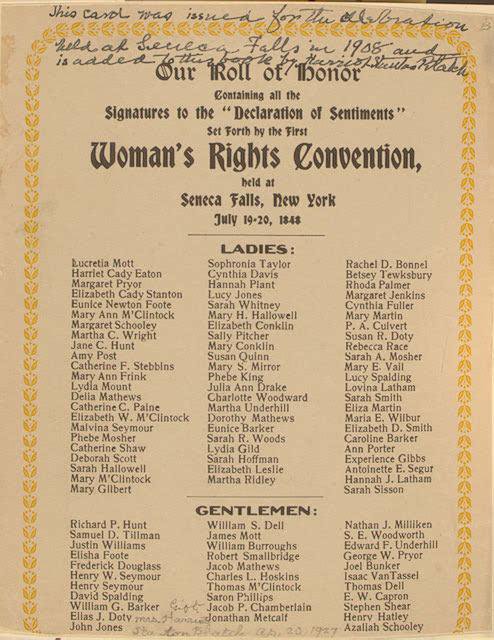
Over two days about three hundred people listened to speeches, read and changed a prepared document called the Declaration of Sentiments, and voted on a list of resolutions. At the end, one hundred of them—sixty-eight women and thirty-two men—signed the Declaration. Its most famous line changed the words of the Declaration of Independence to say that “all men and women are created equal.”
The meeting was small and local, and it was organized in little more than a week. Yet its demand that women claim the right to vote, which almost nobody in public life supported in 1848, turned it into a symbol. For many later Americans it became the starting point of the long struggle that ended with the Nineteenth Amendment to the U.S. Constitution in 1920, which prohibited denying the vote on the basis of sex.
Easy
What life was like for women in 1848
To understand why the meeting mattered, it helps to picture the rules of the time. Women could not vote in any American election. Under the common law idea of “coverture,” a married woman’s legal identity was largely absorbed into her husband’s. In many states she could not sign contracts, control property she brought into the marriage, or keep her own wages. Women did not serve on juries, and very few could attend college or enter professions such as law, medicine or the ministry.
Women who did paid work were usually limited to a narrow range of jobs—teaching small children, sewing, domestic service, or labour in textile mills—and they were typically paid far less than men. The Declaration of Sentiments listed many of these conditions, saying that man had made a married woman “in the eye of the law, civilly dead” and had “taken from her all right in property, even to the wages she earns.”
Things were beginning to change. In April 1848, just three months before the convention, the New York State Assembly passed a Married Women’s Property Act allowing wives to keep property they brought into a marriage or acquired during it. Mississippi had passed an earlier law of this kind in 1839, and Pennsylvania followed New York within weeks. Women reformers saw these laws as signs of hope—but also as proof of how much remained to be done.
Easy
Where the idea came from: abolition, Quakers and a London snub
Many of the women who organized Seneca Falls first learned to speak and organize in the movement to abolish slavery. From the 1830s, the abolitionist William Lloyd Garrison welcomed women into his anti-slavery societies. Women such as Sarah and Angelina Grimké and Abby Kelley lectured against slavery to audiences of men and women—which was itself shocking at the time. Critics told them to be quiet because they were women, and this pushed some of them to think about their own lack of rights.
A famous moment came in 1840, when Lucretia Mott and Elizabeth Cady Stanton travelled to London for the World’s Anti-Slavery Convention. After a day of debate, the male delegates refused to seat the American women; they had to listen from a gallery and could not speak or vote. Stanton and Mott became friends there and talked about holding a convention for women’s rights. It took eight years for the plan to happen.
The Quaker community of western New York provided the rest. Quakers (the Religious Society of Friends) had long allowed women to preach, and a group of reforming Quakers around Waterloo, including the M’Clintock and Hunt families, wanted men and women to have an equal voice in church business too. In June 1848 about two hundred of them formed a new, more radical group called the Congregational or Progressive Friends. Four of the five women who planned the convention were Quakers; Stanton was the exception.
Intermediate
Ten days of planning
In the summer of 1848 Lucretia Mott and her husband James were travelling in central and western New York. They visited the Cattaraugus Reservation of the Seneca Nation, part of the Haudenosaunee (Iroquois) Confederacy, where women held a notably strong position; former enslaved people living in Canada; and Lucretia’s sister Martha Coffin Wright in Auburn. On Sunday, July 9, after Quaker worship, Lucretia Mott, Martha Wright, Mary Ann M’Clintock and Elizabeth Cady Stanton had tea with Jane Hunt at the Hunt home in Waterloo. Stanton, by her own later account, poured out her “long-accumulating discontent,” and the five women decided to hold a convention while Mott, a celebrated speaker, was still nearby.
Their notice appeared in the Seneca County Courier on July 11, giving only eight days’ warning; Frederick Douglass’s newspaper the North Star reprinted it. The first day was to be for women only, the second open to all. The chosen venue, the Wesleyan Chapel, had been built by an anti-slavery congregation and had hosted many reform lectures; it was thought to be the only large building in the area that would open its doors to such a meeting.
On Sunday, July 16, at the M’Clintock house in Waterloo, Stanton worked with Mary Ann M’Clintock and her daughters Elizabeth and Mary Ann Jr. on the documents. One of the M’Clintocks proposed using the Declaration of Independence as a model. The draft was written, according to tradition, on a small round mahogany tea table, which is now in the Smithsonian’s National Museum of American History. Over the next three days Stanton edited the list of grievances and resolutions at home—and added, on her own, a demand for women’s right to vote.
Intermediate
The convention day by day
On the hot morning of July 19 the organizers found a crowd waiting—and the chapel doors locked. Stanton’s young nephew Daniel Eaton was lifted through a window to unbar them. About forty men had come despite the “women only” notice; they were allowed to stay but asked to remain silent. Mary Ann M’Clintock Jr. served as secretary. Stanton gave the opening address, and then read the Declaration aloud, paragraph by paragraph, so that it could be debated and amended. In the afternoon Mott read a humorous newspaper piece by Martha Wright about the endless advice given to overworked mothers, and Elizabeth M’Clintock spoke. In the evening Mott addressed a large mixed audience on the progress of reform movements.
On July 20 the crowd was larger. Because it still seemed too radical for a woman to chair a meeting of both sexes, James Mott presided. The Declaration was read again; when it reached the grievance about property and wages, Assemblyman Ansel Bascom described the new New York property law. After comments from Douglass, Thomas and Mary Ann M’Clintock and Amy Post, the Declaration was adopted. Signatures were gathered in two columns, women first and then men. The temperance reformer Amelia Bloomer attended but did not sign; Bascom did not sign either.
In the afternoon each resolution was voted on separately. Only one was seriously challenged: the ninth, which read that “it is the duty of the women of this country to secure to themselves their sacred right to the elective franchise.” In the evening Thomas M’Clintock read passages from the English jurist William Blackstone to show the legal basis of women’s subordination, and Lucretia Mott added a twelfth resolution calling for “the overthrow of the monopoly of the pulpit” and equal participation for women in trades, professions and commerce. It passed. A committee was named to publish the proceedings.
Intermediate
Reading the Declaration of Sentiments
The Declaration of Sentiments follows the structure of Thomas Jefferson’s 1776 Declaration almost line by line. Where Jefferson wrote that the history of the King of Great Britain was “a history of repeated injuries and usurpations,” Stanton wrote that “the history of mankind is a history of repeated injuries and usurpations on the part of man toward woman.” Where Jefferson spoke of “the patient sufferance of these Colonies,” the new text spoke of “the patient sufferance of the women under this government.”
This borrowing was a deliberate strategy. By speaking in the most respected language of American politics, the authors argued that they were not inventing strange new principles but asking the republic to apply its own founding ideals consistently. At the same time, the parallel was provocative: it cast men as a ruling power and women as colonists entitled to rebel.
The grievances cover law, economy, education, religion and morals. They complain that women must obey laws they had no voice in making; that married women are “civilly dead” in law; that divorce and custody laws favour men; that most profitable jobs and colleges are closed to women; that women are kept out of the ministry; and that a “different code of morals” is applied to men and women. The accompanying resolutions demanded equality in all these areas. The resolution on the vote was the boldest, because it asked for a political right that almost no one—even among reformers—was yet willing to support.
Intermediate
The fight over the vote and Frederick Douglass’s role
Opponents of the suffrage resolution, including Lucretia and James Mott, feared that it would make the whole convention look ridiculous and cost support for the other demands. Mott is reported to have told Stanton, “Why Lizzie, thee will make us ridiculous.” Others felt the meeting should address social, civil and religious rights but leave politics alone. Stanton’s own husband, Henry Stanton, a politician, had warned her that the demand would “turn the proceedings into a farce” and left town rather than be associated with it.
Frederick Douglass—the famous abolitionist editor who had escaped slavery, and the only African American known to have attended—rose to defend the resolution. He argued that he could not accept the right to vote for himself as a Black man if women could not claim it too, and that denying women a share in government meant losing half of the world’s moral and intellectual power. After his speech the resolution passed by a large majority.
Douglass’s support was not a one-time gesture. His newspaper the North Star reported favourably on the convention, and he remained an advocate of women’s suffrage for the rest of his life. Later, however, the alliance between the women’s movement and the anti-slavery movement would come under severe strain, as the next sections explain.
Intermediate
Reactions, ridicule and the conventions that followed
Newspapers reacted in very different ways. The National Reformer of Auburn praised the meeting as forming “an era in the progress of the age.” The Oneida Whig mocked it, asking: “If our ladies will insist on voting and legislating, where, gentlemen, will be our dinners and our elbows?” Other papers joked that men would have to wash the dishes. But Horace Greeley’s influential New York Tribune conceded that if women demanded equal political rights, a sincere republican could give no adequate reason for refusing. Several local ministers denounced the convention from their pulpits the following Sunday.
Ridicule did not stop the movement. Two weeks later, on August 2, many of the same people met in Rochester, New York, where they took the step Seneca Falls had avoided: they elected a woman, Abigail Bush, to preside. The Rochester meeting also approved the Declaration of Sentiments. Over the next two years further local conventions met in Ohio, Indiana and Pennsylvania, and in 1850 the first National Women’s Rights Convention gathered in Worcester, Massachusetts. These national conventions met almost every year until the Civil War began in 1861.
Seventy-two years passed between Seneca Falls and the Nineteenth Amendment, adopted in August 1920. Charlotte Woodward, who had signed as a young woman in 1848, was the only signer still alive in 1920, though she was reportedly too ill to vote. Even then, as historians stress, many African American, Asian American, Hispanic American and Native American women still faced legal and practical barriers to voting for decades.
Advanced
Historiography: how Seneca Falls became the “beginning”
Today Seneca Falls is almost universally presented as the birthplace of the American women’s rights movement. Historians have shown that this status was partly constructed after the fact. In 1870 Paulina Wright Davis published a history of the movement, approved by Mott and Stanton among others, that treated Seneca Falls as one of several local meetings of the late 1840s and dated the national movement to the Worcester convention of 1850. That same year Stanton herself told a National Woman Suffrage Association meeting that the movement in England and America “may be dated from” Worcester.
Lisa Tetrault’s The Myth of Seneca Falls (2014) argues that the change came during the bitter split of the late 1860s between Stanton and Susan B. Anthony’s National Woman Suffrage Association and the American Woman Suffrage Association associated with Lucy Stone. Worcester had been organized by Stone and Davis; Stanton and Anthony had not attended it. Seneca Falls, by contrast, was Stanton’s event, and Stone had not been there. In the History of Woman Suffrage, whose first volume Stanton, Anthony and Matilda Joslyn Gage published in 1881, Seneca Falls became the founding moment, while earlier activity was compressed into a chapter of “Preceding Causes.”
Stanton also cultivated relics. The tea table on which the Declaration was drafted was given to her by the M’Clintocks; she passed it to Anthony—who had not been at Seneca Falls—on her eightieth birthday, and it was displayed at Anthony’s funeral in 1906 and at major suffrage meetings until 1920. None of this means the convention was unimportant. Judith Wellman, a leading historian of the event, has called the Declaration “the single most important factor in spreading news of the women’s rights movement around the country.” Rather, the historiography asks why one origin story was chosen, whose contributions it highlighted, and whose it pushed to the margins—including those of Stone, Davis, and the Quaker women who did much of the organizing.
Advanced
Religion, race and the limits of 1848
Historians such as Gerda Lerner have emphasized the religious roots of the Declaration. Most participants belonged to Quaker or evangelical reform circles, and the document drew on arguments from the Quaker abolitionist Sarah Grimké that God had created woman equal to man and that man had usurped divine authority by claiming “absolute tyranny” over her. Judith Wellman and others have also highlighted the specific role of Hicksite and Progressive Quakers such as the M’Clintocks and Hunts, correcting accounts that centre Stanton alone. Mott herself later described Stanton and Mary Ann M’Clintock as the “chief planners and architects” of the meeting.
Some scholars, notably Sally Roesch Wagner, have argued that the organizers were also influenced by what they knew of Haudenosaunee women, who had recognized roles in choosing leaders and controlling property. The Motts’ visit to the Seneca Nation’s Cattaraugus Reservation in the weeks before the convention is well documented; how far such knowledge shaped the Declaration itself is debated, and the document does not mention Native women.
The convention’s relationship with race is complex. Douglass’s intervention was decisive, and the organizers were committed abolitionists. Yet no Black women are known to have attended, and one of the grievances protested that women were denied rights given to “the most ignorant and degraded men—both natives and foreigners,” a phrase that relied on hierarchies of class, ethnicity and race. After the Civil War, when the Fifteenth Amendment proposed to enfranchise Black men but not women, Stanton opposed it and at times used racially demeaning language; Douglass rebuked her. Modern scholarship therefore treats Seneca Falls both as a genuine landmark and as a window onto the limits of the white, Protestant, middle-class reform culture from which it came.
Advanced
Sources, the lost original and the site today
Our knowledge of the convention rests mainly on the printed Report of the Woman’s Rights Convention published shortly afterwards by the committee named on the second evening, on contemporary newspaper reports, on letters by participants, and on reminiscences written decades later—especially Stanton’s. The later accounts are vivid but, as the historiography shows, shaped by later controversies, so historians compare them carefully with the 1848 record. No manuscript original of the Declaration of Sentiments is known to survive; a 2015 White House campaign, #FindtheSentiments, invited the public to search for it, without success.
The Wesleyan Chapel itself had a long afterlife. Sold and altered many times, it was used for purposes including a laundromat and a garage, and by the 1980s only parts of its walls and roof survived. In 1980 Congress created Women’s Rights National Historical Park in Seneca Falls and Waterloo, which now includes the chapel remains, the Elizabeth Cady Stanton House, the M’Clintock House and the Richard Hunt House. Because little information about the chapel’s original appearance existed, its treatment sparked debate between reconstruction and preservation of the surviving fabric.
The anniversary has repeatedly served as a stage for national politics: a 1948 centennial postage stamp, a 1998 speech by First Lady Hillary Clinton on the 150th anniversary, and continuing debates over the site’s maintenance. That same summer of 1848 also saw a very different gathering, the Conference of Badasht in Iran, where the Bábí poet Táhirih publicly challenged religious and social conventions; historians of women’s movements sometimes place the two events side by side as examples of how the question of women’s status was being raised in many societies at once.
Key ideas
- Equal creation
- The Declaration’s central claim that “all men and women are created equal,” extending the founding principle of the American republic to women.
- Coverture
- The common-law doctrine that merged a married woman’s legal identity into her husband’s, which the grievances attacked as making wives “civilly dead.”
- The elective franchise
- The right to vote—the most controversial demand in 1848 and later the central goal of the women’s movement.
- Using the language of the founders
- By copying the Declaration of Independence, the authors presented women’s rights as the consistent application of accepted ideals rather than a foreign novelty.
- Reform networks
- Abolitionist, Quaker and temperance circles supplied the skills, meeting places, newspapers and personal connections that made the convention possible in ten days.
- Origin story
- Seneca Falls became the symbolic beginning of the movement partly through the choices of later memoirs and histories, a process historians now study critically.
- Interlocking struggles
- The alliance and later tension between women’s rights and Black civil rights, visible in Douglass’s support and in the post–Civil War split.
Records
- 1840 — Women delegates, including Lucretia Mott, are refused seats at the World’s Anti-Slavery Convention in London; Mott and Elizabeth Cady Stanton meet.
- 1848 — April 7: New York passes a Married Women’s Property Act.
- 1848 — June: Progressive (Congregational) Friends form in western New York; the Liberty Party platform mentions votes for women.
- 1848 — July 9: Five women meet for tea in Waterloo and decide to hold a convention; the notice appears on July 11.
- 1848 — July 19–20: The convention meets in Seneca Falls; 68 women and 32 men sign the Declaration of Sentiments.
- 1848 — August 2: The Rochester Women’s Rights Convention, presided over by Abigail Bush, endorses the Declaration.
- 1850 — The first National Women’s Rights Convention meets in Worcester, Massachusetts.
- 1881 — The first volume of the History of Woman Suffrage presents Seneca Falls as the movement’s beginning.
- 1920 — The Nineteenth Amendment is adopted; signer Charlotte Woodward is the last surviving signer.
- 1980 — Congress establishes Women’s Rights National Historical Park in Seneca Falls and Waterloo.
- 1998 — The 150th anniversary is marked with large celebrations in Seneca Falls.
Glossary
- Convention
- A large organized meeting where people discuss a cause and vote on statements or plans.
- Declaration of Sentiments
- The document adopted at Seneca Falls, modelled on the Declaration of Independence, listing women’s grievances.
- Resolution
- A formal statement of opinion or intention voted on by a meeting.
- Suffrage / franchise
- The right to vote in political elections.
- Abolitionist
- A person who worked to end slavery completely.
- Quakers (Religious Society of Friends)
- A Christian group that emphasizes the inner light in every person; many Quakers opposed slavery and allowed women to preach.
- Coverture
- A legal rule under which a married woman had few separate legal rights from her husband.
- Married Women’s Property Act
- State laws of the nineteenth century that allowed married women to own and control property.
- Nineteenth Amendment
- The 1920 change to the U.S. Constitution that forbids denying citizens the vote because of sex.
- Historiography
- The study of how history has been written and why interpretations change.
Questions and answers
Why did a little boy have to climb through a window?
When the organizers arrived on the first morning, the chapel doors were locked. Stanton’s young nephew was lifted through an open window to unlock them from the inside.
Were men allowed at the convention?
The first day was announced for women only, but about forty men came and were allowed to stay quietly. On the second day men took part fully, and 32 men signed the Declaration.
Did the convention win women the vote?
No. It only demanded it. American women won a constitutional guarantee against sex discrimination in voting in 1920, seventy-two years later, after many campaigns.
Was Susan B. Anthony at Seneca Falls?
No. Anthony met Stanton in 1851 and became her closest partner, but she did not attend the 1848 convention, even though she is often wrongly pictured there.
Was Seneca Falls really the first women’s rights meeting?
It was the first convention called specifically to discuss women’s rights, but women had been organizing, petitioning and speaking before 1848. Historians note that treating it as the single ‘beginning’ was partly a later choice by Stanton and Anthony.
Why did Lucretia Mott oppose the voting resolution?
She feared it would make the convention look ridiculous and weaken support for other demands. Many Quaker reformers were also wary of electoral politics in general.
Does the original Declaration still exist?
No handwritten original is known. The text survives through the printed report of the convention and newspaper reprints.
Sources and further reading
- Seneca Falls Convention. Wikipedia
- Declaration of Sentiments. Wikipedia
- The First Women’s Rights Convention. National Park Service, Women’s Rights National Historical Park
- Declaration of Sentiments (text). National Park Service, Women’s Rights National Historical Park
- Women’s Rights National Historical Park. Wikipedia
- Elizabeth Cady Stanton. Wikipedia
- Nineteenth Amendment to the United States Constitution. Wikipedia
- Conference of Badasht. Wikipedia
- Judith Wellman, The Road to Seneca Falls: Elizabeth Cady Stanton and the First Women’s Rights Convention. University of Illinois Press, 2004
- Lisa Tetrault, The Myth of Seneca Falls: Memory and the Women’s Suffrage Movement, 1848–1898. University of North Carolina Press, 2014
Related
- United States Declaration of IndependenceDocument adopted by the Continental Congress on 4 July 1776 declaring the thirteen colonies independent of Britain.
- Mary WollstonecraftEnglish writer and philosopher whose A Vindication of the Rights of Woman (1792) argued that women seem inferior only because they are denied education, a founding text of feminist thought.
- Emancipation ProclamationWartime order signed by President Abraham Lincoln on January 1, 1863, declaring enslaved people in the rebelling Confederate states free and opening the Union army and navy to Black men.
- Virginia WoolfEnglish novelist and essayist whose experiments with narrative time and consciousness helped shape literary modernism.
- Storming of the BastilleThe seizure of a Paris fortress and prison on 14 July 1789 became an early emblem of the French Revolution.
Written with AI assistance from the published sources listed above, and revised as new research appears.