Start at the top for an easy introduction. Go further down for more detail and scholarship.
- Easy
- Intermediate
- Advanced
For young readers
About 180 years ago, the Ottoman Empire was a very old and very big country that covered parts of south-eastern Europe, the Middle East and North Africa. Its capital was Istanbul. But the empire was in trouble: it was losing wars, some provinces were breaking away, and its money was running short.
In 1839 a new young sultan, Abdülmecid, let one of his ministers read out a special announcement in a rose garden next to the palace. The garden was called Gülhane, which means “house of roses.” The announcement promised that everyone’s life, property and honour would be protected, that taxes would be fair, and that people would not be punished without a public trial.
The most surprising promise was that these rights would apply to all the sultan’s subjects, whatever their religion. Before this, Muslims, Christians and Jews had lived under different rules. Now the government said everyone should be equal before the law.
Over the next forty years the government made many changes, like rebuilding a house room by room. It wrote new law books, opened new kinds of schools, set up telegraph lines and railways, printed paper money, counted the population and changed how provinces were run. This whole time is called the Tanzimat, which means “reorganisation.”
Not everyone was happy. Some Muslims felt they were losing their special place. Some Christians wanted their own independent countries instead. In some places there was terrible violence. The government also borrowed a lot of money from Europe and could not pay it back.
In 1876 the reformers gave the empire its first constitution, a rule book for the whole country, and an elected parliament. The new sultan soon closed the parliament, but the ideas of the Tanzimat, such as equal citizenship and written laws, lived on in the countries that later grew out of the empire, including modern Turkey.
At a glance
- Period
- 1839–1876 (from the Edict of Gülhane to the first Ottoman constitution)
- Where
- Ottoman Empire; decisions made in Istanbul, applied from the Balkans to Iraq and North Africa
- Sultans
- Abdülmecid I (r. 1839–1861), Abdülaziz (r. 1861–1876), and at the end Abdülhamid II (from 1876)
- Leading reformers
- Mustafa Reşid Pasha, Mehmed Emin Âli Pasha, Mehmed Fuad Pasha, Midhat Pasha, Ahmed Cevdet Pasha
- Key documents
- Edict of Gülhane (3 November 1839); Reform Edict (18 February 1856); Land Code and Penal Code (1858); Vilayet Law (1864); Nationality Law (1869); Mecelle civil code (1869–1876); Constitution (23 December 1876)
- Main aims
- Security of life and property, fair taxation, regular conscription, legal equality of Muslims and non-Muslims, a centralised and efficient state
- Outcome
- A modernised bureaucracy and legal system, but also foreign debt, bankruptcy in 1875, and continuing nationalist revolts; the constitution was suspended in 1878
Easy
What was the Tanzimat?
Tanzimat is an Ottoman Turkish word meaning “reorganisation” or “regulations.” Historians use it for the period between 1839 and 1876, when the government of the Ottoman Empire carried out a long series of reforms of law, administration, the army, taxation and education. The period began with a public proclamation, the Edict of Gülhane, in 1839, and ended with the proclamation of the first Ottoman constitution in 1876.
The reforms were not a single law but a programme that unfolded over nearly forty years under two sultans, Abdülmecid I and Abdülaziz. They were designed and pushed forward mostly by a small group of high officials trained in diplomacy and languages, who believed that the empire could survive only if it built a modern, centralised state with clear written laws.
At the heart of the Tanzimat was a new idea of the relationship between the ruler and the ruled. Instead of a society divided by religion, in which Muslims, Christians and Jews had different rights and duties, the reformers promised that all subjects would be equally protected by law. This promise, and the struggle to put it into practice, shaped the last century of the empire.
Easy
Why did the empire need reform?
In the eighteenth and early nineteenth centuries the Ottoman Empire lost a series of wars against Russia and Austria. In the Balkans the Serbs rose up and Greece fought a war of independence (1821–1830), ending with an independent Greek state. Powerful local notables and governors often ignored the central government, and the old army could no longer match European armies.
Earlier sultans had already tried to change things. Selim III (r. 1789–1807) created a new European-style army, the Nizam-ı Cedid (“New Order”), but was overthrown. Mahmud II (r. 1808–1839) went further: in 1826 he destroyed the Janissary corps, the old infantry that had resisted change, and began to centralise the state, open new schools and dress officials in European-style clothes.
The immediate crisis came from Egypt. Muhammad Ali, the Ottoman governor of Egypt, had built a strong army and turned against the sultan. In 1839 his forces defeated the Ottoman army, and Mahmud II died in the same summer. The new sultan, Abdülmecid, was only sixteen. The government badly needed the support of European powers, especially Britain, and a firm reform programme was one way to win it. In 1838 the Ottomans had also signed the Treaty of Balta Liman with Britain, which opened Ottoman markets to British trade.
Easy
The Rose Garden Edict of 1839
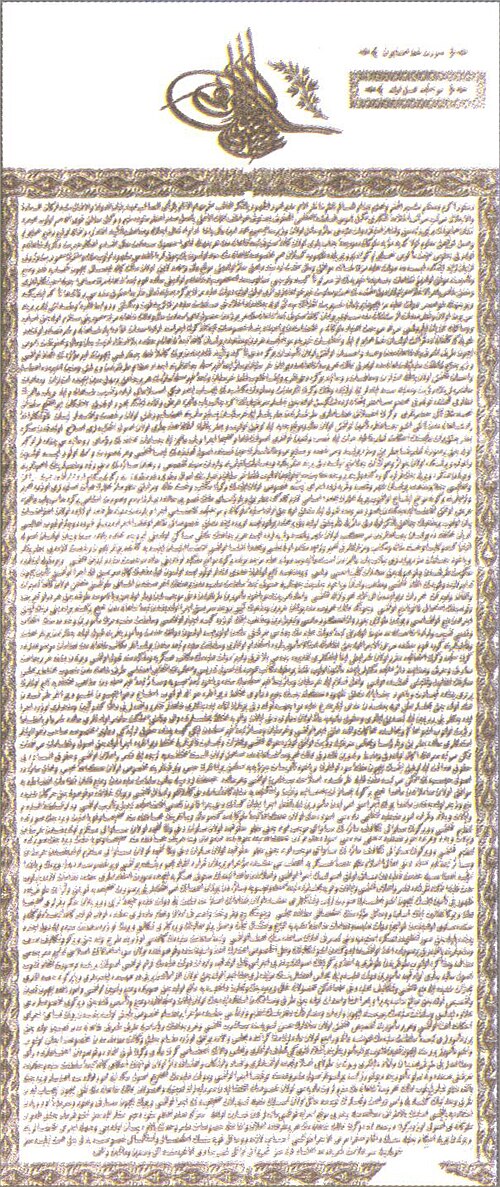
On 3 November 1839 the foreign minister Mustafa Reşid Pasha read out an imperial decree in the Gülhane (“Rose House”) park beside the Topkapı Palace in Istanbul, before officials, religious leaders, representatives of the non-Muslim communities and foreign diplomats. The decree is known as the Edict of Gülhane, or in Turkish the Gülhane Hatt-ı Şerifi.
The edict began by explaining that the empire had grown weak because its old laws had not been respected. It then promised three main things: guarantees for the security of life, honour and property of every subject; a regular and fair system of taxation, ending the practice of tax farming, in which private contractors bought the right to collect taxes; and a regular system of conscription with fixed terms of military service. It also promised that no one would be executed or punished without a public trial according to law.
Most strikingly, the edict said that these guarantees applied to all the sultan’s subjects, “whatever religion or sect they may belong to.” It did not yet change most laws, and many of its promises remained on paper for years. But it set out a programme, and later reformers constantly referred back to it.
Intermediate
The men of the Porte: who made the reforms
The Tanzimat was above all the work of a new kind of Ottoman official. Mustafa Reşid Pasha (1800–1858) had served as ambassador in Paris and London and became convinced that the empire must adopt European-style institutions to regain its strength. He drafted the Gülhane edict and served six times as grand vizier. His protégés Mehmed Emin Âli Pasha and Mehmed Fuad Pasha dominated the government in the 1850s and 1860s, alternating in the posts of grand vizier and foreign minister.
Many of these men had begun their careers in the Translation Office of the Sublime Porte (Bâb-ı Âli), the seat of the grand vizier’s government, where knowledge of French opened the way to diplomacy and high office. During the Tanzimat, power moved away from the palace and towards this bureaucracy. Historians such as Carter Findley have described the Porte as the real centre of government in this period.
New councils were created to prepare and debate laws, such as the Supreme Council of Judicial Ordinances (from 1838) and the Council of Reorganisation (1854). In 1868 these were reorganised into a Council of State and a separate high court. Later reformers included Midhat Pasha, who made his name as governor of the Danube province, and the scholar-statesman Ahmed Cevdet Pasha, who led the codification of civil law.
Intermediate
New laws and new courts
One of the most lasting achievements of the Tanzimat was the creation of written law codes. A Commercial Code was issued in 1850, largely modelled on French law, and mixed commercial courts with Ottoman and European members were set up to hear business cases involving foreigners. A new Penal Code followed in 1858, also inspired by French law; it remained in force in Turkey until 1928.
In 1864 the government established a network of Nizamiye courts, secular state courts that heard civil and criminal cases according to the new codes. The older Islamic courts of the kadis continued to exist, especially for family and inheritance matters, so the empire now had several court systems side by side.
For civil law the reformers chose a different path. Instead of translating the French civil code, as some proposed, a commission led by Ahmed Cevdet Pasha prepared the Mecelle, a civil code based on Hanafi Islamic jurisprudence but arranged in numbered articles like a European code. It was published in sixteen books with 1,851 articles between 1869 and 1876. The Mecelle proved extremely durable: it remained in force in Turkey until 1926 and in several Arab successor states, and in Israel formally until 1984.
Intermediate
The Reform Edict of 1856 and equal citizenship
The Crimean War (1853–1856), in which Britain and France fought alongside the Ottomans against Russia, gave the European allies great influence in Istanbul. On 18 February 1856, just before the peace conference in Paris, Sultan Abdülmecid issued a second great decree, the Reform Edict (Islahat Fermanı), prepared chiefly by Âli Pasha in close consultation with the British and French ambassadors.
The 1856 edict was much more specific than the Gülhane decree about non-Muslims. It promised equal access to government posts and schools regardless of religion, freedom of worship and protection from forced conversion, mixed courts for cases between Muslims and non-Muslims, and the right of non-Muslims to serve in the army, which replaced the special tax formerly paid by them in place of military service. It also allowed foreigners to own property. Mustafa Reşid Pasha, then out of office, criticised the edict as a concession to foreign pressure.
Reactions were mixed. Many Muslims resented the loss of their traditional precedence. Some non-Muslim communities welcomed access to state service but disliked conscription and the loss of the old privileges of their religious leaders. The communities themselves were reorganised: the Greek Orthodox, Armenian and Jewish communities received new internal regulations in the 1860s, including an Armenian National Constitution in 1863 that gave lay members a larger voice.
In 1869 a Nationality Law created a single Ottoman citizenship for all subjects regardless of religion. The political idea behind it, often called Ottomanism, was that loyalty to a shared Ottoman homeland could bind together people of many faiths and languages.
Intermediate
Building a modern state: provinces, land, schools and railways
The reformers wanted a state that knew its population and could tax it directly. A census of the male population was carried out in 1844, and identity papers were introduced. The Vilayet Law of 1864 reorganised the provinces into large units called vilayets, with governors, administrative councils that included elected local members (Muslim and non-Muslim), and new courts. The model was first tried in the Danube province under Midhat Pasha.
The Land Code of 1858 classified land into categories such as state land (miri), private property (mülk), religious endowments (vakıf) and common land, and required holders to register their plots and receive title deeds (tapu). The aim was to increase tax revenue and state control. In practice, in parts of Syria, Palestine and Iraq, village land was often registered in the names of merchants, officials or tribal leaders, turning peasants into tenants of absentee landlords.
Education changed too. The state opened secular secondary schools, colleges for civil servants and a university (darülfünun), although the first attempts at a university struggled. The Galatasaray lycée, founded in 1868, taught in French and brought together students of different religions. Alongside these, telegraph lines (from the 1850s), railways, steamships, the Ottoman Bank (1856), paper money and new ministries transformed the practical working of government.
The Tanzimat also included steps against slavery and the slave trade: the Istanbul slave market was closed in 1847, and the trade in Circassian and Georgian slaves and the trade in enslaved Africans were banned in the 1850s, though enforcement was uneven.
Intermediate
Tensions, violence and debt
The promise of equality could provoke violent resistance as well as hope. In 1860 fighting between Druze and Maronite Christians in Mount Lebanon was followed by an anti-Christian massacre in Damascus. Thousands were killed in each place. France sent troops, and the Ottoman foreign minister Fuad Pasha was sent to Syria with full powers, where he punished officials and rioters severely. In 1861 Mount Lebanon became a special autonomous district (mutasarrifate) under a Christian governor.
In the Balkans, reforms did not stop the growth of nationalist movements. Serbs, Romanians, Bulgarians and others increasingly sought autonomy or independence, often with the support of European powers, especially Russia. In 1870 the Bulgarian Orthodox Church gained its own Exarchate, separate from the Greek Patriarchate, a step towards Bulgarian national identity.
The reforms, together with war, were expensive. The empire took its first foreign loan during the Crimean War and continued to borrow heavily. By 1875 it could no longer pay the interest and declared a partial default. In the same years revolts broke out in Herzegovina, Bosnia and Bulgaria, and the suppression of the Bulgarian uprising of 1876, with the killing of many civilians, turned European opinion against the Ottomans.
Intermediate
The Young Ottomans and the constitution of 1876
By the 1860s a new group of critics had appeared. The Young Ottomans, a secret society founded in 1865 by intellectuals including the writer Namık Kemal, accused the Tanzimat statesmen, especially Âli and Fuad, of ruling in an authoritarian way and of copying Europe without understanding the empire’s own traditions. They argued for a constitution and a parliament, and they tried to ground ideas like liberty (hürriyet) and homeland (vatan) in Islamic political thought. Many of them wrote from exile in Europe.
In May 1876, amid financial collapse and the Balkan crisis, a group of ministers led by Midhat Pasha deposed Sultan Abdülaziz. After a brief reign by Murad V, Abdülhamid II became sultan, having agreed to accept a constitution. On 23 December 1876, as European diplomats met in Istanbul to discuss the Balkan crisis, the constitution was proclaimed. It declared all Ottoman subjects equal before the law and created a parliament with an appointed senate and an elected chamber of deputies.
The first Ottoman parliament met in 1877, with Muslim, Christian and Jewish deputies. But the constitution left the sultan great powers, including the right to exile people considered dangerous, which Abdülhamid used against Midhat Pasha. During the disastrous war with Russia, he suspended parliament on 14 February 1878 and ruled personally for three decades. The constitution was restored only by the Young Turk Revolution of 1908.
Advanced
Westernisation or Ottoman renewal? Debating the origins
A long-standing question is how far the Tanzimat was a copy of European models. Stanford J. Shaw argued that the Gülhane edict was directly influenced by the ideals of the French Declaration of the Rights of Man and of the Citizen of 1789. Butrus Abu-Manneh, by contrast, argued that the edict drew on Ottoman and Islamic ideas of just rule, and on the reforming spirit of the Naqshbandi-Mujaddidi Sufi circles at court, rather than on Western influence. The text itself mixes the language of the sharia and of restoring old laws with new promises that resemble European liberal constitutions.
Roderic Davison’s classic study, Reform in the Ottoman Empire, 1856–1876, emphasised the sincerity and energy of the Tanzimat statesmen, while also showing how limited their base of support was. Later scholarship has placed the reforms in a wider comparative frame: like Egypt under Muhammad Ali, Iran under the Qajars, Japan in the Meiji era or Russia under Alexander II, the Ottoman Empire pursued a “defensive modernisation” in response to European military and economic power.
Recent historians also stress continuity with earlier reforms under Selim III and Mahmud II, and the role of Ottoman society beyond Istanbul. Provincial elites, merchants and religious communities negotiated, used and resisted the new laws. In this view the Tanzimat was not simply imposed from above but was shaped in encounters between the central state and many local actors.
Advanced
Equality on paper and in practice
The most debated legacy of the Tanzimat concerns the equality of Muslims and non-Muslims. Hans-Lukas Kieser has described a gap between the rhetorical promotion of equality on paper and the continued primacy of Muslims in practice. Non-Muslims gained new rights, but in many places they remained vulnerable, and Muslim notables often continued to dominate local councils and courts.
Ussama Makdisi’s study of Mount Lebanon, The Culture of Sectarianism, argued that sectarian identity in the modern sense was not an ancient hatred but was produced in the nineteenth century, when Ottoman reform, European intervention and local elites all began to organise politics along religious lines. The violence of 1860 is thus seen as a product of modernity and reform rather than a survival of the past. Other historians put more weight on social and economic conflicts, such as peasant revolts against landlords.
The reforms also changed the communities from within. New community constitutions gave lay people, especially merchants and professionals, more power relative to clergy, and encouraged national consciousness among Armenians, Bulgarians and others. Some historians therefore see the Tanzimat as having unintentionally encouraged the very nationalism it hoped to contain, while others argue that nationalism had independent roots in the Balkans and in European diplomacy.
Women’s status and slavery are further areas of research. The Tanzimat did not grant political rights to women, but new schools for girls, including a teachers’ college, were founded, and women began to appear as writers and readers of the new press in the following decades.
Advanced
Sources, memory and national perspectives
The Tanzimat is unusually well documented. The Ottoman archives in Istanbul hold the texts of laws, council minutes, provincial correspondence, land registers and census records. The new official gazette and private newspapers of the period, in Ottoman Turkish, Greek, Armenian, Bulgarian, Arabic, Ladino and French, allow historians to follow public debate. European consular and diplomatic reports add another, often critical, perspective.
How the Tanzimat is remembered depends on who is remembering. In the Turkish Republic, it was long presented as the first stage of Westernisation leading to Atatürk’s reforms, sometimes praised as progressive and sometimes criticised as superficial imitation of Europe that weakened Islamic tradition. In Arab historiography it is linked with new provincial administration, land registration and the rise of urban notables, as well as with the beginnings of the Arab cultural revival. In Balkan national histories it often appears as a failed attempt to hold together an empire from which their nations were escaping.
Some historians, following Şerif Mardin’s work on the Young Ottomans, emphasise the Tanzimat’s intellectual legacy: the idea of constitutional government, the language of rights and citizenship, and the debate about how Islam and modern institutions could be reconciled. These questions continued in the successor states of the empire long after 1876.
Key ideas
- Rule of law
- The Gülhane edict promised that the sultan’s subjects would not lose life, honour or property except by lawful public judgment, limiting arbitrary power.
- Legal equality (Ottomanism)
- All subjects, Muslim and non-Muslim, were to be equal before the law and share a common Ottoman citizenship, formalised in 1869.
- Centralisation
- The state tried to govern directly through salaried officials, registers and uniform provincial institutions instead of intermediaries like tax farmers and local notables.
- Codification
- Law was written down in systematic codes, some based on French models and one, the Mecelle, on Islamic jurisprudence in modern form.
- Defensive modernisation
- Reform was driven by the need to survive against European military, economic and diplomatic pressure.
- Bureaucratic rule
- Power shifted from the palace to the Sublime Porte, run by a new class of officials skilled in diplomacy and languages.
- Constitutionalism
- Critics such as the Young Ottomans argued that true reform required a constitution and parliament, achieved briefly in 1876–1878.
Records
- 1826 — Mahmud II abolishes the Janissary corps, opening the way for centralising reforms.
- 1838 — Treaty of Balta Liman opens Ottoman markets to British trade.
- 1839 — Mahmud II dies; on 3 November the Edict of Gülhane is proclaimed under Abdülmecid I.
- 1850 — A Commercial Code and mixed commercial courts are introduced.
- 1856 — The Reform Edict (18 February) promises equality to non-Muslims; the Ottoman Bank is founded.
- 1858 — The Land Code and a new Penal Code are promulgated.
- 1860 — Civil conflict in Mount Lebanon and massacre in Damascus.
- 1864 — Vilayet Law reorganises provinces; Nizamiye courts are established.
- 1865 — The Young Ottoman society is founded.
- 1869 — Nationality Law creates a common Ottoman citizenship; publication of the Mecelle begins.
- 1875 — The Ottoman government defaults on its foreign debt.
- 1876 — Abdülaziz is deposed; the first Ottoman constitution is proclaimed on 23 December.
Glossary
- Tanzimat
- “Reorganisation”; the Ottoman reform era of 1839–1876.
- Hatt-ı Şerif / ferman
- An imperial decree issued by the sultan; the Gülhane edict and the 1856 Reform Edict were such decrees.
- Sublime Porte (Bâb-ı Âli)
- The office of the grand vizier and, by extension, the Ottoman government.
- Millet
- A recognised religious community (e.g., Greek Orthodox, Armenian, Jewish) with its own leaders and internal law.
- Tax farming (iltizam)
- A system in which private contractors bought the right to collect taxes, which the Gülhane edict promised to abolish.
- Vilayet
- A large province created by the 1864 provincial law.
- Mecelle
- The Ottoman civil code (1869–1876) based on Hanafi Islamic law.
- Nizamiye courts
- Secular state courts established in 1864 to apply the new codes.
- Tapu
- A title deed recording the right to hold and use a plot of land.
- Young Ottomans
- A group of intellectuals from 1865 who called for constitutional government.
Questions and answers
Why is it called the “Rose Garden” edict?
Because it was read out in the Gülhane (“Rose House”) park next to the Topkapı Palace in Istanbul on 3 November 1839.
Did the Tanzimat make everyone equal?
It promised equality before the law and created a common citizenship, but in practice inequalities between Muslims and non-Muslims, rich and poor, and men and women continued.
Were the reforms forced on the Ottomans by Europe?
European pressure mattered, especially in 1856, but the reforms also grew from earlier Ottoman efforts and from the convictions of Ottoman statesmen. Historians disagree about the balance.
Did the Tanzimat save the empire?
It strengthened the central state and helped the empire survive for several more decades, but it did not stop territorial losses, nationalist revolts or financial collapse.
What happened to the 1876 constitution?
Sultan Abdülhamid II suspended parliament in 1878. The constitution was restored in 1908 after the Young Turk Revolution.
Why did the reformers write an Islamic civil code instead of adopting the French one?
Ahmed Cevdet Pasha and others argued that a code based on Hanafi law would be more familiar and acceptable to judges and the public, while its modern article-by-article form made it usable in the new courts.
Is the Tanzimat connected with modern Turkey?
Yes. Many institutions and ideas of the Republic, such as written codes, secular courts and state schools, built on foundations laid during the Tanzimat.
Sources and further reading
- Tanzimat. Wikipedia
- Edict of Gülhane. Wikipedia
- Ottoman Reform Edict of 1856. Wikipedia
- Mecelle. Wikipedia
- Ottoman Land Code of 1858. Wikipedia
- 1860 civil conflict in Mount Lebanon and Damascus. Wikipedia
- Young Ottomans. Wikipedia
- Constitution of the Ottoman Empire. Wikipedia
- Roderic H. Davison, Reform in the Ottoman Empire, 1856–1876. Princeton University Press, 1963
- Ussama Makdisi, The Culture of Sectarianism: Community, History, and Violence in Nineteenth-Century Ottoman Lebanon. University of California Press, 2000
Related
- Suleiman the MagnificentTenth Ottoman sultan (r. 1520–1566), whose long reign combined conquests from Hungary to Iraq, the harmonisation of Ottoman law, and a flowering of architecture and poetry.
- Meiji RestorationThe political transfer of authority to the Meiji emperor in 1868 began a far-reaching transformation of Japan’s government and society.
- Emancipation reform of 1861Alexander II’s reform that legally freed some 23 million privately owned serfs in the Russian Empire, while making them buy their land through decades of redemption payments.
- First Opium WarWar between Britain and Qing China from 1839 to 1842, rooted in disputes over the opium trade and foreign commerce.
- Storming of the BastilleThe seizure of a Paris fortress and prison on 14 July 1789 became an early emblem of the French Revolution.
Written with AI assistance from the published sources listed above, and revised as new research appears.