Start at the top for an easy introduction. Go further down for more detail and scholarship.
- Easy
- Intermediate
- Advanced
For young readers
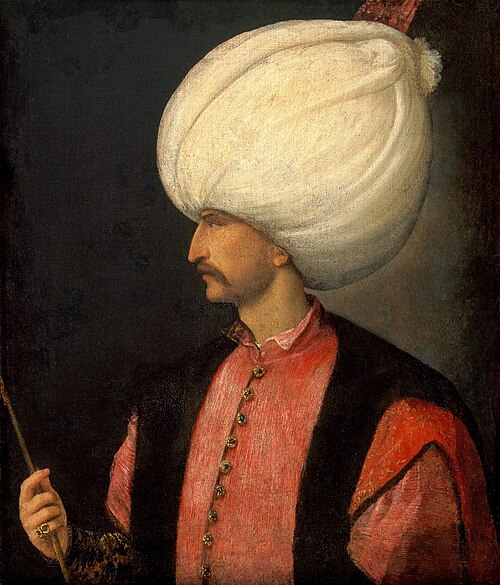
About 500 years ago, a huge empire stretched across three continents: parts of Europe, Asia and Africa. It was called the Ottoman Empire, and its capital was the great city of Istanbul, which sits on both sides of a narrow sea. The ruler of this empire was called the sultan.
In 1520 a young man named Suleiman became sultan. He was about twenty-five years old. He ruled for forty-six years, longer than any other Ottoman sultan, so a child born when he took the throne would have been a grandparent by the time he died.
People in Europe called him “the Magnificent” because his court was so rich and his armies so powerful. People in his own empire later called him “Kanuni,” which means “the Lawgiver,” because he is remembered for putting the empire’s rules in order, a bit like tidying a messy cupboard full of old notes into one clear book.
Suleiman spent much of his life on horseback leading his army. He captured the city of Belgrade and the island of Rhodes, won a famous battle in Hungary, and marched as far as Vienna in the west and Baghdad in the east. Wars also brought great suffering: towns were destroyed and many people were killed or taken as captives.
He also loved beautiful things. He wrote poems under a pen name, Muhibbi, which means “the one who loves.” His chief architect, Sinan, built him an enormous mosque on a hill in Istanbul, the Süleymaniye, with schools, a hospital and a kitchen for the poor all around it. You can still visit it today.
Suleiman married Hürrem, a woman who had come to the palace as a captive and became one of the most powerful people in the empire. Their family story also had very sad parts, because Suleiman ordered the deaths of two of his own sons. Historians today try to understand him as a real person: a great builder and lawmaker, but also a ruler of a violent age.
At a glance
- Lived
- 6 November 1494 (Trabzon) – 6 September 1566 (at the siege of Szigetvár, Hungary)
- Reigned
- 30 September 1520 – 6 September 1566 (46 years), the tenth Ottoman sultan
- Capital
- Istanbul (Constantinople), with the Topkapı Palace as the seat of government
- Parents
- Sultan Selim I and Hafsa Sultan
- Epithets
- “The Magnificent” in European usage; Kanunî, “the Lawgiver,” in Turkish (a title probably first attested in the 18th century)
- Major campaigns
- Belgrade (1521), Rhodes (1522), Mohács (1526), Vienna (1529), Iraq and Baghdad (1534–35), Safavid wars ending with the Peace of Amasya (1555), Szigetvár (1566)
- Key figures of his reign
- Hürrem Sultan, Pargalı Ibrahim Pasha, the jurist Ebussuud Efendi, the architect Mimar Sinan, the admiral Hayreddin Barbarossa
- Burial
- Mausoleum in the Süleymaniye complex, Istanbul (his internal organs were buried near Szigetvár)
Easy
Who was Suleiman?
Suleiman I (in Turkish, Süleyman) was the tenth sultan of the Ottoman dynasty. He came to the throne in 1520 and ruled until his death in 1566, the longest reign of any Ottoman sultan. During these forty-six years the empire reached one of the high points of its power: it ruled south-eastern Europe as far as central Hungary, most of the Middle East including Iraq, Syria and the holy cities of Mecca and Medina, Egypt, and long stretches of the North African coast.
He is known by two very different nicknames. In Western Europe he was called “the Magnificent,” a name that reflects how European ambassadors and writers saw the splendour of his court and the strength of his armies. In Turkey he is remembered as Kanunî, “the Lawgiver,” because of the great effort in his reign to collect and harmonise the empire’s laws. Each name tells us something about who was looking at him and what they cared about.
Suleiman was not only a warrior and administrator. He wrote poetry in Ottoman Turkish and Persian under the pen name Muhibbi, and his reign is linked with some of the most admired buildings, manuscripts and decorative arts of the Islamic world, many of them designed by the architect Mimar Sinan and produced by the court workshops in Istanbul.
Easy
The empire he inherited
The Ottoman state began around 1300 as a small principality in north-western Anatolia (the Asian part of modern Turkey). Over two centuries it grew into a large empire. In 1453 Suleiman’s great-grandfather Mehmed II conquered Constantinople, the old capital of the Byzantine Empire, and made it the Ottoman capital, known in Turkish as Istanbul.
Suleiman’s father, Selim I, ruled for only eight years (1512–1520), but in that short time he defeated the Mamluk Sultanate and brought Syria, Egypt and the Hejaz, the region of Mecca and Medina, under Ottoman rule. So when Suleiman became sultan, he inherited an empire that was suddenly much larger, much richer, and responsible for protecting the holiest places of Islam.
The Ottoman world was very diverse. Muslims, Orthodox Christians, Armenians, Jews and many others lived under the sultan’s rule and spoke Turkish, Greek, Arabic, Slavic languages, Armenian, Hebrew and more. The empire’s great rivals were the Habsburg family, who ruled Austria and Spain and whose head, Charles V, was Holy Roman Emperor, and the Safavid dynasty of Iran in the east.
Easy
Growing up to be sultan
Suleiman was born on 6 November 1494 in Trabzon, a port on the Black Sea, where his father was then serving as provincial governor. His mother, Hafsa Sultan, was a concubine of unknown origin who had converted to Islam; she lived until 1534 and was an important figure at court in the early years of his reign.
Ottoman princes were trained for rule by being sent out to govern provinces. Suleiman studied history, literature, religion and military matters, and as a young man he served as governor of Kaffa (Feodosia in Crimea) and then of Manisa in western Anatolia, with a short spell in Edirne. In Manisa he formed a close friendship with a young man of Greek-speaking origin from Parga, named Ibrahim, who would later become his grand vizier.
Selim I died in September 1520, and Suleiman, his only surviving adult son, took the throne on 30 September 1520 without the bloody struggle among brothers that had marked earlier successions. He was about twenty-five years old.
Intermediate
Campaigns in Europe: Belgrade, Rhodes, Mohács and Vienna
Suleiman began his reign with rapid victories. In 1521 his army took Belgrade, a fortress that had resisted Mehmed II, opening the road into Hungary. In 1522 he besieged the island of Rhodes, held by the crusading order of the Knights Hospitaller; after about five months the knights surrendered and were allowed to leave. They eventually settled on Malta, where the Ottomans would attack them again in 1565 and fail.
The most decisive battle came on 29 August 1526 at Mohács in southern Hungary. The Ottoman army, much larger and better supplied with artillery, destroyed the Hungarian royal army in a few hours. King Louis II drowned while fleeing, and a large part of the Hungarian nobility and clergy died with him. In Hungary the battle is still remembered as a national catastrophe; a common saying about a misfortune is that “more was lost at Mohács.”
After Mohács, two rival kings claimed Hungary: John Zápolya, whom Suleiman supported, and the Habsburg Ferdinand, brother of Charles V. In 1529 Suleiman marched to Vienna itself. The siege lasted from late September to mid-October, but heavy rain had forced the Ottomans to leave much of their heavy artillery behind, supplies ran short, and the defenders held their walls. A second advance in 1532 was delayed at the small fortress of Güns (Kőszeg) and never reached Vienna.
In 1541 Suleiman annexed central Hungary, including Buda, as an Ottoman province. Hungary was divided for about a century and a half between Ottoman Hungary, Habsburg “Royal Hungary” in the north and west, and the principality of Transylvania, which accepted Ottoman overlordship. These wars caused great destruction for the villages of the frontier, where raids, enslavement and flight were a constant danger.
Intermediate
Wars in the east and on the seas
In the east, the Ottomans’ great rival was Safavid Iran. The two empires competed for territory and also represented different forms of Islam: the Ottomans were Sunni, while the Safavids had made Twelver Shi‘ism their state religion. Suleiman led three major campaigns against the Safavid shah Tahmasp. In the first (1533–1536) he entered Baghdad in 1534, where he restored the tomb of Abu Hanifa, founder of the Hanafi school of law followed by the Ottomans. Later campaigns in 1548–49 and 1553–55 met a Safavid strategy of retreat and scorched earth.
The eastern wars ended with the Peace of Amasya in 1555, one of the first formal peace treaties between the two empires. It divided the Caucasus region, leaving Iraq, including Baghdad, with the Ottomans and giving them access to the Persian Gulf.
At sea, Suleiman made the corsair Hayreddin Barbarossa admiral of the Ottoman fleet. In 1538 Barbarossa defeated a fleet of the Holy League commanded by Andrea Doria at Preveza, off western Greece, giving the Ottomans a strong position in the Mediterranean for decades. In 1535–36 the Ottomans and King Francis I of France, both enemies of the Habsburgs, formed an alliance, and a Franco-Ottoman fleet wintered at Toulon in 1543–44, which shocked many Christian observers.
Ottoman power also reached the Indian Ocean. The Ottomans took Aden in 1538 but failed to capture the Portuguese fortress of Diu in India the same year. They sent soldiers to help the Adal Sultanate in the Horn of Africa and, later in the reign, received an embassy from Aceh in Sumatra asking for help against the Portuguese.
Intermediate
Law and government: why he is called the Lawgiver
The Ottoman Empire had two kinds of law. One was the sharia, Islamic religious law as interpreted by Muslim jurists. The other was kanun, the sultan’s own administrative law, which dealt with taxes, landholding, criminal penalties, the army and the organisation of the provinces. Earlier sultans had issued many kanun decrees, but they were scattered, repetitive and sometimes contradictory.
During Suleiman’s reign these regulations were gathered, compared and reissued in more uniform law codes (kanunname) for the empire and for individual provinces. The work was carried out by the imperial chancery and legal scholars rather than by the sultan alone, and it continued ideas already begun under earlier rulers. The resulting framework shaped Ottoman administration for centuries.
The central figure was Ebussuud Efendi, who served as şeyhülislam (chief mufti) from 1545 until 1574. Ebussuud worked to show that the sultan’s kanun was compatible with sharia, especially in the difficult areas of land ownership and taxation, and he organised the issuing of fatwas (legal opinions) through a formal office with clear procedures. His fatwas also gave religious legitimacy to Suleiman’s wars and to the persecution of groups considered heretical, such as the Kızılbaş supporters of the Safavids.
Suleiman’s government was run by a large household of officials, many of whom had entered service through the devşirme, the levy of Christian boys who were converted to Islam and trained as soldiers or administrators. The grand vizier headed the imperial council. One well-known act of the reign, in 1553 or 1554, was a decree denouncing blood-libel accusations against Jews, reportedly prompted by the sultan’s Jewish physician Moses Hamon.
Intermediate
Court and family: Ibrahim, Hürrem and the princes
In 1523 Suleiman made his friend Ibrahim grand vizier, jumping him over senior officials in a way that broke with custom. Ibrahim Pasha led armies in Hungary and against the Safavids and handled diplomacy with European powers. But on 15 March 1536 he was strangled in the palace on the sultan’s orders. Historians still debate why: explanations include Ibrahim’s growing pride and power, his rivalries with other statesmen, and the sultan’s wish to rule more directly.
Suleiman’s most famous relationship was with Hürrem Sultan, known in Europe as Roxelana. She was born in Ruthenia (in today’s western Ukraine), captured in a Crimean Tatar slave raid, and brought to the palace harem. Breaking with Ottoman custom, Suleiman freed and formally married her, probably in 1534, and kept her at court in Istanbul. She was his political adviser, corresponded with foreign rulers such as King Sigismund II Augustus of Poland, and founded charitable institutions, including a mosque complex in Istanbul and a public kitchen in Jerusalem. She died in 1558. Some of Suleiman’s love poems to her survive.
The succession to the throne was a dangerous matter in the Ottoman dynasty, since only one son could rule. In 1553 Suleiman had his eldest son Mustafa, a popular prince born to another consort, Mahidevran, executed in his army camp, accusing him of plotting rebellion. Later, two of Hürrem’s sons, Selim and Bayezid, fought each other; Bayezid fled to Safavid Iran and was executed there with his sons in 1561 by agreement with the shah. Selim became Suleiman’s successor as Selim II.
European observers, above all Venetian ambassadors, wrote vivid reports about these events, often blaming Hürrem for the deaths of Ibrahim and Mustafa. Modern historians treat such stories cautiously, because foreign diplomats rarely saw inside the harem and relied on rumour.
Intermediate
Poetry, architecture and the arts
Suleiman was an accomplished poet who wrote in Ottoman Turkish and Persian under the pen name Muhibbi, “the lover.” A collection of his poems (a divan) survives. Some of his lines became proverbs in Turkish. His reign is also associated with the leading poets Bâkî and Fuzûlî, the latter writing mainly in Baghdad, and with the historian and painter Matrakçı Nasuh, who illustrated the routes of Suleiman’s campaigns.
The court supported a large organisation of artisans called the Ehl-i Hiref, the “community of the talented.” Payroll registers from 1526 list about forty groups with more than six hundred members, including painters, bookbinders, goldsmiths and textile makers. Their work gave rise to a characteristic Ottoman style of ornament with tulips, carnations and long curving leaves. The sultan’s tughra, an elaborate calligraphic monogram placed at the top of official documents, became a work of art in its own right.
The greatest figure of the age in architecture was Mimar Sinan, chief court architect from 1538 until his death in 1588. For Suleiman he built the Şehzade Mosque (1543–48) in memory of the sultan’s son Mehmed, and then the Süleymaniye complex (1550–57) on one of Istanbul’s hills. Its mosque answers the great dome of Hagia Sophia with a vast central dome and semi-domes, and around it Sinan placed colleges (madrasas), a medical school, a hospital, a public kitchen, a caravanserai, a bath and shops. Suleiman and Hürrem are buried in mausoleums beside it.
Suleiman’s building programme reached far beyond Istanbul. He had the walls of Jerusalem rebuilt, much as they stand today, restored the Dome of the Rock with new tilework, carried out works in Mecca, and founded a complex in Damascus. These projects presented him as a protector of Islam and its holy places.
Intermediate
The last campaign and death at Szigetvár
In May 1566, at the age of seventy-one, Suleiman set out on his thirteenth campaign, again into Hungary. The army besieged the fortress of Szigetvár, defended by the Croatian-Hungarian commander Nikola Zrinski (Zrínyi Miklós). Suleiman died in his tent on the night of 6–7 September 1566, shortly before the fortress fell; the defenders died in a final sortie.
His death was kept secret for weeks by the grand vizier Sokollu Mehmed Pasha, so that the army would not lose heart and Selim II could travel to take the throne safely. Suleiman’s internal organs were buried near Szigetvár, where a memorial site later grew up, and his body was carried back to Istanbul and buried in his mausoleum at the Süleymaniye.
The siege of Szigetvár became a heroic story in Croatian and Hungarian memory; Zrinski’s great-grandson, the poet Miklós Zrínyi, wrote an epic about it in the seventeenth century. In Turkish memory the same event is the peaceful death of the old sultan on campaign, at the head of his army.
Advanced
“Magnificent” or “Lawgiver”? Names and images
The two epithets come from different traditions. “The Magnificent” reflects Renaissance European usage, in which magnificence was a princely virtue expressed through display, and it matches the awed tone of many Venetian and Habsburg reports. Ogier Ghiselin de Busbecq, the Habsburg envoy in Istanbul in the 1550s, left influential letters that contrasted Ottoman discipline and merit with European aristocratic privilege, although he wrote with his own political aims in mind.
The Turkish title Kanunî is surprisingly late. It does not appear in sixteenth- and seventeenth-century Ottoman sources and seems to date from around the eighteenth century, when writers looked back on Suleiman’s reign as a model of order. This means that the image of Suleiman as the lawgiver was partly created by later generations, who projected their ideals onto him.
There is also an ambiguity in his regnal number. Some older Western works call him Suleiman II, counting Süleyman Çelebi, one of the sons of Bayezid I who ruled part of the Ottoman realm during the civil war after 1402. Ottoman usage and modern scholarship do not count Süleyman Çelebi as a legitimate sultan, so Suleiman the Magnificent is Suleiman I.
Suleiman himself worked hard at shaping his image. Ottoman texts of the period presented him as a universal ruler, the “Solomon of the age” (a play on his name, the Turkish form of Solomon), and in the early part of the reign some writers linked him with apocalyptic ideas about a last world ruler. Historians such as Cornell Fleischer have studied how this imperial ideology shifted over the reign from messianic claims towards a more sober image of the just, law-abiding Sunni sultan.
Advanced
Golden age and “decline”: a historiographical debate
For a long time historians treated Suleiman’s reign as the peak of Ottoman greatness, followed by a long “decline.” This view was built partly on Ottoman sources themselves. From the late sixteenth century, writers of advice literature (nasihatname), such as Mustafa Âlî and later Koçi Bey, complained about corruption and disorder and pointed back to Suleiman’s time as an ideal age of justice.
Since the 1980s most Ottoman historians have rejected the simple decline thesis. They point out that the advice writers often spoke for particular groups, such as cavalrymen holding timar land grants, whose position was weakened by military and fiscal change; their golden-age nostalgia was an argument, not a neutral description. The empire after 1566 changed its army, its tax system and its politics, but it also continued to function and even expand for another century.
Scholars now often describe the period after Suleiman as one of transformation. Baki Tezcan, for example, argued that a “Second Ottoman Empire” emerged in which power was shared more widely among the dynasty, the palace, the janissaries and the legal scholars. Seen this way, Suleiman’s reign is less a peak before a fall than a stage in a long process of state building.
Leslie Peirce’s study of the imperial harem has similarly changed how the reign is understood. Instead of seeing Hürrem’s influence as the beginning of harmful “petticoat politics,” Peirce shows how the dynasty’s household, including royal women, was part of the structure of sovereignty. The later “Sultanate of Women” can then be read as a new way of organising dynastic power rather than as a symptom of weakness.
Advanced
Sources and perspectives
Historians of Suleiman can draw on an unusually rich body of evidence. On the Ottoman side there are chronicles and illustrated histories, including the Süleymannâme produced at court, registers of the imperial council and of the treasury, law codes, fatwa collections, endowment deeds for his buildings, and the sultan’s own poetry and letters. On the European side there are Venetian ambassadors’ reports (relazioni), Habsburg diplomatic correspondence and letters such as Busbecq’s.
Each type of source has its own biases. Ottoman court histories praise the sultan and describe wars as victories of the faith; Venetian and Habsburg reports mix sharp observation with rumour and stereotypes about “the Turk.” Archival registers are less dramatic but more reliable for questions of taxation, landholding and the running of the state, which is why modern historians rely on them heavily.
Memory of Suleiman also varies by country. In Turkey he is a national hero and a symbol of imperial greatness, and his life has been the subject of popular television dramas that have been criticised by historians and by some conservatives for their portrayal of the palace. In Hungary, Croatia, Serbia and Greece, his reign is also remembered through the loss of independence, the destruction of war and the enslavement of captives. A balanced picture keeps both the achievements and the violence in view.
Key ideas
- Kanun and sharia
- Ottoman government rested on two kinds of law: the sultan’s administrative law (kanun) and Islamic religious law (sharia). Suleiman’s reign, with Ebussuud Efendi, sought to harmonise them.
- Universal sovereignty
- Suleiman and his court presented him as a world ruler and a new Solomon, heir to Rome and protector of Islam, competing with the Habsburg claim to universal empire.
- Frontier warfare
- Hungary and the Mediterranean were long-term frontiers between the Ottoman and Habsburg worlds, marked by sieges, raids and captive-taking as well as trade and diplomacy.
- Sunni–Shi‘i rivalry
- The wars with Safavid Iran were territorial but also ideological, and helped define the Ottoman state as a champion of Sunni Islam.
- Patronage and the classical style
- Through Sinan and the court workshops, Suleiman’s reign produced a recognisable ‘classical’ Ottoman style in architecture, calligraphy, ceramics and book arts.
- Dynastic household
- The palace, the harem and the princes were part of government; succession struggles and the role of royal women shaped politics.
- Golden age as a later image
- The picture of Suleiman’s reign as a perfect golden age was sharpened by later writers and modern nationalism, and historians now treat it critically.
Records
- 1494 — Suleiman is born in Trabzon on 6 November, son of the future Selim I.
- 1520 — He becomes sultan on 30 September after his father’s death.
- 1521 — The Ottomans capture Belgrade.
- 1522 — Rhodes surrenders after a siege of about five months; the Knights Hospitaller leave the island.
- 1526 — Ottoman victory at Mohács on 29 August; King Louis II of Hungary dies.
- 1529 — Siege of Vienna (late September to mid-October) fails.
- 1534 — Suleiman enters Baghdad; around this year he marries Hürrem.
- 1536 — Grand Vizier Pargalı Ibrahim Pasha is executed on 15 March.
- 1538 — Barbarossa’s fleet wins the Battle of Preveza; Sinan becomes chief court architect.
- 1541 — Buda and central Hungary become an Ottoman province.
- 1555 — Peace of Amasya with Safavid Iran.
- 1566 — Suleiman dies during the siege of Szigetvár on 6–7 September; Selim II succeeds.
Glossary
- Sultan
- The title of the Ottoman ruler; Suleiman was the tenth sultan of the dynasty.
- Grand vizier
- The sultan’s chief minister, head of the imperial council and often commander of the army.
- Kanun / kanunname
- The sultan’s administrative law, and a written code collecting such laws.
- Şeyhülislam
- The chief mufti of the Ottoman Empire, the highest authority on Islamic law.
- Fatwa
- A legal opinion given by a qualified Muslim jurist in answer to a question.
- Devşirme
- The levy of Christian boys, mostly from the Balkans, who were converted and trained for palace, army or government service.
- Janissaries
- The sultan’s elite infantry corps, recruited largely through the devşirme.
- Haseki Sultan
- The title for the sultan’s chief consort, first held by Hürrem.
- Tughra
- The sultan’s calligraphic monogram placed on official documents.
- Nasihatname
- Ottoman ‘advice literature’ addressed to rulers, often contrasting the present with an ideal past.
Questions and answers
Why was he called “the Magnificent”?
Europeans used the name to describe the splendour of his court and the power of his armies. In Turkey he is called Kanunî, “the Lawgiver,” although that title appears only in later Ottoman writing.
Did Suleiman write all the laws himself?
No. The collection and harmonisation of laws was a long project carried out by officials and jurists, above all Ebussuud Efendi, building on earlier sultans’ decrees. The sultan’s authority stood behind the result.
Did he conquer Vienna?
No. His siege of Vienna in 1529 failed, and a second advance in 1532 did not reach the city. Vienna marked the western limit of his conquests.
Who was Hürrem Sultan?
A woman from Ruthenia who came to the harem as a captive and became Suleiman’s legal wife and adviser. She was the mother of his successor Selim II and founded major charitable buildings.
Why did he have his own sons executed?
In the Ottoman system only one son could inherit, and rival princes could raise armies. Suleiman executed Mustafa in 1553 on charges of plotting rebellion, and Bayezid was executed in 1561 after rebelling against the chosen heir Selim. The deaths were controversial even at the time.
Did the Ottoman Empire decline after Suleiman?
Older histories said so, but most historians now describe the following period as one of transformation and adaptation rather than decline. The empire lasted until 1922.
What is the best evidence for his reign?
Ottoman archival registers, law codes and fatwas are the most reliable for how the state worked; court chronicles and European ambassadors’ reports are vivid but must be read critically for bias.
Sources and further reading
- Suleiman the Magnificent. Wikipedia
- Hürrem Sultan. Wikipedia
- Ebussuud Efendi. Wikipedia
- Battle of Mohács. Wikipedia
- Süleymaniye Mosque. Wikipedia
- Transformation of the Ottoman Empire. Wikipedia
- Halil İnalcık, The Ottoman Empire: The Classical Age 1300–1600. Weidenfeld & Nicolson, 1973
- Leslie P. Peirce, The Imperial Harem: Women and Sovereignty in the Ottoman Empire. Oxford University Press, 1993
- Cornell H. Fleischer, Bureaucrat and Intellectual in the Ottoman Empire: The Historian Mustafa Âli (1541–1600). Princeton University Press, 1986
- Baki Tezcan, The Second Ottoman Empire: Political and Social Transformation in the Early Modern World. Cambridge University Press, 2010
Related
- Selimiye MosqueImperial mosque built by the architect Sinan for Sultan Selim II in 1568–1575, whose single vast dome and four slender minarets crown the former Ottoman capital of Edirne.
- TanzimatThe Ottoman reform era of 1839–1876, which promised all subjects equality before the law and rebuilt the empire’s laws, taxes, provinces and schools.
- Fall of ConstantinopleOttoman capture of Constantinople in 1453, ending the Byzantine Empire.
- Hagia SophiaA monumental church built for the Byzantine emperor Justinian I in Constantinople between 532 and 537 CE.
- AkbarThird Mughal emperor (r. 1556–1605), who expanded the empire across northern India and held famous debates among representatives of many religions.
- Ibn KhaldunNorth African historian and thinker whose Muqaddimah examines how societies and states change.
Written with AI assistance from the published sources listed above, and revised as new research appears.