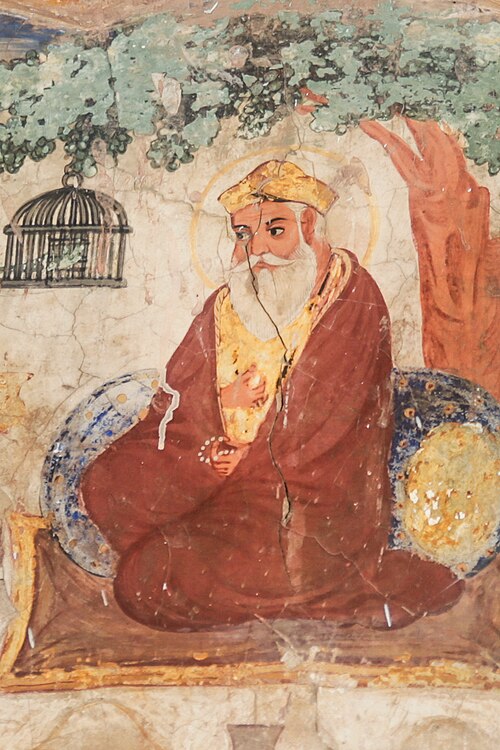
Start at the top for an easy introduction. Go further down for more detail and scholarship.
- Easy
- Intermediate
- Advanced
For young readers
More than 550 years ago, a boy named Nanak was born in a village in the Punjab, a land of five rivers in what is now Pakistan and India. Stories told by Sikhs say he was a thoughtful child who asked big questions about God and did not like rituals that seemed empty to him.
When he grew up, Nanak worked as a storekeeper. Sikhs tell that one morning he went to bathe in a river and disappeared for three days. When he came back, his first words were: “There is no Hindu, there is no Muslim.” He meant that God does not divide people into groups, and that everyone is equal.
Nanak then travelled far and wide, often with his friend Mardana, a Muslim musician who played a stringed instrument called the rabab. Nanak sang songs he had composed about God, and people from many backgrounds came to listen. Many stories about these journeys have been told and retold for centuries.
Later he settled in a village by a river, called Kartarpur, and lived there with his family and followers. Everyone worked, prayed and sang together, and they all ate side by side in a shared kitchen, no matter who they were. This free community kitchen, called langar, is still part of every Sikh gurdwara today.
Before he died, Nanak chose a faithful follower to be the next Guru. His songs were written down and later became part of the Sikh holy book, the Guru Granth Sahib. Today about 25 to 30 million Sikhs around the world celebrate his birthday every year.
At a glance
- Lived
- 15 April 1469 (traditional; a November date is also celebrated) – 22 September 1539
- Born
- Rai Bhoi di Talwandi, now Nankana Sahib, Punjab, Pakistan (then under the Delhi Sultanate)
- Died
- Kartarpur on the Ravi River, now in Narowal District, Punjab, Pakistan
- Known as
- First of the ten Sikh Gurus; regarded by Sikhs as the founder of Sikhism
- Works
- 974 hymns in the Guru Granth Sahib, including the Japji, Asa di Var and Sidh Gosht
- Languages
- Early Punjabi and the composite devotional language often called Sant Bhasha, with Persian and Sanskrit vocabulary
- Core teachings
- One God (Ik Onkar); remembrance of the divine Name; honest work; sharing; equality regardless of caste, religion or gender
- Successor
- Bhai Lehna, renamed Guru Angad (appointed 1539)
Easy
Who was Guru Nanak?
Guru Nanak was a spiritual teacher, mystic and poet who lived in the Punjab, the land of five rivers in the north-west of the Indian subcontinent, in the late fifteenth and early sixteenth centuries. Sikhs revere him as the first of the ten Sikh Gurus and as the founder of their religion. He is also widely known as Baba Nanak, “Father Nanak”, and honoured by many Hindus and Muslims in the region.
In Sikh belief, the word Guru means an enlightener and guide, and the divine light that shone in Nanak passed to each of the nine Gurus who followed him, and finally to the scripture, the Guru Granth Sahib. For Sikhs, therefore, Nanak is not only a historical figure but the source of an ongoing spiritual presence. Historians, for their part, study him as a figure of great importance in the religious history of South Asia.
Nanak’s teaching centred on one God, whom he described as the eternal Truth present in all creation, and on the equality of all human beings before God. He criticized empty ritual, the caste system and religious hypocrisy, and he taught a life that joined devotion with ordinary work and family responsibilities.
His words survive as 974 hymns in the Guru Granth Sahib. The most famous is the Japji, recited by devout Sikhs every morning. His birthday, Guru Nanak Gurpurab, is celebrated each year by Sikh communities around the world.
Easy
His life as the Sikh tradition tells it
Nanak was born in 1469 in the village of Rai Bhoi di Talwandi, now the town of Nankana Sahib in Pakistan. His parents, Kalu (Kalyan Chand) and Tripta, were Hindus of the Khatri caste; his father was a village accountant working for a local Muslim landlord, Rai Bular. His elder sister Nanaki is remembered as the first to recognize his spiritual gifts. Tradition says he learned arithmetic, accounts and scripts, and later Persian, and that he refused, as a boy, to be invested with the sacred thread worn by high-caste Hindus.
As a young man Nanak married Sulakhani, and they had two sons, Sri Chand and Lakhmi Das. He moved to Sultanpur Lodhi, where his sister’s husband helped him find work as a storekeeper for the local governor, Daulat Khan Lodi. There he met again his childhood friend Mardana, a Muslim musician, and spent his mornings and evenings singing devotional songs.
According to the tradition, one morning Nanak went to bathe in the Bein river and vanished. After three days he returned and said, “There is no Hindu, there is no Muslim.” Sikhs understand this as the moment of his calling, when he was taken into the divine presence and charged to teach the Name of God. The janamsakhis, the traditional life stories, connect it with the opening words of the Japji.
Soon afterwards Nanak left his employment to begin a life of travel and teaching. Accounts of Sikh tradition place this experience in Nanak’s early thirties, around 1500, while the scholar Kapur Singh dated it to about 1496, when Nanak was 27.
Easy
Journeys and stories
The janamsakhis describe long journeys called udasis. In the best-known version there are four great tours: east to Varanasi, Bengal, Assam and Puri; south to Tamil Nadu and Sri Lanka; north into the Himalaya; and west to Mecca, Medina and Baghdad. On many of these journeys Mardana accompanied him, playing the rabab while Nanak sang.
The stories use vivid scenes to teach lessons. At Haridwar, when pilgrims threw water toward the rising sun for their ancestors, Nanak threw water toward the west, saying he was watering his fields in the Punjab; if their water could reach the dead, his could surely reach his crops. At Mecca, when a man objected that he was sleeping with his feet toward the Kaaba and turned his feet away, the Kaaba seemed to move with them, showing that God is everywhere. In another story he chose to eat the plain bread of Lalo, a poor carpenter, rather than the rich food of Malik Bhago, who had grown wealthy by exploiting others.
Nanak visited Hindu temples, mosques, Sufi shrines and the centres of yogis, and held discussions with holy men of many kinds. One of his compositions, the Sidh Gosht, is framed as a dialogue with the Siddhas, yogis who sought liberation through withdrawal from the world, and argues for living spiritually within society.
Historians agree that Nanak travelled, but they debate how far, and many details of the journeys appear only in later versions of the stories. For Sikhs, the lessons of the stories matter more than exact routes, and many places associated with his visits are marked by gurdwaras.
Intermediate
Kartarpur: the first Sikh community
In the last part of his life, probably from around 1520, Nanak settled at Kartarpur (“the town of the Creator”) on the right bank of the Ravi River, on land given by a follower. Some sources date the foundation earlier, to 1504. There he lived as a householder with his family, and followers came to live around him. They were known as the Nanak Panth, the “path of Nanak”, and outsiders sometimes called them Kartaris, the people of Kartarpur.
Life at Kartarpur followed a daily rhythm. The community rose before dawn, bathed, sang hymns together in kirtan and recited compositions such as the Japji, then went to work in the fields and at other tasks, and gathered again in the evening. Nanak himself worked on the land. The ideal was an active life in the world, not the renunciation practised by ascetics.
Two institutions associated with Kartarpur became central to Sikh life: langar, the community kitchen where everyone eats the same food, and pangat, sitting together in rows regardless of caste or status. Langar had parallels in Sufi and Nath practice, but in the Sikh community it became a deliberate, daily expression of equality, supported by communal donations and voluntary service (seva).
Nanak’s compositions were collected at Kartarpur in a book (pothi), which he handed to his successor. Kartarpur is now in Pakistan, a few kilometres from the Indian border. The Gurdwara Darbar Sahib Kartarpur marks the place where he is believed to have died, and in November 2019 a visa-free corridor was opened so that pilgrims from India could visit it.
Intermediate
Teachings: one God, the divine Name and a life of equality
The Guru Granth Sahib opens with the Mul Mantar (“root formula”), whose essential elements are found in Nanak’s compositions: “One Creator; Truth is the Name; the Maker, without fear, without enmity; timeless in form, unborn, self-existent; known by the Guru’s grace.” The first expression, Ik Onkar, written with the numeral one, has been translated as “There is one God” or “One Reality is”; scholars discuss whether it should be understood as monotheism, monism or a mystical awareness of the One expressed through the many.
For Nanak, the human problem is haumai, self-centredness, which keeps people trapped in the cycle of birth and death. The remedy is nam simran, loving remembrance and repetition of the divine Name, through which a person becomes gurmukh, oriented toward the Guru and God, rather than manmukh, following one’s own impulses. Liberation (mukti) comes through divine grace and personal conduct, not through birth, ritual or priestly mediation.
Popular tradition summarizes Nanak’s way in three principles: naam japo (remember God’s Name), kirat karo (earn an honest living) and vand chhako (share what you have with others). He rejected the division of society into castes (varna), taught that women were not impure or inferior, and criticized rulers for greed and cruelty.
Nanak did not seek to merge Hinduism and Islam, nor simply to reform them; in Sikh understanding he revealed a distinct path. He addressed people of all backgrounds in their own terms. One of his verses describes what it truly means to be a Muslim: to take faith to heart, to rid oneself of pride, to accept the will of God and to be merciful to all living beings. Similar verses challenge Hindu ritual. The emphasis is on inner truth over outward identity.
Intermediate
The poet: hymns, ragas and language
Nanak called himself a poet, and his hymns (shabad) are among the earliest major works in the Punjabi literary tradition. He wrote in a mixture of early Punjabi and the widely understood devotional language of northern India often called Sant Bhasha, drawing on Persian, Arabic and Sanskrit vocabulary as the subject required. This choice of vernacular speech made his teaching accessible to ordinary people rather than only to those educated in classical languages.
His compositions use forms such as the salok (couplet), the pad (lyric hymn) and the var (ballad in stanzas). In the Guru Granth Sahib the hymns are arranged by raga, the melodic modes of Indian music, because they were meant to be sung. Music, kirtan, remains the heart of Sikh worship.
The Japji, which stands at the beginning of the Guru Granth Sahib, consists of the Mul Mantar followed by 38 stanzas (pauri) and a final salok. It reflects on the nature of God, the vastness of creation, the limits of human knowledge and the stages of spiritual ascent. The Asa di Var is sung in the early morning in gurdwaras, and the Sidh Gosht takes the form of a dialogue with yogis.
A group of four hymns known as the Babur Vani responds to the invasions of Babur, the founder of the Mughal dynasty, in the 1520s. Nanak describes the suffering of the people, especially women, at Saidpur and elsewhere, and questions why God allowed such cruelty. These hymns are among the rare contemporary Indian voices on those events.
Intermediate
Nanak’s world: sultans, saints and a changing Punjab
Nanak lived under the Lodi sultans of Delhi, whose governors ruled the Punjab, and saw the beginning of the Mughal empire when Babur defeated Ibrahim Lodi at Panipat in 1526. Punjab was a crossroads of peoples, languages and religions, with Hindu communities of many kinds, Sunni and Shia Muslims, Sufi orders, Nath yogis, Jains and others.
Religiously, Nanak’s era was shaped by the Sant tradition of northern India, poet-saints who worshipped a formless God (nirgun) beyond images and caste. The most famous was Kabir, some of whose verses, together with those of other Hindu and Muslim devotees such as Ravidas, Namdev and Sheikh Farid, were later included in the Sikh scripture. Sufi poetry in Punjabi also formed part of the atmosphere in which Nanak worked.
Older scholarship often described Nanak’s movement as a blend of Hinduism and Islam. More recent scholarship has moved away from this idea, placing him instead within the Sant and bhakti movements of medieval India, with some Islamic influence, while Sikh scholars emphasize the originality of his revelation. The label “syncretic” has been criticized as vague and selectively applied.
Nanak’s followers came at first from his relatives and friends and from traders of his own Khatri background, and increasingly from the Jat peasantry of central Punjab. This social base would shape the later development of the Sikh community.
Intermediate
Succession and the making of a tradition
Nanak did not appoint either of his sons as his successor. His elder son, Sri Chand, followed an ascetic life, which Nanak had criticized; he later founded the Udasi order of ascetics, which remained influential in Sikh history. Instead, Nanak chose a devoted follower, Bhai Lehna, and renamed him Angad, “part of one’s own body”. In a ceremony Nanak placed a coconut and five coins before him and bowed to him.
Sikhs understand this succession as the same light passing into another body. The hymns of the court bards Balvand and Satta, preserved in the Guru Granth Sahib, express this idea: the light and the way were the same, only the body had changed. The choice of a successor on the basis of devotion rather than birth ensured that the community continued as a distinct movement after Nanak’s death on 22 September 1539.
Guru Angad moved the community’s centre to Khadur. He is credited in Sikh tradition with standardizing the Gurmukhi script, in which the scriptures are written, and with continuing the collection of hymns. Successive Gurus expanded the scriptural corpus, and in 1604 the fifth Guru, Arjan, completed the Adi Granth and installed it at Harmandir Sahib, the Golden Temple, in Amritsar.
In 1708 the tenth Guru, Gobind Singh, declared that after him the scripture itself would be the Guru. Since then the Guru Granth Sahib, which opens with Nanak’s Japji, has been treated by Sikhs as the living Guru.
Intermediate
Legacy and places of memory
Today Sikhism has some 25–30 million followers. More than nine in ten live in India, especially in Punjab, and there are large communities in the United Kingdom, Canada, the United States and elsewhere. Every gurdwara (Sikh place of worship) keeps Nanak’s teaching alive through the scripture, kirtan and langar, where anyone may eat regardless of religion or status.
Guru Nanak Gurpurab, his birth anniversary, is one of the most important Sikh festivals, with processions, continuous readings of the scripture and community meals. It is celebrated on the full moon of the month of Kattak (October–November), although most early sources place his birth in the month of Vaisakh (April).
The places of his life, Nankana Sahib, where he was born, and Kartarpur, where he died, lie in Pakistan since the partition of 1947, which divided the Punjab and forced most Sikhs to leave the western part. Pilgrimages to these shrines across the border have deep emotional significance, and the opening of the Kartarpur Corridor in 2019, on the eve of the 550th anniversary of his birth, was widely welcomed.
Beyond the Sikh community, Nanak is honoured as a poet of the Punjabi language, a teacher of interreligious respect and social equality, and a figure shared by the people of both Pakistani and Indian Punjab. According to his traditional life story, when he died his Hindu and Muslim followers disputed whether to cremate or bury him, a story that expresses how both communities claimed him.
Advanced
Sources and the historical Nanak
Almost everything known about Nanak’s life comes from sources written after his death. The most important are the janamsakhis (“birth stories”), prose narratives that circulated first orally and were written down from the later sixteenth century onward. Four main traditions survive: the Bala, Miharban, Adi and Puratan. A prose text called Sakhi Mahal Pehle Ki, published in 2014 and dated to around 1570–74, is now considered by some scholars the oldest and a source for the others. Other sources are the ballads (vars) of Bhai Gurdas, written a few decades after Nanak’s death, and Nanak’s own compositions.
The janamsakhis were not written as critical biography. They combine memories, teachings and legends, and they explain hymns through stories. Scholars have noted parallels with the miracle stories of Sufi saints and with Hindu and Buddhist narrative traditions. Many episodes, such as the journey to Baghdad, appear only in later versions; the stone inscription in Baghdad sometimes cited as evidence of his visit is considered by many Western scholars to be of nineteenth-century date.
In Guru Nanak and the Sikh Religion (1968), W. H. McLeod classified 124 janamsakhi episodes as established, probable, possible, improbable or impossible, and concluded that only a small core of biographical facts could be confirmed. His method was highly controversial: many Sikhs and some Sikh scholars objected that it applied approaches derived from the historical criticism of the Christian Gospels and stripped the Guru’s life of its meaning. Later scholars have tried to read the janamsakhis on their own terms, as didactic texts that reveal how early Sikhs understood their Guru.
Even basic dates are debated. Most early janamsakhis give a birth in the month of Vaisakh (April) 1469, while the Bala tradition and some later texts give Kattak (autumn); the community celebrated his birthday in April at Nankana Sahib as late as 1815, and the Kattak celebration is recorded from the nineteenth century. Various explanations have been offered, and the question remains a matter of discussion within the community and among historians.
Advanced
Interpreting Nanak: founder, reformer or revealer?
How to describe Nanak’s role is itself a question of perspective. In Sikh understanding, his teaching was divinely revealed, as his own hymns state, and the Gurus who followed were one light in ten bodies. Within Sikh tradition there are further nuances: some emphasize that the Guru is an illumined soul rather than a prophet or an incarnation, while others, citing Bhai Gurdas and verses of the scripture, speak of the Guru and God as one.
Historians of religion ask different questions: how Nanak’s ideas related to those of the Sants and Sufis, what was new in them, and when a distinct Sikh community with its own identity emerged. Some date the start of Sikhism to the Kartarpur community of around 1520; others emphasize that clear boundaries between Sikh, Hindu and Muslim identities developed gradually over the following centuries, especially with the Khalsa of 1699 and the reform movements of the colonial period.
Recent scholars such as Arvind-Pal Singh Mandair have argued that framing Nanak’s thought as “monotheism” in the Abrahamic sense can distort it. They emphasize his concern with transforming the human mind and ending the dualities of self and other, and his claim that anyone can attain direct experience of the divine in the course of ordinary life. Others focus on the social dimensions of his teaching, its critique of caste and of political oppression.
These interpretations need not exclude one another, but they come from different starting points: faith, theology and historical analysis. A respectful account distinguishes what the community believes about Nanak from what historians can reconstruct from sources, without treating either as a replacement for the other.
Key ideas
- Ik Onkar
- “One Creator” or “One Reality”, the opening words of the Mul Mantar and the central affirmation of Nanak’s teaching.
- Nam simran
- Loving remembrance of the divine Name, the heart of spiritual practice in Nanak’s teaching.
- Haumai
- Self-centredness or ego, which separates people from God and must be overcome.
- Kirat karo, vand chhako
- Earn an honest living and share with others: spirituality lived within ordinary work and family life.
- Equality
- Rejection of caste hierarchy and of the idea that women are inferior; embodied in langar and pangat.
- Guruship
- The divine light that passed from Nanak through nine successors to the scripture, the Guru Granth Sahib.
- Historical and legendary Nanak
- Scholars distinguish what sources can confirm from the teachings expressed through the janamsakhi stories.
Records
- 1469 — Nanak is born at Rai Bhoi di Talwandi (Nankana Sahib), traditionally on 15 April.
- 1487 — Nanak marries Sulakhani at Batala, according to tradition.
- c. 1499 — Experience at the Bein river at Sultanpur Lodhi; Nanak begins his public teaching (dates from about 1496 to about 1502 are given).
- c. 1500 — Beginning of the period of long journeys (udasis), lasting until around 1520.
- c. 1520 — Nanak settles at Kartarpur on the Ravi and forms a community of followers (some sources give 1504).
- 1526 — Babur defeats the Lodi sultan at Panipat; Nanak’s Babur Vani hymns respond to the invasions of this period.
- 1539 — Nanak appoints Bhai Lehna as Guru Angad and dies at Kartarpur on 22 September.
- c. 1570 — Probable date of the Sakhi Mahal Pehle Ki, possibly the earliest janamsakhi text.
- 1604 — Guru Arjan completes the Adi Granth, which opens with Nanak’s Japji, and installs it at Amritsar.
- 1708 — Guru Gobind Singh declares the scripture the eternal Guru (Guru Granth Sahib).
- 1968 — W. H. McLeod publishes Guru Nanak and the Sikh Religion, opening a long debate on the sources.
- 2019 — The Kartarpur Corridor opens for pilgrims before the 550th anniversary of Nanak’s birth.
Glossary
- Guru
- In Sikhism, the enlightener and guide; the title of the ten human Gurus and of the scripture.
- Sikh
- A “learner” or disciple; a follower of the Gurus’ teaching.
- Guru Granth Sahib
- The Sikh scripture, compiled as the Adi Granth in 1604 and proclaimed the eternal Guru in 1708.
- Japji
- Nanak’s composition that opens the scripture, recited by Sikhs every morning.
- Mul Mantar
- The ‘root formula’ at the start of the Guru Granth Sahib, summarizing Sikh belief about God.
- Shabad
- A hymn of the Sikh scripture; also the divine Word.
- Janamsakhi
- Traditional life stories of Guru Nanak, combining memory, teaching and legend.
- Udasi
- Nanak’s missionary journeys; also the name of the ascetic order founded by his son Sri Chand.
- Langar
- The community kitchen of a gurdwara, where all eat together as equals.
- Gurdwara
- A Sikh place of worship, literally “door of the Guru”.
- Sant tradition
- Poet-saints of medieval northern India who worshipped a formless God, such as Kabir and Ravidas.
- Gurmukhi
- The script used for the Sikh scriptures and for Punjabi in India.
Questions and answers
What did Guru Nanak teach?
That there is one God present in all creation, that all people are equal, and that a good life means remembering God, working honestly and sharing with others.
Why did he say “There is no Hindu, there is no Muslim”?
Sikhs understand it to mean that before God people are not divided by religious labels; what matters is truthful living and devotion.
Who was Mardana?
A Muslim musician and Nanak’s childhood friend, who travelled with him and played the rabab while Nanak sang his hymns.
What is langar?
A free community kitchen where everyone sits together and eats the same food. It began in the early Sikh community and is found in every gurdwara today.
Are the stories of his journeys historically true?
Historians agree he travelled widely, but many details appear only in later versions of the stories, and scholars debate how far he went. Sikhs value the stories above all for their teachings.
Why is his birthday celebrated in November if he was born in April?
Most early sources give April, but the celebration came to be held on the full moon of Kattak (October–November) by the nineteenth century. Several explanations have been proposed, and the question is still discussed.
Is it right to call Nanak the ‘founder’ of Sikhism?
Sikhs revere him as the first Guru and founder of their faith. Historians also discuss how a distinct Sikh identity developed gradually under the later Gurus and afterwards.
Sources and further reading
- Guru Nanak. Wikipedia
- Sikhism. Wikipedia
- Janamsakhis. Wikipedia
- Guru Granth Sahib. Wikipedia
- Mul Mantar. Wikipedia
- Japji Sahib. Wikipedia
- Guru Angad. Wikipedia
- Kartarpur, Pakistan. Wikipedia
- W. H. McLeod, Guru Nanak and the Sikh Religion. Clarendon Press (Oxford), 1968
- J. S. Grewal, The Sikhs of the Punjab (The New Cambridge History of India II.3). Cambridge University Press, 1990
Related
- KabirNorth Indian poet-saint whose verses question religious boundaries and outward ritual.
- AkbarThird Mughal emperor (r. 1556–1605), who expanded the empire across northern India and held famous debates among representatives of many religions.
- RumiPersian-language poet and Sufi teacher whose verse explores love and spiritual transformation.
- Siddhartha Gautama (the Buddha)Founder of Buddhism, who taught a path to liberation from suffering on the Ganges plain. His dates are disputed.
- Adi ShankaraIndian philosopher associated with Advaita Vedanta, which teaches the ultimate unity of the self and brahman.
Written with AI assistance from the published sources listed above, and revised as new research appears.