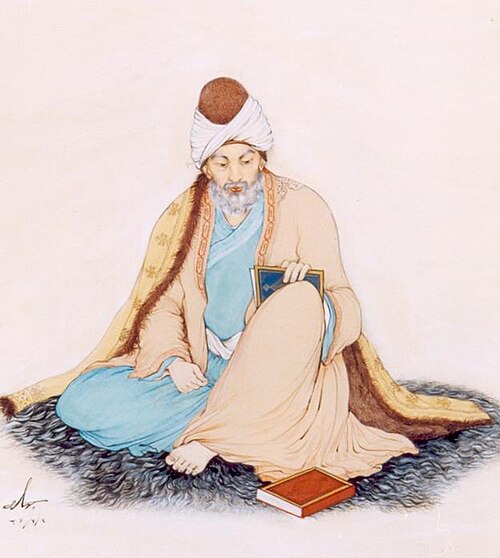
Start at the top for an easy introduction. Go further down for more detail and scholarship.
- Easy
- Intermediate
- Advanced
For young readers
About 800 years ago a boy named Jalal al-Din was born in Central Asia. His father was a famous preacher and teacher. When Jalal al-Din was still a child, his family set off on a very long journey west, travelling through great cities and deserts, and finally settled in the city of Konya in what is now Turkey.
Jalal al-Din grew up to be a respected teacher of Islamic law and religion, just like his father. People called him Mawlana, which means “our master”. Today most people know him as Rumi, which means “the man from Rum”, the old name for the land where he lived.
When he was about 37, Rumi met a wandering holy man named Shams of Tabriz. They talked for days and became inseparable friends. Shams changed Rumi’s life. Rumi began to write poems, to listen to music and to turn round and round in a dance of joy. When Shams disappeared, Rumi’s sadness and love poured out as thousands of poems.
Rumi’s poems say that every person is like a flute made from a reed that was cut from its reed bed. The flute sings a sad, beautiful song because it misses its home. In the same way, Rumi says, our hearts long to return to God, the source of all love.
After Rumi died, his followers formed a group called the Mevlevi. They are famous for the “whirling” ceremony, in which dancers in white robes spin slowly to music as a kind of prayer. Rumi’s tomb in Konya is visited by people from every part of the world.
At a glance
- Full name
- Jalal al-Din Muhammad, known as Mawlana (Mevlânâ), Rumi or, in Iran and Afghanistan, Balkhi
- Born
- 1207, in the region of Balkh; many scholars locate the family home in the small town of Wakhsh (in present-day Tajikistan)
- Died
- 17 December 1273, Konya, Seljuk Sultanate of Rum (present-day Turkey)
- Language
- Mostly Persian; also some Arabic, with occasional Turkish and Greek words and lines
- Major works
- Masnavi (Mathnawi, about 25,000 couplets in six books); Divan-e Shams-e Tabrizi (lyric poems); Fihi ma fihi (discourses); letters and sermons
- Religion
- Sunni Muslim scholar of the Hanafi school and Sufi (Islamic mystical) teacher
- Turning point
- Meeting with the wandering mystic Shams of Tabriz in Konya, late 1244
- Legacy
- The Mevlevi Sufi order and its sema (“whirling”) ceremony; one of the most widely read poets in the world
Easy
Who was Rumi?
Rumi was a Muslim scholar, preacher, Sufi teacher and poet who lived from 1207 to 1273. He spent most of his adult life in Konya, a city in central Anatolia that was then the capital of the Seljuk Sultanate of Rum. That is why he is called Rumi, “the one from Rum”, a name that recalls that Anatolia had long been part of the (East) Roman world. In Turkey he is known as Mevlânâ, “our master”, and in Iran and Afghanistan often as Mowlavi or Balkhi, after his birthplace region.
For most of his life Rumi was a respected religious scholar, trained in the Qur’an, Islamic law and theology. In his late thirties his friendship with a wandering mystic, Shams of Tabriz, transformed him into one of the greatest poets in the Persian language.
His two great poetic works are the Masnavi, a long spiritual poem full of stories, and a huge collection of lyric poems known as the Divan-e Shams-e Tabrizi, “the collected poems of Shams of Tabriz”, because Rumi often signed them with his friend’s name. His words have been treasured for centuries across the Persian, Turkish, Arab and South Asian worlds, and in the last century they have become popular in many other languages too.
Easy
A childhood on the move
Rumi was born in 1207 in the eastern Persian-speaking world, in the region of Balkh (in present-day northern Afghanistan). Research on his father’s writings suggests that the family actually lived in the small town of Wakhsh, north of the Amu Darya (Oxus) River in present-day Tajikistan, although Balkh is the traditional birthplace. His father, Baha al-Din Walad, was a preacher and scholar whose collection of spiritual reflections, the Ma‘arif, later influenced his son.
In the 1210s the family left Central Asia. Later biographers connect the departure with the Mongol threat, though disputes with local rulers and scholars may also have played a part. They went by way of Samarkand, Nishapur and Baghdad, made the pilgrimage to Mecca, and then lived for some years in Anatolia, notably in Larende (Karaman), where Rumi married and his son Sultan Walad was born. A famous legend says that in Nishapur the old poet Attar met the boy and predicted his greatness; historians regard this as a pious story.
Around 1228 the family settled in Konya, invited, according to tradition, by the Seljuk sultan Kayqubad I. When Baha al-Din died in 1231, the young Rumi took over his father’s teaching position. His father’s former pupil Burhan al-Din Muhaqqiq of Tirmidh guided him in mystical training, and Rumi also studied in Aleppo and Damascus, the great centres of learning in Syria.
Easy
The meeting with Shams of Tabriz
In late 1244 a wandering dervish named Shams al-Din of Tabriz arrived in Konya. He was in his sixties, sharp-tongued and uninterested in fame or ordinary religious learning. Accounts of their first meeting vary, but all agree that it overwhelmed Rumi. For months the two spent almost all their time together in conversation and spiritual companionship.
Rumi’s students and family were jealous and hostile, feeling that a stranger had stolen their teacher. In 1246 Shams left for Damascus. Rumi was heartbroken and sent his son Sultan Walad to bring him back, which he did. But tensions returned, and in 1247 or 1248 Shams vanished for good. A later story claims he was murdered with the involvement of Rumi’s son ‘Ala al-Din, but this is not confirmed by early sources, and many historians think Shams may simply have left.
Rumi searched for his friend, travelling to Damascus, but did not find him. In the end he came to feel that he had found Shams within himself. The grief, longing and joy of this friendship are the great themes of the lyric poems of the Divan. Shams’s own sayings were also recorded by disciples, in a collection known as the Maqalat (Discourses).
Intermediate
The works: Divan, Masnavi and prose
The Divan-e Shams-e Tabrizi (also called Divan-e Kabir, “the Great Divan”) contains roughly 35,000 couplets of ghazals, short rhyming lyric poems, and some 2,000 quatrains (ruba‘i). Many were composed spontaneously, sometimes, according to tradition, while Rumi listened to music or turned in dance. They speak of the beloved, wine, the tavern, the moon and the garden, using the images of Persian love poetry to express the soul’s love for God, often through the figure of Shams.
After Shams, Rumi found companionship first in Salah al-Din Zarkub, a humble goldsmith, and then in his disciple Husam al-Din Chalabi. It was Husam al-Din who, according to tradition, asked Rumi to compose a long didactic poem for his followers. The result was the Masnavi-ye Ma‘navi, “Rhyming Couplets of Deep Meaning”, dictated over many years from around the late 1250s until Rumi’s death, and written down by Husam al-Din. It fills six books and about 25,000 couplets; the sixth book breaks off unfinished.
The Masnavi weaves together hundreds of stories, from animal fables and folk tales to Qur’anic episodes and sayings of the Prophet, with commentary and digressions, so that one story often opens into another. It begins with the famous “Song of the Reed”: “Listen to the reed, how it tells a tale, complaining of separations.” In Persian-speaking lands the Masnavi has been called “the Qur’an in Persian”, a phrase attributed to the poet Jami, reflecting how deeply it was revered as a guide to the inner meaning of Islam.
Rumi’s prose works include Fihi ma fihi (“In it is what is in it”), a record of his informal talks to disciples and visitors; Majalis-e sab‘a (“Seven Sessions”), a collection of sermons; and a collection of letters, many of them written to help people with practical matters. These texts show Rumi as a teacher and community leader as well as a poet.
Intermediate
Core ideas: love, separation and transformation
Rumi belonged to the Sufi tradition, the mystical dimension of Islam, which seeks direct experience of God through love, devotion, discipline and the guidance of a spiritual master. His central theme is love (‘eshq): a burning, transforming force that draws the soul out of its selfishness toward God.
Separation and return are the heart of his vision. The reed flute cries because it was cut from its reed bed; the human soul longs because it has been separated from its divine origin. This longing is painful but also precious, because it is what moves the soul to return. Rumi often speaks of “dying before you die”, letting the ego fall away, so that the self can be reborn in God.
Rumi’s poetry is full of paradox and daring images, and it sometimes seems to go beyond outward forms of religion. But he was also a practising Muslim scholar, and the Masnavi is saturated with quotations from the Qur’an and hadith. Scholars emphasize that his universal appeal grows out of, rather than away from, his Islamic faith. He taught that outward practice and inward meaning belong together, and he used everyday stories to show how pride, greed and anger block the heart.
Music and movement were also part of his spiritual life. Rumi took part in sama‘, gatherings in which participants listened to music and poetry and sometimes turned in ecstatic dance. Some religious scholars of his time disapproved of this practice, and Rumi’s defence of it became part of his legacy.
Intermediate
Rumi’s world: Konya in the age of the Mongols
Rumi lived through one of the most turbulent centuries in West Asian history. The Mongol invasions devastated Central Asia and Iran from 1219 onward, sending waves of refugees, including scholars, mystics and artisans, westward into Anatolia. In 1243 the Mongols defeated the Seljuks at the Battle of Köse Dağ, and the Sultanate of Rum became a vassal of the Mongol Ilkhanate; in 1258 the Mongols sacked Baghdad.
Paradoxically, Konya flourished as a cultural centre in these years. Persian was the language of the Seljuk court and of high literature, Arabic the language of religious learning, and Turkish the language of many ordinary people; Greek and Armenian Christians and Jews also lived in the city. Rumi’s circle included merchants, craftsmen and officials, and his occasional verses in Greek and Turkish reflect this mixed society.
Konya was also home to other major Sufi figures, notably Sadr al-Din Qunawi, the leading disciple of the philosopher-mystic Ibn ‘Arabi. Rumi’s poetry of love and the more systematic metaphysics of Ibn ‘Arabi’s school were two streams of the same flourishing Sufi culture, though historians debate how far they influenced each other.
Intermediate
After Rumi: the Mevlevi order and the whirling ceremony
Rumi died in Konya on 17 December 1273. According to his biographers, members of every community of the city, Muslims, Christians and Jews, joined the funeral procession. His followers call the anniversary of his death Şeb-i Arus, the “wedding night”, because they understand death as the soul’s union with the Beloved. His tomb, under a green-tiled dome, is now the Mevlana Museum.
Husam al-Din Chalabi led Rumi’s followers after his death, and then Rumi’s son Sultan Walad (d. 1312) and grandson Ulu ‘Arif Chalabi organized them into a Sufi order, the Mevleviyya (Mevlevi order). Its lodges spread across Anatolia and later throughout the Ottoman Empire, and it became a major patron of poetry, music and calligraphy.
The order is best known for the sema ceremony, in which dervishes in tall felt hats and white robes turn slowly to music played on the ney (reed flute) and drums, one hand raised to receive grace and the other lowered to pass it to the earth. In 1925 the Republic of Turkey closed all Sufi lodges, and the ceremony survived for years in private and later as a public performance. UNESCO proclaimed the Mevlevi Sema Ceremony a Masterpiece of the Oral and Intangible Heritage of Humanity in 2005, and it was inscribed on the Representative List in 2008.
Intermediate
Rumi around the world
For centuries the Masnavi was studied, copied and commented on from the Balkans to Bengal. Commentaries were written in Persian, Ottoman Turkish, Urdu and Arabic, and poets such as Jami in Herat and Muhammad Iqbal in twentieth-century South Asia claimed Rumi as a master. In Persian-speaking lands, verses of the Masnavi became proverbs.
Modern Western interest began with nineteenth-century translations and grew with the scholarly work of Reynold A. Nicholson, who published a critical edition, translation and commentary of the Masnavi between 1925 and 1940, and his student A. J. Arberry. In the late twentieth century, free English versions by the American poet Coleman Barks made Rumi one of the best-selling poets in the United States.
These popular versions have been criticized by many scholars for loosening Rumi’s poetry from its Islamic and Persian context, sometimes presenting him as a spiritual teacher without religion. Others reply that they have introduced millions of readers to his vision. The debate raises important questions about translation, appropriation and how a religious poet can speak across cultures.
Rumi is also claimed by several nations. Turkey honours him as a figure of Anatolia, where he lived, taught and is buried; Iran and Afghanistan honour him as a Persian-language poet born in the eastern Persian world; Tajikistan honours his birthplace. In 2007, the 800th anniversary of his birth, UNESCO supported international commemorations. Many admirers stress that Rumi himself belongs to all of these traditions.
Advanced
How reliable are the biographies?
Almost everything we know about Rumi’s life comes from sources written by his family and followers. The earliest are the verse narrative of his son Sultan Walad, the Ebteda-nama (also known as the Walad-nama), and the Resala of Faridun Sepahsalar, who claimed to have been Rumi’s disciple for forty years. The most detailed is the Manaqeb al-‘arefin (“Feats of the Knowers of God”) by Shams al-Din Aflaki, written between about 1318 and 1353.
Aflaki’s work is a hagiography: a collection of edifying anecdotes and miracle stories meant to glorify Rumi and the Mevlevi lineage. It contains valuable information, but it also contains legends and anachronisms, and it was written two to three generations after Rumi’s death. Historians therefore test its stories against Rumi’s own writings, his father’s Ma‘arif, the Maqalat of Shams, Rumi’s letters and non-Mevlevi sources.
The most thorough modern critical biography in English is Franklin D. Lewis’s Rumi: Past and Present, East and West (Oneworld, 2000), which sifts legend from evidence and surveys Rumi’s reception up to the present. Earlier scholarship by Badi‘ al-Zaman Foruzanfar in Iran, Abdülbaki Gölpınarlı in Turkey and Annemarie Schimmel in Germany laid the foundations, and Fritz Meier’s study of Baha al-Din Walad clarified the family’s origins in Wakhsh.
Several points remain debated: the exact birthplace; the reasons for the family’s emigration and whether it came before or because of the Mongol advance; the exact date of Shams’s arrival and disappearance; and the fate of Shams. Careful readers of Rumi’s biography learn to distinguish between what the sources report, what they wish to teach, and what can be confirmed.
Advanced
Texts, manuscripts and interpretation
Rumi’s works survive in unusually early manuscripts. Copies of the Masnavi were made in Konya within a few years of his death, and a manuscript dated 677 AH (1278), kept in the Mevlana Museum, is regarded as a key witness to the text. Nicholson’s edition relied on early manuscripts, and later editions, such as those by Mohammad Este‘lami in Iran and Tawfiq Sobhani, have drawn on the oldest copies to establish a text closer to what Husam al-Din wrote down.
The Divan is more problematic. Over the centuries many poems by other authors were added to collections circulating under Rumi’s name. Foruzanfar’s critical edition of the Divan-e Kabir (published 1957–1967 in Tehran) used early manuscripts to separate authentic poems from later additions, and it remains the standard text. Some popular verses attributed to Rumi on the internet are not found in his works at all.
Interpretation is also debated. Classical commentators often read the Masnavi through the metaphysics of Ibn ‘Arabi’s school, for example the idea of the “unity of being”; some modern scholars argue that Rumi’s own thought is less systematic and more rooted in the ethical and devotional Sufism of his father and of earlier Persian poets such as Sana’i and Attar. Another debate concerns the role of Shams: whether he should be seen primarily as a teacher of doctrine, a catalyst of experience, or a literary figure in whom Rumi projected the divine beloved.
Finally, scholars examine the Masnavi as literature: its framing structure, its shifts of voice between narrator, characters and commentary, and its oral origin as dictated teaching. These features help explain why the work can be read both as a manual of spiritual training and as one of the great story collections of world literature.
Key ideas
- Love (‘eshq)
- The central force in Rumi’s thought: a transforming passion that draws the soul away from selfishness and toward God.
- Separation and return
- Like the reed cut from its bed, the soul longs to return to its divine origin; the longing itself is a gift.
- Spiritual companionship
- Rumi’s relationships with Shams, Salah al-Din and Husam al-Din show the Sufi belief that the divine is encountered through a friend and guide.
- Dying before death
- Letting the ego fall away so that the self can be reborn; a traditional Sufi idea that Rumi expresses in many images.
- Stories as teaching
- The Masnavi uses fables, folk tales and Qur’anic stories to teach inner meaning in a way ordinary listeners can grasp.
- Sama‘
- Listening to music and poetry, sometimes with turning dance, as a path to spiritual experience; the root of the Mevlevi ceremony.
- Islamic roots and universal reach
- Rumi’s universal appeal grows out of his Muslim faith and Persian culture, a point stressed by scholars against decontextualized readings.
Records
- 1207 — Jalal al-Din Muhammad is born in the region of Balkh, probably at Wakhsh.
- c. 1216 — His family leaves Central Asia and travels west via Samarkand, Nishapur, Baghdad and Mecca.
- c. 1228 — The family settles in Konya, capital of the Seljuk Sultanate of Rum.
- 1231 — His father Baha al-Din Walad dies; Rumi succeeds him as a teacher.
- 1243 — The Mongols defeat the Seljuks at Köse Dağ; Rum becomes a Mongol vassal.
- 1244 — Rumi meets Shams of Tabriz in Konya.
- c. 1247 — Shams disappears for good (1247 or 1248).
- c. 1258 — Rumi begins dictating the Masnavi to Husam al-Din Chalabi.
- 1273 — Rumi dies in Konya on 17 December.
- 1312 — Death of Sultan Walad, who organized Rumi’s followers into the Mevlevi order.
- 1925 — The Republic of Turkey closes Sufi lodges, including those of the Mevlevi.
- 2008 — The Mevlevi Sema Ceremony is inscribed on UNESCO’s Representative List (proclaimed 2005).
Glossary
- Sufism
- The mystical tradition within Islam, which seeks inner closeness to God through love, devotion and spiritual discipline.
- Dervish
- A member of a Sufi order, or a wandering Sufi ascetic like Shams.
- Masnavi (mathnawi)
- A long Persian poem in rhyming couplets; Rumi’s Masnavi is so famous that it is often simply called “the Masnavi”.
- Ghazal
- A short lyric poem with a single rhyme, usually about love; the main form of Rumi’s Divan.
- Ruba‘i
- A four-line poem, or quatrain.
- Divan
- A collected volume of a poet’s lyric poems.
- Ney
- The reed flute, the central instrument of Mevlevi music and a symbol of the longing soul.
- Sema (sama‘)
- A ceremony of listening to music and poetry; in the Mevlevi order, the ritual turning dance.
- Hagiography
- A biography of a holy person that aims to inspire and glorify, often including miracle stories.
- Sultanate of Rum
- The Seljuk Turkish state in Anatolia (c. 1077–1308), with Konya as its capital.
Questions and answers
Why is he called Rumi?
“Rumi” means “from Rum”, the old name for Anatolia (present-day Turkey), where he lived. People there called him Mevlânâ, “our master”.
What language did Rumi write in?
Mostly Persian. He also wrote some poems in Arabic and used a few Turkish and Greek words and lines.
What happened to Shams of Tabriz?
He disappeared from Konya in 1247 or 1248. A later legend says he was murdered, but early sources do not confirm this, and he may simply have left.
Do the whirling dervishes come from Rumi?
Yes. Rumi took part in music and dance gatherings, and after his death his son and grandson organized his followers into the Mevlevi order, whose turning ceremony is still performed today.
Are all the Rumi quotes online really by Rumi?
No. Many popular quotations are loose paraphrases, and some do not come from his works at all. Scholarly translations based on critical editions are the safest guide.
How reliable is Aflaki’s biography of Rumi?
It is valuable but hagiographical, written two to three generations later to glorify Rumi and the Mevlevi. Historians check it against Rumi’s own works, his father’s Ma‘arif and the Maqalat of Shams.
Was Rumi Turkish, Persian or Afghan?
Those modern national categories did not exist in his time. He was born in the eastern Persian-speaking world, wrote in Persian and lived in Seljuk Anatolia, so Afghanistan, Tajikistan, Iran and Turkey all honour him.
Sources and further reading
- Rumi. Wikipedia
- Shams Tabrizi. Wikipedia
- Mevlevi Order. Wikipedia
- Mevlevi Sema Ceremony. UNESCO Intangible Cultural Heritage
- Franklin D. Lewis, Rumi: Past and Present, East and West. The Life, Teachings and Poetry of Jalâl al-Din Rumi. Oneworld, 2000
Related
- HafezPersian lyric poet especially known for ghazals of love, longing and spiritual ambiguity.
- ShahnamehPersian epic by Ferdowsi recounting Iran's legendary kings and historical past.
- Genghis KhanFounder of the Mongol Empire, proclaimed supreme ruler in 1206.
- AvicennaPhysician and philosopher whose writings shaped medicine and philosophy across the Islamic world and Europe.
- KabirNorth Indian poet-saint whose verses question religious boundaries and outward ritual.
Written with AI assistance from the published sources listed above, and revised as new research appears.