Start at the top for an easy introduction. Go further down for more detail and scholarship.
- Easy
- Intermediate
- Advanced
For young readers
Long before computers or printing presses with movable letters were common, one way to make many copies of a book was to carve each page backwards into a flat block of wood, cover it with ink, and press paper onto it, like a giant stamp.
About 780 years ago, the people of the Korean kingdom of Goryeo carved every Buddhist holy book they could collect onto wooden blocks: more than 81,000 of them. If you stacked them up, the pile would be higher than a very tall mountain. Each block has writing on both sides, and the carving is so neat that it looks as if one person wrote it all.
They did this while an enemy army from Mongolia was attacking their country. The king and his court had fled to an island called Ganghwa. They hoped that making this great gift to the Buddha would protect their land, and it was also a way to show that Goryeo was a land of learning and faith.
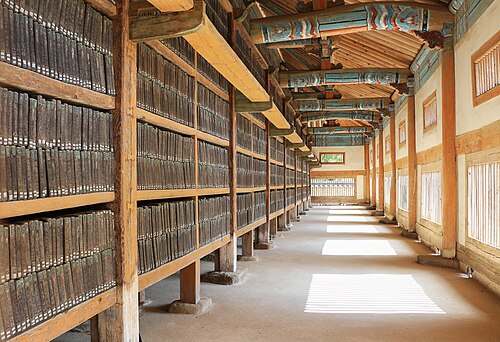
Today the blocks are kept at Haeinsa, a temple in the mountains of southern Korea, in two long wooden buildings that were built more than 500 years ago. The buildings have clever windows of different sizes that let the wind blow through and keep the blocks dry, so the wood has not rotted or bent.
The Tripitaka Koreana is so precious that its storage halls are a UNESCO World Heritage Site and the blocks themselves are part of UNESCO’s Memory of the World. Scholars all over the world still use the texts.
At a glance
- What
- The Buddhist canon (Tripiṭaka) in classical Chinese, carved on woodblocks for printing
- Carved
- Blocks dated 1237–1248 under King Gojong of Goryeo; preparations began in the mid-1230s and a completion ceremony was held in 1251
- Where made
- Directed by the Tripitaka Directorate (Daejang Dogam) on Ganghwa Island, with a branch office in Namhae; the exact carving sites are debated
- Size
- 81,258 blocks in the national designation (a 2014 survey counted 81,352 including later blocks); about 1,500 texts in over 6,500 fascicles
- Blocks
- About 24 cm high and 70 cm long, 2.6–4 cm thick; carved on both sides, usually 23 lines of 14 characters per side
- Kept at
- Janggyeong Panjeon (storage halls, built 1488) at Haeinsa Temple, Hapcheon, South Gyeongsang Province, since about 1398–1399
- Status
- National Treasure; storage halls on the UNESCO World Heritage List (1995); woodblocks on the Memory of the World Register (2007)
- Other names
- Palman Daejanggyeong (“Eighty-Thousand Tripitaka”), Goryeo Daejanggyeong, second Goryeo edition (Jaejo Daejanggyeong)
Easy
What is the Tripitaka Koreana?
A Tripiṭaka (“three baskets” in Sanskrit) is a complete collection of Buddhist scriptures: the discourses of the Buddha (sutras), the rules of monastic discipline (vinaya) and scholarly treatises (abhidharma), together with commentaries and other works. In East Asia this collection, translated into classical Chinese, is called the Great Storehouse of Scriptures, Daejanggyeong in Korean.
The Tripitaka Koreana is the Korean edition of this canon produced in the thirteenth century by the Goryeo dynasty (918–1392). Instead of copying the texts by hand, Goryeo carved them onto wooden blocks so that complete sets could be printed again and again. Over 81,000 blocks survive, the oldest complete Buddhist canon on woodblocks in the world that is still intact.
In Korea the collection is popularly called Palman Daejanggyeong, the “Eighty-Thousand Tripitaka”. The name refers both to the number of blocks and to the Buddhist idea that the Buddha taught 84,000 teachings to cure the 84,000 afflictions of the human mind.
The Tripitaka Koreana is admired for three things at once: its accuracy as a text, the beauty and consistency of its carving, and its extraordinary preservation for nearly eight centuries.
Easy
How woodblock printing works
To print from a woodblock, a scribe first writes the text neatly on thin paper. The paper is pasted face down onto a smooth wooden board, so the characters appear in reverse. A carver then cuts away the wood around each stroke, leaving the characters standing up in relief. To print, ink is brushed onto the block, a sheet of paper is laid on top and rubbed, and the text appears the right way round.
Each Tripitaka Koreana block is about 24 cm high and 70 cm wide and weighs roughly 3 kg. Both faces are carved, usually with 23 lines of 14 characters. Thicker strips of wood are fitted at the ends of each block, which act as handles, keep the carved surfaces from touching when blocks are stacked and help stop warping. The corners are fastened with metal fittings, and the blocks were coated with lacquer.
Scientific study of the wood in the 1990s found that most blocks were made from wild cherry (sanbeotnamu), with others of wood such as wild pear. Later tradition says the wood was soaked in seawater and dried for years before carving; this is plausible but not recorded in thirteenth-century sources.
Easy
How to “read” a single block
Imagine picking up one block. It is heavy and dark with old ink and lacquer, and it smells faintly of wood. The characters stand up from the surface in reverse, like the letters on a rubber stamp, so to read them you have to look at them as if in a mirror, or read a printed sheet made from the block.
Each face is laid out like one sheet of a scroll. The main text runs in vertical columns from right to left. At the edge of the sheet, a short line in smaller characters gives the title of the text, the fascicle number, the sheet number and a character from the Thousand Character Classic that tells which case the text belongs to. With this system, a monk could find any page among tens of thousands.
At the end of each fascicle, many blocks carry a colophon in a standard formula, such as “carved by royal command by the Tripitaka Directorate of the Kingdom of Goryeo in the year dingyu” (1237), with the cyclical year of carving. Blocks made in Namhae name the branch directorate instead. In the margins, and sometimes at the end of a column, small characters record the names of the individual carvers.
The handwriting style is remarkably uniform across the whole collection. It follows a clear, regular script influenced by the Chinese calligrapher Ouyang Xun, which later admirers compared to the work of a single hand. This uniformity, achieved by many scribes and carvers over many years, is itself evidence of careful planning and supervision.
Easy
Why was it made? Faith in a time of war
Goryeo had made a Tripitaka before. In the early eleventh century, when the Khitan Liao state invaded, King Hyeonjong began carving the first Goryeo edition (Chojo Daejanggyeong), finished around 1087. People believed that this great act of devotion had helped drive the invaders away.
In 1231 the Mongols invaded Goryeo. The next year the court, dominated by the military ruler Choe U, moved the capital from Gaegyeong (Kaesong) to Ganghwa Island, where the Mongol cavalry could not easily attack. In 1232 the first Tripitaka blocks, kept at Buinsa temple near present-day Daegu, were burned by the invaders.
The court decided to carve a new canon. A prayer composed in 1237 by the scholar-official Yi Gyubo, the Daejang gakpan gunsin gigomun (“Prayer of the King and Ministers on Carving the Tripitaka”), explains the purpose: to ask the Buddhas and bodhisattvas to repel the Mongols as they had once repelled the Khitan. Historians also see political motives: the project showed the legitimacy of the Choe regime and the court, and united the country behind a shared religious effort during decades of war.
Intermediate
How it was made: organization and editing
The project was managed by a special government office, the Tripitaka Directorate (Daejang Dogam), with a branch directorate (Bunsa Daejang Dogam) in Namhae on the southern coast. The dated colophons on the blocks run from 1237 to 1248, and according to the History of Goryeo (Goryeosa), King Gojong led officials to a ceremony at the Tripitaka block hall outside the west gate of the capital on Ganghwa in 1251, marking the completion.
Thousands of people must have taken part: loggers, sawyers, scribes, carvers, printers and officials. Many carvers’ names are cut into the margins of the blocks, and research on these names has helped reconstruct how work was divided. The labour, timber and funds came from the state, the Choe family and Buddhist communities, and ordinary people bore much of the burden, in a country already suffering from invasion.
What made the Tripitaka Koreana exceptional was its editing. The monk Sugi of Gaetaesa led a team that compared three earlier versions: the first Goryeo edition (through surviving printed copies), the official Northern Song edition printed in China (the Kaibao canon of 983) and the Khitan (Liao) canon. Where the versions disagreed, the editors chose the best reading and explained their decisions in a 30-fascicle work, the Goryeo-guk sinjo daejang gyojeong byeollok (Supplementary Record of Collation for the Newly Carved Great Canon of Goryeo). This critical method, unusual for its time, is a main reason the edition is valued so highly.
The texts are arranged and numbered according to the order of characters in the Thousand Character Classic, a standard way of cataloguing large collections in East Asia, so that each case could be found quickly.
Intermediate
What the canon contains
The canon contains about 1,500 separate titles. These include the Mahayana sutras that were central to East Asian Buddhism, such as the Prajñāpāramitā (Perfection of Wisdom) sutras, the Avataṃsaka (Flower Garland), the Lotus and the Nirvana sutras; texts of early Buddhism such as the Āgamas; monastic codes; philosophical treatises of Indian schools; and works by Chinese Buddhist scholars.
The largest single work is the Great Prajñāpāramitā Sutra translated by the Chinese pilgrim Xuanzang, in 600 fascicles, which stands at the beginning of the collection. Some texts in the Tripitaka Koreana are lost in their original Sanskrit and survive only in Chinese translation, which gives the collection great value for the study of Indian Buddhism.
Besides the national canon, Haeinsa also holds thousands of other woodblocks carved by the temple and by various sponsors from the eleventh to the twentieth century. UNESCO’s Memory of the World registration in 2007 covers both the Tripitaka Koreana and these “miscellaneous” scriptures, some of which survive nowhere else.
Intermediate
From Ganghwa to Haeinsa, and the storage halls
After the war, the blocks remained on Ganghwa, possibly at the temple Seonwonsa. According to the Veritable Records of the Joseon Dynasty, in 1398, the early years of the new Joseon dynasty, the blocks were moved from Ganghwa to Jicheonsa temple in Seoul, and they reached Haeinsa soon afterwards. The exact route and date of arrival at Haeinsa are still discussed.
At Haeinsa, a major temple in the Gaya Mountains, the blocks are kept in the Janggyeong Panjeon, a set of storage halls. Roof tiles bearing a date equivalent to 1488 show that the present buildings were rebuilt or repaired in the early Joseon period. The two main halls, the Sudarajang to the south and the Beopbojeon to the north, are long, plain buildings, each fifteen bays wide, with the blocks standing upright on shelves like books in a library.
The buildings are designed for natural ventilation. Windows on the front and back walls are of different sizes and placed at different heights, so that air enters, circulates around the blocks and leaves, reducing humidity. The earthen floors are reported to contain charcoal, lime, salt and clay, which absorb moisture in wet weather and release it in dry weather. The site on a slope of the mountain, facing southwest, also takes advantage of local winds and sunlight.
In 1995 the Janggyeong Panjeon became one of Korea’s first UNESCO World Heritage Sites. UNESCO notes that the halls are an outstanding example of how traditional architecture solved a practical problem of conservation.
Intermediate
Later history: printing, requests and survival
Sets printed from the blocks were distributed within Korea and abroad. Throughout the late Goryeo and early Joseon periods, Japanese envoys repeatedly requested printed sets of the Korean canon, which were highly prized in Japan; the Joseon court, which favoured Confucianism, sent many sets. Japanese missions even asked for the blocks themselves, but the Joseon court refused.
The blocks survived Japanese invasions in the 1590s, several fires at Haeinsa (the storage halls were spared) and the Korean War. A widely told story holds that in 1951 a South Korean Air Force pilot, Kim Young-hwan, disobeyed an order to bomb the temple area, where North Korean guerrillas were hiding, in order to save the Tripitaka.
In the twentieth century, printed sets and later photographic and digital editions made the texts available to scholars worldwide. The Japanese Taishō Shinshū Daizōkyō (1924–1934), the most widely used modern edition of the Chinese Buddhist canon, took the Tripitaka Koreana as its base text. The Tripitaka Koreana Research Institute and other organizations have since produced digital versions.
Intermediate
Significance and legacy
The Tripitaka Koreana is a landmark of East Asian printing. Woodblock printing had developed in East Asia centuries earlier, and Goryeo would also produce the oldest surviving book printed with metal movable type, the Jikji (1377). The Tripitaka shows the highest standards of an older technology used on an enormous scale.
It is also a monument of Buddhist scholarship. Because of Sugi’s careful editing, the Goryeo canon became a standard reference for scholars in China, Japan and later in the West. Modern research on Chinese Buddhist texts still regularly compares readings against it.
In Korea it stands as a symbol of national endurance and faith, a record of how people under invasion devoted enormous resources to preserving knowledge. At the same time historians remind us of its costs: the labour and resources demanded from ordinary people during a devastating war, and the fact that the Mongol invasions continued despite the prayers.
Advanced
Scholarly debates: where and how it was carved
Where was it carved? The traditional view is that the blocks were carved on Ganghwa Island under the main Directorate, with Namhae only playing a supporting role. Research on colophons and on the branch directorate has led many scholars to argue that a large share of the carving took place in Namhae and elsewhere in the south, where timber was more easily available, and that the blocks were then shipped to Ganghwa. The balance between the two centres is still debated.
Who carved it? The carvers’ names in the margins include monks, commoners and people with official titles. Some scholars see the project as a state mobilization; others emphasize the participation of Buddhist communities and local elites who sponsored individual texts. The names are an unusual source for social history, but interpreting them requires caution because the same name may refer to different people.
What is the relationship to earlier editions? Surviving printed copies of the first Goryeo edition, many preserved in Japan (for example at Nanzen-ji in Kyoto) and some in Korea, allow scholars to compare the two editions directly. This comparison shows how Sugi’s team corrected and reorganized the text and helps reconstruct the lost Kaibao and Khitan canons.
When did the blocks reach Haeinsa? The 1398 entry in the Veritable Records is the key evidence for the move from Ganghwa, but interpretations differ over whether the blocks went directly to Haeinsa, whether some were already stored elsewhere, and whether all were moved at once.
Advanced
Conservation science and access
The survival of more than 81,000 wooden objects for almost 800 years is remarkable. Conservation scientists have studied the Janggyeong Panjeon’s microclimate, measuring temperature, humidity and airflow, and have generally confirmed that the passive ventilation system works well. The blocks show relatively little warping or insect damage.
Surveys in the 2010s, including a full inventory that counted 81,352 blocks, found cracks, damaged fittings and some areas of deterioration, and led to programmes of monitoring and careful repair. Because the halls work best when left as they are, conservators generally prefer minimal intervention.
Balancing access and protection is a continuing question. Direct access to the storage halls is restricted, and Haeinsa has experimented with limited guided visits. Printing from the original blocks, which puts stress on the wood, is now rare; high-resolution imaging and digital texts allow scholars to study the canon without touching it.
The Tripitaka Koreana thus illustrates a general lesson of heritage science: the building and the object form a single system, and preserving one means understanding the other.
Key ideas
- Tripiṭaka
- The complete Buddhist canon of sutras, monastic rules and treatises; in East Asia, the Chinese-language collection called the Great Storehouse of Scriptures.
- Faith as defence
- Goryeo carved the canon as an act of devotion to ask the Buddha’s protection against the Mongols, as the first edition had been made against the Khitan.
- Critical editing
- The monk Sugi compared Goryeo, Song and Khitan editions and recorded his corrections, making the text unusually accurate.
- Woodblock printing
- Carving whole pages in reverse on wood so that complete sets could be printed many times.
- Architecture for conservation
- The Janggyeong Panjeon’s windows, floor and site keep the blocks dry and ventilated without machines.
- State and society
- The project was led by the court and the Choe military regime but depended on the labour and sponsorship of many people.
- Living heritage
- The blocks remain in a working Buddhist temple and are still the base of modern editions of the Chinese Buddhist canon.
Records
- c. 1011 — During Khitan invasions, King Hyeonjong begins the first Goryeo edition of the Tripitaka (completed around 1087).
- 1231 — The Mongols invade Goryeo.
- 1232 — The court moves to Ganghwa Island; the first-edition blocks at Buinsa are burned.
- 1237 — Yi Gyubo writes the prayer for the carving; the earliest dated blocks are carved.
- 1243 — The branch Tripitaka Directorate in Namhae becomes active (dated blocks 1243–1247).
- 1248 — The latest dated blocks, including the catalogue, are completed.
- 1251 — King Gojong holds a completion ceremony at the block hall on Ganghwa.
- 1398 — The blocks are moved from Ganghwa toward Seoul and then to Haeinsa.
- 1488 — The Janggyeong Panjeon storage halls are rebuilt (date on roof tiles).
- 1962 — The woodblocks are designated a National Treasure of Korea.
- 1995 — The Janggyeong Panjeon is inscribed on the UNESCO World Heritage List.
- 2007 — The woodblocks are inscribed on UNESCO’s Memory of the World Register.
Glossary
- Tripiṭaka
- Sanskrit for “three baskets”: the Buddhist canon of sutras, vinaya and abhidharma.
- Sutra
- A discourse attributed to the Buddha or, in Mahayana, to Buddhas and bodhisattvas.
- Fascicle
- A volume or roll of a text; long sutras are divided into many fascicles.
- Colophon
- A note at the end of a text or block recording when, where or by whom it was made.
- Daejang Dogam
- The Tripitaka Directorate, the government office that managed the carving.
- Goryeo
- The Korean dynasty (918–1392) from which the English name “Korea” comes.
- Choe regime
- The military family that dominated the Goryeo court from 1196 to 1258.
- Janggyeong Panjeon
- The storage halls at Haeinsa built to keep the Tripitaka blocks.
- Kaibao canon
- The first printed Chinese Buddhist canon, produced under the Northern Song and completed in 983.
- Relief carving
- Cutting away the background so that the design, here the characters, stands out.
Questions and answers
Why is it called the “Eighty-Thousand Tripitaka”?
Because there are more than 80,000 blocks, and because Buddhists speak of 84,000 teachings for the 84,000 troubles of the mind.
How long did it take to carve?
The dated blocks run from 1237 to 1248, about twelve years, with preparations before and a completion ceremony in 1251.
Did the Tripitaka stop the Mongols?
No. The war went on, and Goryeo eventually made peace with the Mongols and became a subordinate ally. But the canon survived and became a great treasure.
Why hasn’t the wood rotted?
Careful preparation of the wood, lacquer coating and, above all, the naturally ventilated storage halls at Haeinsa, which keep humidity stable.
Can people print from the blocks today?
Printing from the originals is now very rare because it puts stress on the wood. Scholars use earlier prints, photographs and digital editions.
Why is the Goryeo edition considered so accurate?
The editor Sugi collated the first Goryeo, Northern Song and Khitan editions and recorded his reasons in a 30-fascicle collation record.
Where exactly were the blocks carved?
Under the Directorate on Ganghwa and its branch in Namhae. How much carving took place in each place, and elsewhere in the south, is still debated.
Is the Tripitaka Koreana the oldest printed book in Korea?
No. Earlier woodblock prints exist, such as the Dharani sutra found in the Seokgatap pagoda at Bulguksa, dated to the eighth century or earlier. The Tripitaka Koreana is special as the oldest complete Buddhist canon whose original blocks survive intact.
Sources and further reading
- Haeinsa Temple Janggyeong Panjeon, the Depositories for the Tripitaka Koreana Woodblocks. UNESCO World Heritage Centre
- Printing woodblocks of the Tripitaka Koreana and miscellaneous Buddhist scriptures. UNESCO Memory of the World
- 박상국 (Park Sang-guk), 합천 해인사 대장경판 (Tripitaka Koreana Woodblocks at Haeinsa). Encyclopedia of Korean Culture, Academy of Korean Studies
- 김동현 (Kim Dong-hyun), 합천 해인사 장경판전 (Janggyeong Panjeon at Haeinsa). Encyclopedia of Korean Culture, Academy of Korean Studies
- Tripitaka Koreana. Wikipedia
- Haeinsa. Wikipedia
- Janggyeong Panjeon. Wikipedia
- Mongol invasions of Korea. Wikipedia
Related
- SeokguramEighth-century Buddhist grotto near Gyeongju, known for its granite Buddha and surrounding sculptures.
- Samguk sagiHistory of Korea's Three Kingdoms compiled under Kim Busik and presented to the Goryeo court in 1145.
- Genghis KhanFounder of the Mongol Empire, proclaimed supreme ruler in 1206.
- Siddhartha Gautama (the Buddha)Founder of Buddhism, who taught a path to liberation from suffering on the Ganges plain. His dates are disputed.
- Gutenberg BibleLatin Bible printed in Mainz in the 1450s using movable metal type.
- HunminjeongeumThe Korean alphabet promulgated by King Sejong in 1446, and the title of the text explaining it.
Written with AI assistance from the published sources listed above, and revised as new research appears.