Start at the top for an easy introduction. Go further down for more detail and scholarship.
- Easy
- Intermediate
- Advanced
For young readers
Most buildings are made by piling things up: bricks, stones or wood. The churches of Lalibela were made the other way round. Workers started at the top of a hill of rock and chipped away everything that was not the church, digging deep trenches around it. What was left in the middle became a whole church – walls, roof, windows, pillars and all – made from one single piece of stone.
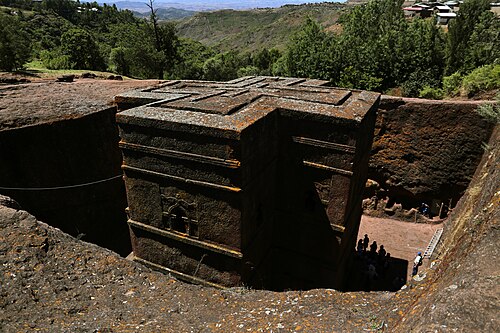
There are eleven of these churches in the mountain town of Lalibela in Ethiopia, in East Africa. The most famous, the Church of Saint George, is shaped like a cross. From the ground you look down on its flat roof, because the whole church stands at the bottom of a square pit, like a giant stone toy sitting in a hole.
Ethiopian Christians tell a story about a king named Lalibela. When he was a baby, bees swarmed around him, and his mother took it as a sign that he would be great. Later he is said to have had a vision telling him to build a new Jerusalem, the holy city, in his own land. So the town has a river called the Jordan and churches named after holy places.
An old story also says angels helped: the workers carved by day, and at night angels carried on the work. Historians think the churches were really made by many skilled people with hammers and chisels, perhaps over a long time.
Today the churches are not museums. Priests pray in them every day, and at Christmas and at the festival of Timkat thousands of pilgrims dressed in white come to sing, pray and celebrate.
At a glance
- What
- Eleven monolithic and semi-monolithic churches carved from the living rock, linked by trenches and tunnels
- Where
- Lalibela (traditionally Roha), Lasta, Amhara Region, northern Ethiopian highlands; about 2,500 m above sea level
- When
- Traditionally the reign of Gebre Meskel Lalibela (c. 1181–1221); scholars argue for several phases, possibly from the 7th–8th to the 14th century
- Builders
- Commissioned, according to tradition, by King Lalibela of the Zagwe dynasty (c. 1137–1270)
- Groups
- Northern group (5 churches), eastern/southern group (5), and the separate Church of Saint George (Bete Giyorgis)
- Religion
- Ethiopian Orthodox Tewahedo Church; an active pilgrimage site, especially at Genna (Christmas, 7 January) and Timkat (Epiphany, 19 January)
- Status
- UNESCO World Heritage Site since 1978
- Idea
- A symbolic “New Jerusalem,” with a stream called the Jordan and churches named after holy places
Easy
What are the rock-hewn churches of Lalibela?
Lalibela is a small town in the mountains of northern Ethiopia, in the Lasta district of the Amhara Region, about 2,500 metres above sea level. Around it are eleven medieval churches that were not built but carved: workers cut them downward out of the solid volcanic rock of the hillside. Four of them are completely free-standing blocks of rock; the other seven are still joined to the rock on one or more sides.
The town was traditionally called Roha. It takes its present name from King Gebre Meskel Lalibela, a ruler of the Zagwe dynasty who reigned around 1181–1221 and whom Ethiopian tradition credits with creating the churches. The Ethiopian Orthodox Tewahedo Church venerates him as a saint.
The churches are grouped around a small seasonal stream named the Jordan. Five lie to the north of it, five to the south and east, and the most famous, the cross-shaped Church of Saint George, stands on its own to the west. Trenches, passages and tunnels connect the churches in each group.
The site was one of the first to be placed on UNESCO’s World Heritage List, in 1978. Unlike many ancient monuments, it has never stopped being used for its original purpose: priests, monks and nuns live and worship there, and it is one of the holiest places of pilgrimage for Ethiopian Orthodox Christians.
Easy
How to “read” the site: churches in the ground
The strangest thing for a first-time visitor is that you often see the churches from above. Because they were carved downward, their roofs are at about the level of the surrounding ground, and you look down into deep trenches to see the walls. To enter, you walk down narrow passages cut into the rock.
The Church of Saint George (Bete Giyorgis) shows this most clearly. It is carved in the shape of a cross, so that from above the whole building reads as a Christian symbol cut into the ground. It stands alone at the bottom of a square pit, reached by a narrow, winding trench that becomes a tunnel near the church. It is usually thought to be one of the last and best preserved of the churches.
The other churches are all different. Bete Medhane Alem (“House of the Saviour of the World”) is a large rectangular church that houses a famous processional cross known as the Lalibela Cross. Bete Maryam (“House of Mary”), possibly the oldest, has colourful paintings of geometric patterns and biblical scenes. Bete Golgotha has rare carved human figures in relief and, according to tradition, contains the tomb of King Lalibela.
Look also at the details. Many windows and doors have frames with projecting corner blocks, and some walls imitate layers of wood and stone. These are stone copies of the timber-and-stone building style of the ancient Ethiopian kingdom of Aksum, which you can still see in some older built churches in Tigray and Eritrea.
Easy
A New Jerusalem
Ethiopian tradition tells that before he became king, Lalibela was taken – in a vision, or on a real journey – to Jerusalem, and was told to build a second Jerusalem in Ethiopia. Many names in the town follow this plan. The stream is called the Jordan, after the river where Jesus was baptised. There are churches named after Golgotha, where Jesus was crucified, and Bethlehem, where he was born, and other places in the landscape carry biblical names.
Some experts connect this idea with a real event. In 1187 the Muslim leader Saladin captured Jerusalem from the Crusaders. It has been suggested that Lalibela’s project was, in part, a response: if pilgrimage to Jerusalem had become harder or more dangerous, a holy city could be recreated at home. This remains an interpretation rather than a documented fact.
Ethiopian Christians had long-standing links with Jerusalem and with Egypt. Ethiopians are firmly attested living in Egypt in the 11th and 12th centuries, and an Ethiopian community in Jerusalem is documented from the later 13th century, probably with earlier roots. The king’s knowledge of the holy city was, historians think, enough to inspire the layout and names of his capital.
For believers, the symbolism is not only historical. Walking from church to church, going down into the rock and climbing out again, pilgrims move through a sacred landscape that recalls the life, death and resurrection of Christ.
Intermediate
How the churches were carved
Rock-hewn architecture is subtractive: space is created by removing material rather than adding it. At Lalibela the carvers first marked out the plan on the rock surface, then cut deep trenches around a block that would become the church. Working from the top down, they shaped the roof, then the upper walls, and hollowed out the interior through doors and windows – rooms, pillars, arches and vaults all carved from the same stone.
The rock is a soft volcanic stone, described in different studies as scoriaceous basalt or volcanic tuff. It is relatively easy to cut when freshly exposed but weathers over time, which is one of the main conservation problems today. The tools were simple: hammers and chisels. There was no room for mistakes – a wrongly cut pillar cannot be put back.
The churches are also clever pieces of engineering in another way. Water collects in wells beside many of them, fed by an artesian system that brings groundwater up through the rock of the ridge on which the town stands. Water was not just practical: pools and wells also served rituals such as baptism.
How long all this took is unknown. Portuguese visitors in the 1520s were told by the local priests that the churches had been made in 24 years. Later tradition, recorded in the king’s hagiography, says that angels worked alongside the human labourers at night. Modern scholars mostly think that the work took much longer and happened in several phases, sometimes reshaping older carved structures.
Intermediate
The Zagwe kings and their world
The churches belong to the period of the Zagwe dynasty, which ruled much of northern Ethiopia and Eritrea from about 1137 to 1270. The Zagwe were Agaw (Agew) people from Lasta, and their name probably comes from a Ge’ez phrase meaning “of the Agaw.” They came to power after the decline of the ancient kingdom of Aksum, whose rulers had adopted Christianity in the 4th century.
Much about the Zagwe is uncertain. Even the number of kings is disputed: different lists give five, eleven or even sixteen names. Later Ethiopian rulers of the Solomonic dynasty, who overthrew the Zagwe in 1270 and claimed descent from King Solomon and the Queen of Sheba, portrayed their predecessors as illegitimate, which has coloured the surviving record.
Lalibela is the best documented Zagwe king. His life is told in a hagiography, the Gadla Lalibela. According to it, he was born in Roha, and a swarm of bees gathered around him as a baby; his name was explained as meaning “the bees recognise his sovereignty.” He spent years in exile, reportedly in Jerusalem, before winning the throne from his brother. Land grants from his reign, dated 1204 and 1225 in the sources, and an account by an embassy from the Patriarch of Alexandria around 1210 also survive.
The Zagwe kings kept close ties with the Coptic Church in Egypt, which appointed the head of the Ethiopian church, the abuna. Historians have suggested that Coptic Egyptians who came to Ethiopia in Lalibela’s time may have contributed to some decorative work, but the architecture itself follows local Aksumite traditions.
Intermediate
A living holy place
The churches of Lalibela belong to the Ethiopian Orthodox Tewahedo Church, the largest of the Oriental Orthodox churches, whose roots go back to the conversion of the Aksumite court in the 4th century. Every church has a tabot, a consecrated tablet representing the Ark of the Covenant, kept in the inner sanctuary where only priests may enter. In the Church of Saint George, behind a curtain, is such a replica of the Ark.
Daily prayers and services continue in the churches, many of which are also homes for clergy and monks. Each church has its own clergy and its own treasures, such as processional crosses, and the churches are the setting for the chanted liturgy in Ge’ez, the ancient church language.
Two festivals draw especially large crowds. At Genna, Ethiopian Christmas on 7 January, great numbers of pilgrims come for multi-day services, processions and music. At Timkat, Epiphany on 19 January, which commemorates the baptism of Christ in the Jordan, the tabots are carried in procession, wrapped in rich cloth on the heads of priests, to a pool, where the water is blessed and sprinkled on the faithful.
Pilgrims come from across Ethiopia and beyond. At the Church of Saint George, pilgrims who died after reaching the site were placed in simple open tombs in the surrounding rock walls. For pilgrims, Lalibela is not an ancient monument but a place where the sacred is present.
Intermediate
Later history: visitors, wars and survival
Lalibela appears on the Venetian world map of Fra Mauro (1457–59) as “Lalabeda.” The first European to describe the churches in detail was the Portuguese priest Francisco Álvares, who visited in the 1520s with a Portuguese embassy. Amazed, he wrote that he was afraid no one would believe him, and swore by God that everything he had written was true.
In the 1530s the armies of Ahmad ibn Ibrahim al-Ghazi of the Adal Sultanate invaded the Ethiopian highlands. The chronicle of his campaigns claims he burned one of the Lalibela churches. The historian Richard Pankhurst was sceptical, noting that the royal chronicles do not mention this, and suggested that if the story is true it may refer to Bete Medhane Alem or to a similar church nearby. A Portuguese soldier in the 1540s reported that attempts to destroy the churches had failed.
In the 20th century Lalibela was touched by Ethiopia’s wars. In 1936, during the Italian invasion, Emperor Haile Selassie made a pilgrimage there before Italian forces took the town. During the Ethiopian Civil War in the 1980s, rebel attacks reduced tourism. In 2021, during the Tigray War, the town changed hands several times, and in 2023 it saw fighting between the federal army and Fano militias, raising international concern for the churches.
Despite these dangers, the churches have survived largely intact, partly because they are carved from the living rock and partly because local communities have cared for them continuously for centuries.
Intermediate
Conservation: shelters, rain and disagreement
Because the churches are carved from soft volcanic rock and stand open to the weather, rain and erosion are a constant threat to their surfaces, carved details and paintings. Protecting them without changing their character or disturbing worship is difficult.
In 2008, with funding from the European Union, four large shelters were put up over five of the churches as a temporary protection. They have stayed much longer than planned, and there are now fears that the heavy structures and their supports could themselves damage the churches if they fail. Ethiopia’s heritage authority has said they must be removed, but a long-term solution has not been agreed.
Other restoration projects, including one funded through the United States Embassy for Bete Gabriel-Rufael and Bete Golgotha, have also faced difficulties. Communication between the national heritage authority (ARCCH), local church committees and foreign partners has not always been good, and there have been disagreements about the scope of the work.
These problems raise a basic question found at many living religious sites: who decides how a sacred place is conserved? The clergy and pilgrims who use the churches every day, national experts and international organisations can have different priorities. Balancing worship, tourism and preservation remains a central challenge at Lalibela.
Advanced
When were the churches made? A dating debate
Tradition attributes all eleven churches to Gebre Meskel Lalibela, and older textbooks date them to around 1200. However, no inscription or contemporary text describes their construction, and the dating rests on tradition, style and archaeology. David Buxton established a widely used stylistic chronology, noting that two of the churches follow the older built tradition of Debre Damo and Yemrehanna Krestos very closely. Because carving so much rock seemed too great a task for one reign, he suggested the work continued into the 14th century.
David Phillipson, a Cambridge archaeologist, proposed a longer and more complex history. He argued that some structures now used as churches – Bete Merkorios, Bete Gabriel-Rufael and Bete Danagel – were first cut as fortifications or palace buildings in the late Aksumite period, perhaps between about 600 and 800, and were converted to churches later. On this view, Lalibela’s name became attached to the whole complex after his death.
Other evidence points in different directions. A local historian, Getachew Mekonnen, credits Lalibela’s queen, Meskel Kibra, with commissioning Bete Abba Libanos as a memorial to her husband. Recent excavations have found abundant pottery and animal bones dating to about 900–1100, suggesting that the site was a largely secular settlement before becoming a religious centre, which fits a transformation under Lalibela. The discovery of pre-Christian carved animal friezes at the nearby Washa Mikael cave suggests the region was still being Christianised at this time.
Most scholars now agree that the churches developed in several phases, with major work in the Zagwe period and later alterations, but the details – which church came first, and how much is due to Lalibela himself – remain open. Written evidence is limited: a manuscript acquired in 1882, once said to describe 500 foreign workers brought from Alexandria and Jerusalem, turned out on closer study to contain nothing of the kind.
Advanced
Local genius or foreign builders? Style, influence and interpretation
European visitors from the 16th century onward often doubted that Ethiopians could have made the churches. Álvares recorded that many local people said they were mainly the work of foreigners, and later writers such as Manuel de Almeida and Hiob Ludolf credited Egyptian architects. Such views often reflected European assumptions about Africa as much as evidence.
Modern scholarship has emphasised the local roots of the architecture. Stuart Munro-Hay pointed out that Bete Amanuel reproduces in stone the Aksumite technique of walls with projecting wooden beams, and that the framed windows and doors echo motifs seen on the great stelae of Aksum. Buxton concluded that, while some decorative details show Coptic influence, the rock churches follow the style of local built churches, which themselves go back to Aksumite models. Phillipson adds that Aksumite features alone do not prove an Aksumite date, since they could have been used long after Aksum’s fall, but they show strong cultural continuity.
Some features point to wider eastern Christian connections. The pitched roof and mouldings of Bete Maryam have been compared with Syrian church architecture, and Munro-Hay noted that many Coptic Egyptians moved to Ethiopia in Lalibela’s time and may have helped with decoration. The prevailing view is that foreign influence was largely limited to decorative techniques within an Ethiopian architectural tradition.
Lalibela is also part of a much larger Ethiopian tradition of rock-cut churches. More than 150 have been recorded in Tigray alone, most probably carved from the 14th and 15th centuries, and new rock churches are still being made today. Seeing Lalibela within this tradition, rather than as an isolated wonder, helps explain both its technical skill and its continuing religious life.
Key ideas
- Subtractive architecture
- Buildings made by removing rock rather than adding material; every wall, pillar and window at Lalibela was carved from the living rock.
- Monolithic church
- A church cut from a single block of stone; four of the Lalibela churches are fully free-standing monoliths.
- New Jerusalem
- The symbolic plan of Lalibela, with a Jordan stream and churches named after holy places, recreating the holy city in Ethiopia.
- Aksumite continuity
- The churches imitate in stone the timber-and-stone building style of ancient Aksum, showing deep local roots.
- Living heritage
- The site is still used daily for worship and pilgrimage, which shapes how it is conserved and visited.
- Multi-phase dating
- Most scholars think the churches were created and altered over several phases rather than all under one king.
- Tradition and history
- Stories of angels and visions are part of the site’s religious meaning; historians study them alongside archaeology and style.
Records
- c. 330 CE — The Aksumite court adopts Christianity; the Ethiopian church is linked to the Coptic Church of Alexandria.
- c. 700 CE — Period in which, according to David Phillipson, some structures later used as churches may first have been carved.
- c. 1137 — The Zagwe dynasty comes to power, according to tradition.
- c. 1181 — Gebre Meskel Lalibela becomes king (traditional date).
- 1187 — Saladin captures Jerusalem; some scholars link this to Lalibela’s idea of a New Jerusalem.
- c. 1221 — End of Lalibela’s reign (traditional date).
- 1270 — The Zagwe dynasty is overthrown by Yekuno Amlak, founder of the Solomonic dynasty.
- c. 1520 — The Portuguese priest Francisco Álvares visits and writes the first detailed European description.
- 1936 — Emperor Haile Selassie makes a pilgrimage to Lalibela during the Italian invasion.
- 1978 — The Rock-Hewn Churches, Lalibela, are inscribed on the UNESCO World Heritage List.
- 2008 — EU-funded temporary shelters are erected over five of the churches.
- 2021 — The town changes hands several times during the Tigray War.
Glossary
- Rock-hewn
- Cut out of natural rock rather than built from separate stones.
- Monolith
- Something made from one single block of stone.
- Zagwe dynasty
- An Agaw royal dynasty that ruled northern Ethiopia and Eritrea from about 1137 to 1270.
- Aksum
- An ancient kingdom in northern Ethiopia and Eritrea, powerful from about the 1st to the 7th century AD, which adopted Christianity in the 4th century.
- Tabot
- A consecrated tablet representing the Ark of the Covenant, kept in the sanctuary of every Ethiopian Orthodox church.
- Timkat
- The Ethiopian Orthodox celebration of Epiphany on 19 January, commemorating the baptism of Jesus.
- Genna
- Ethiopian Orthodox Christmas, celebrated on 7 January.
- Gadla
- A Ge’ez hagiography, the traditional life story of a saint, such as the Gadla Lalibela.
- Ge’ez
- The ancient Ethiopian language, still used in the liturgy of the Ethiopian Orthodox Church.
- Abuna
- The title of the head bishop of the Ethiopian church, historically appointed from the Coptic Church of Egypt.
Questions and answers
Were the churches really made from one piece of rock?
Yes. Four are completely separated from the surrounding rock, and the others are joined to it on some sides, but none was built from separate stones.
Did angels help build them?
That is a traditional belief found in the king’s life story and held by many believers. Historians explain the churches as the work of skilled human carvers over a long time. Both views are part of the site’s story.
Why is there a river called the Jordan in Ethiopia?
Because Lalibela was designed as a New Jerusalem. The stream was named after the river where Jesus was baptised, and other places were given biblical names.
Can visitors go inside?
Yes, visitors may enter the churches, which are still used for worship. The innermost sanctuary with the tabot is reserved for priests.
Did King Lalibela build all eleven churches?
Tradition says so, but many scholars think the churches were made and altered in several phases, some possibly before and some after his reign.
Why are there big roofs over some churches?
They are temporary shelters built in 2008 to keep rain off the soft rock. They have remained much longer than planned and are now a conservation concern.
How does Lalibela relate to Aksum?
The churches copy in stone the building style of Aksum, the earlier Christian kingdom in northern Ethiopia, showing strong continuity with local traditions.
Sources and further reading
- Rock-Hewn Churches, Lalibela. Wikipedia
- Lalibela. Wikipedia
- Gebre Meskel Lalibela. Wikipedia
- Zagwe dynasty. Wikipedia
- Church of Saint George, Lalibela. Wikipedia
- Monolithic church. Wikipedia
- Ethiopian Orthodox Tewahedo Church. Wikipedia
- Timkat. Wikipedia
- David W. Phillipson, Ancient Churches of Ethiopia: Fourth–Fourteenth Centuries. Yale University Press, 2009
Related
- Obelisk of AxumA carved stone funerary monument from the ancient kingdom of Aksum in present-day Ethiopia.
- Hagia SophiaA monumental church built for the Byzantine emperor Justinian I in Constantinople between 532 and 537 CE.
- PetraThe rock-carved capital of the Nabataeans, an Arab people who grew rich on the desert caravan trade in incense and spices. Its temples and tombs, such as the Treasury and the Monastery, were cut directly into sandstone cliffs.
- Great ZimbabweRemains of a major southern African city built and occupied by ancestors of the Shona people.
- Kilwa KisiwaniIsland capital of the Kilwa Sultanate, the richest Swahili city-state of the medieval East African coast, whose coral-stone mosque, palaces and forts survive as ruins.
- Ajanta CavesA group of Buddhist rock-cut caves in western India, known for monasteries, shrines and paintings.
Written with AI assistance from the published sources listed above, and revised as new research appears.