Start at the top for an easy introduction. Go further down for more detail and scholarship.
- Easy
- Intermediate
- Advanced
For young readers
About 900 years ago, in the city of Córdoba in Spain, a boy named Ibn Rushd was born into a family of judges. At that time much of Spain was ruled by Muslims and was called al-Andalus. It had beautiful mosques, gardens and libraries, and Muslims, Christians and Jews lived there.
Ibn Rushd grew up to be a judge like his father and grandfather. He was also a doctor who wrote a big book about medicine. But what he loved most was philosophy, which means “love of wisdom”: asking big questions like “What is the world made of?” and “How do we know what is true?”
One day a friend introduced him to the ruler of the land, the caliph. The caliph said that the books of the ancient Greek thinker Aristotle were very hard to understand. Could someone explain them? Ibn Rushd said yes, and he spent the rest of his life writing explanations of almost everything Aristotle wrote, a bit like a teacher who writes a helpful guide to a difficult textbook.
Some people thought philosophy was dangerous for religion. Ibn Rushd disagreed. He said that truth cannot fight against truth: if the holy book and careful reasoning are both true, they must agree. Near the end of his life a new ruler turned against him for a while, some of his books were burned, and he was sent away from his city. He was forgiven, but died soon afterwards in 1198.
His books travelled further than he ever did. They were translated into Hebrew and Latin, and for hundreds of years students in Paris, Oxford and Padua read Aristotle with Ibn Rushd's explanations beside them. They called him Averroes.
At a glance
- Full name
- Abu al-Walid Muhammad ibn Ahmad ibn Rushd; known in Latin as Averroes
- Life
- Born 14 April 1126 in Córdoba; died 10/11 December 1198 in Marrakesh
- Places
- Al-Andalus (Córdoba, Seville) and Morocco (Marrakesh), under the Almohad caliphate
- Roles
- Philosopher, Maliki jurist and judge (qadi), court physician
- Language
- Arabic; many works survive only in Hebrew or Latin translation
- Major works
- Commentaries on Aristotle; The Decisive Treatise; The Incoherence of the Incoherence; Bidayat al-Mujtahid (law); al-Kulliyat fi al-Tibb (medicine, Latin Colliget)
- Known as
- “The Commentator” in medieval Latin and Hebrew scholarship
- Influence
- Shaped Jewish philosophy and Latin scholasticism; gave his name to “Averroism”
Easy
Who was Ibn Rushd?
Ibn Rushd (1126–1198), known in Europe as Averroes, was one of the great thinkers of the medieval world. He was born in Córdoba, then one of the largest cities in Europe and the old capital of Muslim Spain (al-Andalus). He worked as a judge and a doctor, but he is remembered above all as a philosopher and as the most thorough medieval interpreter of Aristotle.
He wrote on an astonishing range of subjects: philosophy, logic, physics, astronomy, psychology, Islamic law, theology and medicine. The Stanford Encyclopedia of Philosophy counts about 49 surviving works, and older accounts attribute more than a hundred writings to him. Some of his most important works survive only in medieval Hebrew or Latin translations, because the Arabic originals have been lost.
His ideas had relatively little lasting influence in the Islamic world in the centuries after his death, but enormous influence in Jewish and Christian Europe, where he was known simply as “the Commentator”, just as Aristotle was “the Philosopher”. In modern times he has been rediscovered in the Arab world as a symbol of reason and openness.
Easy
His life: from Córdoba to Marrakesh
Ibn Rushd came from a distinguished family of jurists of the Maliki school of Islamic law. His grandfather, also named Abu al-Walid ibn Rushd, was chief judge of Córdoba and a famous legal scholar; to distinguish them, the philosopher is sometimes called Ibn Rushd “the grandson” (al-Hafid). He studied the Qur'an, hadith, law and theology, and also medicine and philosophy. He was influenced by the writings of the Andalusian philosopher Ibn Bajja (Avempace), who died when Ibn Rushd was a boy.
During his youth the Almoravid dynasty, which ruled al-Andalus and North Africa, was overthrown by the Almohads, a Berber reform movement from the Atlas Mountains. The Almohad caliphs ruled from Marrakesh and were keen patrons of learning. Around 1168–1169 the philosopher and court physician Ibn Tufayl introduced Ibn Rushd to Caliph Abu Yaqub Yusuf. According to a story that goes back to Ibn Rushd's own account, the caliph first asked him whether philosophers thought the heavens were eternal or created; Ibn Rushd, alarmed, tried to avoid the question, until the caliph put him at ease by discussing it himself. Afterwards the caliph asked for clear explanations of Aristotle's difficult works, and Ibn Tufayl passed the task to Ibn Rushd.
His career flourished. He was appointed judge (qadi) of Seville in 1169, later served in Córdoba, and in 1182 succeeded Ibn Tufayl as the caliph's physician; he also became chief judge of Córdoba, the office his grandfather had held. He travelled often between Spain and Marrakesh.
In 1195, under Caliph Abu Yusuf Yaqub al-Mansur, he suddenly fell from favour. His teachings were condemned at a gathering in Córdoba, some of his books were burned, and he was exiled to the nearby town of Lucena. Historians generally think the reasons were political: the caliph needed the support of conservative religious scholars during his war against the Christian kingdoms. Ibn Rushd was restored to favour about two years later and died in Marrakesh in December 1198. His body was later carried back to Córdoba for burial; the young mystic Ibn Arabi, who witnessed the procession, remarked that the coffin was balanced on one side of the mule by his books on the other.
Easy
Explaining Aristotle: the three kinds of commentary
Aristotle (384–322 BCE) was the Greek philosopher whose works on logic, nature, the soul, ethics and metaphysics were translated into Arabic in the eighth to tenth centuries. Muslim philosophers such as al-Farabi and Ibn Sina (Avicenna) built on him, but Ibn Rushd believed they had mixed Aristotle's ideas with other doctrines. He wanted to recover what Aristotle himself had really meant.
He wrote three kinds of commentary. The short commentaries or epitomes (jawami') summarise the main ideas of a work. The middle commentaries (talkhis) paraphrase the text section by section. The long commentaries (tafsir or sharh), written mainly late in his life, quote Aristotle's text passage by passage and then explain it line by line, discussing earlier Greek and Arabic interpreters. He wrote long commentaries on only a few central works, such as the Physics, On the Heavens, On the Soul, the Metaphysics and the Posterior Analytics.
Some works he could not find at all. Aristotle's Politics was not available to him, so he wrote a commentary on Plato's Republic instead, applying its ideas to the societies he knew. That commentary survives only in a Hebrew translation. Modern scholars note that the neat threefold division simplifies a more varied body of work, which also includes independent treatises on particular problems.
Intermediate
Faith and reason: The Decisive Treatise
Around 1178–1180 Ibn Rushd wrote the Decisive Treatise (Fasl al-maqal), a short legal opinion on the question: does Islamic law permit, forbid or require the study of philosophy? His answer, as a judge, is that for those capable of it, the law actually commands it, because the Qur'an repeatedly urges believers to reflect on creation, and the best way to reflect is through demonstrative reasoning.
His key principle is often summed up as “truth does not contradict truth”: demonstration and revelation are both true, so they must agree. If a demonstrated conclusion seems to conflict with the literal sense of scripture, the scriptural passage must be interpreted figuratively (ta'wil), following the rules of Arabic language. But such interpretation is for experts and should not be spread among the general public, where it could cause confusion.
He distinguished three kinds of people and three kinds of argument. Most people are persuaded by rhetoric; theologians use dialectical arguments; only philosophers can follow strict demonstration. Scripture speaks to all three at once. This theory allowed him to defend philosophy while also defending the religious law that governs the whole community. In a companion work, al-Kashf 'an manahij al-adilla, he criticised the theological methods of the Ash'arites and others as confusing ordinary believers.
Intermediate
Answering al-Ghazali: The Incoherence of the Incoherence
About eighty years before, the great theologian al-Ghazali (d. 1111) had written The Incoherence of the Philosophers, attacking twenty doctrines of Avicenna and other philosophers. He judged three of them to be unbelief: that the world is eternal, that God knows only universals and not particulars, and that there is no bodily resurrection.
Around 1180 Ibn Rushd replied with The Incoherence of the Incoherence (Tahafut al-tahafut). He quoted al-Ghazali's text section by section and answered it. Often he agreed that Avicenna's arguments were weak, but insisted that Aristotle's own position was stronger and that al-Ghazali had misunderstood it. He argued, for example, that the world's eternity, properly understood, is compatible with its dependence on God as the eternal cause, and that God's knowledge is neither universal nor particular in the human sense but the cause of all things.
On causation, al-Ghazali had argued that there is no necessary connection between fire and burning: God creates the burning directly each time. Ibn Rushd replied that denying real causes in things destroys the possibility of knowledge, since to know something is to know its causes.
Intermediate
The judge and the doctor
Ibn Rushd's legal masterpiece, Bidayat al-mujtahid wa-nihayat al-muqtasid (“The Beginning for One Who Exercises Independent Judgement and the End for One Who Is Content”), is a work of comparative law. Instead of simply stating the rules of his own Maliki school, it sets out the opinions of the different Sunni schools on each question and explains the reasons, textual or logical, behind their disagreements. It is still studied in Islamic law today.
In medicine he wrote al-Kulliyat fi al-tibb (“General Principles of Medicine”), known in Latin as the Colliget. It covers anatomy, health, disease, symptoms, drugs, diet and the preservation of health, organised according to general principles. He reportedly left the detailed treatment of particular diseases to his friend Abu Marwan ibn Zuhr (Avenzoar), whose practical medical work complemented his. The Colliget was translated into Latin and used in European medical teaching.
Ibn Rushd also wrote on astronomy and criticised the Ptolemaic system for relying on epicycles and eccentrics that did not fit Aristotle's physics. He hoped for a new astronomy consistent with natural philosophy, though he did not produce one himself.
Intermediate
The soul and the intellect
The most controversial idea in his philosophy concerns the human mind. In On the Soul, Aristotle had spoken, briefly and obscurely, of an intellect that becomes all things (the material or potential intellect) and an intellect that makes all things (the agent intellect). Earlier interpreters disagreed about whether these belong to each individual.
In his Long Commentary on On the Soul, which survives chiefly in Latin, Ibn Rushd argued that both the agent intellect and the material intellect are single, eternal and separate from bodies, shared by all human beings. Individuals think by connecting their own imagination, which is bodily and personal, with this one intellect. The theory explains how different people can grasp the same universal truths, but it seems to imply that no individual intellect survives death.
This “unity of the intellect” became the central target of Christian critics in thirteenth-century Paris, above all Thomas Aquinas, who argued that each human being has his or her own intellect as the form of the body.
Intermediate
Afterlife in Hebrew and Latin
Jewish thinkers took up his work first. Maimonides, also born in Córdoba, learned of his commentaries around 1190. From about 1230 onwards Hebrew translators rendered nearly all his commentaries, and by around 1340 almost all were available in Hebrew. For many Jewish philosophers he became the main authority on Aristotle; Gersonides wrote supercommentaries on his commentaries, and Elijah Del Medigo later continued the tradition in Italy.
In Latin Europe, Michael Scot and others began translating his commentaries in the 1220s, and they arrived just as the new universities of Paris and Oxford were making Aristotle the basis of their teaching. Scholars used his long commentaries as their guide to the text. Dante placed him among the virtuous non-Christians in Limbo, “Averroës, who made the great commentary” (Inferno IV).
Some Paris masters of arts, such as Siger of Brabant and Boethius of Dacia, followed Aristotle as read by Averroes even on points that conflicted with Christian doctrine, such as the eternity of the world and the unity of the intellect. In 1270 Aquinas wrote On the Unity of the Intellect against the Averroists, and in 1270 and again in 1277 Bishop Étienne Tempier of Paris condemned lists of propositions, 219 in 1277. Opponents accused the “Averroists” of holding a “double truth”, one for philosophy and another for faith, but neither Ibn Rushd nor, it seems, any Latin thinker actually held such a doctrine.
Averroist interpretations of Aristotle survived especially at the University of Padua into the sixteenth century. A great Latin edition of Aristotle's works with Averroes's commentaries was printed in Venice by the Giunta press in 1550–1552. In 1852 the French scholar Ernest Renan published Averroès et l'averroïsme, which defined Averroism as a historical category and presented Ibn Rushd as a hero of free thought.
Advanced
Scholarly debates
Biographical sources. Unlike Avicenna or al-Ghazali, Ibn Rushd left no autobiography, so his life must be pieced together from later writers. The main accounts come from thirteenth-century authors: the Moroccan historian 'Abd al-Wahid al-Marrakushi, who preserves the story of the first meeting with the caliph as told by one of Ibn Rushd's students; the Andalusian biographer Ibn al-Abbar; and the physician-historian Ibn Abi Usaybi'a, whose history of medicine lists his works. These sources are relatively close in time, but they also reflect later judgements of his disgrace, and details such as the exact dates of his appointments vary between them.
Rationalist or believer? Since Renan, some readers have portrayed Ibn Rushd as a secret rationalist who used religious language to protect himself, an early champion of the Enlightenment. Others, noting his lifelong work as a Maliki judge and the arguments of the Decisive Treatise, see him as a sincere Muslim who believed demonstrative philosophy and revelation to be two expressions of one truth. Some interpreters, influenced by Leo Strauss's idea of writing between the lines, read his distinction between the elite and the masses as a strategy of esoteric communication; others consider this anachronistic. The Stanford Encyclopedia of Philosophy emphasises that he integrated rather than subordinated philosophy and religion.
The Almohad context. Historians debate how far his work served the Almohad programme. The Almohads promoted a return to the Qur'an and hadith, opposed some forms of Maliki legal practice and Ash'arite theology, and patronised philosophy at court. Some read Ibn Rushd's attacks on the theologians and his project of recovering the “true” Aristotle as parallel to the Almohad call to return to the original sources; others stress his independence. The reasons for his disgrace in 1195 are likewise debated.
The coherence of his corpus. Because he revised his views across decades and wrote different kinds of commentary for different purposes, scholars disagree on how to reconcile, for example, his earlier and later positions on the material intellect. Some, such as Jamal al-Din al-'Alawi, have emphasised the overall unity of his thought; others trace significant development.
The state of the texts. With many works surviving only in Hebrew or Latin, and with critical editions still in progress, the textual basis for reading Ibn Rushd is uneven. Scholars often have to reconstruct his Arabic terminology from medieval translations, and the discovery of new manuscripts can change interpretations.
Advanced
Ibn Rushd in the Islamic world, then and now
It used to be said that philosophy died in the Islamic world after al-Ghazali, and that Ibn Rushd was its last representative. Historians now reject this story: philosophy and philosophical theology continued to flourish, especially in the eastern Islamic world, but largely along lines set by Avicenna rather than by Ibn Rushd. No school of “Averroism” formed in Islamic lands, and his Aristotelian commentaries were read far less there than in Europe. The historian Ibn Khaldun knew some of his works.
From the late nineteenth century, Arab reformers rediscovered him. The Christian Lebanese writer Farah Antun, drawing on Renan, debated his legacy with the Egyptian reformer Muhammad Abduh in the early 1900s. In the late twentieth century the Moroccan philosopher Mohammed Abed al-Jabri presented Ibn Rushd's rationalism as a model for Arab thought. Youssef Chahine's film Destiny (1997) portrayed him as a symbol of tolerance against fanaticism.
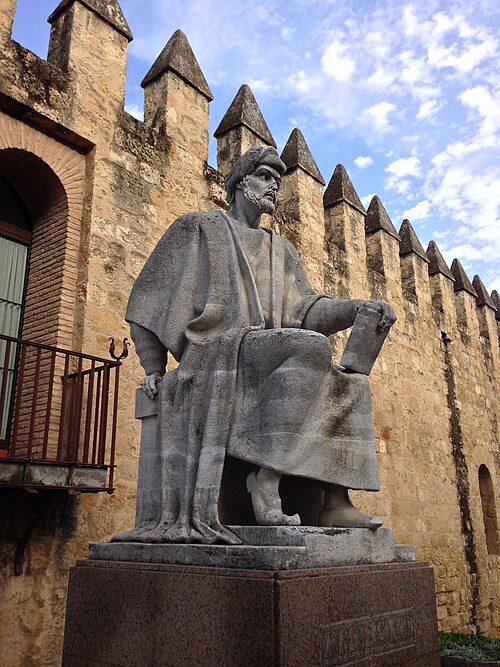
Today Ibn Rushd is honoured in Córdoba with a statue near the old city walls, and in many places as a figure who connects the Islamic, Jewish and Christian intellectual traditions. Historians caution, however, against turning him into a modern liberal: his thought belongs to its twelfth-century world of Islamic law, Aristotelian science and Almohad politics.
Key ideas
- Truth does not contradict truth
- Demonstrative philosophy and revelation are both true, so any apparent conflict must be resolved by interpretation.
- Three kinds of argument
- Rhetoric for most people, dialectic for theologians, demonstration for philosophers; scripture addresses all three.
- Allegorical interpretation (ta'wil)
- When demonstration conflicts with the literal sense of scripture, experts may interpret the text figuratively.
- Return to Aristotle
- His aim of recovering what Aristotle really meant, free of later additions by Avicenna and others.
- Unity of the intellect
- His controversial thesis that the material and agent intellects are one and shared by all humans.
- Real causation
- Against al-Ghazali, he held that things have real causal powers and that knowledge is knowledge of causes.
- Comparative law
- In Bidayat al-mujtahid he explained why the legal schools disagree, not just what they hold.
Records
- 1111 — Death of al-Ghazali, author of The Incoherence of the Philosophers.
- 1126 — Ibn Rushd is born in Córdoba (14 April).
- c. 1169 — Ibn Tufayl introduces him to Caliph Abu Yaqub Yusuf; he is appointed judge of Seville and begins his Aristotle commentaries.
- c. 1179 — He writes The Decisive Treatise and related works on religion and philosophy.
- c. 1180 — He writes The Incoherence of the Incoherence, answering al-Ghazali.
- 1182 — He succeeds Ibn Tufayl as court physician.
- 1195 — He is disgraced, some books are burned, and he is exiled to Lucena.
- 1198 — Restored to favour, he dies in Marrakesh (December).
- c. 1217 — Michael Scot begins translating his commentaries into Latin (dates from 1217 to the 1220s are given).
- 1270 — Thomas Aquinas writes On the Unity of the Intellect against the Averroists.
- 1277 — Bishop Tempier of Paris condemns 219 propositions, many linked to radical Aristotelianism.
- 1852 — Ernest Renan publishes Averroès et l'averroïsme.
Glossary
- Al-Andalus
- The parts of the Iberian Peninsula under Muslim rule (711–1492).
- Almohads
- A Berber reformist dynasty that ruled North Africa and al-Andalus in the 12th–13th centuries.
- Qadi
- A judge who applies Islamic law.
- Maliki school
- One of the four Sunni schools of Islamic law, dominant in North Africa and al-Andalus.
- Commentary
- A work that explains another text, often passage by passage.
- Demonstration
- In Aristotle's logic, a proof from true and certain premises that yields certain knowledge.
- Agent intellect
- In Aristotelian psychology, the active principle that makes things intelligible to the mind.
- Averroism
- A label for medieval and Renaissance thinkers who followed Aristotle as interpreted by Averroes.
- Scholasticism
- The method of teaching and argument in medieval European universities.
- Ta'wil
- Interpretation of scripture beyond its literal sense.
Questions and answers
Why does he have two names?
Ibn Rushd is his Arabic name. Medieval Europeans turned it into Latin as Averroes, just as Ibn Sina became Avicenna.
Did he think religion was false?
No. He argued that true religion and true philosophy agree. Scholars debate how he balanced them, but the idea that he secretly rejected Islam is not supported by most historians.
Why were his books burned?
In 1195 the caliph turned against him, probably for political reasons: he needed the support of conservative religious scholars during a war. Ibn Rushd was forgiven about two years later.
What is “double truth”?
The claim that something can be true in philosophy but false in theology. Opponents accused the Latin Averroists of it, but neither Ibn Rushd nor, it seems, any medieval thinker actually taught it.
Why is he more famous in Europe than in the Islamic world?
His Aristotle commentaries arrived in Europe when universities were adopting Aristotle, while in the Islamic world philosophy followed mainly Avicenna's approach. Modern Arab thinkers have since revived interest in him.
Is he in Raphael's School of Athens?
A turbaned figure in the fresco is traditionally identified as Averroes, but the identification is uncertain.
What was his view of the intellect?
In his mature work he argued that there is one material intellect shared by all humans, connected to each person through imagination. Critics said this denied personal immortality.
Did Averroes know Maimonides?
Both were born in Córdoba, but there is no evidence that they ever met. Maimonides's family left the city when he was young, after the Almohad conquest, and he only came to know Ibn Rushd's commentaries late in life, around 1190.
Sources and further reading
- Ibn Rushd [Averroes]. Stanford Encyclopedia of Philosophy
- H. Chad Hillier, Ibn Rushd (Averroes) (1126–1198). Internet Encyclopedia of Philosophy
- Averroes. Wikipedia
- Averroism. Wikipedia
- The Incoherence of the Incoherence. Wikipedia
- 이븐 루시드. 위키백과 (Korean Wikipedia)
- George F. Hourani (trans.), Averroes on the Harmony of Religion and Philosophy. Luzac, 1961
- Simon van den Bergh (trans.), Averroes' Tahafut al-Tahafut (The Incoherence of the Incoherence). Oxford University Press / E. J. W. Gibb Memorial, 1954
Related
- AristotlePlato's student and Alexander's tutor. He founded the Lyceum and wrote on logic, ethics, politics and the natural world.
- AvicennaPhysician and philosopher whose writings shaped medicine and philosophy across the Islamic world and Europe.
- Al-FarabiPhilosopher of the Islamic world known for works on logic, political thought and music.
- Thomas AquinasDominican theologian and philosopher whose writings became central to medieval Christian thought.
- Divine ComedyItalian narrative poem by Dante Alighieri describing a journey through Hell, Purgatory and Paradise.
- Ibn KhaldunNorth African historian and thinker whose Muqaddimah examines how societies and states change.
Written with AI assistance from the published sources listed above, and revised as new research appears.