Start at the top for an easy introduction. Go further down for more detail and scholarship.
- Easy
- Intermediate
- Advanced
For young readers
Off the coast of Tanzania, in East Africa, lies a quiet island with fishing boats, palm trees and about a thousand people. Walk among the trees and you find huge stone ruins: arches, domes, walls and even an eight-sided swimming pool. They are what is left of Kilwa, once one of the richest cities on the Indian Ocean.
Kilwa grew rich from trade. Every year the monsoon winds blew ships from Arabia, Persia and India to Africa, and then turned around and blew them home. Gold dug far inland, in the land of Great Zimbabwe, was carried to the coast, and Kilwa collected it and traded it for cloth, beads, spices and beautiful Chinese porcelain.
The people of Kilwa spoke Swahili, an African language, and were Muslims. They built with coral stone cut from the sea and made their own copper coins. In 1331 a famous traveller from Morocco, Ibn Battuta, visited and called Kilwa one of the most beautiful and best-built towns in the world.
Not everyone was rich. Many people lived in simple houses of mud and thatch, and some were enslaved. Kilwa’s rulers also took part in capturing and selling people, which is a sad part of its story.
In 1505 Portuguese soldiers arrived with warships, attacked and plundered the city. Kilwa never regained its old power, and in the 1800s the old town was abandoned. Today the ruins are a World Heritage Site that archaeologists are still studying.
At a glance
- Where
- Kilwa Kisiwani island (about 12 km²), Kilwa District, Lindi Region, southern Tanzania
- When
- Settled from about the 9th century; city-state and sultanate at its height in the 13th–15th centuries; sacked 1505; old town abandoned in the 1840s
- People
- Swahili Muslim society of African roots with Persian, Arab and Indian connections
- Wealth
- Control of the gold trade from Sofala and the Zimbabwe plateau; ivory, textiles, beads and Chinese ceramics; its own coinage
- Main monuments
- Great Mosque, Husuni Kubwa palace, Husuni Ndogo, Makutani palace, Gereza fort, many smaller mosques and tombs
- Building material
- Coral stone (coral rag and cut coral) with lime mortar and plaster
- Written sources
- Ibn Battuta (visited 1331), the Kilwa Chronicle (Arabic and Portuguese versions), Portuguese accounts
- Status
- UNESCO World Heritage Site with Songo Mnara since 1981; on the List in Danger 2004–2014
Easy
What is Kilwa Kisiwani?
Kilwa Kisiwani – “Kilwa on the Island” – is a low coral island about 23 km around, lying just off the southern coast of Tanzania, about 9 degrees south of the equator. Today it has around a thousand inhabitants who live by fishing, farming and tourism. There are no roads and no rivers; the island’s wells, some used for more than a thousand years, still supply its water.
In the Middle Ages the island held one of the great cities of the Indian Ocean. Kilwa was the capital of a sultanate whose influence, at its height in the 13th to 15th centuries, reached along much of the East African coast. It may have had more than 10,000 inhabitants and was the leading trading port of the southern Swahili coast.
What survives are ruins built of coral stone: the Great Mosque, the enormous clifftop palace of Husuni Kubwa, a fortified enclosure called Husuni Ndogo, a later fort known as the Gereza, and the remains of houses, smaller mosques and tombs. Much of the site has still not been excavated.
Since 1981 the ruins of Kilwa Kisiwani, together with those of the neighbouring island of Songo Mnara, have been a UNESCO World Heritage Site. They are one of the best places to understand Swahili civilisation, an African coastal culture that linked the interior of the continent with Arabia, Persia, India and China.
Easy
A city made by the monsoon
The secret of Kilwa’s wealth was the wind. In the western Indian Ocean the monsoon winds reverse with the seasons. For part of the year they blow from the north-east, carrying sailing ships from Arabia and India down to Africa; later they blow from the south-west, carrying them home. Traders could plan regular voyages across the ocean, and coastal towns grew up where ships waited for the wind to change.
Kilwa’s great advantage was gold. Gold mined on the Zimbabwe plateau – the region of Great Zimbabwe – was carried to Sofala, a port in what is now Mozambique. Ships from the north seldom sailed that far south, so Kilwa took control of Sofala and acted as the middleman, collecting the gold and shipping it north. It also levied customs duties on gold passing through its port.
Kilwa exported gold, ivory, tortoiseshell, spices, incense and cotton cloth, and imported cloth, glass beads, jewellery and fine pottery. Excavations have found glazed ceramics from the Persian Gulf and large amounts of Chinese porcelain and celadon. Wealthy families displayed these imported bowls in niches built into the walls of their houses.
Kilwa was one of the few places south of the Sahara to mint coins. For centuries it issued mostly copper coins inscribed in Arabic with the names of its sultans. Kilwa coins have been found across the region, including at Great Zimbabwe, and a few have even turned up on islands off northern Australia, though how they got there is unknown.
Easy
Who were the people of Kilwa?
The people of Kilwa belonged to the Swahili culture, which stretched along the coast from southern Somalia to Mozambique. They spoke Kiswahili, a Bantu language of African origin that absorbed many Arabic words, and most were Muslims. The name Swahili comes from an Arabic word for “coasts,” so the Swahili are “people of the coast.”
Kilwa’s own history, the Kilwa Chronicle, says the city’s ruling family was founded by Ali ibn al-Hasan, a prince from Shiraz in Persia, who is said to have bought the island from a local African king. Many Swahili families traditionally called themselves “Shirazi.” Historians have long debated how much of this story is true, and whether it reflects real migration or a later way of claiming prestige.
Archaeology shows that Kilwa was an African town long before any such prince could have arrived. The earliest settlement dates from about the 9th century, and its first houses were built of wattle and daub – wooden frames plastered with mud – like those of other coastal and inland communities. Stone buildings appeared mainly from the 13th century, as the city grew richer.
Kilwa was a very unequal city. The wealthy lived in stone houses with plastered walls, indoor bathrooms and imported ceramics; many others lived in houses of mud and thatch. Some people were enslaved, and the city’s rulers took part in raiding and trading captives. All of these people together made up the society whose ruins we see today.
Intermediate
Reading the ruins: mosque, palaces and houses
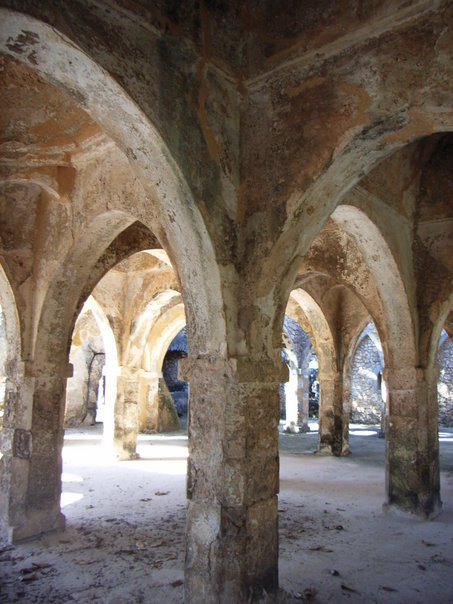
The Great Mosque is one of the oldest surviving mosques on the East African coast. Its northern prayer hall, probably dating to the 11th or 12th century (traditionally 1131–1170), is a rectangular room whose flat roof rested on nine columns, first of coral and later of timber. Unlike many mosques elsewhere, it has no open courtyard. In the early 14th century Sultan al-Hasan ibn Sulaiman added a large southern extension roofed with vaults and domes, including a great dome, which Ibn Battuta may have seen in 1331.
Husuni Kubwa, the “Great Palace,” stands on a cliff above the sea outside the old town. Built mainly under the same sultan in the early 14th century, it covered roughly two acres and combined a commercial courtyard, probably for storing and trading goods, a residential complex with more than a hundred rooms, a reception pavilion, a monumental stair down to the shore, and an octagonal pool. Strangely, it seems to have been occupied only briefly and may never have been finished. Nothing like it is described in the chronicles.
Nearby Husuni Ndogo, the “Little Palace,” is a walled rectangular enclosure with towers at the corners. Its purpose is unclear – it looks like a fort but may have been used at times as a mosque. In the town centre, the Gereza (“prison”) is a fort begun by the Portuguese in 1505 and rebuilt in its present form under Omani rule; the ruins of the Makutani palace stand nearby.
The houses reveal daily life. Wealthier houses were built of coral rag set in lime mortar, with long narrow rooms roofed with timber or mangrove poles and coral slabs, plaster floors, and carved niches for displaying ceramics. Cemeteries lie at the edges of the town, and open spaces were probably used for gatherings. Excavations have also found spindle whorls showing that cotton was spun locally from at least the 12th century.
Intermediate
Building with coral
Kilwa’s builders used the materials of the sea. The island rests on fossil coral limestone, and the reef provides living coral. Rough blocks of fossil coral (coral rag) were used for walls, set in mortar; finer “porites” coral, cut fresh from the reef while still soft, could be carved into precise shapes for door frames, arches and decorative panels before it hardened in the air.
Lime for mortar and plaster was made by burning coral in kilns. This required large amounts of fuel, much of it mangrove wood from the coastal swamps. Mangrove poles, which are straight and resist insects, were also used as roof beams. The scale of building therefore depended on the wealth of the city: when trade declined in the late 14th century, demand for lime and building stone fell and construction slowed.
At the harbour, builders made causeways and platforms from blocks of reef and coral nearly a metre high. These acted as breakwaters and landing places for boats. The pattern of mangroves growing along them still makes some of these structures visible from a distance.
Water was carefully managed. The Great Mosque had an ablution area with a network of baked-clay channels for ritual washing, and wealthier houses had bathrooms with drains – the “indoor plumbing” that impressed later visitors and historians.
Intermediate
The rise and height of the Kilwa Sultanate
According to the Kilwa Chronicle, the first Shirazi ruler, Ali ibn al-Hasan, founded the dynasty in the 10th century; coins bearing his name are among the earliest known from Kilwa, though archaeologists debate whether the dynasty really began as early as the chronicle claims. The chronicle then lists a long line of rulers, some deposed by the people of Kilwa, others killed by rivals, which suggests that the town’s merchants and citizens had real political weight.
The key turning point came in the late 12th and 13th centuries, when Kilwa won control of the gold trade of Sofala from its northern rival Mogadishu. The chronicle credits Sultan Sulaiman ibn al-Hasan with this and with building much of the city. The profits financed the city’s expansion along the coast.
Around the end of the 13th century a new dynasty, the Mahdali or Abu al-Mawahib family, who claimed descent from Yemeni sayyids (descendants of the Prophet), took power. Under Sultan al-Hasan ibn Sulaiman in the early 14th century Kilwa reached a peak of splendour: the Great Mosque was enlarged and Husuni Kubwa was built. At its greatest, in the 15th century, Kilwa claimed authority over towns from Malindi and Mombasa to Zanzibar, Mafia, the Comoros and Sofala, and over trading posts in Madagascar.
This “empire” was more like a confederation of trading towns than a centralised state. Local elites ran their own cities, and the sultan’s governors had very different powers from place to place. In the later 15th century powerful viziers and emirs dominated the sultans, and after a murderous coup around 1500 many vassal towns stopped recognising Kilwa’s authority – just as the Portuguese arrived.
Intermediate
Ibn Battuta’s visit, 1331
The Moroccan traveller Ibn Battuta sailed down the East African coast and reached Kilwa around 1331. In the account of his travels he described it as one of the most beautiful and best-constructed towns in the world. He was impressed by the city’s planning and by the character of its ruler, Sultan al-Hasan ibn Sulaiman, praising his generosity, humility and piety.
Ibn Battuta’s description also records darker realities. He reported that the sultan often led raids into the mainland interior, which he describes as a holy war against non-Muslims, and that captives and other plunder were taken. His account thus shows how Kilwa’s wealth was tied not only to gold and trade goods but also to violence and enslavement on the mainland.
His testimony must be used carefully. He wrote years later from memory, and some details, such as his claim that the town’s buildings were made of wood, conflict with the archaeological evidence of stone walls that predate his visit. Nevertheless, he is one of the very few outside eyewitnesses to Kilwa at its height.
For modern readers, Ibn Battuta’s visit also shows that Kilwa was part of a single Islamic world stretching from Morocco to China. A scholar trained in North Africa could travel to East Africa, pray in its mosques and be welcomed at court, because its elite shared the same language of religion and law.
Intermediate
The Portuguese attack and the long decline
The Portuguese reached the East African coast with Vasco da Gama’s voyage to India in 1497–98. In 1500 Pedro Álvares Cabral tried to negotiate with Kilwa’s ruler, Emir Ibrahim, without success. In 1502 da Gama returned with a heavily armed fleet and forced Kilwa to pay a large tribute.
In July 1505 a fleet under Francisco de Almeida, the first Portuguese viceroy of India, landed some 500 soldiers, drove out Emir Ibrahim, and sacked and burned the city. The Portuguese installed a puppet ruler, built a fort, and imposed rules that allowed only Portuguese ships to carry trade to the main coastal towns, ruining many Kilwan merchants. The gold trade shifted to Portuguese-controlled Sofala, and trade at Kilwa largely collapsed. The Portuguese abandoned their fort in 1512.
Kilwa recovered some of its prosperity but never its former power. In the 18th century it became a centre of the slave trade: in 1776 its ruler agreed to supply a French merchant with 1,000 enslaved people a year for plantations on the Indian Ocean islands. In 1784 the Omani rulers of Zanzibar conquered Kilwa, and the Gereza fort took its present form. After the Omani conquest the French built a fort at the northern tip of the island, but the old town was abandoned in the 1840s.
From 1886 to 1918 the area was part of German East Africa, and then of British-ruled Tanganyika. The overgrown ruins attracted archaeological interest and legal protection only in the 20th century.
Intermediate
Excavation, danger and conservation
The most important excavations at Kilwa were carried out between 1958 and 1965 by the British archaeologist Neville Chittick for the British Institute in Eastern Africa. His two-volume publication of 1974 set out a chronology for the town and its buildings that later work has refined. More recent research has turned from the monuments and harbour to houses, craft production and the surrounding hinterland.
The ruins face serious threats. Erosion by the sea is eating away the cliff on which Husuni Kubwa stands, and parts of the palace’s eastern side are disappearing. Rainwater washes away soil around the walls, and vegetation, while slowing erosion, forces its roots into the masonry and breaks it apart. In 2004 UNESCO placed Kilwa Kisiwani and Songo Mnara on the List of World Heritage in Danger.
Conservation work followed. Volunteers from a French heritage association worked on the site between 2001 and 2007; the World Monuments Fund placed Kilwa on its 2008 Watch List and has since supported conservation work on various buildings; and between 2005 and 2009 the Zamani Project recorded the main ruins with 3D laser scanning. In 2014 the site was removed from the List in Danger.
Local residents are central to the site’s future. Visitors need permits, and the island community – whose ancestors have lived there for centuries – shares its landscape with the ruins. Balancing tourism, conservation and the needs of a small, isolated population remains a challenge.
Advanced
African or foreign? The debate over Swahili origins
Much of Kilwa’s history was first written by Omani and European colonial administrators and scholars in the 19th and early 20th centuries. Many of them assumed that the stone towns of the coast must have been built by Arab or Persian colonists, treating Swahili civilisation as a foreign implant on African soil. The Shirazi legend in the Kilwa Chronicle seemed to confirm this.
From the 1970s onward, archaeologists and historians – among them Mark Horton, John Middleton and many East African scholars – emphasised the African origins of Swahili society. Excavations showed that coastal towns grew out of earlier African farming and fishing villages, that their language was Bantu, and that stone architecture developed locally over centuries. The Swahili appeared not as colonists but as African communities that adopted Islam and became expert participants in Indian Ocean trade.
In 2023 an ancient DNA study published in Nature (Brielle and colleagues) analysed 80 individuals from medieval and early modern coastal towns, including Kilwa. It found that many had more than half of their ancestry from African, mainly female, ancestors, and a large share from Asian ancestors, 80–90% of which came from Persian men, with mixing beginning by about AD 1000. Before about 1500 the Asian ancestry was mainly Persian-related, which the authors noted is consistent with the Kilwa Chronicle’s Shirazi narrative; later it became increasingly Arabian.
These results have not ended the debate but reframed it. Many scholars stress that ancestry is not the same as culture or identity: Swahili language, material culture and towns remained fundamentally African, even as families intermarried with Persian and later Arab migrants. Others see the findings as a reminder that oral traditions like the Kilwa Chronicle can preserve real historical memories. The question is now less “African or foreign?” than how African and Asian people together created a new coastal society.
Advanced
Sources and chronology: chronicle, coins and radiocarbon
The Kilwa Chronicle survives in two main versions: an Arabic text, the Kitab al-Sulwa, and a Portuguese summary included by the historian João de Barros in his Décadas da Ásia (1552). Their genealogies are broadly similar but differ in many details, and both were compiled centuries after the events they describe, probably from oral traditions. Their reign lengths and dates, which place the founding in the 10th century, are therefore used with caution.
Coins provide an independent check. Excavations found hoards of copper coins bearing the name of Ali ibn al-Hasan, the chronicle’s founder, in the upper levels of the Great Mosque, suggesting that the mosque itself is older than his coinage. Some archaeologists, following Chittick’s excavations, have used coins and stratigraphy to argue that the Shirazi dynasty rose later than the chronicle’s 10th-century date. At the same time, radiocarbon dates show that people were living on the island from about the 9th century.
The dating of buildings is also debated. The Great Mosque’s phases have been dated variously to the 10th, 11th–12th and 13th–14th centuries, and inscriptions, coins and architectural style do not always agree. Husuni Kubwa, clearly early 14th century in its main phase, may include earlier parts. Even Ibn Battuta’s account does not match the archaeology in every respect.
These uncertainties make Kilwa a good example of how historians combine different kinds of evidence: local traditions, travellers’ reports, colonial-era writings, coins, radiocarbon dates, imported ceramics that can be dated by their place of origin, and now ancient DNA. Each has its biases and gaps. The picture that emerges is of an African Muslim city that rose over several centuries, reached its peak in the 14th and 15th centuries, and was undone by a combination of internal conflict and Portuguese violence.
Key ideas
- Swahili civilisation
- An African, Muslim, urban culture of the East African coast, speaking a Bantu language and linked by sea to Arabia, Persia, India and China.
- Monsoon trade
- Seasonal reversing winds allowed regular voyages across the western Indian Ocean and made coastal towns like Kilwa possible.
- Gold middleman
- Kilwa’s power rested on controlling the flow of gold from the Zimbabwe plateau through Sofala to the northern markets.
- Coral architecture
- Buildings of fossil and fresh-cut coral with lime mortar and plaster, a distinctive Swahili tradition.
- Confederation of towns
- The Kilwa Sultanate was a loose network of trading cities rather than a centralised territorial state.
- Inequality and slavery
- Kilwa’s wealth was unevenly shared and linked to raiding and the slave trade, especially in its later history.
- Multiple evidence
- Chronicles, travellers, coins, radiocarbon, ceramics and ancient DNA must be combined to reconstruct Kilwa’s history.
Records
- c. 800 CE — Radiocarbon dates show settlement on Kilwa Kisiwani from about the start of the 9th century.
- c. 957 CE — Traditional date in the Kilwa Chronicle for the founding of the dynasty by Ali ibn al-Hasan of Shiraz.
- c. 1100 — Kilwa begins minting its own coins; the Great Mosque’s northern prayer hall is built in the 11th–12th century.
- c. 1200 — Kilwa gains control of the Sofala gold trade; stone buildings spread through the town.
- c. 1277 — The Mahdali (Abu al-Mawahib) dynasty takes power.
- c. 1331 — Ibn Battuta visits and praises the city and its sultan, al-Hasan ibn Sulaiman, builder of Husuni Kubwa.
- 1502 — Vasco da Gama forces Kilwa to pay tribute.
- 1505 — Francisco de Almeida’s Portuguese fleet sacks Kilwa and builds a fort.
- 1776 — Kilwa’s ruler agrees to supply a French merchant with 1,000 enslaved people a year.
- 1784 — The Omani rulers of Zanzibar conquer Kilwa.
- 1981 — Kilwa Kisiwani and Songo Mnara are inscribed as a UNESCO World Heritage Site.
- 2014 — The site is removed from the List of World Heritage in Danger after conservation work (placed on it in 2004).
Glossary
- Swahili
- The coastal people of East Africa and their Bantu language, Kiswahili; the name means “people of the coast.”
- Monsoon
- A seasonal reversal of winds, which in the Indian Ocean allowed ships to sail one way in one season and back in another.
- Sultanate
- A state ruled by a sultan, a Muslim sovereign.
- Shirazi
- A name used by many Swahili families claiming descent from settlers from Shiraz in Persia.
- Coral rag
- Rough blocks of fossil coral limestone used as building stone on the Swahili coast.
- Sofala
- A port in present-day Mozambique, the main outlet for gold from the Zimbabwe plateau.
- Celadon
- A green-glazed Chinese stoneware, widely traded across the Indian Ocean and found at Kilwa.
- Mihrab
- A niche in the wall of a mosque that shows the direction of Mecca for prayer.
- Husuni Kubwa
- “Great Palace” (or fort), the huge early 14th-century palace and trading complex at Kilwa.
- Ancient DNA
- Genetic material recovered from old human remains, used to study ancestry and migration.
Questions and answers
Why was a small island so rich?
Because it controlled a key trade route: gold from the African interior came through Kilwa on its way to Arabia and India, and the monsoon winds brought traders every year.
Did Persians build Kilwa?
Kilwa was an African town before any Persian arrivals, and its people spoke an African language. A tradition says a Persian prince founded its ruling family, and DNA shows Persian ancestry among its medieval people, but the city and culture were African.
What did Ibn Battuta say about Kilwa?
He called it one of the most beautiful and best-built towns in the world and praised its sultan’s generosity, though he also described raids that took captives.
What destroyed Kilwa?
Internal power struggles weakened it, and in 1505 the Portuguese sacked the city and took over the gold trade. It declined slowly and was abandoned in the 1840s.
Was Kilwa involved in the slave trade?
Yes. Its rulers raided the mainland for captives in the Middle Ages, and in the 18th century Kilwa became a major slave-trading port supplying French plantations.
Did Kilwa really have its own money?
Yes. It minted mostly copper coins with Arabic inscriptions naming its sultans for several centuries; they have been found as far away as Great Zimbabwe.
Can you visit Kilwa Kisiwani?
Yes, by boat from Kilwa Masoko, with a permit from the local tourist office. A small community still lives on the island.
Sources and further reading
- Kilwa Kisiwani. Wikipedia
- Kilwa Sultanate. Wikipedia
- Great Mosque of Kilwa. Wikipedia
- Kilwa Chronicle. Wikipedia
- Swahili coast. Wikipedia
- Songo Mnara. Wikipedia
- Esther S. Brielle et al., Entwined African and Asian genetic roots of medieval peoples of the Swahili coast. Nature, 2023
- H. Neville Chittick, Kilwa: An Islamic Trading City on the East African Coast. British Institute in Eastern Africa, 1974
- Mark Horton and John Middleton, The Swahili: The Social Landscape of a Mercantile Society. Blackwell, 2000
Related
- Ibn BattutaMoroccan traveler whose account describes journeys across Africa, Asia and parts of Europe.
- Great ZimbabweRemains of a major southern African city built and occupied by ancestors of the Shona people.
- Rock-Hewn Churches of LalibelaEleven churches carved downward out of solid volcanic rock in the Ethiopian highlands, traditionally under the Zagwe king Gebre Meskel Lalibela, as a symbolic “New Jerusalem” that remains a centre of Ethiopian Orthodox pilgrimage.
- TimbuktuDesert-edge city near the Niger River that became West Africa’s great centre of trans-Saharan trade and Islamic scholarship, known for its earthen mosques and manuscripts.
- Great Mosque of DjennéThe world’s largest mud-brick building, rebuilt in 1906–1907 by Djenné’s masons on the site of a mosque founded, by tradition, in the thirteenth century.
- Columbus's First VoyageChristopher Columbus's 1492 Atlantic voyage for the Spanish Crown reached islands inhabited by Indigenous peoples.
Written with AI assistance from the published sources listed above, and revised as new research appears.