Start at the top for an easy introduction. Go further down for more detail and scholarship.
- Easy
- Intermediate
- Advanced
For young readers
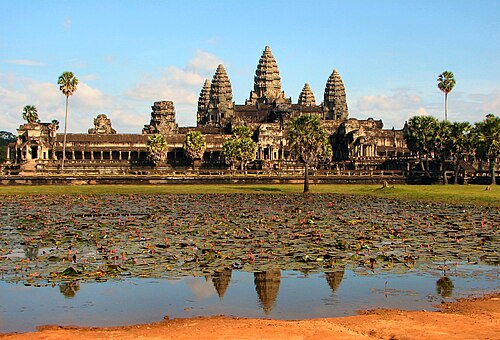
Imagine a stone mountain that people made by hand. It has five towers shaped like lotus buds, long hallways covered in carvings, and a wide moat of water all around it, like a castle. That is Angkor Wat, in the country of Cambodia in Southeast Asia.
About 900 years ago, a king named Suryavarman II ordered it to be built. Thousands of workers cut huge blocks of sandstone from a hill about 40 kilometres away, moved them to the building site, and stacked them so neatly that most of the temple is still standing today.
The walls are like a giant stone comic book. If you walk along the outer hallway, you can see armies of monkeys helping a hero rescue a princess, gods and demons pulling on a huge snake to churn an ocean, and the king himself riding an elephant. There are also more than a thousand carved dancing goddesses, each with her own hairstyle and jewellery.
The temple was first built for Vishnu, a Hindu god. Later, many Cambodians became Buddhists, and Buddhist monks started to live and pray there. They never really left, so Angkor Wat has been a living place of worship for hundreds of years.
Today Angkor Wat is so important to Cambodians that it is drawn on their national flag. Every morning, visitors wait in the dark to watch the sun rise behind its towers.
At a glance
- Built
- Early 12th century, during the reign of Suryavarman II (r. 1113–c. 1150); some carving was left unfinished
- Place
- Angkor, near Siem Reap, northwest Cambodia
- Builder
- Khmer Empire (Angkor period, c. 9th–15th centuries)
- Original dedication
- Vishnu (Hindu); gradually became a Theravada Buddhist site from roughly the 14th–16th centuries
- Materials
- Sandstone from the Kulen hills (about 40 km away) over a laterite and earth core
- Size
- Moat about 190 m wide around an enclosure of roughly 1.5 × 1.3 km; central tower about 65 m above the ground
- UNESCO
- Part of the World Heritage Site “Angkor”, inscribed 1992 (on the Danger list 1992–2004)
- Why it matters
- The largest religious monument in the world and the high point of classical Khmer architecture and relief sculpture
Easy
What is Angkor Wat?
Angkor Wat is a temple complex in northwestern Cambodia, a few kilometres north of the modern town of Siem Reap. It stands inside the area of Angkor, which for several centuries was the capital region of the Khmer Empire, one of the largest states in Southeast Asian history. The name is modern and simply means “the temple (wat) of the city (angkor)”; both words come from Sanskrit or Pali (nagara, “city”, and vāṭa, “enclosure”).
It was built in the first half of the twelfth century for King Suryavarman II as his state temple, dedicated to the Hindu god Vishnu. Its original name is not recorded on any foundation inscription, but it may have been called Vrah Viṣṇuloka, “the sacred world of Vishnu”, which echoes the king’s posthumous name, Paramaviṣṇuloka, “he who has gone to the supreme world of Vishnu”.
Unlike most Angkorian temples, Angkor Wat was never fully abandoned. From about the fourteenth century onward it became a Theravada Buddhist monastery and pilgrimage site, and monks still live and worship there. That continuous use is one reason it survived in better shape than many neighbouring temples that were swallowed by the forest.
Today it is Cambodia’s national symbol, appearing on the national flag, banknotes and countless logos, and it is the centrepiece of the UNESCO World Heritage Site of Angkor.
Easy
How to “read” the layout: a mountain of the gods
Angkor Wat is a map of the universe in stone. In Hindu and Buddhist cosmology the centre of the world is Mount Meru, the home of the gods, surrounded by rings of mountain ranges and oceans. The temple copies this picture: the moat stands for the cosmic ocean, the enclosure walls for the surrounding mountain ranges, and the five central towers for the five peaks of Meru. Khmer architects called this kind of building a temple-mountain: a stepped pyramid with shrines on top.
Visitors normally enter from the west, crossing the moat on a long stone causeway lined with balustrades shaped like nāgas (many-headed serpents, guardians of water and thresholds). A grand gateway (gopura, a monumental entrance pavilion) in the outer wall leads to a second causeway about 350 m long, flanked by two small buildings usually called “libraries” and by two ponds that were added later.
The temple proper rises in three nested rectangular galleries, each higher than the last. The outer gallery (about 187 × 215 m) carries the famous relief panels. A cross-shaped cloister, Preah Poan, links it to the second level, where the walls are crowded with carved female deities. The innermost level, the Bakan, is reached by very steep stairs; its steepness is often read as a reminder that climbing to the realm of the gods is hard. On top, four corner towers surround the central tower, arranged in a quincunx (the pattern of five dots on a die).
Movement through the building is a movement inward and upward: from the everyday world outside the moat, through ever more restricted spaces, to the dark central shrine where the image of Vishnu once stood. Ordinary people probably had access only to the outer parts, while the upper levels were reserved for priests and the court.
Easy
The carved galleries and the dancing goddesses
The walls of the outer gallery hold one of the longest continuous sequences of relief carving in the world, stretching for several hundred metres. A bas-relief is a carving that projects only slightly from a flat background, like a picture raised from the stone. The panels are read counter-clockwise, starting from the northwest corner, which is unusual and part of a scholarly debate discussed below.
The west gallery shows the Battle of Lanka from the Ramayana, where Rama and his monkey army fight the demon king Ravana, and the Battle of Kurukshetra from the Mahabharata, the great war of the Pandavas and Kauravas. The south gallery has the only historical scene: a procession of Suryavarman II’s court and army, with the king seated beneath fifteen parasols, followed by a vision of heavens and hells where the dead are judged.
The east gallery contains the most famous panel, the Churning of the Ocean of Milk. Gods (devas) and demons (asuras) pull on the body of the serpent Vasuki, wrapped around a mountain that rests on a turtle, an avatar of Vishnu. As they churn, the ocean releases treasures, including amṛta, the nectar of immortality, and the celestial dancers known as apsarās. Parts of the north and east galleries were carved much later, in the sixteenth century, completing what the original workshop had left blank.
All over the upper levels stand devatās, female divinities carved almost life-size, singly or in groups. More than 1,700 have been catalogued. Their crowns, hairstyles, jewellery and garments vary so much that the French artist Sappho Marchal, who studied them in the 1920s, concluded that they drew on real fashions of the Angkor court. For modern Cambodians they are also an inspiration for classical dance.
Intermediate
How it was built: stone, water and labour
By the twelfth century Khmer builders had moved from brick to sandstone for their most important monuments. The visible surfaces of Angkor Wat are made of fine-grained sandstone quarried in the Kulen hills (Phnom Kulen), about 40 km to the northeast. Hidden structural parts, foundations and the outer enclosure wall use laterite, a reddish, iron-rich soil that can be cut into blocks when wet and hardens when exposed to air. The whole mass sits on a huge platform of compacted sand and earth.
Estimates of the number of sandstone blocks run into the millions, many weighing more than a tonne. The blocks were most likely moved by water: studies of satellite images have identified ancient canals linking the Kulen quarries to Angkor, which would have allowed rafts to carry stone much of the way. The small holes visible in many blocks are thought to have held pegs used for lifting and positioning.
Khmer builders did not use true arches. Their galleries are roofed with corbelled vaults, in which each course of stone projects a little beyond the one below until the two sides meet. Blocks were fitted with extremely tight joints, largely without mortar, and some were joined with iron clamps. Carving was done after the blocks were in place, which explains why reliefs flow continuously across joints.
No record tells us how many people worked on the temple, but calculations based on the volume of stone and the time available suggest a workforce of many thousands over several decades, including quarrymen, boatmen, masons and highly skilled sculptors. Angkorian inscriptions from other temples list villages and people assigned to supply temples with labour, rice and goods, so construction and upkeep were probably organized through the same system of obligations owed by communities to temples and the state.
Water was part of the design, not just decoration. The moat, roughly 190 m wide with a perimeter of more than 5 km, helped stabilize the sandy foundations by keeping the water table steady, and it connected the temple to the wider network of canals and reservoirs (barays) that managed the monsoon rains around Angkor.
Intermediate
Historical context: the Khmer Empire and the twelfth-century world
The Khmer Empire is traditionally dated from 802 CE, when, according to a much later inscription, Jayavarman II had himself consecrated as universal ruler on the Kulen hills. Over the next centuries successive kings built capitals, reservoirs and temple-mountains in the Angkor region. At its height the empire’s influence reached across much of what is now Cambodia, Thailand, Laos and southern Vietnam.
Suryavarman II came to power around 1113 after a period of rival claimants. Inscriptions describe him as a warrior king who campaigned against Đại Việt (northern Vietnam) and Champa (central Vietnam) and who sent missions to the Song court in China. He relied on a powerful Brahmin priest, Divākarapaṇḍita, who performed his consecration. Angkor Wat, his state temple, was the most ambitious project of his reign, and work stopped around his death, in about 1150, leaving some reliefs unfinished.
In the wider world, the 1110s–1150s saw Song China lose its northern capital to the Jurchen Jin (1127) and re-establish itself in the south; the Pagan kingdom building temples in Burma; the Goryeo court in Korea compiling the Samguk sagi (1145); Crusader states established in the Levant; and early Gothic architecture beginning in France. Angkor Wat belongs to this age of great religious building across Eurasia, but it drew above all on South and Southeast Asian traditions.
Those traditions reached Cambodia through centuries of trade and exchange with the Indian subcontinent. Older scholarship called this process “Indianization”, as if Indian culture had simply been transplanted. Most historians now stress local agency: Khmer rulers and priests selected Sanskrit texts, Hindu and Buddhist deities and Indian architectural ideas, and combined them with Khmer language, ancestor cults and ideas of kingship to create something distinctively their own.
Intermediate
Religious meaning: from Vishnu to the Buddha
Most earlier Khmer state temples honoured Shiva, often in the form of a linga (a stylized pillar symbolizing the god). Angkor Wat’s dedication to Vishnu reflects the Vaishnava devotion of Suryavarman II. A large eight-armed stone Vishnu, now known as Ta Reach and venerated in the western gateway, may once have stood in the central shrine, although this is not certain.
Khmer kingship was closely tied to the gods. A king built a temple-mountain as the centre of his realm and associated himself with its deity, both in life and after death. The idea of a special cult of the “god-king” (devarāja) was once taken to mean that kings were worshipped as gods; many scholars now think the term referred to a protective deity of the kingdom, and that the relationship between king and god was more complex than simple deification.
After Angkor was sacked by forces from Champa in 1177, Jayavarman VII restored the kingdom and made Mahayana Buddhism the focus of royal religion, building the new walled capital of Angkor Thom and its state temple, the Bayon. Over the following centuries Theravada Buddhism, the form of Buddhism followed in Sri Lanka and much of mainland Southeast Asia, became the religion of most Khmer people.
Angkor Wat was adapted rather than abandoned. The open doorways of the central shrine were walled in and carved with standing Buddhas, and pilgrims left thousands of Buddha images in the Preah Poan cloister. Local tradition reinterpreted the temple within Buddhist stories. Seventeenth-century Japanese visitors even identified it as Jetavana, the Buddha’s monastery in India. For Cambodians today it is a Buddhist sacred site, a place of merit-making and pilgrimage, and a monument that also keeps its Hindu imagery in full view.
Intermediate
Later history: never truly “lost”
The Chinese envoy Zhou Daguan stayed at Angkor in 1296–97 and wrote the only surviving eyewitness description of the city in its later prime. He described the royal processions, markets, festivals and religious specialists, and mentioned a great stone tomb-like monument south of the city, usually identified as Angkor Wat.
During the fourteenth and fifteenth centuries Angkor faced wars with the Thai kingdom of Ayutthaya. Thai chronicles record a capture of Angkor in 1431 (the exact date is uncertain), and in the following period the Khmer royal centre moved south toward the region of Phnom Penh. Historians debate how far this shift was caused by warfare, by changes in maritime trade that favoured the Mekong region, or by stresses on Angkor’s water system during a period of unstable monsoons.
Angkor Wat itself remained in use. In the sixteenth century a Khmer king had the unfinished relief panels completed. Portuguese travellers heard of it: the Capuchin friar António da Madalena visited around 1586 and described a temple “like no other building in the world”. Japanese pilgrims came in the seventeenth century and left ink inscriptions on the pillars, including one by Morimoto Ukondayu Kazufusa dated 1632.
The popular story that the French explorer Henri Mouhot “discovered” a lost temple in the jungle in 1860 is therefore misleading. Mouhot’s posthumously published travel notes (1864) made Angkor famous in Europe, but local people and monks had always known it, and other Europeans had visited before him. France made Cambodia a protectorate in 1863, and the northwestern provinces containing Angkor were transferred from Siam to French-ruled Cambodia in 1907.
Intermediate
Restoration, war and conservation today
In 1908 the École française d’Extrême-Orient (EFEO) set up the Conservation d’Angkor to clear vegetation, study and repair the monuments. From the 1930s French conservators adopted anastylosis, a method developed in the Dutch East Indies in which a structure is taken apart stone by stone, its foundations are consolidated, and the original blocks are put back in place, with new material added only where necessary and identifiable. Major work on Angkor Wat continued into the 1960s.
The civil war and the Khmer Rouge regime (1975–79) halted conservation. The monument suffered relatively little direct war damage, but in the 1980s and early 1990s looters cut heads and statues from many Angkorian temples for the international art market. Between 1986 and 1992 the Archaeological Survey of India carried out cleaning and repairs at Angkor Wat; some of the chemical treatments used then were later criticized for harming the stone surface, as were earlier uses of cement.
In 1992 UNESCO inscribed Angkor on the World Heritage List and at the same time on the List of World Heritage in Danger; it was removed from the Danger list in 2004. Since 1993 an International Coordinating Committee (ICC-Angkor), co-chaired by France and Japan, has coordinated work by many countries, while the Cambodian APSARA National Authority, created in 1995, manages the site. The German Apsara Conservation Project, for example, focuses on the weathering of the devatā reliefs, which suffer from salts, microbial films and water.
Present-day challenges include mass tourism (more than two million visitors a year before the COVID-19 pandemic), pressure on groundwater from hotels in Siem Reap, and questions about the communities who live inside the heritage park. In 2022–23 the authorities relocated thousands of families from within the Angkor area to a new settlement; the government presented this as necessary for conservation, while human-rights organizations, including Amnesty International, criticized it as forced eviction. How to protect a monument while respecting the people whose lives and religion are bound up with it remains an open question.
Intermediate
Influence and legacy
Angkor Wat defines what art historians call the “Angkor Wat style”, the classical phase of Khmer architecture, with its lotus-bud towers, axial galleries, cross-shaped terraces and dense but disciplined decoration. Its formula of concentric galleries around a temple-mountain influenced later Khmer temples and, more loosely, religious architecture in neighbouring Thai and Lao kingdoms.
In the colonial period Angkor Wat became a symbol of empire as well as of Cambodia. France reproduced it in plaster casts and full-scale pavilions at colonial and universal exhibitions in Paris and Marseille between 1889 and 1937, presenting French rule as the rescuer of a fallen civilization. Cambodian nationalists, in turn, made the temple the emblem of their own history and independence.
Every Cambodian national flag since the mid-nineteenth century has carried an image of a temple, usually Angkor Wat, whatever the political regime. For Cambodians it links present-day identity to the Angkorian past; for Buddhist communities it is a living sanctuary. It is also one of the most visited heritage sites in Asia, a fact that brings income and pride but also the pressures described above.
Advanced
Scholarly debates and open questions
Why does it face west? Almost all Angkorian temples open to the east, the direction of the rising sun. Angkor Wat’s western orientation and the counter-clockwise reading of its reliefs (prasavya, the reverse of the normal clockwise circumambulation) led scholars such as George Cœdès and Maurice Glaize to argue that it was built as Suryavarman II’s funerary temple, since reversed order is associated with funeral rites. Others point out that several temples face west and that the west is associated with Vishnu, so the orientation may express the dedication rather than a funerary purpose. The two views are not mutually exclusive: the temple could be both a Vishnu temple and the place where the king was venerated after death.
Astronomy and measurement. The architect-historian Eleanor Mannikka argued in the 1990s that the temple’s measurements, expressed in the Khmer unit of length (hat), encode calendrical and cosmological cycles, and that sight lines mark solstice and equinox sunrises. It is widely accepted that the main axis is aligned so that at the equinoxes the sun rises over the central tower when seen from the western entrance. The more detailed numerical readings have been received with interest but also scepticism, because with so many measurements some matches can arise by chance. Popular claims linking Angkor to constellations or lost civilizations are rejected by specialists.
A temple or a town? Older studies imagined the space inside the moat as an empty sacred precinct. Since 2012, airborne lidar (laser scanning that “sees” the ground surface through vegetation) and excavation by teams including Roland Fletcher, Damian Evans and Miriam Stark have revealed a grid of mounds, ponds and roads inside the enclosure, suggesting that a resident population, possibly several thousand temple servants and their families, lived there in houses of wood and thatch that have vanished. Lidar also showed traces of earlier structures on the site that were built and demolished during construction.
The hydraulic city and Angkor’s decline. In the mid-twentieth century Bernard-Philippe Groslier described Angkor as a “hydraulic city” whose vast reservoirs irrigated rice fields and underpinned royal power. Critics argued that the barays were too small or too poorly connected to irrigate much land and served mainly religious purposes. More recent work sees the water network as real and extensive but primarily for flood control and distribution, and links its breakdown to decades of droughts and heavy monsoons in the fourteenth and fifteenth centuries, which tree-ring studies have identified. Most historians now explain the move of the capital as the result of several interacting causes rather than a single catastrophe.
Advanced
Evidence and methods: how we know what we know
Inscriptions. Angkorian history is reconstructed mainly from more than a thousand stone inscriptions in Sanskrit (usually verse praising kings and gods) and Old Khmer (usually prose recording donations, land and personnel). Their decipherment and publication, above all by George Cœdès in the multi-volume Inscriptions du Cambodge, created the chronology of kings still used today. Angkor Wat itself, however, has no foundation stele. Its date rests on indirect evidence: the short captions on the south gallery relief that name Suryavarman II by his posthumous title (showing the captions were written after his death), inscriptions about his reign elsewhere, and the style of the architecture and carving.
Texts from outside. Zhou Daguan’s account of 1296–97 (in Chinese, known as the Zhenla fengtu ji) is the only detailed description of daily life at Angkor. It is invaluable but must be read critically, as the work of a foreign envoy writing for a Chinese audience. Portuguese, Spanish and Japanese sources from the sixteenth and seventeenth centuries, and the temple’s own later Khmer inscriptions, document its continued use.
Archaeology and science. Excavation, radiocarbon dating of charcoal and wood, analysis of sediments in reservoirs, tree-ring records of past climate, and remote sensing (satellite imagery, ground-penetrating radar and lidar) have transformed the field since the 1990s. They shifted attention from temples and kings to the whole urban landscape, farming and water management.
Methodological cautions. Much of what visitors see is the result of twentieth-century restoration, so architectural details must be checked against old photographs and excavation reports before being treated as original. Interpretations of the reliefs are also shaped by the texts scholars bring to them: the Khmer versions of the Ramayana (the Reamker) differ from Indian versions, and scenes should be read against Khmer as well as Sanskrit traditions. Finally, the colonial framing of Angkor as a “lost civilization” rediscovered by Europeans still colours popular accounts, and recent scholarship consciously replaces it with a history of continuity.
Key ideas
- Temple-mountain
- The standard form of a Khmer state temple: a stepped pyramid crowned by shrines, representing Mount Meru, the centre of the universe.
- Mount Meru
- The cosmic mountain at the centre of the world in Hindu and Buddhist cosmology, home of the gods, surrounded by oceans and mountain ranges; the moat, walls and five towers of Angkor Wat reproduce it.
- Royal patronage and divine kingship
- Khmer kings built temples to anchor their rule in the sacred order; the king was associated with the temple’s god in life and after death, though scholars debate how literally.
- Continuity of worship
- Angkor Wat changed from a Hindu Vishnu temple to a Theravada Buddhist sanctuary without being abandoned, which is why it survived better than many other temples.
- Water and urbanism
- Moats, canals and reservoirs were central to Angkor’s cities, used for flood control, water storage and symbolism; their management and failure are key to Angkor’s history.
- Local agency
- Khmer builders adapted Indian religious and artistic ideas into a distinctive Khmer civilization, rather than passively receiving them.
- Heritage and people
- Conservation at Angkor involves international experts, the Cambodian state, monks, residents and tourists, whose interests do not always agree.
Records
- 802 CE — Jayavarman II is consecrated as universal ruler on the Kulen hills, the traditional founding date of the Khmer Empire.
- c. 1113 — Suryavarman II comes to power; construction of Angkor Wat begins early in his reign.
- c. 1150 — Death of Suryavarman II; work on the temple stops with some reliefs unfinished.
- 1177 — Forces from Champa sack Angkor.
- 1181 — Jayavarman VII is crowned and makes Mahayana Buddhism the focus of royal religion, building Angkor Thom and the Bayon.
- 1296 — Chinese envoy Zhou Daguan arrives at Angkor (stays until 1297) and later writes his description of the city.
- c. 1431 — Ayutthaya captures Angkor according to Thai chronicles; the Khmer royal centre later shifts south.
- c. 1586 — Portuguese friar António da Madalena visits Angkor Wat, one of the first European visitors on record.
- 1632 — Japanese visitor Morimoto Ukondayu Kazufusa leaves an ink inscription in the temple.
- 1860 — Henri Mouhot visits Angkor; his notes, published in 1864, make it famous in Europe.
- 1908 — The École française d’Extrême-Orient establishes the Conservation d’Angkor.
- 1992 — Angkor is inscribed on the UNESCO World Heritage List (and the Danger list, until 2004).
Glossary
- Khmer
- The majority people of Cambodia and their language; also used for the Angkor-period empire.
- Bas-relief
- A carving in which figures project only slightly from a flat background.
- Gopura
- A monumental entrance pavilion or gateway in a temple wall.
- Devatā / apsarā
- Female divinities (devatā) and celestial dancers (apsarā) carved on temple walls; the terms are often used loosely for the same figures.
- Nāga
- A serpent spirit, often many-headed, associated with water and protection; used for causeway balustrades.
- Quincunx
- An arrangement of five points, four at the corners of a square and one in the centre, like the towers of Angkor Wat.
- Laterite
- A reddish, iron-rich soil that can be cut into blocks and hardens in air; used for foundations and hidden structure.
- Corbelled vault
- A roof made by projecting each stone course slightly further inward until the sides meet, without a true arch.
- Baray
- A large rectangular reservoir built by Khmer rulers at Angkor.
- Anastylosis
- A restoration method that dismantles and rebuilds a monument using its original stones, adding new material only where needed.
- Lidar
- Airborne laser scanning that maps the ground surface beneath vegetation, revealing lost roads, ponds and building platforms.
- Theravada
- The branch of Buddhism dominant in Sri Lanka, Cambodia, Thailand, Laos and Myanmar.
Questions and answers
How old is Angkor Wat?
About 900 years old. It was built in the first half of the twelfth century, during the reign of Suryavarman II (about 1113–1150).
Who built Angkor Wat?
Khmer workers and artists of the Khmer Empire, under the orders of King Suryavarman II. It was not built by outsiders or a “lost” people; the Khmer are the ancestors of today’s Cambodians.
Is Angkor Wat Hindu or Buddhist?
Both, at different times. It was built as a Hindu temple for Vishnu and gradually became a Theravada Buddhist site from roughly the fourteenth century. It is a Buddhist place of worship today.
How long did it take to build?
Roughly three to four decades, within the king’s reign; work stopped at his death, leaving some carvings unfinished until the sixteenth century.
Was Angkor Wat ever lost?
No. It remained a Buddhist monastery and pilgrimage site. Europeans who arrived in the nineteenth century, such as Henri Mouhot, made it famous in Europe, but Cambodians always knew it.
Why does Angkor Wat face west?
No one knows for sure. Many scholars think it was the king’s funerary temple, because the west is linked to death and the reliefs run in reverse order; others think the west orientation honours Vishnu.
Why is Angkor Wat on the Cambodian flag?
It is the greatest monument of the Angkorian past and has been Cambodia’s national emblem since the nineteenth century, symbolizing continuity and national identity.
What are the main scholarly sources for its history?
Khmer and Sanskrit inscriptions (edited mainly by George Cœdès), Zhou Daguan’s thirteenth-century account, art-historical analysis, excavations and remote sensing such as lidar.
Sources and further reading
- Angkor. UNESCO World Heritage Centre
- Angkor Wat. Wikipedia
- Angkor. Wikipedia
- Khmer Empire. Wikipedia
- Suryavarman II. Wikipedia
- Angkor Wat. Encyclopaedia Britannica
- Henri Mouhot. Wikipedia
- Zhou Daguan. Wikipedia
- Michael D. Coe, Angkor and the Khmer Civilization. Thames & Hudson, 2003
- Charles Higham, The Civilization of Angkor. Weidenfeld & Nicolson, 2001
Related
- BorobudurLarge Buddhist monument in Central Java, built around the eighth and ninth centuries.
- RamayanaA Sanskrit epic about Rama, Sita and their exile, preserved in many versions across South and Southeast Asia.
- MahabharataA vast Sanskrit epic centered on a conflict between related royal families, with the Bhagavad Gita among its parts.
- Ajanta CavesA group of Buddhist rock-cut caves in western India, known for monasteries, shrines and paintings.
- SeokguramEighth-century Buddhist grotto near Gyeongju, known for its granite Buddha and surrounding sculptures.
Written with AI assistance from the published sources listed above, and revised as new research appears.