Start at the top for an easy introduction. Go further down for more detail and scholarship.
- Easy
- Intermediate
- Advanced
For young readers
Long, long ago in India, people told a story about a kind and brave prince named Rama. His father was the king of a city called Ayodhya. Everyone expected Rama to become the next king. But one of the king's wives made the king keep an old promise, and Rama was sent to live in the forest for fourteen years.
Rama did not complain. He went into the forest with his wife Sita and his loyal brother Lakshmana. They lived simply, among trees, rivers and wise hermits.
One day a demon king named Ravana, who had ten heads, tricked them. He sent a magical golden deer to lure Rama and Lakshmana away, and then he carried Sita off in his flying chariot to his island kingdom, Lanka.
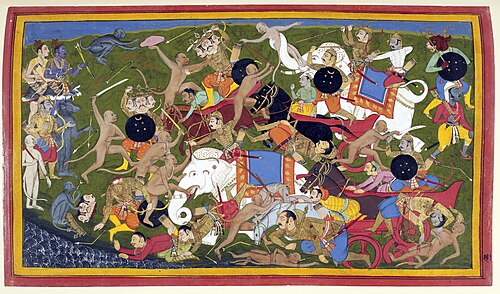
Rama searched everywhere. He made friends with a kingdom of monkeys and bears. The bravest monkey, Hanuman, made a giant leap across the sea, found Sita in Ravana's garden and told her that Rama was coming. Then the monkeys built a bridge of stones across the sea, and Rama's army fought a great battle. Rama defeated Ravana and rescued Sita.
The story is called the Ramayana, which means "Rama's journey". It was first written as a long poem in Sanskrit, an old language of India. Since then people have retold it in hundreds of ways: in other languages, in dance, puppet shows, paintings, comics and television. Every autumn, at the festival of Dussehra, many people in India burn huge figures of Ravana to celebrate good winning over evil.
At a glance
- Type
- Sanskrit epic poem (itihāsa, "so it was"); traditionally called the ādikāvya, the "first poem"
- Traditional author
- The sage Valmiki (Vālmīki)
- Date
- Formed over several centuries; the core is often placed between about the 7th/5th and 4th centuries BCE, with later layers extending to about the 3rd century CE (dates debated)
- Length
- About 24,000 verses (ślokas) in roughly 500 cantos (sargas)
- Structure
- Seven books (kāṇḍas): Bāla, Ayodhyā, Araṇya, Kiṣkindhā, Sundara, Yuddha, Uttara
- Setting
- Ayodhya and the kingdom of Kosala in the Ganges plain, the forests of central and southern India, and Lanka
- Main characters
- Rama, Sita, Lakshmana, Bharata, Dasharatha, Kaikeyi, Hanuman, Sugriva, Ravana
- Reach
- Retold in almost every language of South Asia and across Southeast Asia (Thailand, Cambodia, Laos, Myanmar, Malaysia, Indonesia)
Easy
What is the Ramayana?
The Ramayana ("Rama's journey" or "Rama's progress") is one of the two great Sanskrit epics of ancient India; the other is the Mahabharata. It tells the life of Rama, prince of Ayodhya, who is exiled to the forest, loses his wife Sita to the demon king Ravana, and recovers her in a great war on the island of Lanka.
Indian tradition calls it the ādikāvya, the "first poem", and calls its author, the sage Valmiki, the ādikavi, the "first poet". This does not mean it is the oldest Sanskrit text; the Vedas are much older. It means that the Ramayana was remembered as the first work of kāvya, polished poetry composed with conscious art, as opposed to hymns or ritual texts.
The version attributed to Valmiki has about 24,000 verses, mostly in the two-line śloka metre. It is divided into seven books called kāṇḍas. Most modern scholars think the poem grew over several centuries, from oral storytelling to a written text, and that the first and last books were added later than the central five.
The Ramayana is at once a story, a moral guide and, for many Hindus, a sacred text. Rama is worshipped as an avatar (earthly form) of the god Vishnu, and Hanuman is one of the most beloved deities in India. The story is also shared by Buddhists and Jains and by many people in Southeast Asia who know it mainly as a national epic and a theatre tradition.
Easy
The story, book by book
Book 1, Bāla Kāṇḍa (Childhood): King Dasharatha of Ayodhya has no sons, so he performs a great sacrifice. Four sons are born to his three queens: Rama to Kausalya, Bharata to Kaikeyi, and the twins Lakshmana and Shatrughna to Sumitra. As a youth Rama goes with the sage Vishvamitra to protect his rituals from demons. At the court of King Janaka of Videha, Rama bends and breaks the mighty bow of the god Shiva, which no one else could lift, and so wins the hand of Janaka's daughter Sita, who was found as a baby in a furrow of the earth.
Book 2, Ayodhyā Kāṇḍa (Ayodhya): Dasharatha decides to crown Rama as heir. But Queen Kaikeyi, encouraged by her maid Manthara, reminds the king of two wishes he once promised her. She demands that her son Bharata be crowned and that Rama be exiled to the forest for fourteen years. Bound by his word, the king agrees and soon dies of grief. Rama leaves calmly with Sita and Lakshmana. Bharata refuses to take the throne; he places Rama's sandals on it and rules only as Rama's deputy until his return.
Book 3, Araṇya Kāṇḍa (Forest): In the forest the demoness Shurpanakha tries to seduce Rama and Lakshmana and is mutilated by Lakshmana. Her brother Ravana, the ten-headed king of Lanka, takes revenge. His follower Maricha turns into a golden deer; while Rama chases it and Lakshmana follows, Ravana carries Sita away. The old vulture Jatayu fights Ravana and is mortally wounded, but lives long enough to tell Rama what happened.
Book 4, Kiṣkindhā Kāṇḍa (Kishkindha): Rama allies with Sugriva, an exiled monkey (vānara) prince, and helps him defeat his brother Vali and regain the throne of Kishkindha. In return Sugriva sends search parties in every direction. Book 5, Sundara Kāṇḍa (the "Beautiful" book), belongs to Hanuman: he leaps across the ocean, finds Sita in Ravana's grove of ashoka trees, gives her Rama's ring, and sets Lanka on fire with his burning tail before returning.
Book 6, Yuddha Kāṇḍa (War): The monkey army builds a causeway across the sea to Lanka. After many battles against Ravana's warriors, including his son Indrajit and his giant brother Kumbhakarna, Rama kills Ravana. Ravana's brother Vibhishana, who had joined Rama, becomes king of Lanka. Rama at first refuses to take Sita back; she proves her purity by entering a fire, from which the fire god returns her unharmed. They return to Ayodhya, and Rama is crowned. Book 7, Uttara Kāṇḍa (the Last book), continues the story: Rama banishes the pregnant Sita because his subjects gossip about her time in Ravana's house. She gives birth to twins, Lava and Kusha, in Valmiki's hermitage. Years later the boys recite the Ramayana at Rama's court; Sita is recalled, and instead of undergoing another test she asks the Earth, her mother, to take her back, and the ground opens and receives her.
Easy
Valmiki and the birth of poetry
Almost nothing historical is known about Valmiki. The epic itself makes him a character: a sage whose hermitage gives shelter to Sita and her sons, and who teaches the poem to Lava and Kusha. Later legends, not found in the early text, say he was once a robber who was turned toward a holy life by sages and meditated so long that an anthill (valmīka) grew around him, which explains his name.
The Bāla Kāṇḍa tells a famous story about how the poem began. Valmiki saw a hunter shoot one of a pair of mating cranes (krauñca). Moved by the cry of the surviving bird, he spoke a curse, and to his surprise the words came out in a regular metre. The god Brahma then told him to use this new metre, the śloka, to tell the story of Rama. In this legend, poetry (śloka) is born from grief (śoka), a play on words that later Sanskrit critics loved.
Modern scholars treat Valmiki as the name attached to a tradition rather than as a single author whose life can be dated. The poem probably took shape through generations of bards who performed it aloud, before a relatively fixed text was written down. Many retellings in other languages keep Valmiki's name as the original teller even when they change the story considerably.
Intermediate
Dharma, kingship and the ideal family
The central idea of the Ramayana is dharma: duty, righteousness and the order that holds society and the cosmos together. Rama is presented as the ideal man (maryādā puruṣottama in later tradition), who keeps his father's promise even when it costs him a kingdom. Bharata's refusal of the throne, Lakshmana's devotion and Sita's loyalty show dharma in other relationships: brother to brother, wife to husband, subject to king.
The poem is also a reflection on kingship. Ayodhya under Rama becomes the model of a perfect kingdom, and "Rāma-rājya" (the rule of Rama) came to mean a golden age of justice and prosperity. In the modern era Mahatma Gandhi used Ram Rajya as a name for his vision of a just, self-governing India. The exile books, in contrast, describe the dangers of court politics: a single broken promise nearly destroys the royal house.
The epic does not present its moral problems as simple. Readers have argued for two thousand years about Rama's killing of Vali from hiding, about the mutilation of Shurpanakha, about the fire ordeal and above all about the banishment of Sita in the Uttara Kāṇḍa. The Sanskrit dramatist Bhavabhuti (8th century) wrote a play, the Uttararāmacarita, that reworks the ending and reunites Rama and Sita, showing that even classical authors found the original troubling.
Devotion (bhakti) is another important theme, especially in later versions. Hanuman embodies selfless devotion to Rama, and in many regional Ramayanas the main purpose of hearing the story is to grow in love of Rama as God. Ravana, meanwhile, is not simply a monster: he is a learned king and a devotee of Shiva, brought down by desire and pride. Some later traditions even see him as a figure who achieves liberation by dying at Rama's hands.
Intermediate
Historical and geographical context
The world of the Ramayana is the world of kingdoms in the middle Ganges plain, such as Kosala (capital Ayodhya) and Videha (capital Mithila), which appear in late Vedic and early Buddhist texts. The forests to the south, inhabited in the poem by hermits, demons (rākṣasas), monkeys and bears, reflect how people in the north imagined the less familiar regions of central and southern India.
Many historians see in the story echoes of the spread of settled, Brahmanical society into forest regions in the first millennium BCE. Others warn against reading the epic as a coded history of real migrations or conflicts; the monkeys and demons are literary and religious figures, and identifying them with particular peoples has sometimes been used to support prejudice.
There is no archaeological evidence for the events of the story, and scholars do not agree whether any historical king lies behind Rama. The location of Lanka is itself debated: most traditions identify it with Sri Lanka, but some scholars have argued that the geography of the early text points to a place in central India. Modern Ayodhya, in Uttar Pradesh, has been identified with Rama's city for many centuries, while the earlier city of Saketa is often thought to lie at or near the same site.
Intermediate
Many Ramayanas across India
Valmiki's poem is not the only Ramayana. The Mahabharata contains its own short version, the Rāmopākhyāna. Buddhists preserved the Dasharatha Jātaka, in which Rama is a previous life of the Buddha and there is no abduction by Ravana. Jains told the story in works such as Vimalasuri's Prakrit Paumacariya, where Rama is a Jain hero and it is Lakshmana, not Rama, who kills Ravana.
From the medieval period, great poets retold the story in regional languages. Kamban's Tamil Irāmāvatāram (often dated to the 12th century) is a masterpiece of Tamil literature. Krittivas wrote a Bengali version, Ezhuthachan a Malayalam one, and Tulsidas composed the Awadhi Rāmcaritmānas (begun in 1574 according to its own account), which became the most widely recited Ramayana in northern India. Its public performance as Ramlila, a staged drama over many nights, is recognized by UNESCO as intangible cultural heritage.
These versions differ in important ways. Tulsidas, for example, says that the real Sita was hidden in the fire before the abduction and only an illusory Sita was taken, so that the goddess is never touched by Ravana. Folk and women's songs often tell the story from Sita's point of view. The scholar A. K. Ramanujan, in a well-known essay titled "Three Hundred Rāmāyaṇas", argued that there is no single original story but a vast family of tellings; the essay caused controversy when it was removed from a Delhi University syllabus in 2011.
Intermediate
The Ramayana in Southeast Asia
The Ramayana travelled with traders, priests and courtly culture to Southeast Asia during the first millennium CE. In Java the Old Javanese Kakawin Rāmāyaṇa, usually dated to the 9th century, is one of the earliest works of Javanese literature, and scenes from the story are carved on the 9th-century Hindu temple complex of Prambanan. At Angkor Wat in Cambodia, 12th-century reliefs show the battle of Lanka.
Each region made the story its own. Cambodia has the Reamker; Laos the Phra Lak Phra Lam; Myanmar the Yama Zatdaw; Malaysia the Hikayat Seri Rama, which was retold within a Muslim society. In Thailand the Ramakien, whose best-known version was composed under King Rama I at the end of the 18th century, became a national epic. Its episodes are painted around the cloister of the Temple of the Emerald Buddha in Bangkok, and the kings of the Chakri dynasty are known in English as Rama I, Rama II and so on.
In much of Southeast Asia the Ramayana lives above all in performance: shadow puppetry (wayang kulit in Indonesia and Malaysia, nang yai in Thailand), masked dance (khon), and court and temple dance. Hanuman often becomes a more playful and romantic hero than in Sanskrit, and local characters and jokes are added. These traditions show that the epic is a shared Asian heritage, not only an Indian one.
Intermediate
The Ramayana in modern times
The Ramayana remains alive in daily life. The festival of Dussehra (Vijayadashami) celebrates Rama's victory over Ravana, often by burning giant effigies; Diwali, the festival of lights, is linked in northern India with Rama's return to Ayodhya. Children's comics, films and animated series retell the story, and the phrase "Lakshman rekha" (Lakshmana's line, a boundary not to be crossed) is part of everyday Hindi and English in India.
In 1987–88 a television serial of the Ramayana directed by Ramanand Sagar was broadcast on India's state channel Doordarshan and drew enormous audiences; streets reportedly emptied when it aired. Scholars have argued that the serial helped create a more uniform national image of Rama.
The epic has also become part of modern politics. The claim that a mosque in Ayodhya, the Babri Masjid, stood on Rama's birthplace became the centre of a long dispute. The mosque was demolished by activists in 1992, followed by deadly riots; in 2019 India's Supreme Court awarded the site for a temple and allotted separate land for a mosque, and a temple was consecrated in January 2024. Many Hindus see the temple as the fulfilment of a religious hope, while many Muslims and secular critics see the events as an injury to India's plural society. Both views are part of the Ramayana's modern history.
Writers have also retold the epic critically. Dalit and Dravidian movements in the 20th century, for example, challenged the portrayal of southern peoples as demons, and feminist writers have retold the story from the perspective of Sita, Shurpanakha or Urmila, Lakshmana's wife left behind in Ayodhya.
Advanced
Dating and the growth of the text
Scholarly estimates of the Ramayana's date vary widely. Robert P. Goldman, general editor of the Princeton translation, has argued for an oral core in roughly the 8th to 6th centuries BCE, noting that the epic reflects a political world of small Gangetic kingdoms and does not mention the rise of Magadha or of Pataliputra. John Brockington, analysing the language and style, distinguishes several stages, with the main body of the poem taking shape from around the 5th–4th centuries BCE and later additions continuing into the first centuries CE. A common summary is a core by about the 4th century BCE and a complete text by about the 3rd century CE.
Since Hermann Jacobi's work in the 1890s, most scholars have held that Books 2–6 form the oldest core and that Books 1 and 7 are later. Arguments include differences in language and style; the fact that the portrayal of Rama as an incarnation of Vishnu appears mainly in the first and last books, while in the core he is chiefly a heroic human prince; and the presence of summaries and tables of contents that do not match the full text. Some scholars, however, argue that the whole epic should be read as a meaningful literary unity, whatever its history.
Dating is complicated because the text was transmitted orally and then in manuscripts written on perishable materials. The surviving manuscripts are far later than the composition; the oldest are roughly a thousand years old and come from Nepal. The relationship between Valmiki's epic and the Mahabharata's Rāmopākhyāna, and between both and the Buddhist Dasharatha Jātaka, is also debated: scholars disagree about which preserves older material.
Advanced
Manuscripts, recensions and the critical edition
Manuscripts of the Valmiki Ramayana fall into two main recensions (families of text), a northern and a southern, with the northern often divided further into north-western and north-eastern versions. They share most of the story but differ in about a third of their verses, in wording and in the order and presence of many episodes. Some well-known passages found in popular versions appear only in some branches.
Between about 1960 and 1975 the Oriental Institute of the Maharaja Sayajirao University of Baroda published a critical edition, comparing a large number of manuscripts from across India to reconstruct the oldest recoverable form of the text. Passages found only in part of the tradition were moved to footnotes and appendices. The Princeton University Press translation led by Robert P. Goldman and Sally J. Sutherland Goldman, completed in the 2010s, is based on this edition and has extensive notes on variant readings and commentaries.
The critical edition has been very influential but also criticized. Some scholars argue that the idea of a single archetype does not suit an oral epic that always existed in multiple performances, and that the edition gives the misleading impression of an "original" text. Others defend it as the best available tool for seeing how the tradition grew. Traditional commentaries in Sanskrit, such as those by Govindaraja and others from the medieval period, show how learned readers in India interpreted difficult passages, often in the light of devotional theology.
Advanced
Interpretive debates: gender, caste and power
The treatment of Sita is the most debated question in modern Ramayana studies. Some read her as a model of wifely devotion and strength; others read the fire ordeal and the banishment as evidence of patriarchal control over women's bodies. Scholars have also stressed that Sita's final refusal to prove herself again, and her return to the Earth, can be read as an act of dignity and protest within the text itself.
The Uttara Kāṇḍa includes the episode of Shambuka, a Shudra (a member of the lowest of the four traditional varṇas) whom Rama kills for practising asceticism, which in the story had been reserved for higher castes. This episode has been criticized by anti-caste thinkers such as B. R. Ambedkar and E. V. Ramasamy (Periyar), while defenders of the tradition have noted that it belongs to the later layer of the text or have interpreted it allegorically. The debate shows how the epic's authority makes its difficult passages politically significant.
Another line of research, associated with Sheldon Pollock among others, asks how the Ramayana shaped ideas of divine kingship and how its imagery of a righteous king opposing a demonic "other" was used by rulers in different periods. Anthropologists and folklorists, by contrast, have emphasized the plurality of tellings and the ways ordinary performers adapt the story, as in the essays collected in Paula Richman's volume Many Rāmāyaṇas (1991). Together these approaches treat the Ramayana not as a fixed book but as a living tradition that each community reads through its own concerns.
Key ideas
- Dharma
- Duty and righteousness; Rama keeps his father's word even at the cost of his throne, and every major character is tested by what dharma requires.
- Ādikāvya
- "First poem": the Ramayana is remembered as the first artful Sanskrit poem, and the legend of Valmiki's crane links poetry to compassion and grief.
- Ideal kingship (Ram Rajya)
- Rama's reign became a model of just rule, invoked by later kings and by modern leaders including Gandhi.
- Devotion (bhakti)
- Especially in later versions, the story is a way to love Rama as God; Hanuman is the model devotee.
- Many Ramayanas
- There is not one Ramayana but hundreds of versions in different languages, religions and art forms across South and Southeast Asia.
- Layers of composition
- The epic grew over centuries; most scholars see Books 2–6 as the core and Books 1 and 7 as later additions.
- Contested ethics
- Episodes such as Sita's fire ordeal and banishment, Vali's killing and Shambuka's death have provoked debate for centuries.
Records
- c. 600 BCE — Approximate period of the Gangetic kingdoms, such as Kosala and Videha, that form the background of the story; oral storytelling about Rama may already have begun (dates debated).
- c. 400 BCE — The core of the Valmiki Ramayana (Books 2–6) is thought to have taken shape by around this time.
- c. 200 CE — Later layers, including much of Books 1 and 7, are thought to be complete by around the 2nd–3rd centuries CE.
- c. 700 CE — Bhavabhuti writes the Sanskrit play Uttararāmacarita, reworking the story's ending.
- c. 850 CE — Ramayana reliefs are carved at Prambanan in Java; the Old Javanese Kakawin Rāmāyaṇa is composed around this period.
- c. 1150 — Kamban composes the Tamil Irāmāvatāram (date debated).
- 1574 — Tulsidas begins the Awadhi Rāmcaritmānas, according to the poem itself.
- c. 1797 — The Thai Ramakien is composed under King Rama I.
- c. 1960 — The Baroda critical edition of the Valmiki Ramayana begins publication (completed about 1975).
- 1987 — Ramanand Sagar's Ramayana television serial begins broadcasting on Doordarshan.
- 1992 — The Babri Masjid in Ayodhya is demolished, leading to deadly violence and a long legal dispute.
- 2024 — A Rama temple is consecrated at Ayodhya after the Supreme Court's 2019 judgment.
Glossary
- Epic
- A long narrative poem about heroes and great events.
- Sanskrit
- The classical language of ancient India, used for religious, literary and learned texts.
- Śloka
- A two-line verse form of 32 syllables, the main metre of the Ramayana and Mahabharata.
- Kāṇḍa
- A book or major division of the Ramayana; there are seven.
- Avatar
- A god's descent to earth in a particular form; Rama is regarded as an avatar of Vishnu.
- Rākṣasa
- A demon or ogre in Indian mythology; Ravana is king of the rākṣasas.
- Vānara
- The monkey people of the epic, including Hanuman and Sugriva.
- Recension
- A family of manuscripts that share a particular version of a text.
- Critical edition
- An edition that compares many manuscripts to reconstruct the earliest recoverable text.
- Ramlila
- A traditional dramatic performance of the Rama story, especially in northern India around Dussehra.
Questions and answers
Is the Ramayana a true story?
Many Hindus regard Rama as a historical and divine figure. Historians have found no archaeological evidence for the events, and most treat the epic as literature and sacred tradition that may contain distant memories of real places and societies.
Who is Hanuman?
Hanuman is a monkey hero, son of the wind god, who finds Sita in Lanka and helps Rama win the war. He is worshipped as a symbol of strength and devotion.
How long is the Ramayana?
The Valmiki Ramayana has about 24,000 verses, a little longer than the Iliad and Odyssey together. Many later versions are shorter or longer.
Why did Rama send Sita away?
In the last book, Rama banishes Sita because his subjects doubted her purity after her time in Ravana's palace. This episode is in the later layer of the text and has been debated and retold differently for centuries.
Which parts of the Ramayana are the oldest?
Most scholars since Hermann Jacobi think Books 2 to 6 are the oldest core, while Book 1 (Rama's childhood) and Book 7 (the aftermath and Sita's banishment) were added later.
Is there one "original" Ramayana?
The Valmiki text is the oldest surviving full version, but it exists in several manuscript recensions, and the story was also told independently by Buddhists, Jains and many regional poets. Scholars such as A. K. Ramanujan have stressed this plurality.
Why do Thai kings use the name Rama?
The Chakri dynasty closely identifies itself with the hero of the Ramakien, the Thai Ramayana. In the early 20th century King Vajiravudh introduced the custom of referring to the dynasty's kings as Rama I, Rama II and so on, and the usage became standard.
Sources and further reading
- Ramayana. Wikipedia
- Valmiki. Wikipedia
- Ramakien. Wikipedia
- Ramcharitmanas. Wikipedia
- 라마야나. Wikipedia (Korean)
- Robert P. Goldman, Sally J. Sutherland Goldman et al. (trans.), The Rāmāyaṇa of Vālmīki: An Epic of Ancient India (7 vols.). Princeton University Press, 1984–2017
- John Brockington, The Sanskrit Epics. Brill, 1998
- Paula Richman (ed.), Many Rāmāyaṇas: The Diversity of a Narrative Tradition in South Asia. University of California Press, 1991
Related
- MahabharataA vast Sanskrit epic centered on a conflict between related royal families, with the Bhagavad Gita among its parts.
- RigvedaThe oldest collection of Vedic Sanskrit hymns, handed down orally for centuries before it was written down.
- KālidāsaA Sanskrit poet and playwright whose works are landmarks of classical Indian literature.
- Angkor WatMonumental temple complex built in the Khmer Empire under King Suryavarman II.
- KabirNorth Indian poet-saint whose verses question religious boundaries and outward ritual.
- Siddhartha Gautama (the Buddha)Founder of Buddhism, who taught a path to liberation from suffering on the Ganges plain. His dates are disputed.
Written with AI assistance from the published sources listed above, and revised as new research appears.