Start at the top for an easy introduction. Go further down for more detail and scholarship.
- Easy
- Intermediate
- Advanced
For young readers
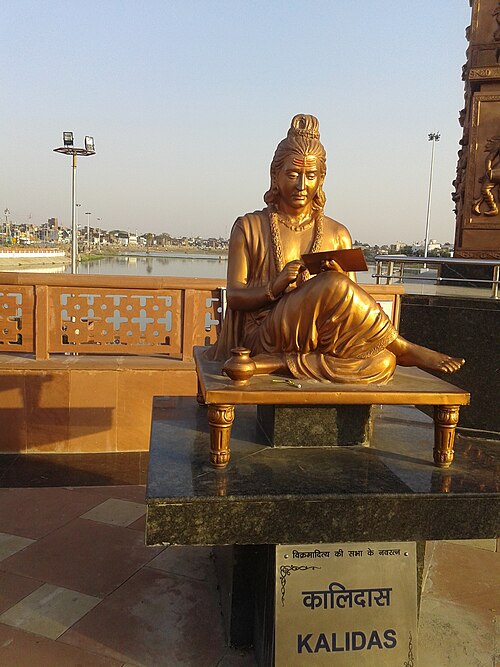
Kālidāsa lived in India a very long time ago, probably around 400 CE. He wrote in Sanskrit, the old language of Indian poetry, religion and learning, a bit like Latin in Europe. We know almost nothing for certain about his life, but his poems and plays have been loved for more than 1,500 years.
His most famous play is Shakuntala. A king goes hunting in the forest and falls in love with Shakuntala, a girl who grew up in a hermitage among deer and flowers. They marry, and the king gives her a ring. But a grumpy sage puts a curse on her: the king will forget her until he sees the ring again. Then she loses the ring in a river! In the end a fisherman finds it inside a fish, the king remembers, and the family is happily reunited.
In another poem, The Cloud Messenger, a lonely spirit far away from home asks a rain cloud to carry a love message to his wife. He tells the cloud about all the mountains, rivers and cities it will float over on the way north. Reading it is like taking a trip across India on a cloud.
Kālidāsa was especially good at comparisons, saying that one thing is like another in a surprising and beautiful way. Indian readers have an old saying that when it comes to similes, Kālidāsa is the best.
Stories grew up about him, too. One legend says he began as a foolish young man who married a clever princess by a trick and became a great poet only after praying to the goddess Kālī. His name means “servant of Kālī”. Historians think this story is a legend, but it shows how much people wondered about the man behind the poems.
At a glance
- Lived
- Uncertain; most scholars place him around the late 4th to 5th century CE, in the Gupta period
- Place
- Traditionally linked with Ujjain in central India; other regions, including Kashmir, Bengal and Vidisha, have also been proposed
- Language
- Classical Sanskrit (with Prakrit dialects for many characters in his plays)
- Plays
- Abhijñānaśākuntalam (Shakuntala), Vikramorvaśīyam, Mālavikāgnimitram
- Poems
- Raghuvaṃśa and Kumārasambhava (long court epics); Meghadūta (lyric); Ṛtusaṃhāra (attribution debated)
- Known for
- Refined language, vivid imagery of nature, masterly similes, and the aesthetic of emotional “taste” (rasa)
- Earliest evidence
- Named as a famous poet in the Aihole inscription of 634 CE; echoes of his verse have been seen in a Mandasor inscription of 473 CE
- Influence
- A model for later Sanskrit poets; Shakuntala, translated into English in 1789, inspired Goethe and European Romanticism
Easy
Who was Kālidāsa?
Kālidāsa is the most celebrated poet and dramatist of classical Sanskrit literature. Three plays, two long narrative poems and one famous lyric poem are generally accepted as his, and they became models of perfect style for Indian writers for more than a thousand years. His name means “servant of Kālī”, the Hindu goddess, suggesting that he or his family were devotees of Shiva and his consort, though his works also honour other gods.
We know very little about his life. He tells us almost nothing about himself, and no reliable biography survives from his time. Most scholars think he lived in the late fourth or fifth century CE, when the Gupta dynasty ruled much of northern India. His loving descriptions of the city of Ujjain have led many to connect him with that city, which was an important royal and cultural centre.
Kālidāsa wrote in Sanskrit, the classical language of learning, religion and courtly literature in South Asia. In his plays, kings, gods and Brahmin men speak Sanskrit, while women, servants and many other characters speak various Prakrits, the spoken languages of the time. This mix reflects the social world of the royal court for which he wrote.
Kālidāsa’s works are still read, performed and taught across India and beyond. His plays are staged in Sanskrit and in translation, his poems are set to music and dance, and the Kālidāsa Samman, one of India’s arts awards, is named after him.
Easy
Legends about his life
Because so little is known, many legends grew up around Kālidāsa. The most famous says that he was born a simple, uneducated young man. A proud and learned princess had refused every suitor who could not beat her in debate. Her enemies tricked her into marrying the foolish Kālidāsa, pretending that his silent gestures were deep philosophy. When she discovered the truth she rejected him, and in shame he prayed to the goddess Kālī, who gave him the gift of poetry.
Another tradition makes him one of the “Nine Gems” (navaratna), nine famous scholars and artists at the court of a king called Vikramāditya of Ujjain. This list comes from a verse in a much later text, and the people it names lived at very different times, so historians regard it as legendary. The legend nevertheless reflects a real possibility: many scholars think Kālidāsa was connected with the court of the Gupta king Chandragupta II, who used the title Vikramāditya.
Other stories, told in various regions, describe his travels, his death in Sri Lanka, or his rivalries with other poets. These tales tell us how later people imagined the ideal poet, not facts about the historical Kālidāsa.
Easy
Shakuntala: the recognition of a lost love
Kālidāsa’s masterpiece is the play Abhijñānaśākuntalam, “The Recognition of Shakuntala”, in seven acts. King Duṣyanta, hunting in the forest, enters the hermitage of the sage Kaṇva and meets Shakuntala, Kaṇva’s adopted daughter, the child of a nymph and a royal sage. They fall in love and marry privately in the gāndharva way, by mutual consent. The king returns to his capital, leaving her his signet ring as a promise.
Lost in thoughts of the king, Shakuntala fails to greet the short-tempered sage Durvāsas, who curses her: the one she is thinking of will forget her. Softened by her friends, he adds that the curse will end when the king sees a token of recognition. On the way to court, pregnant, Shakuntala loses the ring in a sacred pool. The king does not recognize her, and she is carried away by her divine mother.
Later a fisherman finds the ring in the belly of a fish. The moment the king sees it, his memory returns and he is overwhelmed by grief. In the final act, after helping the god Indra in a war against demons, he finds Shakuntala and their son Bharata in a heavenly hermitage, and the family is reunited. Bharata is remembered as the ancestor of a great royal line, and India’s official name, Bhārat, is traditionally linked to him.
The story comes from the Mahābhārata, but Kālidāsa transformed it. In the epic, the king remembers Shakuntala perfectly but denies her for fear of scandal; in the play, the curse and the lost ring free him from blame and turn the story into a meditation on memory, love and loss. The farewell scene of Act Four, in which Shakuntala leaves the hermitage and the plants, animals and her foster father mourn her departure, is among the most admired passages in Sanskrit literature.
Intermediate
The Cloud Messenger: a journey across India
The Meghadūta (“Cloud Messenger”) is a lyric poem of about 110 to 120 stanzas, depending on the manuscript tradition, all in the slow, stately mandākrāntā metre. A yakṣa, a minor divine being in the service of Kubera, the god of wealth, has been exiled for a year to the hills of Rāmagiri in central India because he neglected his duties. At the beginning of the rainy season, longing for his wife in the Himalayan city of Alakā, he asks a passing cloud to carry a message to her.
The first part of the poem describes the cloud’s route northward: mountains, rivers, forests and cities, including a long, affectionate description of Ujjain and its temple of Shiva Mahākāla. Each place is presented through the eyes of a lover, so that the landscape itself seems full of desire. The second part describes the magical city of Alakā, the yakṣa’s house and his wife, pale and thin with longing, and gives the message itself, with its hope of reunion when the exile ends.
The Meghadūta created a whole genre, the sandeśa-kāvya or “messenger poem”, in which a lover sends a message by a cloud, a bird, the wind or another messenger. Many later poets in Sanskrit and other South Asian languages imitated it. It was translated into English by Horace Hayman Wilson in 1813 and has since been translated into many languages; Gustav Holst composed a choral work based on it.
Intermediate
The court epics: Raghuvaṃśa and Kumārasambhava
Kālidāsa also wrote two mahākāvyas, long courtly poems in many cantos, a genre that later Sanskrit critics treated as the highest form of poetry. The Raghuvaṃśa (“Lineage of Raghu”) tells the history of the solar dynasty, the family of kings to which Rāma, the hero of the Rāmāyaṇa, belongs. In nineteen cantos, it moves from King Dilīpa and his devotion to a sacred cow, through the world conquest of Raghu and the story of Rāma, to the dissolute last king Agnivarṇa, whose reign ends the poem.
The Raghuvaṃśa is both a celebration and a reflection on kingship. Good kings are shown protecting their people, keeping order and giving generously, while the final decline shows the danger of rulers who abandon their duty. Some scholars read Raghu’s world conquest as a poetic image of the campaigns of the Gupta kings.
The Kumārasambhava (“Birth of Kumāra”) tells how the goddess Pārvatī, daughter of the Himalaya mountain, wins the love of the ascetic god Shiva through her own austerities, so that their son Kumāra (Skanda) can be born to defeat a demon. Its descriptions of the Himalaya, of Pārvatī’s beauty and penance, and of the god Kāma burned to ashes by Shiva’s third eye are famous. Most scholars think Kālidāsa wrote only the first eight cantos; the later cantos, which narrate Kumāra’s birth and victory, are generally regarded as additions by another hand.
In the eighth canto, Kālidāsa describes the love of Shiva and Pārvatī in openly sensual terms. Later critics debated whether such a description of the divine parents of the universe was appropriate, a debate that shows how highly his work was valued and how closely it was read.
Intermediate
The other plays and the poem of the seasons
Mālavikāgnimitram (“Mālavikā and Agnimitra”) is usually regarded as Kālidāsa’s earliest play. It is a light court comedy about King Agnimitra, a historical ruler of the Śuṅga dynasty of the second century BCE, who falls in love with Mālavikā, a dancing girl in the queen’s service who turns out to be a princess. Its prologue famously asks the audience to give a new poet a fair hearing even though the old masters are so well known.
Vikramorvaśīyam (“Urvaśī Won by Valour”) retells an ancient story found as far back as the Ṛgveda: the love of the mortal king Purūravas for the heavenly nymph Urvaśī. Its fourth act, in which the king, maddened by her loss, wanders through the forest questioning plants and animals, includes songs in Prakrit and has been admired as an early example of lyrical drama.
The Ṛtusaṃhāra (“Garland of the Seasons”) describes the six Indian seasons, from the burning summer through the rains to spring, in relation to love. Traditionally it is called Kālidāsa’s youthful work, but many scholars doubt that he wrote it, because its style is simpler than his other poems and early critics rarely cite it.
Many other works, including handbooks on metre and astrology, were later attributed to Kālidāsa, showing how his name became a mark of quality. Scholars generally accept only the six or seven works described above.
Intermediate
Historical context: the Gupta age and Sanskrit court culture
If the usual dating is correct, Kālidāsa lived under the Gupta dynasty, which ruled much of northern India from the fourth to the sixth century CE. Chandragupta II (reigned about 380–415), who took the title Vikramāditya and whose empire included Ujjain, is the king most often suggested as his patron, but there is no direct evidence.
The Gupta period is often called a “classical age” of Indian culture, although modern historians caution that this label can hide the achievements of other periods and regions. It saw the flourishing of Sanskrit literature, of Hindu temple architecture and sculpture, of mathematics and astronomy, and of Buddhist centres of learning. The Ajanta cave paintings, some of which were made in the fifth century under a related dynasty, share with Kālidāsa a courtly world of elegance and love.
Sanskrit had become a language of political prestige used by rulers across South and Southeast Asia, from inscriptions to royal poetry. Court poets like Kālidāsa were expected to master grammar, metre, rhetoric, the epics, religious lore, the arts of love and the sciences of kingship. Their works were performed and recited before connoisseurs called sahṛdaya, “those with sympathetic hearts”, who could appreciate subtle suggestion and emotion.
Kālidāsa’s works reflect the religious world of his time: devotion to Shiva and Vishnu, respect for Brahmin sages and hermitages, and belief in karma and the duties of each stage of life. They also idealize kingship, portraying the king as protector of the moral order (dharma), a view that fitted well with royal patronage.
Intermediate
Style and ideas: rasa, similes and nature
Indian aesthetics describes the goal of drama and poetry as rasa, literally “taste” or “flavour”: an emotional experience, such as love, heroism or compassion, that a sensitive audience savours through the art. Kālidāsa’s works are considered classic examples of śṛṅgāra rasa, the erotic or romantic mood, in both its forms: love in union and love in separation. Separation, as in Shakuntala’s rejection or the yakṣa’s exile, gives much of his poetry its intensity.
Kālidāsa is famous above all for his upamā, similes. A traditional saying, “upamā kālidāsasya”, declares that for similes one should look to Kālidāsa. His comparisons draw on nature, myth and daily life, and are admired for being exact as well as beautiful.
Nature in his work is not a background but a participant. Plants, animals, rivers and clouds share human emotions: the creepers of the hermitage seem to weep when Shakuntala leaves, and the cloud becomes a friend and messenger. This sympathy between humans and nature, and the precise observation of seasons, landscapes and animals, is one reason modern readers still find him fresh.
Later Sanskrit literary theorists, such as Ānandavardhana in the ninth century, drew many examples from Kālidāsa when explaining dhvani, “suggestion”, the idea that the deepest meaning of poetry is conveyed indirectly. His works thus helped shape not only the practice but also the theory of Sanskrit literature.
Intermediate
Influence in India and the world
Within South Asia, Kālidāsa became the standard of excellence. Later poets imitated his epics and messenger poem, critics cited his verses as models, and commentators wrote learned explanations of his works. The most famous commentator, Mallinātha, who probably lived in the fourteenth or fifteenth century in South India, wrote commentaries on his poems that are still printed alongside the texts.
In 1789 the British judge and scholar Sir William Jones, working in Calcutta, published an English translation of Shakuntala from which a German version by Georg Forster was made in 1791. The play caused a sensation. Johann Wolfgang von Goethe wrote an admiring epigram about it, and the prologue of his Faust is often said to be modelled on the prologue of Kālidāsa’s play. Within a century, dozens of translations had appeared in European languages, and Shakuntala helped create European Romantic images of India.
In modern India, Kālidāsa has been read in many ways: as a national classic, a poet of nature, a model for modern theatre, and an object of critical debate. Rabindranath Tagore wrote essays and poems about him; filmmakers, painters such as Raja Ravi Varma, dancers and theatre directors have adapted his works. The city of Ujjain holds an annual Kālidāsa festival, and his works are part of school and university curricula.
Western praise sometimes called him “the Shakespeare of India”. The comparison helped introduce him to new readers but can be misleading, since his art belongs to a different theatrical and poetic tradition with its own aims and rules.
Advanced
Scholarly debates: when did Kālidāsa live?
Kālidāsa’s dates have been argued for more than two centuries. The firmest limits are these. His play Mālavikāgnimitram has as its hero Agnimitra, a Śuṅga king of the second century BCE, so Kālidāsa cannot be earlier than that. At the other end, the Aihole inscription of the Chalukya king Pulakeśin II, dated 634 CE, names Kālidāsa together with the poet Bhāravi as a model of poetic fame, so he must have lived before then.
An older Indian tradition placed him at the court of a King Vikramāditya of Ujjain supposedly associated with the Vikrama era beginning in 57 BCE. Most modern scholars reject this, because there is no good evidence for such a king at that time, and Kālidāsa’s language, style and cultural references fit the Gupta period better.
The Gupta dating rests on several arguments. The title Vikramorvaśīyam may allude to the royal title Vikramāditya used by Chandragupta II; the Kumārasambhava, “birth of Kumāra”, has been connected with Kumāragupta, his successor. In the Raghuvaṃśa, Raghu’s conquests include peoples called Hūṇas, and some scholars see this as a reference to the Huns who reached the borders of India in the fifth century. A Sanskrit inscription at Mandasor dated 473 CE appears to echo verses of Kālidāsa. None of these arguments is decisive on its own, but together they have convinced most scholars to place him between about 350 and 475 CE.
Scholars such as V. V. Mirashi have also tried to locate his home by analysing his geography, arguing for Ujjain or the Vidarbha region, while others have proposed Kashmir because of his detailed knowledge of the Himalaya. The fact that experts disagree shows the limits of reading biography from poetry.
Advanced
Evidence and methods: manuscripts, recensions and commentaries
No manuscript from Kālidāsa’s time survives. His works were copied by hand for centuries on palm leaf and birch bark in many scripts, and the oldest surviving manuscripts are many centuries later than the author. As a result, there are significant variations between regional versions. Shakuntala survives in several recensions, including Bengali, Devanagari (northern and western), Kashmiri and South Indian versions, which differ in length and wording; the question of which is closest to the original has been debated since the nineteenth century.
Editors have used the methods of textual criticism, comparing manuscripts, noting variant readings and using the evidence of commentators and anthologies, to reconstruct the text. The commentaries themselves are valuable evidence, because they preserve readings and interpretations that circulated at particular times and places. Quotations of Kālidāsa’s verses in works on poetics and in anthologies show which passages were most famous.
The same methods help to decide questions of authorship. The spurious later cantos of the Kumārasambhava, the doubts about the Ṛtusaṃhāra, and the many works falsely ascribed to him are judged by style, metre, vocabulary, and whether early critics cite them.
Modern scholarship also asks how Kālidāsa should be read. Translators and critics such as Barbara Stoler Miller emphasized the theatrical and aesthetic logic of his plays within Indian traditions, rather than judging them by European standards. Others have examined questions of gender, power and nature in his works, for example how Shakuntala’s voice is shaped by the court’s ideals of womanhood. These debates keep Kālidāsa a living subject of study rather than a fixed monument.
Key ideas
- Kāvya
- Classical Sanskrit literary art, prized for polished language, figures of speech and emotional depth; Kālidāsa is its supreme model.
- Rasa
- The emotional “taste” that drama and poetry aim to create in a sensitive audience; Kālidāsa excels in the mood of love.
- Love in separation
- Longing between separated lovers, as in Shakuntala and the Meghadūta, is central to his poetry.
- Simile (upamā)
- Comparisons are Kālidāsa’s hallmark; tradition says that for similes he is unequalled.
- Sympathy of nature
- Plants, animals, rivers and clouds share human feelings and take part in the action.
- Ideal kingship
- His works portray the king as protector of dharma, reflecting and shaping the ideals of the royal court.
- Memory and recognition
- Shakuntala turns on forgetting and remembering, making recognition a moment of moral and emotional truth.
Records
- c. 150 BCE — Reign of the Śuṅga king Agnimitra, later the hero of Kālidāsa’s Mālavikāgnimitram.
- c. 380 CE — Chandragupta II (Vikramāditya) begins his reign; he is often proposed as Kālidāsa’s patron.
- c. 400 CE — Kālidāsa probably active (dates uncertain; most scholars place him c. 350–475).
- 473 CE — A Mandasor inscription appears to echo Kālidāsa’s verses.
- 634 CE — The Aihole inscription of Pulakeśin II names Kālidāsa as a model poet.
- c. 850 CE — Ānandavardhana cites Kālidāsa in developing the theory of poetic suggestion (dhvani).
- c. 1400 — Mallinātha writes his influential commentaries on Kālidāsa’s poems.
- 1789 — Sir William Jones publishes an English translation of Shakuntala in Calcutta.
- 1791 — Georg Forster’s German translation appears; Goethe writes an epigram praising the play.
- 1813 — Horace Hayman Wilson publishes an English translation of the Meghadūta.
Glossary
- Sanskrit
- The classical language of ancient and medieval South Asia, used for religion, learning and literature.
- Prakrit
- The spoken languages related to Sanskrit; in plays, used by women, servants and many other characters.
- Mahākāvya
- A long courtly poem in many cantos, considered the highest genre of Sanskrit poetry.
- Nāṭaka
- The main type of Sanskrit drama, usually with a hero of royal or divine origin; Shakuntala is the classic example.
- Gupta dynasty
- A dynasty that ruled much of northern India from the 4th to the 6th century CE.
- Yakṣa
- A nature spirit or minor divine being; the hero of the Meghadūta is a yakṣa serving Kubera.
- Mandākrāntā
- A slow, stately Sanskrit metre used throughout the Meghadūta.
- Sandeśa-kāvya
- The “messenger poem” genre, created by the Meghadūta.
- Recension
- A distinct version of a text, often associated with a region, arising from its manuscript transmission.
- Dhvani
- “Suggestion”: the theory that the finest poetic meaning is conveyed indirectly.
Questions and answers
When did Kālidāsa live?
We are not sure. Most scholars place him in the Gupta period, roughly 350–475 CE, but older traditions put him as early as the first century BCE.
What is Shakuntala about?
A king marries Shakuntala in a forest hermitage, forgets her because of a curse, and remembers her only when he sees the ring he gave her, found in a fish; the family is finally reunited.
Why is a cloud a messenger?
In the Meghadūta an exiled spirit sees the first rain cloud of the monsoon, the season when lovers long for each other, and asks it to carry his message north to his wife.
Was Kālidāsa really one of the Nine Gems of King Vikramāditya?
The Nine Gems list comes from a late text and names people from different periods, so historians regard it as legend, though he may have been linked to a Gupta court.
Did he write the Ṛtusaṃhāra?
Tradition says so, but many scholars doubt it because its style is simpler and early critics rarely cite it.
Why are there different versions of Shakuntala?
The play was copied by hand for centuries in different regions, producing several recensions that differ in length and wording.
How did Kālidāsa influence Europe?
William Jones’s 1789 English translation of Shakuntala and later German versions excited Goethe and other Romantics and helped shape European interest in Indian literature.
Sources and further reading
- Kālidāsa. Wikipedia
- Abhijnanashakuntalam. Wikipedia
- Meghadūta. Wikipedia
- Raghuvaṃśa. Wikipedia
- Kumārasambhava. Wikipedia
- 칼리다사. 위키백과
- Barbara Stoler Miller (ed.), Theater of Memory: The Plays of Kālidāsa. Columbia University Press, 1984
Related
- MahabharataA vast Sanskrit epic centered on a conflict between related royal families, with the Bhagavad Gita among its parts.
- RamayanaA Sanskrit epic about Rama, Sita and their exile, preserved in many versions across South and Southeast Asia.
- Ajanta CavesA group of Buddhist rock-cut caves in western India, known for monasteries, shrines and paintings.
- Johann Wolfgang von GoetheGerman writer whose poetry, drama and fiction, from the Sturm und Drang to Weimar Classicism, became central to German literature and European culture.
- Rabindranath TagoreBengali poet, writer and educator whose work reached readers across India and the wider world.
Written with AI assistance from the published sources listed above, and revised as new research appears.