Start at the top for an easy introduction. Go further down for more detail and scholarship.
- Easy
- Intermediate
- Advanced
For young readers
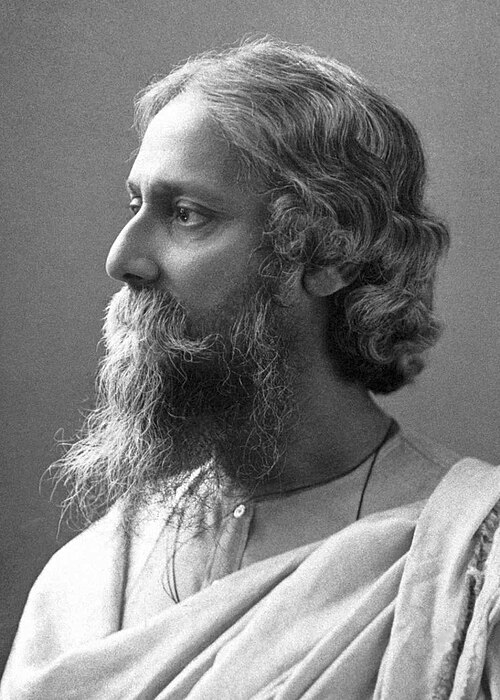
Rabindranath Tagore was born in 1861 in the big city of Calcutta (now Kolkata) in India. He was the youngest of many brothers and sisters in a large, busy family full of musicians, writers and thinkers. He did not like school at all, because he felt it was like a cage, so he mostly learned at home and by exploring on his own.
He started writing poems when he was about eight years old, and he never stopped. He wrote thousands of poems and more than two thousand songs, plus stories, plays and novels, mostly in his own language, Bengali. People in India and Bangladesh still sing his songs today, at weddings, festivals and in school.
Two countries use his songs as their national anthems: “Jana Gana Mana” in India and “Amar Shonar Bangla” in Bangladesh. That means millions of people sing his words every day.
Because he remembered how unhappy he was in school, he started his own school in a quiet place called Santiniketan. Children there often had lessons outdoors under the trees, and they learned music, art and nature study as well as reading and maths.
When he translated some of his poems into English, readers in Europe were amazed. In 1913 he won the Nobel Prize in Literature. He travelled all over the world, from Japan and China to Argentina and America, telling people that nations should not hate one another and that all human beings belong together.
At a glance
- Lived
- 7 May 1861 – 7 August 1941, Calcutta (Kolkata), British India
- Name
- Rabindranath Thakur in Bengali; “Tagore” is the anglicised family name; often called Gurudev (“revered teacher”)
- Language
- Wrote mainly in Bengali; also translated and wrote in English
- Forms
- Poetry, about 2,230 songs (Rabindra Sangeet), short stories, novels, plays, essays, letters; painting in later life
- Major works
- Gitanjali (1910; English Song Offerings, 1912), Gora (1910), The Home and the World (Ghare Baire, 1916), The Post Office (1912), Galpaguchchha (stories), Nationalism (1917)
- Institutions
- School at Santiniketan (1901); Visva-Bharati (1921; central university from 1951); rural reconstruction centre at Sriniketan (1920s)
- Honours
- Nobel Prize in Literature 1913; knighted 1915, renounced the knighthood in 1919 after the Jallianwala Bagh massacre
- Anthems
- Wrote the words and music of India’s “Jana Gana Mana” and Bangladesh’s “Amar Shonar Bangla”
Easy
Who was Rabindranath Tagore?
Rabindranath Tagore (1861–1941) was a writer from Bengal, the region in eastern South Asia that is now divided between India and Bangladesh. He is best known as a poet, but he did almost everything: he wrote songs and composed their music, told short stories, wrote novels and plays, gave lectures, founded a school and a university, worked to improve village life and, in his sixties, became a painter.
In Bengali his name is Rabindranath Thakur. “Tagore” is the way the British wrote the family name. People in South Asia often call him Gurudev, “revered teacher”, or Kabiguru, “poet-teacher”, and in Bangladesh and West Bengal he is simply known as Rabindranath or even “Robi Thakur”.
He lived under British colonial rule, and much of his life was spent thinking about how India could be free and modern without becoming narrow or hateful. He was proud of Indian traditions, but he also believed that the ideas of all cultures should meet and mix. His motto for his university, taken from an old Sanskrit verse, spoke of a place “where the whole world meets in a single nest”.
Easy
Growing up in the house at Jorasanko
Tagore was born on 7 May 1861 in the family mansion at Jorasanko in north Calcutta, then the capital of British India. He was the youngest of the surviving thirteen children of Debendranath Tagore, a wealthy landowner and religious reformer who led the Brahmo Samaj, a movement that sought a simple, non-idolatrous form of Hinduism based on the Upanishads.
The Tagore household was one of the centres of the “Bengal Renaissance”, a flowering of literature, religion, science and social reform in nineteenth-century Bengal. His brothers and sisters included a philosopher, a musician and playwright, the first Indian member of the elite Indian Civil Service, and one of the first Bengali women novelists. Plays, concerts and magazines were produced at home.
Rabindranath hated formal schooling and left several schools. He was taught at home by tutors and learned a great deal by himself. In 1878 he was sent to England to study, first at a school in Brighton and then briefly at University College London, but he returned in 1880 without a degree. In 1883 he married Mrinalini Devi; they had five children, two of whom died in childhood.
Several deaths marked his life deeply: his sister-in-law and close companion Kadambari Devi in 1884, and later, within a few years, his wife (1902), a daughter (1903), his father (1905) and his youngest son (1907). Grief, and the search for peace beyond it, became major themes of his poetry.
Easy
Rivers, villages and short stories
In 1890 Tagore’s father sent him to manage the family estates in rural East Bengal, around Shelaidaha on the Padma River (now in Bangladesh). He spent much of the next decade living on a houseboat, travelling along the rivers and meeting farmers, boatmen and village families.
This experience changed his writing. He wrote beautiful letters about the river landscape, later collected as Glimpses of Bengal, and a series of short stories about ordinary village people: a lonely postmaster and the orphan girl who serves him, a fruit-seller from Kabul who befriends a little girl in Calcutta, young brides trapped in unhappy marriages. Tagore is often called the creator of the modern Bengali short story; his stories were collected in Galpaguchchha (“a bunch of stories”).
The stories are gentle but also critical. They show the cruelty of the dowry system, the loneliness of child marriage and the gap between educated city people and the rural poor. Many were later made into films, including several by the Bengali director Satyajit Ray.
Intermediate
Santiniketan and Visva-Bharati: a school under the trees
In 1901 Tagore opened a small school at Santiniketan (“abode of peace”), an ashram his father had set up in the dry countryside of Birbhum, about 160 km north of Calcutta. It started with only a handful of pupils. Tagore wanted children to learn in harmony with nature, through music, drama, art and direct observation, not by memorising for examinations. Classes were often held outdoors under trees, a custom that continues today.
Over the years the school grew into an international university, Visva-Bharati, formally founded in 1921. Tagore invited scholars from Europe and Asia to teach there, including specialists in Chinese, Tibetan and Islamic studies, and he spent the Nobel Prize money and much of his own income on the institution. Its art school, Kala Bhavana, became a centre of modern Indian art. In 1951, after Tagore’s death, Visva-Bharati became a central university of India.
Nearby, at Sriniketan, Tagore and the English agricultural economist Leonard Elmhirst began an institute for rural reconstruction in the early 1920s. It worked on farming, health, crafts and cooperatives, reflecting Tagore’s belief that India’s freedom had to begin with self-reliant villages, not only with politics in the cities. In 2023 Santiniketan was inscribed on the UNESCO World Heritage List.
Intermediate
Gitanjali and the Nobel Prize
Gitanjali (“song offering”) was published in Bengali in 1910, with 157 devotional poems and songs addressed to a divine presence who is at once God, friend, lover and the life of the world. In 1912, while travelling to England, Tagore made his own English prose translations of some of these and other poems. In London the painter William Rothenstein showed them to the Irish poet W. B. Yeats, who was deeply moved and wrote an introduction.
The English Gitanjali: Song Offerings appeared in November 1912 with 103 prose poems, 53 from the Bengali Gitanjali and the rest from other collections. The translations were very free: Tagore shortened, rearranged and even combined poems, and turned rhymed Bengali songs into rhythmic English prose. Readers in Britain and America admired their simplicity and spiritual depth.
On 13 November 1913 the Swedish Academy announced that Tagore had won the Nobel Prize in Literature, citing his “profoundly sensitive, fresh and beautiful verse” which, “with consummate skill”, he had made part of the literature of the West “in his own English words”. He was the first non-European to receive the prize. Overnight he became world-famous, and the prize was celebrated across Asia as a sign that Asian writers could stand beside European ones.
One of the best-known poems of the English Gitanjali (No. 35) begins “Where the mind is without fear and the head is held high”. It imagines a free country where knowledge is open to all and the world is not “broken up into fragments by narrow domestic walls”. It is still recited in Indian schools.
Intermediate
Novels, songs, plays and paintings
Tagore wrote eight novels and several novellas. Chokher Bali (1903) explores the desires of a young widow in a society that forbade widows to remarry. Gora (serialised 1907–1910) follows a fiercely orthodox Hindu nationalist who discovers that he was born to Irish parents, a revelation that dissolves his ideas of purity and caste. The Home and the World (Ghare Baire, 1916) is set during the Swadeshi movement against the partition of Bengal and shows how a charismatic nationalist leader manipulates a young wife and divides a household.
Music was at the heart of Tagore’s creative life. He composed about 2,230 songs, known as Rabindra Sangeet, drawing on Indian classical music, Bengali folk traditions such as the songs of the wandering Bauls, and even Western melodies. They cover every mood, from devotion and love to the seasons and patriotism, and remain central to Bengali culture on both sides of the border.
He wrote many plays, including The Post Office (Dak Ghar, 1912), about a sick boy who dreams of the world beyond his window. In 1942, in the Warsaw Ghetto, the educator Janusz Korczak staged it with the orphans in his care, shortly before they were deported and murdered at Treblinka. Late in life, from his sixties onwards, Tagore also became a painter, producing a large body of striking, dreamlike drawings and paintings that were exhibited in Europe from 1930.
Intermediate
Freedom without hatred: Tagore on nationalism
When the British partitioned Bengal in 1905, Tagore joined the protest movement, writing patriotic songs such as “Amar Shonar Bangla” and leading processions in which Hindus and Muslims tied threads on each other’s wrists as a sign of brotherhood. But when the movement turned to boycotts that hurt poor traders and to violence, he withdrew, and he explored his doubts in The Home and the World.
During his travels in Japan and the United States in 1916–17 he gave lectures published as Nationalism (1917). In them he distinguished between a people’s living culture and the “Nation” as an organised machine for power, profit and war. He praised Japan’s achievements but warned the Japanese not to imitate the aggressive nationalism of the West, a message that was not warmly received there, especially as Japan was expanding its empire. He made similar arguments in India, where many nationalists found him too cautious.
In 1919, after British troops fired on an unarmed crowd at the Jallianwala Bagh in Amritsar, killing hundreds, Tagore wrote to the Viceroy renouncing the knighthood he had received in 1915. He wanted, he said, to stand beside his countrymen who were treated as less than human. It was one of the most public protests against the massacre.
Intermediate
Tagore, Gandhi and the wider world
Tagore and Mahatma Gandhi admired each other and are often said to have given each other their famous titles, Gurudev and Mahatma, though the exact origins are debated. They also disagreed openly. In the early 1920s Tagore criticised Gandhi’s non-cooperation movement and his call for everyone to spin cloth on the charkha, arguing that it discouraged independent thought and rejected Western knowledge too sweepingly. In 1934 he rebuked Gandhi for calling a terrible earthquake in Bihar a divine punishment for the sin of untouchability, insisting that natural disasters should not be given moral meanings. Their debates are still read as a model of respectful disagreement.
Tagore travelled to more than thirty countries. He visited Japan several times, lectured in China in 1924 (where some young radicals protested that his spiritual message was out of date), went to South America, Southeast Asia, Iran and Iraq, the Soviet Union, and met figures such as Romain Rolland, H. G. Wells and Albert Einstein, with whom he had a famous conversation about the nature of reality in 1930.
Korea has a special link with him. In 1929, while in Japan, he wrote a short poem for Korean readers that was published in the newspaper Dong-A Ilbo. It describes Korea as one of the lamp-bearers of the golden age of Asia and hopes that the lamp will be lit again to shine in the East. Under Japanese colonial rule, this “Lamp of the East” became a treasured message of hope. Longer versions circulating today sometimes add lines from Gitanjali that were not part of the original poem.
Intermediate
Last years and legacy
Tagore continued to write, paint and travel into his seventies. In his last years he spoke out against fascism and Japanese militarism, and on his eightieth birthday in 1941 he delivered a lecture, “Crisis in Civilization”, in which he condemned the cruelty of British rule and the violence sweeping the world, yet ended by refusing to lose faith in humanity. He died at the Jorasanko house on 7 August 1941.
His legacy is vast. He shaped the modern Bengali language and literature more than any other single writer, and his songs are sung daily in two countries. India and Bangladesh both use his compositions as national anthems. Sri Lanka’s national anthem was written by Ananda Samarakoon, who had studied at Santiniketan; some have claimed Tagore wrote its tune or words, but that claim is disputed.
His reputation in the West rose quickly and then declined after the 1920s, partly because the English translations made him seem a vague mystic. Since the late twentieth century new translations, biographies and studies have presented a more complex figure: a modernist experimenter in Bengali, a critic of nationalism, and a thinker about education and global citizenship.
Advanced
Scholarly debates: the ‘mystic’, translation and cosmopolitanism
A central problem for scholars is translation. Tagore’s international fame rested on his own English prose versions, which simplified his Bengali verse, removed its rhyme and music, and emphasised devotion over the social and experimental range of his writing. Bengali-speaking critics have long argued that non-Bengali readers know a “Western Tagore” quite unlike the poet read in Bengal. Later translators, such as William Radice and Ketaki Kushari Dyson, have tried to restore the variety and formal craft of the originals.
A second debate concerns his politics. Some critics in his own lifetime saw his opposition to nationalism as naïve or elitist, the view of a landowner removed from mass struggle. Later writers, notably Ashis Nandy in The Illegitimacy of Nationalism (1994) and Amartya Sen in essays collected in The Argumentative Indian (2005), have reread him as an important critic of nationalism who defended reason, pluralism and anti-colonial freedom at the same time. Others caution that his cosmopolitan universalism could overlook caste and class realities, even though he also campaigned against untouchability.
Finally, historians of religion discuss how far Tagore’s spirituality belongs to the Brahmo tradition of his father, to the Upanishads, to Bengali Vaishnava devotional poetry, or to the Baul singers and Sufi-influenced mystics such as Kabir, whose poems he translated with Evelyn Underhill in 1915. Most scholars now see his religious thought as a creative synthesis rather than as a fixed doctrine.
Advanced
Sources: an enormous archive
Tagore left one of the largest bodies of writing of any modern author: thousands of poems and songs, plays, novels, stories, essays, lectures in several countries and many thousands of letters, besides manuscripts full of doodles that grew into his art. The standard Bengali collected works, the Rabindra Rachanabali, runs to many volumes, and the Rabindra Bhavana archive at Visva-Bharati holds manuscripts, letters, photographs and paintings.
The English record is complicated because Tagore often rewrote rather than translated his own work, and because some English texts were edited by others. Scholars therefore compare Bengali originals, English versions and manuscript drafts. His Reminiscences (Jiban-smriti, 1912) and My Boyhood Days are important sources for his early life, but they are artful memoirs written decades later.
The best-known modern biography in English is Rabindranath Tagore: The Myriad-Minded Man by Krishna Dutta and Andrew Robinson (1995), which draws on Bengali and English sources. Bengali-language scholarship, notably the multi-volume biography by Prasanta Kumar Pal, is richer still, and readers who depend only on English should be aware of this gap.
Key ideas
- Unity of humanity
- Tagore believed all cultures belong to one human family and should learn from each other rather than compete.
- Critique of the ‘Nation’
- He distinguished living cultures from the modern nation-state as a machine for power, profit and war, and warned against aggressive nationalism in Asia as well as the West.
- Education in freedom and nature
- His schools aimed to develop the whole child through nature, art, music and curiosity rather than rote learning.
- Jivan-devata (‘lord of life’)
- A personal divine presence in his poetry that guides the poet’s life, at once intimate and universal.
- Rural self-reliance
- At Sriniketan he argued that real freedom must begin with healthy, cooperative, educated villages.
- Harmony of opposites
- His work joins joy and grief, East and West, tradition and innovation, the finite and the infinite.
- Courage of conscience
- From renouncing his knighthood to debating Gandhi, he defended the right to disagree openly and non-violently.
Records
- 1861 — Born at Jorasanko, Calcutta, on 7 May.
- 1878 — Goes to England to study; returns in 1880 without a degree.
- 1890 — Begins managing family estates at Shelaidaha in East Bengal; writes many short stories in the 1890s.
- 1901 — Founds a school at Santiniketan.
- 1905 — Joins protests against the partition of Bengal; writes “Amar Shonar Bangla”.
- 1910 — Publishes Gitanjali in Bengali; Gora completes serialisation.
- 1912 — English Gitanjali: Song Offerings published in London with Yeats’s introduction.
- 1913 — Awarded the Nobel Prize in Literature, the first non-European laureate.
- 1916 — Publishes The Home and the World; lectures on nationalism in Japan and the USA (1916–17).
- 1919 — Renounces his knighthood in protest at the Jallianwala Bagh massacre.
- 1921 — Visva-Bharati formally founded at Santiniketan.
- 1941 — Delivers “Crisis in Civilization” and dies in Calcutta on 7 August.
Glossary
- Bengali (Bangla)
- The language of Bengal, spoken today by more than 200 million people in Bangladesh and India.
- Bengal Renaissance
- A 19th- and early 20th-century flowering of literature, religious reform, science and social reform in Bengal.
- Brahmo Samaj
- A Hindu reform movement founded in 1828 that rejected idol worship and emphasised the Upanishads; Tagore’s father was a leader.
- Rabindra Sangeet
- The body of about 2,230 songs composed by Tagore, with his own words and music.
- Santiniketan
- “Abode of peace”: the ashram and school founded by the Tagores in rural Bengal, now a UNESCO World Heritage Site.
- Visva-Bharati
- The university Tagore founded in 1921, whose name suggests “the world in communion with India”.
- Swadeshi
- “Of one’s own country”: a movement to boycott British goods, especially after the 1905 partition of Bengal.
- Baul
- Wandering mystic singers of Bengal whose songs of inner devotion greatly influenced Tagore.
- Jallianwala Bagh
- A garden in Amritsar where British troops killed hundreds of unarmed Indians on 13 April 1919.
- Gurudev
- An honorific meaning “revered teacher”, commonly used for Tagore.
Questions and answers
Did Tagore really write two national anthems?
Yes. He wrote the words and music of “Jana Gana Mana”, India’s anthem, and of “Amar Shonar Bangla”, Bangladesh’s anthem. He wrote them long before either country became independent.
Why didn’t Tagore like school?
He felt schools of his day were like prisons, where children memorised things without joy. That is why he built a school where children learned outdoors, through music, art and nature.
What was the Nobel Prize given for?
For Gitanjali: Song Offerings, the English versions of his poems. The Swedish Academy praised his sensitive, fresh and beautiful verse, which he had expressed in his own English words.
Did Tagore and Gandhi get along?
They respected each other deeply but argued in public about nationalism, the spinning wheel and the meaning of natural disasters. Both saw honest disagreement as a sign of friendship.
Why did he give back his knighthood?
To protest the 1919 Jallianwala Bagh massacre, in which British troops killed hundreds of unarmed people in Amritsar.
Is the English Gitanjali a faithful translation?
Not in a strict sense. Tagore selected, rearranged and freely rewrote his Bengali poems as English prose. Scholars treat the English Gitanjali as a partly new work.
What is the ‘Lamp of the East’ poem about Korea?
A short poem Tagore wrote in 1929 for Korean readers, published in the Dong-A Ilbo, calling Korea a lamp-bearer of Asia’s golden age. Some popular versions wrongly add lines from Gitanjali to it.
Sources and further reading
- Rabindranath Tagore. Wikipedia
- 라빈드라나트 타고르. 위키백과 (Korean Wikipedia)
- Rabindranath Tagore – Facts. NobelPrize.org
- Gitanjali. Wikipedia
- Visva-Bharati University. Wikipedia
- Krishna Dutta and Andrew Robinson, Rabindranath Tagore: The Myriad-Minded Man. Bloomsbury, 1995
- Ashis Nandy, The Illegitimacy of Nationalism: Rabindranath Tagore and the Politics of Self. Oxford University Press, 1994
- Amartya Sen, The Argumentative Indian. Allen Lane, 2005
Related
- Early UpanishadsTexts that ask what the self (ātman) is and how it relates to ultimate reality (brahman) — a foundation of later Indian philosophy.
- KabirNorth Indian poet-saint whose verses question religious boundaries and outward ritual.
- KālidāsaA Sanskrit poet and playwright whose works are landmarks of classical Indian literature.
- Natsume SōsekiJapanese novelist whose fiction explores social change, loneliness and the tension between personal wishes and obligation.
- Lu XunChinese writer and critic whose fiction and essays examined social hierarchy, custom and the pressures of modern change.
- March 1st MovementA Korean independence movement began with public declarations and demonstrations on 1 March 1919 and spread across the peninsula.
Written with AI assistance from the published sources listed above, and revised as new research appears.