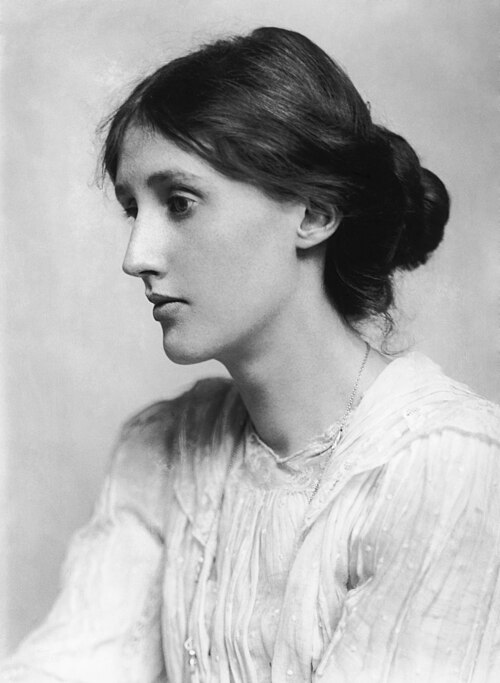
Start at the top for an easy introduction. Go further down for more detail and scholarship.
- Easy
- Intermediate
- Advanced
For young readers
Have you ever noticed how your thoughts jump around? You might be walking to school, see a red door, and suddenly remember a birthday party from years ago. Virginia Woolf wanted to write stories that work the way our minds really work, jumping from the present to memories and back again.
Virginia was born in London in 1882 into a big family full of books. Her father was a famous writer. Her brothers were sent to good schools and university, but Virginia and her sister mostly had to learn at home. She read and read in her father’s huge library and decided she would be a writer.
Her novel Mrs Dalloway takes place on just one day in London. A woman buys flowers for a party, and as she walks through the city we hear what she and other people are thinking. Another novel, To the Lighthouse, is about a family on holiday by the sea who plan a trip to a lighthouse, and about how time changes everything.
Virginia and her husband, Leonard, bought a small printing machine and set it up in their dining room. They printed books by hand, and their little hobby grew into a real publishing company called the Hogarth Press.
She also wrote a famous essay called A Room of One’s Own. In it she imagined that Shakespeare had a sister who was just as clever as he was, but who was never allowed to go to school or to write. She said that to write, a woman needs money of her own and a room of her own with a door she can close.
Virginia often suffered from serious illness of the mind, which made her very sad or very unwell for long periods. In 1941, during the Second World War, she took her own life. Today her books are read all over the world.
At a glance
- Lived
- 25 January 1882 (London) – 28 March 1941 (near Rodmell, Sussex)
- Family
- Daughter of the critic Leslie Stephen and Julia Prinsep Stephen; sister of the painter Vanessa Bell; married Leonard Woolf in 1912
- Circle
- A central figure of the Bloomsbury Group of writers, artists and thinkers in London
- Novels
- The Voyage Out (1915), Night and Day (1919), Jacob’s Room (1922), Mrs Dalloway (1925), To the Lighthouse (1927), Orlando (1928), The Waves (1931), The Years (1937), Between the Acts (1941)
- Essays
- The Common Reader (1925), A Room of One’s Own (1929), Three Guineas (1938), and hundreds of reviews and essays
- Publisher
- Co-founded the Hogarth Press with Leonard Woolf in 1917
- Techniques
- Interior monologue and free indirect style, often called stream of consciousness; experiments with time and multiple points of view
- Legacy
- A leading modernist novelist and a foundational figure for feminist literary criticism
Easy
Who was Virginia Woolf?
Virginia Woolf was an English novelist, essayist, critic and publisher, and one of the most important writers of the early twentieth century. Along with writers such as James Joyce, Marcel Proust and T. S. Eliot, she is counted among the modernists, who believed that the old ways of telling stories could no longer capture modern life.
Woolf’s novels move away from plot, the chain of dramatic events that drives most stories, and focus instead on the inner lives of her characters: what they notice, remember, fear and hope from moment to moment. A whole novel might take place in a single day, or cover centuries in a few hundred pages. She wanted fiction to show how time actually feels from inside a person’s mind.
She was also a sharp and funny essayist. Her essays on reading, on other writers and above all on women and writing are still widely read. A Room of One’s Own, based on lectures she gave to women students at Cambridge in 1928, became one of the founding texts of feminist literary criticism.
Easy
Childhood and a family full of books and grief
Adeline Virginia Stephen was born on 25 January 1882 at 22 Hyde Park Gate in South Kensington, London. Her father, Sir Leslie Stephen, was a well-known critic, mountaineer and editor of the Dictionary of National Biography. Her mother, Julia, had been a celebrated beauty and a model for Pre-Raphaelite painters. Both had been married before, so Virginia grew up in a large blended household of eight children, including her full siblings Vanessa, Thoby and Adrian and her half-siblings George, Gerald and Stella Duckworth.
Every summer until 1894 the family stayed at Talland House in St Ives, Cornwall, overlooking the sea and the Godrevy lighthouse. Woolf later called these summers the happiest memories of her childhood, and they became the model for To the Lighthouse.
Her early life was also marked by loss. Her mother died in 1895, when Virginia was thirteen, and she suffered her first serious breakdown. Her half-sister Stella, who had taken over the household, died two years later. Woolf later wrote that she and Vanessa had been sexually abused by their half-brothers Gerald and George Duckworth, experiences that many biographers link to her later suffering.
Unlike her brothers, who went to Cambridge, Virginia received no full formal schooling. She took some classes in Greek, Latin, German and history at the Ladies’ Department of King’s College London, but she mostly educated herself in her father’s library. This difference between the education given to sons and daughters later became a central theme of her essays.
Easy
Bloomsbury, marriage and the Hogarth Press
After Leslie Stephen died in 1904, the four Stephen siblings moved to 46 Gordon Square in Bloomsbury, then an unfashionable part of London. There Thoby began inviting his Cambridge friends for Thursday evening conversations. This informal circle became known as the Bloomsbury Group. It included the economist John Maynard Keynes, the biographer Lytton Strachey, the art critic Roger Fry, the painter Duncan Grant, the novelist E. M. Forster and, eventually, Leonard Woolf. The group was known for frank talk about art, sex and politics and for its break with Victorian conventions.
In 1906 Thoby died of typhoid fever after a family trip to Greece, another loss that would shape Woolf’s fiction. In 1910 she took part in the Dreadnought hoax, in which friends disguised in costume and dark make-up as an Abyssinian prince and his entourage fooled the Royal Navy into giving them a tour of a battleship; the prank caused a scandal and is now also discussed critically for its use of racial disguise.
In 1912 Virginia married Leonard Woolf, a writer and political thinker who had worked as a colonial civil servant in Ceylon (Sri Lanka). He was Jewish and from a less wealthy family than hers. Their partnership, though not without strain, supported her writing throughout her life.
In 1917 the Woolfs bought a small hand press and set it up in the dining room of Hogarth House, their home in Richmond. Their first publication, Two Stories, contained one story by each of them, including Virginia’s “The Mark on the Wall”. The Hogarth Press went on to publish T. S. Eliot’s The Waste Land (1923), translations of Russian writers, English translations of Sigmund Freud, and all of Virginia Woolf’s later books. Owning their own press meant that she could experiment without worrying about what an outside editor would accept.
Intermediate
The novels
Woolf’s first two novels, The Voyage Out (1915) and Night and Day (1919), are relatively traditional in form. With the short stories of Monday or Tuesday (1921) and the novel Jacob’s Room (1922), which tells the life of a young man killed in the First World War through fragments seen by others, she began to develop her own method.
Mrs Dalloway (1925) takes place on a single day in June 1923 in London. Clarissa Dalloway, the wife of a Conservative politician, prepares for an evening party. Her thoughts move between the present and her youth, including her feelings for her old friend Sally Seton and the man she did not marry, Peter Walsh. Running parallel is the story of Septimus Warren Smith, a veteran suffering from shell shock, whose doctors fail him and who takes his own life. The two never meet, but news of his death reaches Clarissa’s party. The striking of Big Ben marks the hours; Woolf’s working title was “The Hours”.
To the Lighthouse (1927) is in three parts. In “The Window”, the Ramsay family and their guests spend a day at their summer house in the Hebrides; young James wants to go to the lighthouse, but his father says the weather will be bad. The short middle section, “Time Passes”, covers ten years in which the empty house decays and, in brief bracketed sentences, Mrs Ramsay and two of her children die. In “The Lighthouse”, the survivors return; the trip is finally made, and the painter Lily Briscoe completes her picture. The book draws on Woolf’s memories of her parents.
Orlando (1928), a playful “biography”, follows a nobleman who lives for more than three hundred years, from the Elizabethan age to 1928, and wakes one day as a woman. It was inspired by Woolf’s close, romantic friendship with the writer Vita Sackville-West. The Waves (1931), her most experimental novel, consists of the soliloquies of six friends from childhood to middle age, divided by poetic passages describing the sun passing over the sea in a single day. Her last novel, Between the Acts, set on the day of a village pageant on the eve of war, was published after her death in 1941.
Intermediate
Writing the mind: technique and time
Woolf set out her ideas about the novel in essays such as “Modern Fiction” (1919, revised 1925) and “Mr Bennett and Mrs Brown” (1924). She criticized older novelists such as Arnold Bennett for describing houses, incomes and clothes in great detail while missing the inner life of their characters. She urged writers to record the impressions that fall upon the mind, “an incessant shower of innumerable atoms”, in the order in which they fall. In the second essay she provocatively claimed that “on or about December 1910 human character changed”.
Her technique is often called stream of consciousness, but critics usually describe it more precisely as free indirect style: the narrator stays in the third person but takes on the vocabulary, rhythm and feelings of each character, moving from one mind to another, sometimes in mid-paragraph. In Mrs Dalloway, a passing car or an aeroplane writing letters in the sky becomes a link that carries the narrative from one person to the next.
Woolf was fascinated by the difference between clock time and felt time. In her diary she described her discovery, while writing Mrs Dalloway, of a “tunnelling process” by which she dug out caves of memory behind her characters. In her memoir “A Sketch of the Past” she described “moments of being”, rare moments of intense awareness that stand out from the cotton wool of ordinary days; many of her novels are built around such moments.
She also paid close attention to rhythm and sound. The Waves in particular is sometimes called a “playpoem”, and Woolf herself spoke of writing to a rhythm rather than to a plot.
Intermediate
A Room of One’s Own and Three Guineas
In October 1928 Woolf gave two lectures on “women and fiction” at Newnham and Girton, the two women’s colleges at Cambridge. She expanded them into A Room of One’s Own (1929). Its central argument is materialist rather than romantic: “a woman must have money and a room of her own if she is to write fiction”. Genius, she argues, needs leisure, education, privacy and confidence, all of which had been denied to women for centuries.
To make the point vivid, Woolf invents Judith Shakespeare, William’s equally gifted sister, who is kept from school, runs away to London to act, is mocked and exploited, and dies by suicide, her talent wasted. She surveys women writers such as Aphra Behn, Jane Austen, the Brontës and George Eliot, and asks how their work was shaped by the conditions in which they wrote. She also proposes that the greatest minds are “androgynous”, combining masculine and feminine qualities.
Three Guineas (1938), written as the Spanish Civil War raged and fascism spread in Europe, is a darker and more radical book. Answering a letter that asks how war can be prevented, Woolf connects militarism with the patriarchal structures of education, the professions and the family, and argues that women should form a “Society of Outsiders” rather than join the institutions that make war. The book was controversial even among her friends.
Woolf also wrote hundreds of essays and reviews, many collected in The Common Reader (1925) and its second series (1932). She wrote about lesser-known lives, forgotten women and the pleasures of reading, and helped create the modern literary essay.
Intermediate
Illness, war and death
Throughout her life Woolf experienced periods of severe mental illness, including breakdowns after her mother’s death in 1895, after her father’s death in 1904 and in 1913, when she attempted suicide. These episodes involved deep depression, agitation and at times hearing voices. They were treated with the methods of the time, especially enforced rest. Doctors and biographers have since suggested various diagnoses, most often bipolar disorder, but any diagnosis made long after death is uncertain.
Illness did not stop her from working; indeed, she wrote about it in the essay “On Being Ill” (1926) and in the character of Septimus Smith, whose treatment by doctors in Mrs Dalloway is a sharp critique of the medicine of her day. At the same time she was extremely productive, keeping a diary for decades and writing thousands of letters.
The Second World War brought new fears. The Woolfs’ London homes were damaged in the bombing of 1940. Leonard was Jewish and both were known opponents of fascism, and they agreed to end their lives if Germany invaded Britain. In early 1941, after finishing Between the Acts, Woolf felt another breakdown approaching. On 28 March 1941 she wrote farewell letters to Leonard and Vanessa, filled her coat pockets with stones and drowned herself in the River Ouse near their house, Monk’s House, at Rodmell in Sussex. Her ashes were buried in the garden there.
Intermediate
Influence and legacy
In the decades after her death, Woolf’s reputation dipped somewhat; some critics saw her as a delicate, upper-class aesthete. From the 1970s, however, the women’s movement and feminist criticism made her a central figure. A Room of One’s Own gave rise to whole fields of study recovering forgotten women writers, and her phrase became a slogan.
The publication of her diaries (five volumes, edited by Anne Olivier Bell, 1977–84) and letters (six volumes, edited by Nigel Nicolson and Joanne Trautmann) revealed her as a brilliant, funny and politically engaged writer, and fed a huge body of scholarship. Her novels are now studied worldwide and translated into dozens of languages.
Her influence reaches across media and cultures. Michael Cunningham’s novel The Hours (1998), which interweaves Woolf’s life with two women reading or living Mrs Dalloway, won the Pulitzer Prize and was made into a film. Orlando has been adapted for film and stage, and Edward Albee’s play Who’s Afraid of Virginia Woolf? (1962) made her name a household word, though the play is not about her. Writers from many countries have cited her as a model for writing about consciousness, gender and time.
Advanced
Critical debates
Feminism and androgyny. Feminist critics have disagreed about Woolf. Elaine Showalter, in A Literature of Their Own (1977), criticized the ideal of the androgynous mind in A Room of One’s Own as a retreat from confronting female anger and experience. Toril Moi, in Sexual/Textual Politics (1985), answered that Woolf’s shifting, ironic style itself undermines fixed identities, and read her alongside French post-structuralist theory. The debate helped shape feminist criticism as a whole.
Class and privilege. Critics have long pointed out that Woolf wrote from a privileged position, and that her portraits of servants and working-class people can be condescending. Others argue that her essays explicitly acknowledge the material basis of writing and that works such as Three Guineas critique the institutions of her own class.
Prejudice and empire. Her letters and diaries contain antisemitic and racist remarks, even though she was married to a Jewish man, and she participated in the Dreadnought hoax. Postcolonial critics have examined how empire appears in her novels, from The Voyage Out, set in South America, to the imperial figures of Mrs Dalloway. Scholars differ on how far her fiction reproduces or satirizes these attitudes.
Illness and art. Another debate concerns how to relate Woolf’s mental illness to her writing. Earlier biographies sometimes framed her life as a tragic case history; later writers, including Hermione Lee, emphasize her strength, discipline and humour and caution against reading the novels as symptoms. Disability studies and the history of psychiatry have also re-examined the treatment she received.
Advanced
Sources and biography
Woolf is one of the best-documented writers of her century. Besides her published works, we have her diaries from 1915 to 1941, earlier journals, around four thousand letters, memoirs such as “A Sketch of the Past” (published in Moments of Being, 1976), and manuscripts and typescripts held in libraries including the British Library, the New York Public Library’s Berg Collection and the University of Sussex.
The first full biography was written by her nephew Quentin Bell (1972). It had access to family papers and memories but was also written from within the family and the Bloomsbury circle. Hermione Lee’s Virginia Woolf (1996) is widely regarded as the standard modern biography; it treats the diaries critically and stresses the many different versions of Woolf that have been constructed by readers and biographers.
The manuscripts reveal how her novels changed during composition; for example, early drafts of Mrs Dalloway show that Clarissa herself was originally meant to die or kill herself, a role later given to Septimus. Scholarly editions now record such variants. As with any writer who left so many private papers, biographers must be careful: the diary is a literary work in its own right, shaped by moods and by awareness of future readers.
Key ideas
- Stream of consciousness
- A way of writing that follows the flow of a character’s thoughts, feelings and memories as they happen.
- Free indirect style
- Third-person narration that takes on a character’s own words and feelings, sliding from one mind to another.
- Moments of being
- Woolf’s term for rare moments of intense awareness that stand out from ordinary life.
- A room of one’s own
- Her argument that women writers need money, privacy and education, not just talent.
- Judith Shakespeare
- Woolf’s imagined sister of Shakespeare, showing how talent was wasted when women were denied opportunity.
- Androgynous mind
- The idea that the greatest writers combine masculine and feminine perspectives; debated by later feminists.
- Felt time
- Woolf’s novels contrast clock time with how time is experienced, stretching a day or compressing years.
Records
- 1882 — Born Adeline Virginia Stephen in London on 25 January.
- 1895 — Her mother, Julia Stephen, dies; Virginia suffers her first breakdown.
- 1904 — Her father dies; the Stephen siblings move to Gordon Square in Bloomsbury.
- 1906 — Her brother Thoby dies of typhoid fever.
- 1912 — Marries Leonard Woolf.
- 1915 — Publishes her first novel, The Voyage Out.
- 1917 — Founds the Hogarth Press with Leonard; Two Stories is its first publication.
- 1925 — Publishes Mrs Dalloway and The Common Reader.
- 1927 — Publishes To the Lighthouse.
- 1928 — Publishes Orlando; gives lectures at Cambridge that become A Room of One’s Own (1929).
- 1931 — Publishes The Waves.
- 1938 — Publishes Three Guineas.
- 1941 — Dies by suicide in the River Ouse on 28 March; Between the Acts is published posthumously.
Glossary
- Modernism
- An early-twentieth-century movement in the arts that experimented with form to express modern experience.
- Bloomsbury Group
- An informal circle of English writers, artists and intellectuals centred on the Stephen siblings in the London district of Bloomsbury.
- Interior monologue
- The presentation of a character’s thoughts as they occur, as if we could overhear them.
- Shell shock
- The term used during and after the First World War for psychological trauma suffered by soldiers.
- Essay
- A short piece of non-fiction prose expressing the author’s thoughts on a subject.
- Feminist criticism
- The study of literature with attention to gender, women’s writing and the power relations between the sexes.
- Hand press
- A small manually operated printing press; the Woolfs set type and printed their first books themselves.
- Soliloquy
- A speech in which a character speaks their thoughts aloud, as in The Waves.
- Pageant
- An outdoor performance of scenes from history, like the village pageant in Between the Acts.
Questions and answers
Why is Virginia Woolf so famous?
She changed how novels could be written by following people’s thoughts from moment to moment, and she wrote powerful essays about why women had so few chances to become writers.
What happens in Mrs Dalloway?
On one day in June 1923, Clarissa Dalloway prepares a party in London while remembering her past; at the same time a war veteran, Septimus Smith, struggles with trauma and dies. Their stories meet only when news of his death reaches the party.
What does “a room of one’s own” mean?
Woolf argued that women need money and a private space to write. Without independence and time, even a genius cannot produce great work.
Did Woolf really print her own books?
Yes. She and Leonard set type by hand on a small press in their dining room from 1917. Their Hogarth Press became an important publishing house.
Is Woolf’s method the same as James Joyce’s?
Both explored the inner life of characters, but Joyce’s Ulysses often reproduces raw, fragmentary thought, while Woolf usually keeps a flowing third-person narrator who moves between minds. Woolf admired and criticized Ulysses.
What mental illness did Woolf have?
She suffered recurrent episodes of severe depression and agitation. Many writers suggest bipolar disorder, but diagnoses made long after a person’s death remain uncertain.
How have feminist critics disagreed about Woolf?
Some, like Elaine Showalter, criticized her ideal of androgyny as avoiding women’s anger; others, like Toril Moi, argued her style undermines fixed gender identities. The debate shaped feminist criticism.
Sources and further reading
- Virginia Woolf. Wikipedia
- 버지니아 울프. 위키백과 (Korean Wikipedia)
- Mrs Dalloway. Wikipedia
- To the Lighthouse. Wikipedia
- The Waves. Wikipedia
- A Room of One’s Own. Wikipedia
- Hogarth Press. Wikipedia
- Bloomsbury Group. Wikipedia
- Hermione Lee, Virginia Woolf. Chatto & Windus, 1996
- Quentin Bell, Virginia Woolf: A Biography. Hogarth Press, 1972
Related
- Jane AustenEnglish novelist whose sharp accounts of family, marriage and social standing remain central to the history of the novel.
- William ShakespeareEnglish playwright and poet whose plays span comedy, history and tragedy.
- UlyssesJames Joyce’s novel follows a day in Dublin through changing styles and the inner lives of its characters.
- Franz KafkaPrague-born German-language writer whose stories portray uncertainty, opaque authority and people struggling to understand their circumstances.
Written with AI assistance from the published sources listed above, and revised as new research appears.