Start at the top for an easy introduction. Go further down for more detail and scholarship.
- Easy
- Intermediate
- Advanced
For young readers
In 1917 Russia was a huge, poor country fighting in the First World War. Millions of soldiers had died, and in the cities there was not enough bread. In February that year, angry workers and soldiers forced the emperor, called the tsar, to give up his throne.
A new temporary government took over, but it kept fighting the war and could not fix the food shortages. At the same time, workers and soldiers had their own councils, called soviets, and many people listened to them more than to the government.
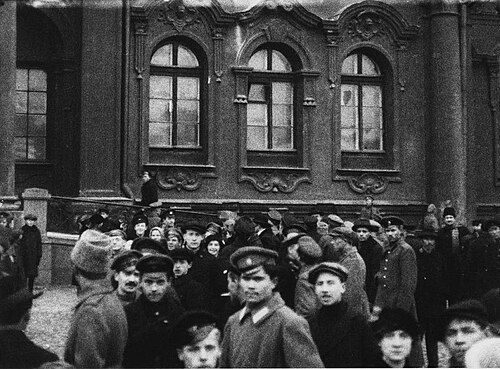
One party, the Bolsheviks, led by a man named Vladimir Lenin, promised exactly what tired people wanted: “Peace, land and bread.” During the night of 25 October 1917, Bolshevik soldiers and armed workers took over bridges, the telegraph office and train stations in the capital, Petrograd, and then entered the Winter Palace, where the government ministers were meeting. There was very little fighting.
The Bolsheviks said they were building a fair society where workers and farmers would rule and no one would be rich or poor. But they soon banned other parties, closed newspapers and set up a secret police. A long, terrible civil war followed, and millions of people died from fighting, hunger and disease.
The revolution led to the creation of the Soviet Union, which lasted until 1991 and shaped the whole twentieth century. People still argue about it: some see it as a great attempt to free working people, others as the start of a cruel dictatorship.
At a glance
- Date
- 24–26 October 1917 (Julian calendar used in Russia) = 6–8 November 1917 (Gregorian); main takeover 25 October / 7 November
- Place
- Petrograd (St Petersburg), then capital of Russia; fighting in Moscow and other cities followed
- Led by
- The Bolshevik party (Vladimir Lenin; Leon Trotsky chaired the Petrograd Soviet and its Military Revolutionary Committee)
- Overthrown
- The Russian Provisional Government headed by Alexander Kerensky
- New government
- Council of People’s Commissars (Sovnarkom), chaired by Lenin, approved by the Second All-Russian Congress of Soviets
- First decrees
- Decree on Peace and Decree on Land (26 October / 8 November 1917)
- Aftermath
- Dissolution of the Constituent Assembly (January 1918), Treaty of Brest-Litovsk (March 1918), Russian Civil War (1917/18–1922), founding of the USSR (1922)
- Also called
- Great October Socialist Revolution (official Soviet name); Bolshevik Revolution; Bolshevik seizure of power
Easy
What was the October Revolution?
The October Revolution was the seizure of power in Russia by the Bolshevik party in 1917. On 25 October 1917 by the old Russian calendar (7 November by the calendar used in most of the world), armed Bolshevik supporters took control of Petrograd, the capital, and overthrew the Provisional Government that had ruled since the fall of the tsar earlier that year.
Why “October” if it happened in November? Russia still used the Julian calendar, which by then was 13 days behind the Gregorian calendar used in Western Europe. The new Soviet government switched to the Gregorian calendar in February 1918, so the anniversary of the “October” Revolution was celebrated every year on 7 November.
The revolution brought to power the world’s first government that called itself socialist and aimed at communism, a society without private ownership of land and factories. It led to a devastating civil war, the creation of the Union of Soviet Socialist Republics (USSR) in 1922, and a political system that shaped world history until the Soviet Union collapsed in 1991.
Easy
Why did it happen? War, hunger and the fall of the tsar
In 1914 Russia entered the First World War against Germany and Austria-Hungary. The war went badly. By 1917 millions of Russian soldiers had been killed, wounded or captured. Railways could not carry enough food and fuel to the cities, prices rose steeply, and people stood in long queues for bread in the freezing winter.
In February 1917 (March by the Western calendar), strikes and bread protests in Petrograd turned into a revolution when soldiers refused to shoot at the crowds and joined them. Tsar Nicholas II abdicated, ending more than three hundred years of rule by the Romanov dynasty. This was the February Revolution.
After February, two bodies claimed authority. The Provisional Government, formed by members of the old parliament, promised to hold free elections for a Constituent Assembly that would decide Russia’s future. At the same time, the Petrograd Soviet of Workers’ and Soldiers’ Deputies, and hundreds of other soviets across the country, spoke for workers and soldiers. This situation was called “dual power”.
It is important to remember that the Russian Empire was not only Russian. Fewer than half its people were ethnic Russians; the rest included Ukrainians, Poles, Finns, Jews, Georgians, Armenians, Tatars, Kazakhs and many others. The collapse of the tsarist state in 1917 also opened the way for national movements, from Finland and Ukraine to the Caucasus and Central Asia, which demanded autonomy or independence. The revolution of 1917 was therefore many revolutions at once: of workers in the cities, of peasants in the countryside, of soldiers at the front and of nations at the edges of the empire.
Easy
From February to October: the year of crisis
The Provisional Government decided to continue the war, partly to keep faith with its allies Britain and France, and it postponed land reform and elections. As the months went on, soldiers deserted, peasants began seizing landowners’ estates themselves, and workers took control of factories. The government, led from July by the socialist lawyer Alexander Kerensky, grew weaker.
In April 1917 Vladimir Lenin, leader of the Bolshevik faction of the Russian Social Democrats, returned from exile in Switzerland, travelling through Germany in a train arranged with the German authorities, who hoped he would weaken Russia’s war effort. At Petrograd’s Finland Station he called for no support for the Provisional Government and “all power to the soviets”. His programme, the April Theses, was summed up in the slogan “Peace, land and bread”.
In July, armed demonstrations in Petrograd (the July Days) were put down; the government accused the Bolsheviks of being German agents, arrested some leaders, and Lenin went into hiding in Finland. But in late August the army’s commander, General Lavr Kornilov, appeared to move troops against the capital. Kerensky turned to the soviets for help, and armed workers, including Bolshevik Red Guards, stopped him. After this, the Bolsheviks won majorities in the Petrograd and Moscow soviets, and in September Leon Trotsky became chairman of the Petrograd Soviet.
Intermediate
The seizure of power, 24–26 October 1917
On 10 October Lenin, secretly back in Petrograd, persuaded the Bolshevik Central Committee to vote, by ten votes to two, for an armed uprising. The two opponents, Lev Kamenev and Grigory Zinoviev, even made their disagreement public. The Petrograd Soviet had set up a Military Revolutionary Committee, dominated by Bolsheviks and led in practice by Trotsky, which won the loyalty of most of the city’s garrison. The uprising was timed to coincide with the Second All-Russian Congress of Soviets.
On 24 October Kerensky tried to close Bolshevik newspapers and raise the bridges over the Neva. The Military Revolutionary Committee answered by sending soldiers, sailors and Red Guards to take the bridges, railway stations, telegraph office, telephone exchange and power stations. Most of this happened with little shooting; many government troops simply stayed away. On the morning of 25 October Lenin announced that the Provisional Government had been deposed, though it was still meeting in the Winter Palace.
In the evening of 25 October the cruiser Aurora fired a blank shot as a signal, and guns from the Peter and Paul Fortress fired on the palace, mostly missing. The palace was defended by military cadets, some Cossacks and a women’s battalion, many of whom drifted away during the evening. In the early hours of 26 October the attackers entered and arrested the ministers. Kerensky had already left the city by car to seek troops at the front. Casualties in the capital were very small.
The dramatic “storming of the Winter Palace”, with crowds charging the gates, is largely an image created later, especially by a mass re-enactment staged in 1920 and by Sergei Eisenstein’s film October (1928).
Intermediate
The Congress of Soviets and the first decrees
The Second All-Russian Congress of Soviets opened late on 25 October. Bolsheviks were the largest group, with their allies the Left Socialist Revolutionaries. The moderate socialist parties, Mensheviks and Right Socialist Revolutionaries, denounced the seizure of power as a conspiracy and walked out. Trotsky famously told them to go to “the dustbin of history”. Their departure left the Bolsheviks and their allies in control.
On 26 October the Congress approved a new government, the Council of People’s Commissars (Sovnarkom), with Lenin as chairman, Trotsky as commissar for foreign affairs and Joseph Stalin as commissar for nationalities. It passed two famous decrees drafted by Lenin. The Decree on Peace called on all warring countries to begin immediate negotiations for a “just, democratic peace” without annexations or indemnities. The Decree on Land abolished private ownership of landed estates and handed land over to peasant committees, largely accepting what peasants were already doing.
Other decrees followed quickly: workers’ control in factories, the nationalisation of banks, the separation of church and state, the abolition of legal estates and titles, a declaration of the right of the peoples of Russia to self-determination, civil marriage and easier divorce. Alexandra Kollontai, commissar for social welfare, was among the first women in the world to hold a government ministry.
Intermediate
Holding on to power: Moscow, the Assembly and the Cheka
Outside Petrograd the takeover was not so easy. In Moscow about a week of heavy fighting between Red Guards and officer cadets, with artillery used in the city centre, cost hundreds of lives before the Bolsheviks won in early November. Kerensky’s attempt to return with Cossack troops was defeated near Petrograd at Pulkovo. In many provincial towns soviets took power; elsewhere, local authorities and national movements resisted.
Elections to the long-promised Constituent Assembly took place in November 1917. They were the freest elections in Russia’s history up to that time. The Socialist Revolutionaries, the party of the peasants, won the most seats; the Bolsheviks won about a quarter of the vote, mainly in the cities and the army. When the Assembly met in January 1918 and refused to accept Soviet power, the Bolsheviks dissolved it after a single session, and troops fired on a demonstration in its support.
In December 1917 the government created the Cheka, an Extraordinary Commission to fight “counter-revolution and sabotage”, under Felix Dzerzhinsky. Opposition newspapers were closed, and the liberal Kadet party was outlawed. After March 1918 the Left Socialist Revolutionaries, who had briefly joined the government, left it in protest over the peace treaty with Germany. By mid-1918 Russia was effectively a one-party state.
Intermediate
Consequences: peace, civil war and the Soviet state
To get out of the world war, the Soviet government signed the Treaty of Brest-Litovsk with Germany and its allies in March 1918, giving up huge territories including Ukraine, the Baltic lands and Finland. The same month the capital moved to Moscow. In July 1918 the former tsar and his family were shot by Bolsheviks in Yekaterinburg.
From 1918 a many-sided civil war raged between the Red Army, organised by Trotsky, and a range of opponents: the “Whites” led by former tsarist generals, socialist rivals, peasant armies, national independence movements and foreign intervention forces. Both sides committed terror against civilians. Together with epidemics and the famine of 1921–22, the civil war period caused the deaths of many millions of people; estimates vary widely, often from about seven to twelve million.
The Bolsheviks won, and in December 1922 they founded the Union of Soviet Socialist Republics. The new state promised equality, literacy, health care and the emancipation of women and national minorities, and made real advances in some of these. It also built a one-party dictatorship that, especially under Stalin from the late 1920s, carried out forced collectivisation, mass famine and the Great Terror.
Intermediate
Echoes around the world, including in East Asia
The revolution inspired and frightened the world. In 1919 the Bolsheviks founded the Communist International (Comintern) to promote revolution abroad. Communist parties appeared in Europe, Asia, Latin America and Africa. For many anti-colonial activists, Lenin’s promises of national self-determination and his attacks on imperialism offered an alternative to the liberal ideas of the United States president Woodrow Wilson.
In East Asia its influence was profound. The Chinese Communist Party was founded in 1921 with Comintern help. Among Koreans, the Korean People’s Socialist Party (Hanin Sahoedang) was founded in 1918 in Khabarovsk in the Russian Far East, and socialist and communist ideas spread among independence activists after the March First Movement of 1919, adding a new current to the struggle against Japanese colonial rule. Japan, meanwhile, sent troops to Siberia (1918–22) as part of the Allied intervention and passed strict laws against communism.
In Western countries, fear of Bolshevism shaped politics for decades, from the “Red Scare” in the United States to the rise of anti-communist movements, including fascism, which presented itself as a bulwark against revolution.
Intermediate
Memory: from national holiday to contested past
In the Soviet Union the “Great October Socialist Revolution” was the founding myth of the state. Every 7 November, military parades filled Red Square. Official history presented the revolution as a mass uprising led by a united party under Lenin, and, from the 1930s, gave Stalin a prominent role he had not actually played, while erasing Trotsky and other leaders who had fallen from favour.
After the collapse of the USSR in 1991, Russian attitudes became more divided. In 2005 the 7 November holiday was replaced by a new National Unity Day on 4 November, commemorating the expulsion of Polish forces from Moscow in 1612. The centenary in 2017 was marked only modestly by the Russian state. In other former Soviet countries, such as Ukraine and the Baltic states, the revolution is often remembered mainly as the start of Soviet rule and repression.
Outside Russia, too, the revolution remains a symbol: for some, of hope for social justice betrayed; for others, of the dangers of utopian politics; for others still, of the achievements and costs of modernisation by force.
Advanced
Historians’ debates: coup or popular revolution?
The interpretation of 1917 has been shaped by the Cold War. Soviet historiography treated October as the lawful outcome of class struggle, led by a party that expressed the will of the proletariat. Many Western historians of the mid-twentieth century, influenced by the “totalitarian” model, saw it instead as a coup d’état by a small, disciplined conspiracy that exploited chaos and then imposed dictatorship. Richard Pipes’s The Russian Revolution (1990) is the best-known later statement of this view.
From the 1960s and 1970s “revisionist” social historians studied workers, soldiers, sailors and peasants rather than leaders. Alexander Rabinowitch’s The Bolsheviks Come to Power (1976) showed that the Bolshevik party in Petrograd in 1917 was relatively open and responsive, and that its support among workers and soldiers was real by autumn 1917. Sheila Fitzpatrick’s The Russian Revolution (1982) placed October within a longer revolutionary process lasting until the 1930s. These historians did not deny the later dictatorship but argued that October had genuine popular backing in the cities, however much it lacked a national majority.
After the Soviet archives opened in the 1990s, historians gained access to party and police records. Works such as Orlando Figes’s A People’s Tragedy (1996) combined the social and political approaches, emphasising both popular radicalism and the violence and authoritarian choices of the Bolshevik leadership. Current research also looks beyond Petrograd, at the non-Russian peoples of the empire, at the countryside, and at the revolution as part of a wider crisis of empires during and after the First World War.
Advanced
Sources: eyewitnesses, decrees and archives
The revolution is recorded in a wide variety of sources: newspapers of every party, the minutes of the Bolshevik Central Committee and of the soviets, government decrees, and many eyewitness memoirs. The American journalist John Reed’s Ten Days That Shook the World (1919) is a vivid, sympathetic account written soon after the events. Nikolai Sukhanov, a Menshevik-leaning socialist, wrote detailed Notes on the Revolution, and Trotsky’s History of the Russian Revolution (1930–32) is both a major narrative and a partisan defence of his role.
All of these must be read critically. Memoirs were written with hindsight, often to justify their authors. Soviet publications of documents in the Stalin era were edited to fit the official story. Émigré memoirs by defeated opponents have their own biases. Historians compare these with archive records, statistics on elections and food supply, and local studies.
Key texts of the new regime, such as Lenin’s reports on peace and land to the Second Congress of Soviets, are available in translation, for example in the Lenin Internet Archive. Reading them alongside the Constituent Assembly election results and the petitions of workers and peasants helps show both what the Bolsheviks promised and what different groups in Russian society wanted.
Key ideas
- Dual power
- The division of authority between the Provisional Government and the soviets after February 1917, which neither side could resolve peacefully.
- “All power to the soviets”
- Lenin’s slogan demanding that the councils of workers and soldiers, not the Provisional Government, should rule.
- “Peace, land and bread”
- The Bolshevik promise that spoke directly to war-weary soldiers, land-hungry peasants and hungry city dwellers.
- Vanguard party
- Lenin’s idea that a disciplined party of professional revolutionaries should lead the working class to power.
- Dictatorship of the proletariat
- The Marxist idea of a transitional rule by the working class; in practice it became the rule of the Communist Party.
- Self-determination of peoples
- The Bolshevik promise that nations of the former empire could choose their own future, influential worldwide but often limited in practice.
- Coup or revolution
- The central historiographical question: whether October was a conspiracy by a minority or the culmination of a broad popular revolution.
Records
- 1914 — Russia enters the First World War.
- 1917 — February (March N.S.): February Revolution; Nicholas II abdicates; Provisional Government and Petrograd Soviet formed.
- 1917 — April: Lenin returns to Petrograd and issues the April Theses.
- 1917 — July–August: July Days in Petrograd; Kornilov affair strengthens the Bolsheviks.
- 1917 — 10 October: Bolshevik Central Committee votes for an armed uprising.
- 1917 — 25–26 October (7–8 November N.S.): Bolsheviks seize Petrograd and the Winter Palace; Congress of Soviets passes the decrees on peace and land.
- 1917 — November–December: Constituent Assembly elections; Cheka created.
- 1918 — January: Constituent Assembly dissolved; February: Gregorian calendar adopted; March: Treaty of Brest-Litovsk and move of the capital to Moscow.
- 1918 — July: Nicholas II and his family are killed in Yekaterinburg; civil war spreads.
- 1919 — Founding of the Communist International (Comintern).
- 1922 — Civil war ends in the main; the USSR is founded in December.
- 1991 — The Soviet Union dissolves.
Glossary
- Bolsheviks
- The radical faction of the Russian Social Democratic Labour Party led by Lenin; renamed the Communist Party in 1918.
- Mensheviks
- The more moderate faction of Russian Social Democrats, who believed Russia was not yet ready for socialist revolution.
- Soviet
- Russian for “council”; elected councils of workers, soldiers or peasants.
- Provisional Government
- The temporary government that ruled Russia from the February Revolution until October 1917.
- Julian calendar
- The old calendar used in Russia until 1918, 13 days behind the Gregorian calendar in the 20th century.
- Sovnarkom
- The Council of People’s Commissars, the government created by the Bolsheviks in October 1917.
- Red Guards
- Armed units of factory workers that supported the Bolsheviks in 1917.
- Constituent Assembly
- An elected body meant to write Russia’s constitution; dissolved by the Bolsheviks in January 1918.
- Cheka
- The Soviet political police founded in December 1917, forerunner of later bodies such as the NKVD and KGB.
- Socialist Revolutionaries (SRs)
- A mass socialist party with strong peasant support; it split in 1917 into Left and Right wings.
Questions and answers
Why is it called the October Revolution if it happened in November?
Russia used an older calendar at the time, which was 13 days behind. By that calendar it was 25 October; by ours it was 7 November.
Was the Winter Palace really stormed in a big battle?
No. Most defenders had left, and the attackers entered in the early morning with few casualties. The famous battle scenes come mostly from a 1920 re-enactment and a 1928 film.
What did “Peace, land and bread” mean?
Peace: stop the war. Land: give farmland to the peasants. Bread: end the food shortages. It was a simple promise that many tired and hungry people wanted to hear.
Did most Russians vote for the Bolsheviks?
No. In the Constituent Assembly elections of November 1917 they won about a quarter of the vote. They were strongest in big cities and in the army; the peasant-based Socialist Revolutionaries won more votes.
What happened to the tsar?
Nicholas II gave up his throne in March 1917 (February by the old calendar). In July 1918 Bolsheviks shot him, his wife, their five children and several servants in Yekaterinburg.
How did the revolution affect Korea?
It helped spread socialist and communist ideas among Korean independence activists, especially in the Russian Far East and in China, and after the March First Movement of 1919 these ideas became an important current in the anti-colonial movement.
Is it better called a coup or a revolution?
Historians disagree. The takeover itself was planned by one party, but it happened amid a real mass revolution of workers, soldiers and peasants. Many scholars now describe it as a party’s seizure of power within a broader popular revolution.
Sources and further reading
- October Revolution. Wikipedia
- 10월 혁명. 위키백과 (Korean Wikipedia)
- Russian Revolution. Wikipedia
- V. I. Lenin, Report on Peace, Second All-Russia Congress of Soviets, October 26 (November 8), 1917. Lenin Internet Archive (marxists.org)
- V. I. Lenin, Report on Land, Second All-Russia Congress of Soviets, October 26 (November 8), 1917. Lenin Internet Archive (marxists.org)
- Sheila Fitzpatrick, The Russian Revolution. Oxford University Press, 1982
- Alexander Rabinowitch, The Bolsheviks Come to Power: The Revolution of 1917 in Petrograd. W. W. Norton, 1976
- Richard Pipes, The Russian Revolution. Alfred A. Knopf, 1990
- Orlando Figes, A People’s Tragedy: The Russian Revolution 1891–1924. Jonathan Cape, 1996
- John Reed, Ten Days That Shook the World. Boni & Liveright, 1919
Related
- Das KapitalKarl Marx’s study of capitalism, labor and value; its first volume appeared in 1867.
- Storming of the BastilleThe seizure of a Paris fortress and prison on 14 July 1789 became an early emblem of the French Revolution.
- Assassination of Archduke Franz FerdinandThe killing of Archduke Franz Ferdinand and his wife Sophie in Sarajevo on 28 June 1914 triggered a diplomatic crisis that led to the First World War.
- March 1st MovementA Korean independence movement began with public declarations and demonstrations on 1 March 1919 and spread across the peninsula.
- Haitian RevolutionA revolution beginning with an uprising of enslaved people in Saint-Domingue led to the abolition of slavery there and Haiti’s independence in 1804.
Written with AI assistance from the published sources listed above, and revised as new research appears.