Start at the top for an easy introduction. Go further down for more detail and scholarship.
- Easy
- Intermediate
- Advanced
For young readers
Imagine a factory. The owner buys machines and materials and pays workers to make shoes. Then the owner sells the shoes for more money than everything cost. Where did the extra money come from? That is the big question of Das Kapital, a book written by Karl Marx about 160 years ago.
Marx was a German thinker who lived most of his adult life in London, then the biggest city in the world and the centre of the new factory age. He spent years in the reading room of the British Museum, reading about money, trade and factories, and government reports about how people worked.
Marx’s answer was that the extra money comes from the workers. He said a worker can make more in a day than the wage he is paid, and the difference goes to the owner as profit. He thought this was unfair, and that it pushed owners to make people work longer and faster.
The book also tells true stories from Marx’s time: children working long hours in factories and mines, families crowded into tiny rooms, and farmers pushed off the land they had used for generations. Marx wanted readers to see the people behind the goods they bought.
Das Kapital changed the world. Many people, from workers and trade unions to revolutionaries and governments, used its ideas, and others argued strongly against them. People still disagree about whether Marx was right, but economists, historians and philosophers still read it and argue about it today.
At a glance
- Author
- Karl Marx (1818–1883); Volumes II and III edited by Friedrich Engels
- Full title
- Das Kapital. Kritik der politischen Ökonomie (Capital: A Critique of Political Economy)
- Published
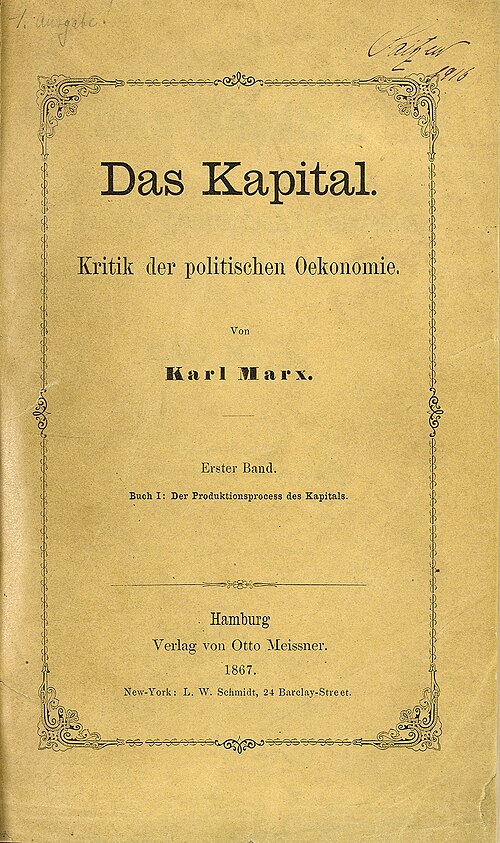
- Volume I: 14 September 1867, Otto Meissner, Hamburg (1,000 copies); Volume II: 1885; Volume III: 1894
- Written
- Mainly in London, from manuscripts of 1857 onward; Marx lived in London from 1849
- Language
- German; first translated into Russian (1872), French (1872–1875) and English (1887)
- Structure of Vol. I
- Eight parts, from the commodity and money to “so-called primitive accumulation” (33 chapters in the English edition)
- Field
- Political economy, philosophy, history and social theory
- Significance
- One of the most influential and most contested books of the modern world, basic to socialist movements and to many academic fields
Easy
What is Das Kapital?
Das Kapital, usually called Capital in English, is Karl Marx’s major work on economics. Its subtitle, “A Critique of Political Economy”, tells us what it tries to do. “Political economy” was the name for the economics of Adam Smith, David Ricardo and their followers. Marx did not simply write a new economics textbook; he tried to show the hidden assumptions and contradictions of that economics and of the capitalist society it described.
Only the first volume was published in Marx’s lifetime, in 1867. After his death in 1883, his friend and collaborator Friedrich Engels edited Marx’s unfinished manuscripts into Volume II (1885) and Volume III (1894). A further body of Marx’s notes on earlier economists, later published as Theories of Surplus Value, is sometimes called the “fourth volume”.
Capital is famous both for its difficulty and for its variety. It contains abstract reasoning in the style of German philosophy, long passages of economic analysis with numbers, sharp satire, and vivid historical reporting based on British government reports about factories, mines and housing. Readers often remark that the first chapters are the hardest; the later chapters on the working day, machinery and primitive accumulation read more like history.
Easy
The big question: where does profit come from?
Marx starts with something everyone knows: in a capitalist society, wealth appears as an “immense accumulation of commodities”, things produced to be sold. A commodity has two sides. It is useful (it has a use-value), and it can be exchanged for other things (it has exchange-value). What makes a coat worth, say, the same as twenty metres of linen? Following earlier economists, Marx argues that what they share is human labour: value is measured by the labour time that society, on average, needs to produce them.
Then comes the puzzle. A capitalist starts with money (M), buys commodities (C), and ends with more money (M′). If fair exchange means equal values are traded, how can money grow? Marx’s answer is that there is one special commodity whose use creates more value than it costs: labour-power, the worker’s capacity to work. The capitalist pays wages equal to the value of labour-power, roughly what workers need to live. But in a working day the worker can produce more value than that. The extra is surplus value, the source of profit, interest and rent.
Marx calls this relationship exploitation. He does not mean that individual employers are necessarily cruel or cheating; the point is that the system works this way even when every exchange is legally fair. Workers, who own nothing but their ability to work, must sell it to live, while the owners of the means of production, the factories, land and machines, keep what workers produce beyond their wages.
Easy
What is in the three volumes?
Volume I, The Process of Production of Capital, is the one most people read. It moves from commodities and money (Part One) to the transformation of money into capital and the buying of labour-power (Part Two), then to how surplus value is produced by lengthening the working day (absolute surplus value) or by making labour more productive through cooperation, the division of labour and machinery (relative surplus value). It ends with wages, the accumulation of capital and a final part on “so-called primitive accumulation”.
Volume II, The Process of Circulation of Capital, looks at how capital moves through its different forms, money, production and goods, and how the whole economy can reproduce itself year after year. It contains Marx’s famous “reproduction schemes”, which divide the economy into a sector producing means of production and a sector producing consumer goods.
Volume III, The Process of Capitalist Production as a Whole, returns to the surface of economic life. It explains how surplus value appears as profit, how competition creates an average rate of profit across industries, why Marx thought the rate of profit tends to fall, and how surplus value is divided into industrial profit, commercial profit, interest and ground rent. It also includes discussions of credit, banking and crises.
Intermediate
Historical context: Victorian London and the industrial age
Karl Marx was born in Trier in the Rhineland in 1818 and studied law and philosophy in Bonn and Berlin, where he was shaped by the philosophy of Hegel and the Young Hegelians. As a radical journalist he was expelled or driven from Prussia, France and Belgium. After the defeated revolutions of 1848, in which he took part with Engels, author of the Communist Manifesto with him, he moved to London in 1849 and lived there for the rest of his life.
Britain was then the most industrialized country in the world. Its cotton mills, coal mines and railways showed the power of the new economy, and also its human cost. Parliament had passed Factory Acts limiting working hours, and government inspectors published detailed reports, the so-called Blue Books. Marx used these reports extensively, especially in the chapters on the working day and on machinery, to document child labour, long hours, industrial accidents and disease.
Marx’s family lived in deep poverty in the 1850s; several of his children died young. His main income came from journalism, including more than a decade as a correspondent for the New-York Daily Tribune, and from Engels, who worked in his family’s cotton business in Manchester and supported Marx financially. Engels also supplied practical knowledge of how a capitalist firm actually worked.
In 1864 Marx helped found the International Workingmen’s Association, the First International, and wrote its founding address. Capital was written at the same time as he was involved in this labour movement, and it was meant to give the movement a scientific understanding of the system it faced.
Intermediate
Key ideas explained
Commodity fetishism. In a famous section of Chapter One, Marx argues that in a market society the social relations between people who work for one another appear as relations between things, as prices and the movements of goods. Just as religious believers attribute power to objects they themselves have made, people in capitalist society experience the market as a natural force beyond their control. This idea has been especially influential in philosophy and cultural theory.
The working day and machinery. Because surplus value can be increased by making people work longer, Marx describes the history of the working day as a struggle between capital and labour, fought out in strikes and in legislation such as the Ten Hours Act of 1847. Machinery, he argues, could lighten work, but under capitalism it is used to intensify labour, replace skilled workers and draw women and children into the factory.
Accumulation and the reserve army of labour. Capitalists compete, and to survive they must reinvest profits and expand. Marx argues that this accumulation tends to replace workers with machines and to create an “industrial reserve army” of unemployed and underemployed people, who keep wages down. He calls this the general law of capitalist accumulation: wealth accumulates at one pole and misery at the other.
Primitive accumulation. In the final part of Volume I, Marx asks how capitalism began. He rejects the story that some people simply saved while others were lazy. Instead he describes the forcible separation of producers from the means of production: the enclosure of common lands in England, laws against vagabonds, colonial plunder and the Atlantic slave trade. Capital, he writes, comes into the world “dripping from head to foot, from every pore, with blood and dirt”. The chapter ends by predicting that the concentration of capital will eventually be overturned: “The expropriators are expropriated.”
Intermediate
How it was written, edited and published
Capital was the result of decades of study. Marx filled notebooks with excerpts from economists and reports, and wrote a series of large drafts: the manuscripts of 1857–1858 now known as the Grundrisse, the book A Contribution to the Critique of Political Economy (1859), a huge manuscript of 1861–1863 in twenty-three notebooks (which contains Theories of Surplus Value), and a manuscript of 1863–1865 which became the main basis of Volume III. His original plan envisaged six books, on capital, landed property, wage labour, the state, foreign trade and the world market; Capital covers only part of it.
Volume I appeared in Hamburg on 14 September 1867, dedicated to Marx’s late friend Wilhelm Wolff. Sales were slow at first. Marx revised it for a second German edition (1872–1873), changing in particular the difficult opening on the form of value, and he closely revised the French translation published in instalments in 1872–1875. The first translation of all was into Russian, in 1872; the tsarist censors let it pass partly because they judged it too difficult to be widely read.
After Marx’s death, Engels prepared the third (1883) and fourth (1890) German editions of Volume I and the English translation by Samuel Moore and Edward Aveling (1887). He then spent years deciphering Marx’s handwriting and organizing unfinished drafts into Volumes II and III. Karl Kautsky later published Theories of Surplus Value in three volumes (1905–1910), rearranging and cutting parts of the manuscript.
Capital is now read in dozens of languages. In Korea it circulated only underground under the military governments; the first complete Korean translation, published in 1987 without the translator’s name, led to the arrest of its publisher in 1989 under the National Security Act, and another complete translation by the economist Kim Soo-haeng appeared the same year.
Intermediate
Influence and legacy
In his preface to the English edition of 1886, Engels wrote that Capital was often called on the Continent “the Bible of the working class”. Social democratic parties, trade unions and revolutionary movements all drew on it, although few members read it in full; summaries and popularizations spread its ideas far more widely than the book itself.
In the twentieth century Marx’s ideas were adopted as official doctrine by the Soviet Union after the October Revolution of 1917, by the People’s Republic of China, and by many other states. These regimes claimed Marx’s authority for one-party rule and planned economies, and many carried out mass repression and caused famines in which millions died. Scholars continue to debate how far these outcomes can be traced to Marx’s own thought, which contains little detail about how a post-capitalist society should be organized.
Outside politics, Capital shaped many academic disciplines. Economists, including critics, have engaged with its analysis of accumulation, crises and technological change. Historians have used its questions about the origins of capitalism, labour and class. Sociologists, from Max Weber onward, defined their own ideas partly in dialogue with Marx. Philosophers and cultural theorists of the Frankfurt School and later drew especially on the concept of commodity fetishism.
Critics have been equally important. Economists of the marginalist school, which emerged in the 1870s, replaced the labour theory of value with theories of value based on subjective utility and scarcity, and most mainstream economists today do not accept Marx’s value theory. Others argue that his predictions of growing impoverishment and revolution in the most advanced countries were not borne out, while supporters answer that his account of globalization, inequality and recurring crises remains strikingly relevant.
Advanced
Scholarly debates
The transformation problem. In Volume I Marx assumes that goods exchange at their values. In Volume III he admits that competition equalizes profit rates, so that prices of production differ from values, and he proposes a way to transform values into prices. Eugen von Böhm-Bawerk (1896) argued that this contradicted Volume I; Ladislaus von Bortkiewicz (1906–1907) showed that Marx’s procedure was incomplete and proposed a correction. After Piero Sraffa’s Production of Commodities by Means of Commodities (1960), Ian Steedman and others argued that labour values are unnecessary for determining prices and profits. Defenders have offered alternative readings, such as the “New Interpretation” and the Temporal Single System Interpretation, and the debate remains unresolved.
The falling rate of profit. Marx argued that as capitalists replace workers with machines, the rate of profit tends to fall, though with counteracting tendencies. Critics, notably through the Okishio theorem (1961), argued that cost-reducing innovations adopted by rational capitalists cannot lower the rate of profit if real wages are constant. Empirical and theoretical disputes over this law continue.
How to read Capital. Louis Althusser and his students in Reading Capital (1965) argued for a “scientific” Marx who broke with Hegelian humanism. The German “New Reading of Marx” and value-form theorists instead emphasize the Hegelian logic of Capital and read it as a theory of social forms, not of embodied labour quantities. Others read it primarily as history, sociology or moral critique.
Engels’s editing. The complete publication of Marx’s manuscripts in the MEGA2 edition has shown how extensively Engels reorganized and sometimes reformulated the drafts behind Volumes II and III, for example in the chapters on the falling rate of profit and on credit. Scholars such as Michael Heinrich argue that the finished-looking volumes give a misleading impression of a completed system, whereas Marx’s own drafts are more open and provisional.
Advanced
Sources, editions and methods
Marx’s own method combined abstraction and history. In the 1873 afterword to the second edition he distinguished the method of inquiry, which must appropriate the material in detail, from the method of presentation, which proceeds from simple abstract categories, such as the commodity, to more concrete ones, like competition and credit. Understanding this order is essential: many statements in Volume I are simplifications that later volumes modify.
The critical edition is the second Marx-Engels-Gesamtausgabe (MEGA2), begun in 1975 in Moscow and East Berlin and continued since 1990 by an international foundation coordinated by the Berlin-Brandenburg Academy of Sciences. Its second section contains all editions of Capital published in Marx’s and Engels’s lifetimes and all of Marx’s preparatory manuscripts, allowing readers to compare drafts, editions and Engels’s interventions.
Historians of economic thought read Capital against its sources: Smith, Ricardo, the Physiocrats and many lesser-known writers whom Marx criticized. Social historians test Marx’s use of the British factory reports against other evidence, and have noted both the reliability of his quotations and the selectivity with which he chose the worst cases. Recent research also uses Marx’s late notebooks on agriculture, natural science, Russia and non-European societies to ask how his views were changing after 1867.
Key ideas
- Commodity
- A product made to be sold, with a use-value (usefulness) and an exchange-value; Marx’s starting point for analysing capitalism.
- Labour theory of value
- The idea, inherited from Smith and Ricardo and reworked by Marx, that the value of commodities is determined by the socially necessary labour time needed to produce them.
- Labour-power
- The worker’s capacity to work, sold to the capitalist for a wage; its use produces more value than it costs.
- Surplus value
- The value workers produce beyond the value of their wages; according to Marx, the source of profit, interest and rent.
- Commodity fetishism
- The way social relations between people appear as relations between things and prices in a market society.
- Accumulation
- The compulsion under competition to reinvest profit and expand, which Marx links to mechanization, unemployment and inequality.
- Primitive accumulation
- The historical, often violent separation of producers from land and tools that created the conditions for capitalism.
- Crisis
- Marx’s view that capitalism is prone to recurring breakdowns arising from its own dynamics rather than outside shocks.
Records
- 1818 — Karl Marx is born in Trier, in the Prussian Rhineland.
- 1848 — Marx and Engels publish the Communist Manifesto; revolutions break out across Europe.
- 1849 — Marx settles in London, where he will live until his death.
- 1857 — Marx begins the manuscripts later published as the Grundrisse (1857–1858).
- 1859 — A Contribution to the Critique of Political Economy is published.
- 1864 — The First International is founded in London.
- 1867 — Volume I of Capital is published in Hamburg on 14 September.
- 1872 — The Russian translation, the first in any language, appears; a revised German edition and the French translation begin.
- 1883 — Marx dies in London on 14 March.
- 1885 — Engels publishes Volume II.
- 1887 — First English translation of Volume I, by Samuel Moore and Edward Aveling.
- 1894 — Engels publishes Volume III.
Glossary
- Political economy
- The name for economics in the 18th and 19th centuries, especially the classical school of Smith and Ricardo.
- Capital
- For Marx, not just money or machines, but value that grows by employing wage labour: M–C–M′.
- Use-value / exchange-value
- The usefulness of a thing versus the proportion in which it exchanges for other things.
- Means of production
- Land, tools, machines, factories and raw materials used to produce goods.
- Constant and variable capital
- Capital spent on means of production (constant) versus on wages (variable), which Marx says alone creates new value.
- Rate of surplus value
- The ratio of surplus value to variable capital; Marx’s measure of the rate of exploitation.
- Industrial reserve army
- The unemployed and underemployed, who according to Marx keep wages down.
- Enclosure
- The fencing-off of common lands into private property, especially in England, forcing many peasants off the land.
- Blue Books
- Printed British parliamentary and government reports, including factory inspectors’ reports used by Marx.
- MEGA
- The Marx-Engels-Gesamtausgabe, the complete critical edition of Marx and Engels’s writings.
Questions and answers
Is Das Kapital hard to read?
The first chapters are difficult and abstract. Many readers find it easier to start with the chapters on the working day, machinery and primitive accumulation, then return to the beginning.
Did Marx finish Capital?
No. He published only Volume I. Engels edited Volumes II and III from Marx’s drafts after his death.
Is Das Kapital the same as the Communist Manifesto?
No. The Manifesto (1848) is a short political pamphlet by Marx and Engels. Capital (1867) is a long scientific study of the capitalist economy.
Did Marx say that bosses are bad people?
Not exactly. He argued that capitalists are driven by competition to exploit labour, whatever their personal character; his target is a system, not individuals.
Do economists today accept Marx’s theory of value?
Most mainstream economists do not, and the transformation problem is a major reason. Marxian economists continue to develop and defend versions of it, and many non-Marxists still value his analysis of accumulation and crises.
Is it true that Marx wanted to dedicate Capital to Darwin?
This is a myth. Marx sent Darwin a copy of the second edition and Darwin replied politely, but a letter once thought to show Marx asking to dedicate a volume to Darwin was later shown to have been addressed to Edward Aveling.
Why is Capital important for Korea?
It influenced Korean independence and labour movements, was effectively banned under the military governments, and its first complete translations in 1987–1989 marked the loosening of censorship during democratization.
Sources and further reading
- Das Kapital. Wikipedia
- 자본론. 위키백과
- Jonathan Wolff and David Leopold, Karl Marx. Stanford Encyclopedia of Philosophy
- Capital, Volume I (English translation by Samuel Moore and Edward Aveling, ed. Frederick Engels, 1887). Marxists Internet Archive
- Karl Marx. Wikipedia
- Marx-Engels-Gesamtausgabe. Wikipedia
- Theories of Surplus Value. Wikipedia
- Transformation problem. Wikipedia
- Michael Heinrich, An Introduction to the Three Volumes of Karl Marx’s Capital. Monthly Review Press, 2012
- David Harvey, A Companion to Marx’s Capital. Verso, 2010
Related
- Georg Wilhelm Friedrich HegelGerman philosopher whose account of history, thought and social institutions profoundly influenced later philosophy.
- October RevolutionBolshevik forces overthrew Russia’s Provisional Government in Petrograd in October 1917, opening a new phase of revolution and civil conflict.
- Storming of the BastilleThe seizure of a Paris fortress and prison on 14 July 1789 became an early emblem of the French Revolution.
- Meiji RestorationThe political transfer of authority to the Meiji emperor in 1868 began a far-reaching transformation of Japan’s government and society.
- Jean-Jacques RousseauGeneva-born writer whose arguments about inequality, political authority and education influenced European thought.
Written with AI assistance from the published sources listed above, and revised as new research appears.