Start at the top for an easy introduction. Go further down for more detail and scholarship.
- Easy
- Intermediate
- Advanced
For young readers
Imagine a book whose storyteller is already dead and tells you his life story from the grave, joking all the way. That is one of the most famous novels from Brazil, and it was published as a book in 1881 by a man named Machado de Assis.
Machado was born in 1839 on a hill in the city of Rio de Janeiro. His family was poor. His father’s parents had been enslaved and later freed, and his mother came from the Azores, Portuguese islands in the Atlantic Ocean. He went to school very little, but he loved books and taught himself.
As a teenager he worked in a printing shop, setting little metal letters in rows to print pages. Later he wrote for newspapers and worked for the government for more than thirty years. He wrote poems, plays, stories, newspaper columns and nine novels.
In one of his novels, Dom Casmurro, a jealous husband tells the story of his marriage. He is sure his wife Capitu was unfaithful, but he never gives real proof. Readers still argue: did she do it, or is the storyteller fooling himself, and us?
Machado lived at a time when Brazil still allowed slavery, which ended only in 1888. He was a man of mixed race, and later many pictures and stories made him look white. Today people are working to remember him as he really was.
At a glance
- Lived
- 21 June 1839 – 29 September 1908, Rio de Janeiro, then the capital of the Empire of Brazil and, from 1889, of the Republic
- Origins
- Born on the Morro do Livramento; father a house painter whose parents had been freed from slavery; mother a washerwoman from the Azores
- Identity
- Of mixed African and Portuguese descent, described in Brazilian terms as pardo; his death certificate nevertheless recorded him as “white”
- Jobs
- Apprentice typesetter, proofreader, journalist and critic; in public service from 1867, and from 1873 in the Ministry of Agriculture, Commerce and Public Works and its successors
- Best-known works
- Memórias Póstumas de Brás Cubas (1881), Quincas Borba (1891), Dom Casmurro (1899), Esaú e Jacó (1904); stories “O Alienista”, “Missa do Galo”, “Pai contra Mãe”
- Institution
- Founding president of the Academia Brasileira de Letras, installed in 1897, until his death
- Language
- Portuguese (Brazilian)
- Known for
- Unreliable narrators, irony, digressions and direct conversations with the reader
Easy
Who was Machado de Assis?
Joaquim Maria Machado de Assis was a writer from Rio de Janeiro who is widely regarded as the greatest figure of Brazilian literature. He wrote in almost every form available to a 19th-century author: poems, plays, theatre and literary criticism, translations, hundreds of short stories, hundreds of newspaper columns called crônicas, and nine novels.
His life story is unusual. Born into a poor family of African and Portuguese descent while slavery was still legal, he had very little schooling and began work as a boy in the printing trade. By the end of his life he was a senior civil servant and the founding president of the Brazilian Academy of Letters.
He is best known for the novels he wrote from 1880 onwards, whose narrators speak directly to the reader, joke, interrupt themselves and cannot always be trusted. Behind the humour lies a sharp picture of Rio de Janeiro’s wealthy families, living comfortably in a society built on slavery and favours.
Easy
A boy from the Livramento hill
Machado was born on 21 June 1839 on the Morro do Livramento, a hill near the port of Rio de Janeiro, on the estate of a wealthy widow, Maria José de Mendonça Barroso Pereira, who became his godmother. He spent his early childhood on the estate.
His father, Francisco José de Assis, was a house painter and gilder whose own parents had been enslaved and later freed. His mother, Maria Leopoldina Machado da Câmara, was a washerwoman from the Azores. Machado lost his younger sister and then his mother while still a child; his father later remarried.
He had little formal schooling. Biographers describe him as a determined, largely self-taught reader; they tell of informal lessons in Latin and French, though the details of these stories are uncertain. At fifteen he published his first poems. In 1856, aged about seventeen, he became an apprentice typesetter at the Imprensa Nacional, the government printing office, and he spent time at the bookshop and press of Francisco de Paula Brito, a meeting place for writers.
Easy
Stories that play games with the reader
Machado’s most famous novel, Memórias Póstumas de Brás Cubas (The Posthumous Memoirs of Brás Cubas), begins with a joke: its narrator is not an author who has died but a dead man who has become an author. Since he no longer needs to impress anyone, he claims to tell the whole truth about his selfish, comfortable life.
Dom Casmurro is told by Bento Santiago, an older man who looks back on his childhood love for Capitu, the girl next door, and on their marriage. As he tells it, he becomes convinced that their son looks like his best friend, Escobar. But all we have is Bento’s word. The book is famous because it lets readers decide whether Capitu betrayed him or whether his jealousy invented the betrayal.
His short stories are just as clever, and can be read once for fun and again for their questions about power, money and truth.
Intermediate
Typesetter, journalist, civil servant
From the printing shop Machado moved into journalism. In 1858 he was working as a proofreader for the Correio Mercantil, and in 1860 he joined the editorial staff of the Diário do Rio de Janeiro, writing reports, theatre criticism and columns. In the 1860s he also published poetry (Crisálidas, 1864) and plays, and translated Victor Hugo’s Les Travailleurs de la mer (1866).
Writing did not pay a living wage, and like many Brazilian writers of the time he found security in public service. After a first post in 1867 as assistant to the director of the Diário Oficial, he was appointed in 1873 to the Ministry of Agriculture, Commerce and Public Works. He remained in ministry posts, under the Empire and then the Republic, for more than thirty years, rising to senior administrative posts.
On 12 November 1869 he married Carolina Augusta Xavier de Novais, the Portuguese-born sister of his friend the poet Faustino Xavier de Novais. The marriage, which was childless, lasted thirty-five years, and contemporaries described it as very close. Carolina died on 20 October 1904; Machado, deeply affected, survived her by four years.
Biographers and medical writers agree that Machado had epilepsy, which worsened in later life; he was also reported to stammer and to be shy. A serious illness at the end of the 1870s forced a long rest, and many critics link the change in his writing that followed to this crisis, though such links remain interpretations.
In 1896–97 a group of writers led by Lúcio de Mendonça founded the Academia Brasileira de Letras. Machado was chosen as its president in January 1897 and presided over its formal installation on 20 July 1897. He led it until his death, attending almost every session and using tact to hold together monarchists and republicans, romantics and naturalists.
Intermediate
From romantic novels to the “mature” Machado
Critics usually divide Machado’s novels into two groups. The first four, Ressurreição (1872), A Mão e a Luva (1874), Helena (1876) and Iaiá Garcia (1878), are often called his romantic phase: love plots, inheritances and young women negotiating marriage, though already with a keen eye for social ambition and dependence on patrons.
Memórias Póstumas de Brás Cubas, serialised in the Revista Brasileira in 1880 and published as a book in 1881, marks a sharp break. Its 160 short chapters jump from topic to topic; one chapter is a “dialogue” between two lovers written only in dots and punctuation marks; the narrator mocks his reader and himself. The book closes with a famous bitter balance sheet: “I had no children; I passed on to no creature the legacy of our misery.”
Quincas Borba, serialised in the magazine A Estação from 1886 and published as a book in 1891, follows Rubião, a provincial schoolteacher who inherits the fortune of the eccentric philosopher Quincas Borba and is ruined by Rio society. Quincas Borba’s mock philosophy, “Humanitism”, sums up its cruel logic in the slogan “To the victor, the potatoes!”, a parody of the social Darwinism and positivism popular at the time.
Dom Casmurro (1899) is among the most widely read Brazilian novels and the source of the endless debate about Capitu. Esaú e Jacó (1904) tells of twin brothers, one a monarchist and one a republican, who quarrel through the fall of the monarchy; it is narrated through the notebooks of the retired diplomat Counsellor Aires, who returns as diarist in Machado’s last novel, Memorial de Aires (1908).
Intermediate
Short stories and chronicles
Machado wrote more than two hundred short stories, most of them first published in newspapers and magazines and later gathered in collections such as Papéis Avulsos (1882), Histórias sem Data (1884), Várias Histórias (1896), Páginas Recolhidas (1899) and Relíquias de Casa Velha (1906). Critics often say that with him the short story reached new possibilities in Brazil.
“O Alienista” (serialised 1881–82) satirises scientific authority: Dr Simão Bacamarte’s asylum, the Casa Verde, swallows most of the town of Itaguaí until he concludes that the only truly abnormal person is himself. “Missa do Galo” (Midnight Mass, 1894) is almost plotless: a man recalls a late-night conversation, at seventeen, with a woman of thirty on Christmas Eve, and still cannot say what it meant.
“Pai contra Mãe” (Father versus Mother), in Relíquias de Casa Velha (1906), is one of his most direct treatments of slavery. It opens by noting that slavery took with it trades and instruments such as the tin-plate mask forced on some enslaved people, then follows Cândido Neves, a poor catcher of runaway slaves who, about to give up his newborn son to a foundling home, captures a pregnant fugitive woman, Arminda, for the reward. She miscarries; he keeps his child. The story ends with a line of chilling irony: “Not all children survive.”
Machado was also a master of the crônica, a short newspaper column mixing comment, anecdote and fiction. His series “Bons Dias!” (1888–89) and “A Semana” (1892–97, a weekly Sunday column), both in the Gazeta de Notícias, commented on abolition, the Republic, financial speculation and city life. In the column of 19 May 1888, six days after abolition, a narrator boasts that he freed his slave Pancrácio before the law did, then hires him for a tiny wage and goes on mistreating him physically: a satire of the self-congratulation of former slave-owners.
Intermediate
Unreliable narrators, irony and the reader
Machado’s narrators are celebrated examples of unreliable narration. Brás Cubas and Bento Santiago tell their own stories in the first person, and what they reveal about themselves is often different from what they intend. The reader is invited to notice gaps, contradictions and self-serving excuses, so that reading becomes a kind of detective work.
A key device is direct address. The narrators speak to the “reader” constantly, flatter or insult him, predict his objections, tell him to skip chapters or to go back. The note to the reader that opens Brás Cubas ends by promising that if the book does not please, the reader will be paid “with a flick of the finger, and farewell”. This playfulness hides a serious point: readers are shown how easily they accept a charming voice.
Machado named his models openly. The first edition of Brás Cubas says the narrator has adopted “the free form of a Sterne, a Lamb or a de Maistre”, referring to Laurence Sterne’s Tristram Shandy, Charles Lamb and Xavier de Maistre’s Journey around My Room; later editions keep Sterne and de Maistre. A later preface adds the Portuguese writer Almeida Garrett: “Xavier de Maistre travelled around his room, Garrett in his own land, Sterne in other people’s lands.” Scholars such as Sergio Paulo Rouanet trace this “Shandean” form, with its digressions, broken time and mix of laughter and melancholy, through Machado’s work.
Brás Cubas describes his own book as written “with the pen of mockery and the ink of melancholy”. That double tone, light on the surface and dark underneath, is the best short description of Machado’s mature style.
Intermediate
Slavery, race and “whitening”
Machado lived most of his life in a slave society: slavery in Brazil ended only on 13 May 1888 with the Lei Áurea, when he was nearly forty-nine. As a civil servant in the 1870s and 1880s, he headed a section of the Ministry of Agriculture responsible for applying the 1871 Free Womb Law, which declared free the children born to enslaved women. The historian Sidney Chalhoub found in the archives that Machado, in this role, sought legal interpretations favourable to enslaved people seeking freedom.
In his fiction, slavery appears less in speeches than in the background of daily life and in moments of shocking casualness. In Brás Cubas, the narrator recalls riding a slave boy, Prudêncio, like a horse when they were children, and later sees Prudêncio, freed by Brás’s father, whipping a man he himself has bought, shouting the same words Brás once shouted at him. Brás remarks, with chilling detachment, that this was Prudêncio’s way of getting rid of the blows he had received by passing them on to someone else.
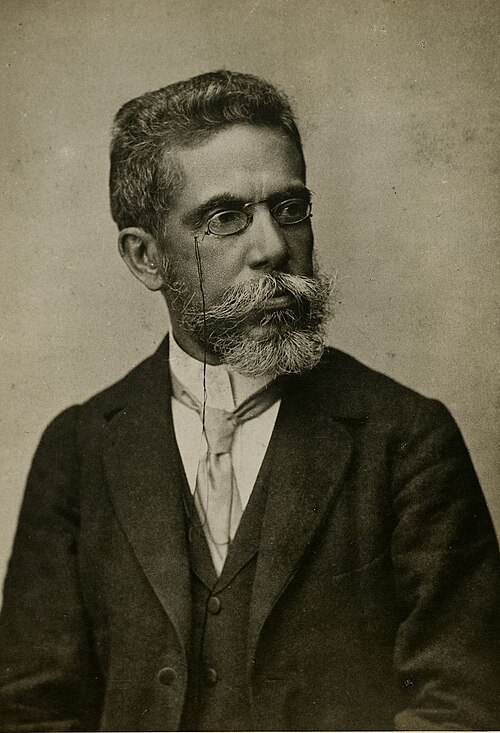
Machado almost never wrote about his own colour in public, and how he was described changed with who was describing him. His friend the critic José Veríssimo called him a “mulatto” in an obituary; the diplomat Joaquim Nabuco wrote to Veríssimo that he would not have used the word, which he called pejorative, and asked for it to be removed. His death certificate recorded him as white, and many of the best-known photographs show him with features that later critics argue were lightened by lighting and reproduction.
This history of “whitening” became a public issue in the 21st century. In September 2011 the state bank Caixa Econômica Federal withdrew a television advertisement for its 150th anniversary in which a white actor played Machado, after complaints from the federal Secretariat for the Promotion of Racial Equality (SEPPIR) and the public; the bank apologised for not portraying the writer as Afro-Brazilian. In 2019 the Faculdade Zumbi dos Palmares, a São Paulo college focused on Black students, launched the campaign “Machado de Assis Real”, which recoloured an 1893 photograph to show his African features and asked publishers to use it.
Intermediate
Meanwhile in the world
The last great abolitions. Brazil was the last country in the Americas to abolish slavery. The Russian Empire had freed its privately owned serfs by imperial decree in 1861, and the United States, after the Emancipation Proclamation of 1863, abolished slavery with the Thirteenth Amendment in 1865. Brazil moved more slowly, through gradual measures such as the Free Womb Law of 1871, before the two-article Lei Áurea of 1888 freed about 700,000 people, with no measures to give them land, work or a place in society. Machado’s columns of May 1888 are a contemporary reaction to this moment, and his satire of Pancrácio’s “generous” master points to the problem many historians stress: freedom on paper without land, work or effective protection.
From Empire to Republic. Eighteen months later, on 15 November 1889, army units led by Marshal Deodoro da Fonseca overthrew the monarchy in Rio de Janeiro, and Emperor Pedro II left for exile in Europe two days later. Machado, a civil servant decorated by the emperor, kept his post under the new regime. He approached the change through irony rather than manifestos: Esaú e Jacó, set across the fall of the monarchy, has often been read as suggesting that the twins’ loud political opposition masks deeper similarities.
Realism across the Atlantic. On 16 April 1878, under the pseudonym “Eleazar”, Machado published in the Rio newspaper O Cruzeiro a severe review titled “Realist literature” of O Primo Basílio, a novel by the Portuguese writer Eça de Queirós; a second article followed later that month. He attacked the book’s unconvincing plot and its focus on sensuality, judged its heroine Luísa inferior to Flaubert’s Emma Bovary, and warned that such books could strangle realism “in the cradle” in the Portuguese language. This is a real, documented connection: Machado measured himself against the realism and naturalism coming from France and Portugal and sparked a lively press controversy. Three years later Brás Cubas offered his own alternative, a novel built on a narrator’s mind rather than on detailed inventories of the world.
Two Latin American literary worlds. In 1888, the year of abolition in Brazil, the Nicaraguan poet Rubén Darío published Azul... in Valparaíso, Chile, helping to launch Spanish-American modernismo. The two literatures developed largely apart: in 1990 Susan Sontag noted that Machado was little read in Spanish-speaking Latin America and that Borges seems never to have read him, although later readers often compare their games with fiction.
Advanced
Different perspectives
Did Capitu betray Bentinho? For about sixty years after 1899, Brazilian and foreign critics largely accepted Bento Santiago’s version: Capitu was guilty. In 1960 the American scholar and translator Helen Caldwell, who had published the first English translation of Dom Casmurro in 1953, argued in The Brazilian Othello of Machado de Assis that Bento is an unreliable narrator whose jealousy mirrors Othello’s, that his evidence is fragile, and that Capitu is innocent. Letters studied by Hélio de Seixas Guimarães show that Caldwell and her editor, Cecil Hemley, were already debating this reading in 1952. Later critics did not all accept her verdict of innocence; some still argued for guilt, and many came to stress undecidability instead: the novel is constructed so that the question cannot be settled from Bento’s testimony, and many readers now treat the question itself as the point.
Absent or coded? Soon after Machado’s death, Hemetério José dos Santos accused him in the Gazeta de Notícias (November 1908) of having renounced his origins and stayed aloof from the problem of slavery, and the image of a writer “absent” from the great national issues persisted for a long time. Critics such as Mário Casassanta in the 1930s and R. Magalhães Júnior in the 1950s rejected this picture, drawing on forgotten writings. More recently Sidney Chalhoub (Machado de Assis, historiador, 2003) read his fiction alongside his work in the civil service, and Eduardo de Assis Duarte, in the anthology Machado de Assis afrodescendente (2007), gathered stories, poems and columns to argue for a deliberate “poetics of dissimulation”: an ironic, oblique critique of white slave-owning society. Duarte even reads the death of Brás Cubas politically: Machado “kills the slave-owner eight years before abolition”. Other critics remain cautious, noting that Machado rarely addressed his own blackness and that labels such as “Black writer” or “mulatto writer” reflect present-day categories as much as his own self-understanding.
Where does he belong in the canon? Writing in The New Yorker in 1990, Susan Sontag called Machado “the greatest author ever produced in Latin America”, with Borges second. Harold Bloom, in Genius (2002), called him “the supreme black literary artist to date”. Such praise drew new readers, but it has also been criticised: the critic Ilan Stavans called Sontag’s ranking “bombastic”, objecting that literature is not a competition, and said Bloom had misrepresented Machado, whose work hardly acknowledged his own blackness. In Brazil, an especially influential modern interpretation is Roberto Schwarz’s: in A Master on the Periphery of Capitalism (1990; English 2001), he argues that the narrator’s capricious “volubility” reproduces, in literary form, the behaviour of a Brazilian ruling class that combined liberal European ideas with slavery and patronage. On this view, Machado is not a European-style writer who happened to live in Brazil but a writer whose form grows out of Brazilian society.
Advanced
Reception, translation and the evidence
In Brazil, Machado was famous in his lifetime and has never left the centre of the canon. Abroad he long remained a writer’s writer. William L. Grossman’s translation of Brás Cubas appeared in 1952 under the title Epitaph of a Small Winner, and Helen Caldwell translated Dom Casmurro in 1953 and several other novels later. In 2018 Margaret Jull Costa and Robin Patterson translated all seven story collections published in his lifetime as The Collected Stories of Machado de Assis.
In 2020 two new English translations of Brás Cubas appeared. The Penguin Classics edition, translated and annotated by Flora Thomson-DeVeaux with a foreword by Dave Eggers, was published in the United States on 2 June 2020 and sold out its print stock on Amazon and Barnes & Noble within about a day, during the protests that followed the killing of George Floyd. Brazilian media covered the event widely; Thomson-DeVeaux herself suggested that Eggers’s foreword and renewed interest in authors of colour may have helped, while stressing that the reasons were uncertain.
What do we actually know about Machado’s life? The evidence comes mainly from his published writing, newspapers, civil service archives and a limited body of letters; he wrote very little about his private life, his illness or his origins. Some early biographies played down his African ancestry, and the records themselves disagree: a death certificate that says “white”, a friend’s obituary that says “mulatto”, photographs whose appearance depends on lighting and printing. A careful account sets these sources side by side rather than choosing one as the simple truth.
Dates also vary slightly between sources: Dom Casmurro carries 1899 on its title page although copies reached readers in early 1900; Brás Cubas and Quincas Borba first appeared as serials; and “Missa do Galo” is sometimes dated 1893 rather than its first periodical appearance in 1894 (it was collected in 1899). Here, years for novels refer to first book editions, and years for stories to first publication, unless stated otherwise.
Key ideas
- Unreliable narrator
- A narrator whose account the reader cannot fully trust. Machado’s first-person narrators, especially Brás Cubas and Bento Santiago, reveal more than they intend, so readers must read against the narrator.
- Irony and the “pen of mockery”
- Machado combines humour with melancholy. His jokes expose vanity, self-interest and cruelty, especially among Rio’s comfortable elite, without preaching.
- Addressing the reader
- His narrators talk to the reader, tease him and anticipate his reactions, turning reading into a game and showing how persuasion works.
- The “free form”
- Short chapters, digressions and broken chronology borrowed from Sterne, Xavier de Maistre and Garrett, which Machado adapted to a Brazilian setting.
- Humanitism
- The mock philosophy of Quincas Borba, which justifies the victory of the strong over the weak; a parody of social Darwinism and positivism.
- Slavery in the background
- Slavery appears less in speeches than in everyday scenes and casual violence, and in a few direct works such as “Pai contra Mãe” and the 1888 columns.
- Ambiguity
- Key questions, such as Capitu’s guilt or the meaning of the night in “Missa do Galo”, are left open by design.
Records
- 1839 — Born on 21 June on the Morro do Livramento, Rio de Janeiro.
- 1856 — Becomes an apprentice typesetter at the Imprensa Nacional.
- 1869 — Marries Carolina Augusta Xavier de Novais on 12 November.
- 1873 — Appointed to the Ministry of Agriculture, Commerce and Public Works (he had entered public service in 1867); he stays in ministry posts for more than thirty years.
- 1881 — Memórias Póstumas de Brás Cubas published as a book after serialisation in 1880.
- 1888 — The Lei Áurea abolishes slavery on 13 May; Machado’s “Bons Dias!” columns satirise the reactions.
- 1897 — Presides over the formal installation of the Academia Brasileira de Letras on 20 July, having been elected its president in January.
- 1899 — Dom Casmurro published (title-page date) and Páginas Recolhidas, with “Missa do Galo”.
- 1904 — Esaú e Jacó published; Carolina dies on 20 October.
- 1908 — Memorial de Aires published; Machado dies at home in Cosme Velho on 29 September.
- 1960 — Helen Caldwell’s The Brazilian Othello of Machado de Assis reopens the question of Capitu’s guilt.
- 2020 — New English translations of Brás Cubas; the Penguin Classics edition sells out in the US within about a day.
Glossary
- Pardo
- A Brazilian term for a person of mixed ancestry, used in censuses and records; Machado is usually described this way.
- Crônica
- A short newspaper column, typical of Brazil, mixing comment, anecdote and fiction about current events.
- Folhetim (serial)
- A novel published in instalments in a newspaper or magazine before appearing as a book.
- Lei Áurea
- The “Golden Law” of 13 May 1888 that abolished slavery in Brazil, in two short articles.
- Free Womb Law
- The law of 28 September 1871 declaring free the children born to enslaved women from then on, with conditions.
- Academia Brasileira de Letras
- The Brazilian Academy of Letters, founded in Rio de Janeiro in 1896–97 on the model of the Académie française, with forty members.
- Unreliable narrator
- A storyteller whose version of events may be biased, mistaken or deliberately misleading.
- Whitening (embranquecimento)
- The social and visual process by which people of African descent were presented as white or lighter-skinned, in records, images and memory.
- Shandean form
- A digressive, playful way of writing novels named after Sterne’s Tristram Shandy.
Questions and answers
Why is a book narrated by a dead man so famous?
Because Brás Cubas uses his death as an excuse to be shockingly honest, and funny, about his own vanity and the society around him. The trick also lets Machado play with time and with the reader in ways that seemed very modern to later writers.
Did Capitu cheat on Bentinho?
Nobody can prove it either way. The whole story is told by Bento, the jealous husband, and his evidence consists of ambiguous observations, such as the boy’s resemblance to his friend Escobar and the way Capitu looked at Escobar’s body at the funeral. Since Helen Caldwell’s 1960 study, many readers think the novel is designed to make the question undecidable.
Was Machado de Assis Black?
He was of mixed African and Portuguese descent: his paternal grandparents had been freed from slavery and his mother was from the Azores. In Brazilian terms he was pardo. Records and images made him look white, and today he is widely recognised as an Afro-Brazilian writer, though scholars use different labels.
Did Machado oppose slavery?
He made no public abolitionist speeches, which some contemporaries held against him. But his columns and stories satirise slave-owners, and archival research shows that as a civil servant he argued for interpretations of the law that helped enslaved people gain freedom.
Who influenced his style?
He named Laurence Sterne, Xavier de Maistre and Almeida Garrett (and, in the first edition of Brás Cubas, Charles Lamb). Critics also point to his wide reading in classical, Portuguese, French and English literature.
Why is he less known abroad than European novelists of his time?
He wrote in Portuguese, which fewer foreign readers know, and good translations came late. Susan Sontag also argued that condescension towards Brazil and Latin America played a role, a view others dispute.
What is the best book to start with?
Many readers begin with Dom Casmurro or with short stories such as “Missa do Galo” and “O Alienista”, then move on to Brás Cubas.
Sources and further reading
- Machado de Assis – Biografia. Academia Brasileira de Letras
- A liderança de Machado de Assis. Academia Brasileira de Letras
- Cronologia da vida de Machado de Assis. Agência Senado, 2008
- Joaquim Maria Machado de Assis. Encyclopedia.com (Encyclopedia of World Biography)
- Machado de Assis. Wikipedia
- Robin Patterson and Margaret Jull Costa, On Joaquim Maria Machado de Assis’s Rise to the Top of Brazilian Literature. Literary Hub, 2020
- Machado de Assis. Brasiliana, Brown University Library
- Memorias Posthumas de Braz Cubas (Typographia Nacional, 1881). Wikisource
- Dom Casmurro. Wikipedia
- Esau and Jacob (novel). Wikipedia
- Missa do galo (text and publication record). MachadodeAssis.net
- Pai contra mãe (text). MachadodeAssis.net
- Marta Passos Pinheiro, Machado de Assis cronista: “Bons Dias!” no avesso da República. Revista de Letras (UNESP) 52, no. 2, 2012 (published 2014)
- Forma livre (Machado Hiperlivro). PUC-SP
- Sergio Paulo Rouanet, Tempo e espaço na forma shandiana: Sterne e Machado de Assis. Estudos Avançados (USP), 2004
- Sidney Chalhoub, Machado de Assis, historiador. Companhia das Letras, 2003
- Marisa Lajolo, Review of Eduardo de Assis Duarte, Machado de Assis afro-descendente. Estudos de Literatura Brasileira Contemporânea, no. 31, 2008
- Ivan Maciel de Andrade, O mulato Machado de Assis. Tribuna do Norte, 2011
- Machado de Assis e o embranquecimento da história. Fundação Perseu Abramo, 2024
- Debate acerca da negritude de Machado de Assis segue em pauta. O Tempo, 2019
- Depois de reclamações, Caixa tira do ar propaganda que retrata Machado de Assis como branco. Agência Brasil (EBC), 2011
- Machado de Assis Real. Universidade Zumbi dos Palmares
- 137 anos depois da Lei Áurea, continua a luta da população negra por direitos no país. Rádio Senado, 2025
- 13th Amendment to the U.S. Constitution: Abolition of Slavery (1865). U.S. National Archives
- Emancipation reform of 1861. Wikipedia
- 15 de novembro de 1889 – A Proclamação da República no Brasil. Assembleia Legislativa do Estado de São Paulo
- Paulo Franchetti, O Primo Basílio e a batalha do Realismo no Brasil. Convergência Lusíada (Real Gabinete Português de Leitura)
- Arnaldo Sampaio de Moraes Godoy, A crítica literária em Machado de Assis. Consultor Jurídico, 2022
- Cousin Bazilio. Wikipedia
- Azul de Rubén Darío. Memoria Chilena, Biblioteca Nacional de Chile
- Carlos Haag, The dilemmas of the Moor of Matacavalos. Revista Pesquisa FAPESP, 2012
- Hélio de Seixas Guimarães, Helen Caldwell, Cecil Hemley e os julgamentos de Dom Casmurro. Machado de Assis em Linha, 2019
- Helen Caldwell, The Brazilian Othello of Machado de Assis: A Study of Dom Casmurro. University of California Press, 1960
- Susan Sontag, Afterlives: The Case of Machado de Assis. The New Yorker, 1990
- Morten Høi Jensen, Mirth and Melancholy: The Collected Stories of Machado de Assis. Los Angeles Review of Books
- Ilan Stavans, Wrestling with Machado. The Yale Review
- Roberto Schwarz, trans. John Gledson, A Master on the Periphery of Capitalism: Machado de Assis. Duke University Press, 2001
- Livro de Machado de Assis em inglês esgota em um dia nos EUA. Exame, 2020
- Nova tradução de Memórias Póstumas de Brás Cubas tem edição esgotada nos EUA. CNN Brasil, 2020
Related
- Emancipation ProclamationWartime order signed by President Abraham Lincoln on January 1, 1863, declaring enslaved people in the rebelling Confederate states free and opening the Union army and navy to Black men.
- Emancipation reform of 1861Alexander II’s reform that legally freed some 23 million privately owned serfs in the Russian Empire, while making them buy their land through decades of redemption payments.
- Azul...Rubén Darío’s 1888 collection of prose and poetry helped establish Spanish American modernismo.
- FiccionesJorge Luis Borges’s collection of stories explores imagined books, labyrinths, chance and the limits of knowledge.
Written with AI assistance from the published sources listed above, and revised as new research appears.