Start at the top for an easy introduction. Go further down for more detail and scholarship.
- Easy
- Intermediate
- Advanced
For young readers
About 160 years ago the United States was fighting a terrible war against itself, called the Civil War. Eleven Southern states had tried to break away and form their own country, the Confederacy. In the South about four million people were enslaved: they were forced to work without pay, could be bought and sold, and were kept from their families and from learning to read.
Abraham Lincoln was the president of the United States. At first he said the war was about keeping the country together. But enslaved people were already running away to the Union army, and many people in the North were saying the war had to end slavery too.
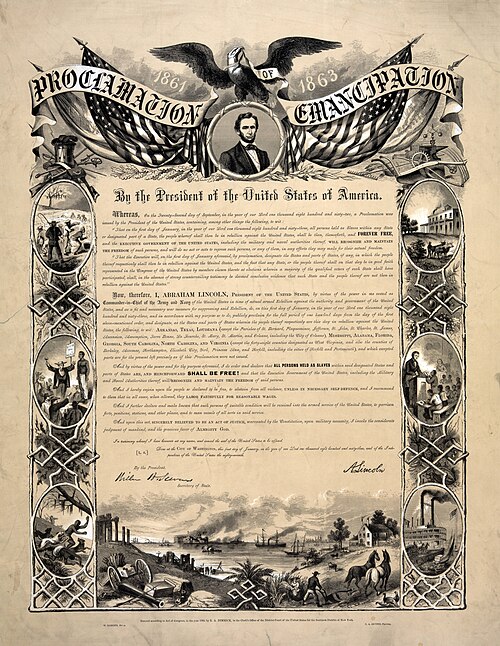
On the first day of 1863 Lincoln signed a paper called the Emancipation Proclamation. “Emancipation” means setting people free. It said that enslaved people in the states fighting against the United States were free from that day on, and that Black men could now join the Union army and navy.
The paper did not free everyone at once. It did not cover some states that had stayed loyal to the Union, and in most of the South the Confederate army was still in control. But every time Union soldiers moved forward, the promise of freedom moved with them. Many enslaved people escaped toward Union lines, and almost 200,000 Black men served as soldiers and sailors for the Union.
On New Year’s Eve, families gathered in churches to wait for midnight and the moment of freedom. The news reached some places very late: in Texas, Union soldiers announced it on June 19, 1865. People still celebrate that day as Juneteenth.
The Proclamation was a giant step, but a law in the Constitution was needed to end slavery everywhere. That law, the Thirteenth Amendment, came into effect at the end of 1865. The real paper Lincoln signed is kept at the National Archives in Washington, D.C.
At a glance
- Issued
- January 1, 1863 (announced in the Preliminary Emancipation Proclamation of September 22, 1862)
- Issued by
- Abraham Lincoln, 16th president of the United States, as commander-in-chief
- Type
- Presidential proclamation and war measure; later numbered Proclamation 95 by the State Department
- Applied to
- Enslaved people in ten Confederate states still in rebellion, excluding exempted Union-held areas; more than 3.5 million of about 4 million enslaved people nationwide
- Did not cover
- The loyal border states (Delaware, Kentucky, Maryland, Missouri), Tennessee, and named Union-held parts of Virginia and Louisiana
- Military effect
- Authorized the enlistment of Black men; about 200,000 Black soldiers and sailors served the Union by 1865
- Original
- Five handwritten pages with ribbons and seal, National Archives, Washington, D.C.
- Completed by
- The Thirteenth Amendment, ratified December 6, 1865, which abolished slavery throughout the United States except as punishment for crime
Easy
What was the Emancipation Proclamation?
The Emancipation Proclamation is one of the most famous documents in American history. Signed by President Abraham Lincoln on January 1, 1863, it declared that “all persons held as slaves” within the parts of the United States then in rebellion “are, and henceforward shall be free.” It also announced that freed men “of suitable condition” would be received into the armed service of the United States.
It was issued during the American Civil War (1861–1865), fought between the United States (the Union) and eleven Southern slave states that had declared themselves an independent Confederacy. Lincoln issued it not as a law passed by Congress but as a military order, using his powers as commander-in-chief of the army and navy. He called it “a fit and necessary war measure for suppressing said rebellion.”
Because it was a war measure, the Proclamation had important limits. It applied only to areas in rebellion, not to slave states that had stayed loyal, and it depended on Union victory to be enforced. Yet it changed the meaning of the war. After January 1, 1863, as the National Archives puts it, every advance of federal troops expanded the domain of freedom.
Easy
Slavery in the United States before 1863
By 1860 almost four million people were enslaved in the United States, nearly all of them of African descent and most living in the South. Enslaved people were treated in law as property. They could be bought, sold, separated from their families, punished violently and denied education. Their unpaid labour produced cotton, tobacco, sugar and rice that made up a large part of the country’s wealth.
Between 1777 and 1804 every Northern state began to abolish slavery, immediately or gradually, but no Southern state did. The U.S. Constitution of 1787 avoided the word “slavery” while protecting it in several ways, such as counting three-fifths of enslaved people for representation and requiring the return of those who escaped. In 1857 the Supreme Court, in the Dred Scott decision, ruled that Black Americans could not be citizens and that Congress could not ban slavery in the western territories.
When Lincoln, who opposed the spread of slavery, was elected president in 1860, most slave states tried to leave the Union. The war that followed was, in its origins, deeply tied to slavery—but at first the U.S. government said it was fighting only to restore the Union.
Easy
The road to emancipation, 1861–1862
Enslaved people themselves forced the question of freedom onto the war. In May 1861 three men who had escaped slavery reached Fort Monroe in Virginia. The Union general there, Benjamin Butler, refused to return them, calling them “contraband of war.” Soon thousands of people fled to Union lines. They were put to work as labourers, and many of their camps became places of schooling and new communities.
Congress moved step by step. In 1861 and 1862 it passed Confiscation Acts freeing enslaved people used to support the rebellion and, later, those of rebel owners who reached Union lines. In March 1862 it forbade the army to return fugitives. In April 1862 slavery was abolished in the District of Columbia, with compensation to owners, and in June Congress banned slavery in all federal territories, rejecting the Dred Scott decision.
Lincoln was cautious. He needed the support of loyal slave states such as Kentucky and Maryland, and of Northern voters, many of whom were willing to fight for the Union but not for Black freedom. He proposed gradual, paid emancipation and even voluntary colonization of freed people abroad. But by the summer of 1862 he had concluded that freeing enslaved people in rebel areas was necessary to win the war.
Intermediate
Drafting, delay and the “hundred days”
Lincoln read a draft proclamation to his cabinet on July 22, 1862. Secretary of State William Seward advised him to wait for a military victory, so that the measure would not look like a desperate last act of a losing side. While Lincoln waited, he publicly answered the editor Horace Greeley, who had demanded faster emancipation. His famous open letter of August 22, 1862, said that his “paramount object” was to save the Union, and that if he could save it “by freeing some and leaving others alone” he would do that. Historians have noted that Lincoln wrote this after he had already drafted the Proclamation; many read it as an effort to prepare Northern opinion by presenting emancipation as a means of saving the Union.
The Union victory at Antietam in Maryland on September 17, 1862, turned back a Confederate invasion. Five days later, on September 22, Lincoln issued the Preliminary Emancipation Proclamation. It warned that on January 1, 1863, all enslaved people in any state or part of a state still in rebellion would be “then, thenceforward, and forever free.” The rebel states had a hundred days to return to the Union and keep slavery, at least for a time. None did.
The preliminary proclamation was politically costly. Democrats attacked it as unconstitutional and inflammatory, and in the autumn elections of 1862 they gained seats in the House and won the governorship of New York. Some supporters feared Lincoln might back down. But on January 1, 1863, exactly as promised, he signed the final Proclamation.
Intermediate
Reading the text: what it said—and what it left out
The Proclamation is written in dry legal language. It begins by quoting the September proclamation, then names the states and parts of states in rebellion: Arkansas, Texas, Louisiana (except New Orleans and thirteen named parishes), Mississippi, Alabama, Florida, Georgia, South Carolina, North Carolina and Virginia (except the forty-eight counties that became West Virginia and several others). In those areas, it declares, enslaved people “are, and henceforward shall be free,” and the government, including the army and navy, “will recognize and maintain” their freedom.
It asks freed people to “abstain from all violence, unless in necessary self-defence” and recommends that they “labor faithfully for reasonable wages.” It announces that they will be received into the armed forces to garrison forts and man vessels. It ends by calling the measure “an act of justice, warranted by the Constitution, upon military necessity” and invoking “the considerate judgment of mankind, and the gracious favor of Almighty God.”
What it left out was as significant as what it said. The four loyal slave states—Delaware, Kentucky, Maryland and Missouri—were not included, because Lincoln believed his war powers did not reach states not in rebellion. Tennessee, largely under Union control, was not named, and neither were the exempted areas of Virginia and Louisiana. Together these exclusions left roughly 800,000 people outside the Proclamation. Critics then and later pointed out the irony: it freed people where the Union could not yet reach and exempted many of those it could.
Intermediate
Freedom on the ground: flight, war and Black soldiers
It is sometimes said that the Proclamation “freed no one.” That is not accurate. In Union-held parts of the Confederacy that were not exempted—such as the Sea Islands of South Carolina and Georgia, parts of eastern North Carolina and the Mississippi Valley—tens of thousands of people became legally free on January 1, 1863. Eyewitnesses recorded celebrations as the text was read aloud. On New Year’s Eve, Black Americans, enslaved and free, had gathered at “Watch Night” services to wait for the moment of freedom.
As Union armies advanced, the Proclamation travelled with them. News spread through networks of enslaved people, encouraging many to flee to Union lines. This drained the Confederacy of the labour that grew its food, built its fortifications and ran its railways. Booker T. Washington, then a boy in Virginia, later remembered a Union officer reading “a rather long paper—the Emancipation Proclamation, I think” and his mother kissing her children with tears of joy.
The Proclamation’s promise to enlist Black men had enormous consequences. By the end of the war about 200,000 Black soldiers and sailors, most of them formerly enslaved, had served the Union; the regiments of the United States Colored Troops made up about a tenth of the army. The National Archives describes this as “enabling the liberated to become liberators.” The Confederacy responded with threats to treat captured Black soldiers and their white officers as insurrectionists, and at Fort Pillow in 1864 Confederate troops massacred Black Union soldiers.
Intermediate
Reactions at home and abroad
Frederick Douglass called the Proclamation “the greatest event of our nation’s history, if not the greatest event of the century.” Abolitionists celebrated, even as many criticized its limits. Anti-war “Copperhead” Democrats denounced it as unconstitutional and warned of racial violence. Many Union soldiers had mixed feelings, though General Ulysses S. Grant wrote in 1863 that emancipation and the arming of Black men were “the heavyest blow yet given the Confederacy.”
Confederate leaders reacted with outrage. President Jefferson Davis threatened to hand captured Union officers in the covered areas to state courts for “exciting servile insurrection,” and General Robert E. Lee described it as a “savage and brutal policy.” Some Confederates argued it proved that the war had always been about slavery and would rally white Southerners to fight harder.
Abroad, the Proclamation helped turn public opinion in Britain and France toward the Union by making the war visibly a struggle against slavery. Working people in Manchester, England, sent Lincoln an address of support praising his steps toward realizing the principle that “all men are created free and equal.” The Italian patriot Giuseppe Garibaldi hailed Lincoln as a “great emancipator.” Combined with the outcome at Antietam, this made European recognition of the Confederacy far less likely.
Intermediate
From proclamation to amendment
Because the Proclamation rested on war powers, many people feared that courts or a later president might treat it as void once the fighting ended. It also left slavery legal in the exempted areas. Lincoln therefore pressed states under Union control to abolish slavery in their own constitutions—which Maryland, Missouri, Tennessee, West Virginia and the Union-held parts of Louisiana and Virginia did during the war—and made a constitutional amendment part of his 1864 re-election campaign.
The Senate passed the Thirteenth Amendment on April 8, 1864, and the House on January 31, 1865. Lincoln was assassinated in April 1865, before ratification. On June 19, 1865, Union General Gordon Granger announced in Galveston that the Proclamation would now be enforced in Texas, the most remote Confederate state; this date is remembered as Juneteenth and became a U.S. federal holiday in 2021. The amendment was ratified on December 6, 1865, finally freeing the remaining enslaved people in Kentucky and Delaware.
The amendment’s exception—“except as a punishment for crime”—would later allow forms of forced prison labour, especially convict leasing in the postwar South. Emancipation also left open the questions of citizenship, voting rights and land for freed people, which Reconstruction and the Fourteenth and Fifteenth Amendments tried, and in many ways failed, to settle.
Advanced
Debate: Lincoln, the army or the enslaved—who freed the slaves?
Historians have long argued over how much credit the Proclamation and Lincoln deserve. In 1948 Richard Hofstadter famously wrote that it had “all the moral grandeur of a bill of lading” and freed slaves precisely where its effect could not reach. At the other extreme, the journalist Lerone Bennett Jr., in Forced into Glory (2000), portrayed Lincoln as a reluctant emancipator committed to white supremacy; most academic historians rejected his conclusions as one-sided, while acknowledging the racist views Lincoln held earlier in his life.
From the 1980s, social historians—notably those associated with the Freedmen and Southern Society Project under Ira Berlin—emphasized “self-emancipation”: enslaved people, by fleeing, refusing work and serving as soldiers, forced the Union to confront slavery and made emancipation a military necessity. James M. McPherson responded that this should not erase the decisive role of Lincoln’s policy and the Union army, without which flight could not have become lasting legal freedom. Most recent accounts combine the two perspectives.
Allen C. Guelzo’s Lincoln’s Emancipation Proclamation (2004) argued that the document’s dry legalism was deliberate: Lincoln, a lawyer and “the last Enlightenment politician,” built emancipation on the strongest constitutional foundation available so that it could survive in the courts. Eric Foner’s The Fiery Trial (2010) traced Lincoln’s changing views on slavery and race, concluding that while he was not an abolitionist and held views typical of his time, he displayed “a remarkable capacity for moral and political growth.”
Advanced
Legal authority and constitutional questions
Before 1865 most Americans, Lincoln included, believed the federal government had no peacetime power to abolish slavery in the states where it existed. Lincoln’s claim was narrower: that as commander-in-chief during an armed rebellion he could seize or free enemy property—including people treated as property—to weaken the enemy. This theory explains the Proclamation’s geography. It reached only areas in rebellion on January 1, 1863, and it did not cite the Confiscation Acts, although the preliminary version had called attention to them.
This foundation was a source of both strength and weakness. It allowed Lincoln to act without Congress and to present emancipation to cautious Northerners as a military measure. But it raised the question of whether freedom granted in war would last in peace. Late in 1862 Lincoln asked Attorney General Edward Bates whether people freed in this way could be re-enslaved; Bates concluded they could not. The Proclamation was never directly challenged in court, but the uncertainty was one reason Lincoln and Congress pursued the Thirteenth Amendment.
Scholars also debate the Proclamation’s place in international law and military ethics. In 1863 the Union also issued the Lieber Code for the conduct of its armies; it was consistent with the Proclamation and insisted that captured Black Union soldiers be treated as prisoners of war, answering the Confederacy’s threat to treat them as escaped slaves. The Proclamation thus sits at an intersection of constitutional law, the laws of war, and the claims of enslaved people who had already begun to treat Union lines as the boundary of freedom.
Advanced
The document, its copies and its memory
The official Proclamation of January 1, 1863, is kept at the National Archives in Washington. Its text covers five handwritten pages, originally tied with narrow red and blue ribbons fixed to the signature page by a wafered impression of the Great Seal. It was bound with other proclamations and kept by the State Department, which later gave it the number 95, and was transferred to the National Archives in 1936. Because it is fragile, it is displayed only for short periods. Lincoln’s handwritten manuscript of the preliminary proclamation is held by the New York State Library. Authorized printed editions, some signed by Lincoln, also circulated during the war.
The Proclamation’s memory has changed over time. Freed people and their descendants celebrated emancipation days on different dates in different regions—January 1 in many places, June 19 in Texas—reflecting when freedom actually arrived. In the century after the war, white Americans often downplayed slavery’s role in the Civil War, and emancipation faded from national commemorations.
During the civil rights movement the Proclamation was revived as an unfulfilled promise. In 1962 Martin Luther King Jr. urged President John F. Kennedy to issue a “Second Emancipation Proclamation” outlawing segregation. King’s “I Have a Dream” speech in 1963 opened with the words “Five score years ago,” referring to the Proclamation, and declared that a hundred years later “the Negro still is not free.” President Lyndon Johnson, presenting the Voting Rights Act in 1965, said that “emancipation is a proclamation and not a fact.”
Key ideas
- War measure
- Lincoln based emancipation on his power as commander-in-chief to weaken the enemy, which defined both its reach and its limits.
- Transforming the war’s purpose
- The Proclamation turned a war to restore the Union into a war that would also end slavery.
- Self-emancipation
- Enslaved people’s flight to Union lines and refusal to work pushed the government toward emancipation and gave the Proclamation its force.
- Liberated to liberators
- By opening military service to Black men, the Proclamation allowed about 200,000 to fight for the Union and freedom.
- Limited scope, expanding effect
- It exempted loyal and occupied areas, but every Union advance extended freedom further into the South.
- Proclamation versus constitutional change
- Lasting abolition required the Thirteenth Amendment, because a war order might not survive the peace.
- Unfinished promise
- Civil rights leaders invoked the Proclamation to demand that legal freedom become real equality.
Records
- 1857 — The Supreme Court’s Dred Scott decision denies Black citizenship and Congress’s power to ban slavery in the territories.
- 1861 — The Civil War begins; in May, General Butler declares escaped slaves at Fort Monroe “contraband of war.”
- 1862 — April 16: slavery is abolished in the District of Columbia; June: Congress bans slavery in the territories; July 17: Second Confiscation Act.
- 1862 — July 22: Lincoln reads a draft proclamation to his cabinet; August 22: open letter to Horace Greeley.
- 1862 — September 22: after Antietam, Lincoln issues the Preliminary Emancipation Proclamation.
- 1863 — January 1: the final Emancipation Proclamation takes effect; recruitment of Black soldiers expands.
- 1864 — April 8: the Senate passes the Thirteenth Amendment; Maryland abolishes slavery in November.
- 1865 — January 31: the House passes the Thirteenth Amendment; April: Lincoln is assassinated.
- 1865 — June 19: emancipation is announced in Galveston, Texas (Juneteenth); December 6: the Thirteenth Amendment is ratified.
- 1936 — The original Proclamation is transferred from the State Department to the National Archives.
- 1963 — Centennial year; Martin Luther King Jr. invokes the Proclamation in the “I Have a Dream” speech.
- 2021 — Juneteenth becomes a U.S. federal holiday.
Glossary
- Emancipation
- Setting people free from slavery or from other legal restrictions.
- Proclamation
- An official public announcement by a head of government.
- Confederacy
- The Confederate States of America, the eleven slave states that tried to leave the United States in 1860–1861.
- Union
- The United States government and the states loyal to it during the Civil War.
- Border states
- Slave states that stayed in the Union: Delaware, Kentucky, Maryland and Missouri (and later West Virginia).
- Contraband
- The wartime label for people who escaped slavery to Union lines, treated at first as captured enemy property.
- Commander-in-chief
- The president’s constitutional role as head of the armed forces.
- Thirteenth Amendment
- The 1865 change to the Constitution that abolished slavery except as punishment for crime.
- United States Colored Troops
- Union army regiments made up mainly of African American soldiers.
- Juneteenth
- June 19, the day in 1865 when emancipation was announced in Texas, now a U.S. federal holiday.
Questions and answers
Did the Emancipation Proclamation free all enslaved people?
No. It applied only to areas in rebellion and left out the loyal slave states and some Union-held areas. It became real as the Union army advanced. Slavery was ended everywhere by the Thirteenth Amendment in December 1865.
Why didn’t Lincoln free everyone at once?
He believed the Constitution gave him power to free slaves only as a war measure against states in rebellion. He also feared losing the loyal slave states and Northern support.
Where is the real Proclamation?
The signed original is at the National Archives in Washington, D.C. It is fragile, so it is shown to the public only for a few days at a time.
What is Juneteenth?
It remembers June 19, 1865, when a Union general announced in Texas that enslaved people there were free. It is now a national holiday in the United States.
Is it true the Proclamation freed no one?
No. Tens of thousands in Union-held parts of the South became free immediately, and millions more gained freedom as the Union army advanced during the war.
How do historians judge Lincoln’s role today?
Most see emancipation as the result of Lincoln’s policy, the Union army and the actions of enslaved people together. They debate how much weight each deserves and how Lincoln’s views on race changed.
Could a later president have cancelled it?
Legally it was a presidential war order, so its permanence was uncertain. That was a key reason for passing the Thirteenth Amendment.
Sources and further reading
- Emancipation Proclamation. Wikipedia
- The Emancipation Proclamation (Featured Documents). U.S. National Archives
- Emancipation Proclamation (Milestone Documents). U.S. National Archives
- Thirteenth Amendment to the United States Constitution. Wikipedia
- Juneteenth. Wikipedia
- Contraband (American Civil War). Wikipedia
- United States Colored Troops. Wikipedia
- Lieber Code. Wikipedia
- Allen C. Guelzo, Lincoln’s Emancipation Proclamation: The End of Slavery in America. Simon & Schuster, 2004
- Eric Foner, The Fiery Trial: Abraham Lincoln and American Slavery. W. W. Norton, 2010
Related
- United States Declaration of IndependenceDocument adopted by the Continental Congress on 4 July 1776 declaring the thirteen colonies independent of Britain.
- Emancipation reform of 1861Alexander II’s reform that legally freed some 23 million privately owned serfs in the Russian Empire, while making them buy their land through decades of redemption payments.
- Haitian RevolutionA revolution beginning with an uprising of enslaved people in Saint-Domingue led to the abolition of slavery there and Haiti’s independence in 1804.
- Seneca Falls ConventionTwo-day meeting in July 1848, usually called the first women’s rights convention in the United States, where 100 people signed the Declaration of Sentiments.
- Langston HughesAmerican poet and writer associated with the Harlem Renaissance, whose work drew on Black life, speech and music.
Written with AI assistance from the published sources listed above, and revised as new research appears.