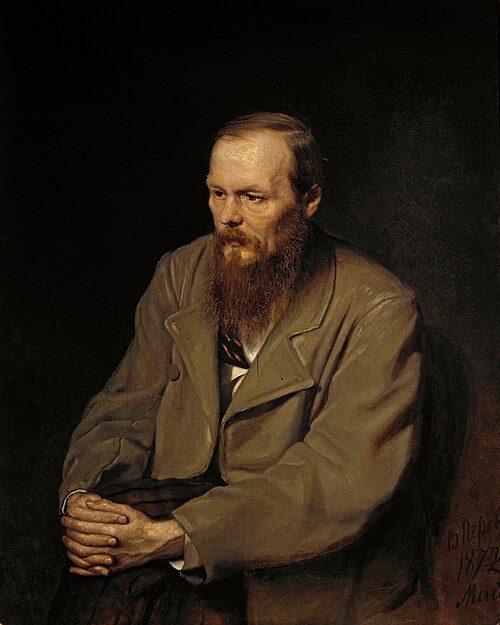
Start at the top for an easy introduction. Go further down for more detail and scholarship.
- Easy
- Intermediate
- Advanced
For young readers
Fyodor Dostoevsky was born in Moscow in 1821. His father was a doctor at a hospital for poor people, and the family lived right there on the hospital grounds. As a boy Fyodor loved stories and read everything he could find.
When he was a young man in the big city of Saint Petersburg, he wrote his first book, Poor Folk, about two poor people who write letters to each other. Famous critics loved it, and suddenly he was a well-known writer at twenty-four.
Then something terrible happened. Dostoevsky joined a group of young people who met to talk about new ideas, including ideas that the tsar, Russia’s ruler, did not allow. The police arrested them. Dostoevsky and his friends were taken to a square to be shot. At the very last moment, a messenger arrived: the tsar had decided to spare their lives. Instead, Dostoevsky was sent to a prison camp in freezing Siberia for four years.
In prison he lived with robbers and murderers, and he learned that even people who had done terrible things could have good hearts. The only book he was allowed was the New Testament. These years changed him forever and filled his later books with deep questions about right and wrong.
Back home, he wrote his greatest novels. In Crime and Punishment, a poor student does something terrible and cannot escape his own conscience. In The Brothers Karamazov, three brothers argue about God and goodness. Dostoevsky’s characters talk and argue so passionately that readers still feel they are listening to real people, and his books are read all over the world today.
At a glance
- Lived
- 11 November 1821 (30 October Old Style), Moscow – 9 February 1881 (28 January Old Style), Saint Petersburg
- Active
- 1846 (Poor Folk) to 1881, mainly in Saint Petersburg, with exile in Siberia (1850–1859) and years in Western Europe (1867–1871)
- Occupation
- Novelist, short-story writer, journalist and editor
- Major works
- Poor Folk (1846), Notes from the House of the Dead (1860–1862), Notes from Underground (1864), Crime and Punishment (1866), The Idiot (1868–1869), Demons (1871–1872), A Writer’s Diary (1873–1881), The Brothers Karamazov (1879–1880)
- Turning point
- Arrested in 1849 for membership of the Petrashevsky Circle; mock execution, then four years of hard labour at Omsk
- Families
- Married Maria Isaeva (1857; d. 1864) and Anna Snitkina (1867), his stenographer, later publisher and memoirist
- Themes
- Freedom and responsibility, suffering and redemption, faith and doubt, poverty and the modern city, the “Russian idea”
- Legacy
- One of the most influential novelists in world literature; important for existentialism, psychology and theology
Easy
Who was Dostoevsky?
Fyodor Mikhailovich Dostoevsky was a Russian writer whose novels explore the deepest questions of human life: Is there a God? If not, is everything allowed? Why do people choose to hurt themselves and others? Can suffering lead to something good? He is usually ranked, together with his contemporary Leo Tolstoy, among the greatest novelists of all time.
His life was as dramatic as his fiction. He became famous overnight with his first novel, was condemned to death for political activity, faced a firing squad that turned out to be a staged ceremony, spent four years as a convict in Siberia and six more as a soldier, suffered from epilepsy, gambled away his money in European casinos, lost his first wife, his closest brother and two of his children, and wrote many of his masterpieces under crushing debt and deadlines.
Dostoevsky’s novels are full of feverish conversations, sudden scandals and characters pushed to extremes: murderers and saints, drunkards and prostitutes, nihilists and monks. Yet behind this drama lies careful thought about philosophy, religion and the fate of Russia. That combination is what has made his work so powerful for readers across the world.
Easy
Early life and first fame
Dostoevsky was born in Moscow at the Mariinsky Hospital for the Poor, where his father, Mikhail, was a doctor. The family was of modest noble status and deeply religious. His mother, Maria, died of tuberculosis in 1837, and his father died in 1839 on the family’s small country estate. According to a long-standing family story, the father was killed by his own serfs; some later researchers have questioned this, and the circumstances remain uncertain.
Following his father’s wishes, Fyodor studied at the Military Engineering School in Saint Petersburg, but he cared much more about literature, reading Pushkin, Gogol, Schiller, Balzac, Dickens and George Sand. He left government service in 1844 to write. His first published work was a translation of Balzac’s novel Eugénie Grandet.
In 1845 he finished Poor Folk, a novel in letters between a poor, elderly copying clerk and a young woman he tries to help. The poet Nikolai Nekrasov and the critic Vissarion Belinsky, the most powerful voice in Russian criticism, praised it enthusiastically, and it was published in January 1846. But his next works, such as The Double (1846), a strange story of a clerk who meets his own double, disappointed Belinsky, and Dostoevsky’s fame quickly faded.
Easy
Arrest, mock execution and Siberia
In the late 1840s Dostoevsky joined the Petrashevsky Circle, a group of young men who met in Saint Petersburg to discuss banned books and utopian socialist ideas. Within it, a smaller secret group around Nikolai Speshnev discussed revolutionary action. At one meeting Dostoevsky read aloud Belinsky’s forbidden “Letter to Gogol”, which attacked the Church and serfdom. After revolutions swept Europe in 1848, Tsar Nicholas I was determined to crush any sign of dissent. In April 1849 about sixty members were arrested.
After months in the Peter and Paul Fortress, Dostoevsky and other prisoners were taken on 22 December 1849 (Old Style) to Semyonovsky Square, told they were sentenced to death, and dressed in white shirts. The first three were tied to posts facing a firing squad. At the last moment an officer announced that the tsar had commuted their sentences. The whole scene had been staged. Dostoevsky later described the thoughts of a man facing execution in The Idiot.
He spent four years (1850–1854) in the prison camp at Omsk, in chains, living among common criminals, and then served as a soldier in Semipalatinsk (in today’s Kazakhstan). There he married a widow, Maria Isaeva, in 1857. He also suffered his first clearly diagnosed epileptic seizures. On the way to Siberia, the wives of exiled Decembrists gave him a copy of the New Testament, the only book he was allowed in prison, and he kept it for the rest of his life. He was allowed to return to Saint Petersburg at the end of 1859.
Intermediate
Return to literature: journals, Europe and the underground
Back in the capital, Dostoevsky rebuilt his career with his brother Mikhail. They edited the journals Time (Vremya, 1861–1863) and Epoch (Epokha, 1864–1865), which promoted pochvennichestvo, “return to the native soil”: the idea that Russia’s educated classes should reconnect with the moral and religious life of the common people rather than copy Western Europe. His Notes from the House of the Dead (1860–1862), a fictionalized account of prison life, was a major success and one of the first works to reveal the Russian penal system to the reading public.
In 1862 he made his first trip to Western Europe, which he described critically in Winter Notes on Summer Impressions (1863), attacking the materialism and self-satisfaction of bourgeois Paris and London. On this and later trips he developed a compulsive passion for roulette that repeatedly left him in debt.
The year 1864 brought disaster: his wife Maria died in April and his brother Mikhail in July, leaving Dostoevsky responsible for debts and for Mikhail’s family. That same year he published Notes from Underground, the monologue of a bitter, isolated former official who rejects the idea that human beings are rational and will always choose their own advantage. People, the Underground Man insists, will act against their own interest just to prove they are free. The work is often seen as a starting point of existentialist literature.
Intermediate
The great novels
Crime and Punishment (serialized in The Russian Messenger in 1866) follows Rodion Raskolnikov, a poor former student in Saint Petersburg who murders an old pawnbroker, partly to test his theory that “extraordinary” people have the right to step over moral laws. The novel is less about solving the crime than about his psychological torment, his duel of wits with the investigator Porfiry Petrovich, and his path toward confession through Sonya Marmeladova, a young woman forced into prostitution to feed her family. While writing it, Dostoevsky also had to deliver a short novel, The Gambler, to a publisher by a strict deadline; he dictated it in under a month to a young stenographer, Anna Snitkina, whom he married in February 1867.
Fleeing creditors, the couple lived abroad from 1867 to 1871, in Germany, Switzerland and Italy. Their first daughter died there in infancy. Dostoevsky wrote The Idiot (1868–1869), an attempt to portray a “positively beautiful” person, the gentle, epileptic Prince Myshkin, whose goodness fails tragically in a world of greed and passion. Demons (1871–1872), inspired by a real murder committed in 1869 by the revolutionary cell of Sergei Nechayev, is a dark satire of political radicalism and a study of how ideas can possess people.
Back in Russia, Anna managed the family’s finances and began publishing his books herself, which finally brought stability. Dostoevsky edited the conservative weekly The Citizen and then published his own monthly A Writer’s Diary, mixing journalism, memoir, stories and political commentary; it made him a national public figure. The Brothers Karamazov (1879–1880), written after the death of his three-year-old son Alyosha in 1878, tells of the murder of a debauched father and the guilt shared by his sons: the passionate Dmitri, the intellectual Ivan, the devout Alyosha and the illegitimate Smerdyakov. It contains Ivan’s “Grand Inquisitor” poem and the teachings of the elder Zosima, one of the most debated pairs of chapters in all literature.
In June 1880 Dostoevsky gave a celebrated speech at the unveiling of the Pushkin monument in Moscow, praising Pushkin’s “universal responsiveness” as the essence of the Russian spirit. The audience’s reaction was ecstatic. He died in Saint Petersburg less than a year later, in February 1881, and tens of thousands of people followed his funeral procession to the Alexander Nevsky Lavra.
Intermediate
Ideas and art
Freedom is at the centre of Dostoevsky’s thought. He believed that human beings are not machines driven only by self-interest, as some rationalist and utilitarian thinkers of his time claimed. Freedom makes great evil possible, but it also makes love, faith and moral responsibility possible. In the Grand Inquisitor story, Christ is condemned for giving people a freedom too heavy to bear, while the Church offers them bread, miracle and authority instead.
Many of his characters test ideas by living them. Raskolnikov acts out the theory of the extraordinary man; Kirillov in Demons tries to prove his freedom through suicide; Ivan Karamazov’s argument that if there is no God and no immortality then morality has no foundation, often summarized as “everything is permitted”, is taken literally by Smerdyakov. Dostoevsky shows the consequences of ideas in real lives, which is why philosophers read him as a thinker as well as a novelist.
He was a Christian thinker, rooted in Russian Orthodoxy, who gave the strongest possible voice to doubt. Ivan’s rebellion against a world in which innocent children suffer is one of the most powerful arguments against faith ever written, and Dostoevsky answered it not with a logical proof but with the example of active love embodied in Zosima and Alyosha. His idea that “each of us is responsible for all” runs through the novel.
Saint Petersburg itself is almost a character in his fiction. Dostoevsky’s city is not the grand imperial capital of palaces and parades but a place of cramped rented rooms, stairwells, taverns and pawnshops, stifling in summer, where clerks, students, widows and the urban poor live on the edge of ruin. Building on Gogol’s Petersburg stories, he made the modern city a setting for isolation, poverty, rumour and sudden encounters between strangers, conditions that push his characters toward extreme ideas and actions. Critics have seen this as one of his great contributions to the European novel of urban modernity.
His political views became increasingly conservative and nationalist. In A Writer’s Diary he argued for Russia’s special religious mission, supported war against the Ottoman Empire in 1877, and attacked Catholicism, socialism and Western liberalism. It also contains antisemitic passages, which scholars treat as a serious and troubling part of his legacy, and which he defended in an 1877 article on the “Jewish question”.
Intermediate
Influence around the world
Dostoevsky’s international fame grew rapidly after translations into French, German and English in the 1880s. Friedrich Nietzsche, who discovered him in a French translation in 1887, called him in Twilight of the Idols the only psychologist from whom he had anything to learn. Sigmund Freud wrote the essay “Dostoevsky and Parricide” (1928), and the novels became central texts for psychoanalysis.
In the twentieth century existentialist writers, including Albert Camus, who adapted Demons for the stage, and Jean-Paul Sartre, saw Dostoevsky as a precursor. Writers as different as Franz Kafka, André Gide and William Faulkner read him closely and acknowledged his importance. Religious philosophers such as Nikolai Berdyaev built on his work, and film-makers from Akira Kurosawa, who filmed The Idiot in 1951, to Robert Bresson adapted his works.
In the Soviet Union his reputation was complicated. His religious faith and his attack on revolutionaries in Demons made him suspect, and he was little taught in the Stalin era, although scholars continued to study him and his works were republished more widely from the mid-1950s. Today he is one of the most widely read Russian authors worldwide, including in Korea and Japan, where translations of his novels have long been popular.
Advanced
Scholarly debates: polyphony, ideology and form
The most influential theoretical reading is Mikhail Bakhtin’s Problems of Dostoevsky’s Art (1929), revised as Problems of Dostoevsky’s Poetics (1963). Bakhtin argued that Dostoevsky created a new kind of “polyphonic” novel, in which characters’ voices and ideas are not subordinated to the author’s single viewpoint but interact as independent, fully valid consciousnesses in unfinished dialogue. The concept of polyphony, along with Bakhtin’s idea of carnival, transformed literary theory far beyond Russian studies.
Critics have debated how far Bakhtin is right. Some argue that Dostoevsky, a committed Orthodox Christian and nationalist, clearly steers readers toward certain conclusions, for example through the structure of The Brothers Karamazov; others hold that his genius lies precisely in letting opposing voices, such as Ivan’s, speak with full force. The question of whether Zosima’s teaching successfully answers the Grand Inquisitor, as Dostoevsky hoped, remains open.
Another debate concerns the relation between the novelist and the publicist. Some scholars treat A Writer’s Diary, with its nationalism and antisemitism, as the key to the novels; others emphasize the gap between the dogmatic journalist and the open-ended artist. Historians of religion, meanwhile, examine how accurately he portrayed Russian Orthodox spirituality, for example the elders of Optina Pustyn, which he visited in 1878 with the philosopher Vladimir Solovyov.
Advanced
Biographical sources and their reliability
The main sources for Dostoevsky’s life are his letters, his working notebooks for the novels, official records such as the files of the Petrashevsky case, and memoirs by people who knew him. The standard scholarly edition is the Academy of Sciences Complete Works in thirty volumes (Leningrad, 1972–1990), which includes drafts, notebooks and letters.
Memoirs must be used critically. Anna Grigoryevna Dostoevskaya’s Reminiscences, written late in her life and published in 1925, are invaluable but protective of her husband’s memory. The memoir of his daughter, Lyubov, contains unreliable stories. A notorious letter of 1883 from the critic Nikolai Strakhov to Tolstoy accused Dostoevsky of moral depravity, including a rumour of abusing a young girl; most biographers regard the accusation as unfounded gossip, partly echoing a scene from Demons that Dostoevsky’s publisher had refused to print.
Some famous facts rest on shaky evidence. The murder of his father by serfs has been doubted by researchers who found that the official investigation recorded a death from natural causes, while others think the family’s story may be true. The link between his epilepsy and his father’s death, central to Freud’s essay, is not supported by the available evidence, and most biographers reject it. Joseph Frank’s five-volume biography (1976–2002, abridged in one volume in 2009) is widely regarded as the most thorough modern account, placing Dostoevsky’s life within the intellectual history of nineteenth-century Russia.
Key ideas
- Freedom
- For Dostoevsky, the defining feature of human beings; it makes both great evil and genuine love and faith possible.
- Suffering and redemption
- Suffering, accepted honestly, can lead to moral rebirth, as in Raskolnikov’s path through confession.
- Ideas lived to the end
- His characters embody theories and follow them to their consequences, showing what ideas do in real lives.
- Faith and doubt
- He gave doubt its strongest voice, as in Ivan Karamazov’s rebellion, and answered it with active love rather than proof.
- Responsibility for all
- Zosima’s teaching that each person is guilty before all and for all, a vision of universal moral solidarity.
- Return to the soil (pochvennichestvo)
- The belief that educated Russians should reconnect with the religious and moral life of the common people.
- Polyphony
- Bakhtin’s term for novels in which many independent voices and viewpoints interact without a single authoritative one.
Records
- 1821 — Born in Moscow on 11 November (30 October Old Style).
- 1839 — His father dies on the family estate, in circumstances later disputed.
- 1846 — Poor Folk is published and praised by Belinsky.
- 1849 — Arrested with the Petrashevsky Circle; mock execution on 22 December (Old Style).
- 1850 — Begins four years of hard labour at the Omsk prison camp.
- 1859 — Returns to Saint Petersburg after military service in Semipalatinsk.
- 1864 — Notes from Underground; deaths of his wife Maria and brother Mikhail.
- 1866 — Crime and Punishment is serialized; The Gambler is dictated to Anna Snitkina.
- 1867 — Marries Anna Snitkina; the couple leave for four years abroad.
- 1871 — Returns to Russia; Demons is serialized (1871–1872).
- 1880 — The Brothers Karamazov is completed; Pushkin speech in Moscow.
- 1881 — Dies in Saint Petersburg on 9 February (28 January Old Style).
Glossary
- Old Style / New Style
- Dates in the Julian calendar used in Russia until 1918 (Old Style) versus the Gregorian calendar (New Style), 12 days apart in the 19th century.
- Petrashevsky Circle
- A Saint Petersburg discussion group of the 1840s interested in utopian socialism, suppressed in 1849.
- Katorga
- The Russian system of penal hard labour, usually in Siberia.
- Nihilism
- In 1860s Russia, a radical movement rejecting traditional authority, religion and art in favour of science and utility.
- Underground Man
- The nameless narrator of Notes from Underground, a model for the alienated, self-contradicting modern hero.
- Pochvennichestvo
- The “native soil” movement promoted by Dostoevsky’s journals, calling for reconciliation between educated Russia and the people.
- Elder (starets)
- In Russian Orthodoxy, a monk respected as a spiritual guide, like Zosima in The Brothers Karamazov.
- Grand Inquisitor
- The prose poem told by Ivan in The Brothers Karamazov, in which a Spanish cardinal condemns the returned Christ.
- Polyphony
- Bakhtin’s term for a novel of many equal voices, which he found in Dostoevsky.
- Serialization
- Publication of a novel in instalments in a journal; most of Dostoevsky’s novels first appeared this way.
Questions and answers
Was Dostoevsky really almost executed?
Yes and no. He was sentenced to death and led before a firing squad, but the execution was a staged ceremony; the tsar had already decided to commute the sentences before it began.
Which book should I read first?
Many readers start with Crime and Punishment, which has a gripping plot. Notes from Underground is short but challenging; The Brothers Karamazov is often considered his masterpiece.
Did Dostoevsky and Tolstoy know each other?
They admired and criticized each other’s works, but they never met in person.
Did Dostoevsky write “If there is no God, everything is permitted”?
Not in exactly those words. The idea is attributed to Ivan Karamazov and discussed by other characters, but the famous sentence is a later summary.
Why did he write so fast?
He was often in debt, partly because of gambling and his brother’s journal, and was paid by the page; many novels were written for serial publication under strict deadlines.
What is Bakhtin’s “polyphonic novel”?
Bakhtin argued that Dostoevsky’s characters speak as independent consciousnesses whose ideas are not simply judged by the author, creating an unfinished dialogue among equal voices.
Was Dostoevsky antisemitic?
Yes, his journalism and letters contain antisemitic statements. Scholars discuss how these relate to his novels, but they are widely acknowledged as part of his record.
Sources and further reading
- Fyodor Dostoevsky. Wikipedia
- 표도르 도스토옙스키. 위키백과
- Petrashevsky Circle. Wikipedia
- Crime and Punishment. Wikipedia
- The Brothers Karamazov. Wikipedia
- Mikhail Bakhtin. Wikipedia
- Joseph Frank, Dostoevsky: A Writer in His Time. Princeton University Press, 2009
- Mikhail Bakhtin, Problems of Dostoevsky’s Poetics (trans. Caryl Emerson). University of Minnesota Press, 1984
Related
- War and PeaceLeo Tolstoy’s novel follows families through the Napoleonic wars and reflects on history, chance and everyday life.
- Friedrich NietzscheGerman philosopher and classical scholar who challenged inherited moral values and examined culture, power and the meaning of life.
- Franz KafkaPrague-born German-language writer whose stories portray uncertainty, opaque authority and people struggling to understand their circumstances.
- Don QuixoteMiguel de Cervantes’s two-part novel follows a man who takes chivalric romances for reality and sets out with Sancho Panza. Its shifting viewpoints helped shape the modern novel.
Written with AI assistance from the published sources listed above, and revised as new research appears.