Start at the top for an easy introduction. Go further down for more detail and scholarship.
- Easy
- Intermediate
- Advanced
For young readers
Friedrich Nietzsche was born in 1844 in a small village in Germany. His father was a church pastor, and everyone thought little Fritz would become a pastor too. He was so serious and so good at reciting Bible verses that other children called him “the little pastor”.
He turned out to be brilliant at old languages like Greek and Latin. When he was only 24, a university in Basel, Switzerland, made him a professor. That is a bit like becoming a head teacher while you are still almost a student!
But Nietzsche was often sick. He had terrible headaches, his eyes hurt when he read, and his stomach was weak. After ten years he had to stop teaching. For the next ten years he travelled around Switzerland, Italy and France, looking for fresh air and sunshine, and wrote book after book.
His books asked big, uncomfortable questions. Why do we think some things are good and others are evil? Where did those ideas come from? Who decided? He compared himself to someone who tests old ideas with a hammer, tapping them to hear which ones sound hollow.
In 1889, when he was 44, his mind suddenly broke down and he could not write or look after himself any more. He lived another eleven years, cared for by his mother and then his sister. Only then did his books become famous all over the world.
At a glance
- Lived
- 15 October 1844 (Röcken, Prussian Saxony) – 25 August 1900 (Weimar)
- Nationality
- Born Prussian; gave up Prussian citizenship on moving to Basel in 1869 and remained officially stateless
- Career
- Professor of classical philology at the University of Basel, 1869–1879; afterwards an independent writer living mainly in Switzerland, Italy and southern France
- Active as author
- 1872 (The Birth of Tragedy) to January 1889, when a mental collapse in Turin ended his writing life
- Major works
- The Birth of Tragedy; Human, All Too Human; The Gay Science; Thus Spoke Zarathustra; Beyond Good and Evil; On the Genealogy of Morality; Twilight of the Idols
- Key ideas
- Death of God, nihilism, revaluation of values, master and slave morality, will to power, eternal recurrence, the Übermensch, perspectivism
- Language
- German, in a vivid literary style that often uses aphorisms (short, sharp sayings)
Easy
Who was Nietzsche?
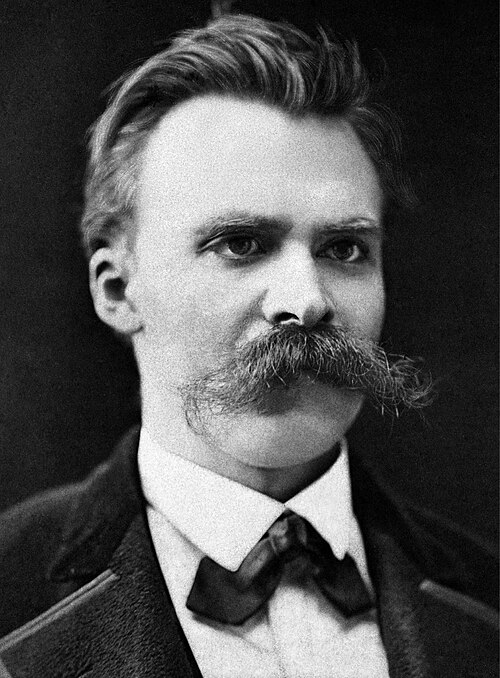
Friedrich Wilhelm Nietzsche (1844–1900) was a German-speaking philosopher, a trained scholar of ancient Greek and Latin literature, and one of the most influential and most argued-about thinkers of the modern world. He wrote about morality, religion, art, science, psychology and the meaning of human life.
His central worry can be put simply. For centuries, most Europeans had built their ideas of good and evil, and their sense that life had a purpose, on Christian faith. Nietzsche believed that this faith was fading among educated people, even among those who still went to church. If the foundation went, he asked, what would happen to everything built on top of it? He feared a crisis he called nihilism: the feeling that nothing has value at all.
Nietzsche did not want to answer this crisis by going back to old beliefs. Instead he tried to understand where our values came from and to imagine new ways of valuing life that would say “yes” to it, including its pain. That is why his books are full of both fierce criticism and bold hope.
Nietzsche was not widely read during his working life. Most of his later books sold only a few hundred copies, and some he paid to print himself. His fame exploded in the 1890s, after he had fallen ill and could no longer write, and he has been read, admired, misused and debated ever since.
Easy
Growing up: the pastor’s son
Nietzsche was born on 15 October 1844 in Röcken, a village near Leipzig in the Prussian province of Saxony. His father, Carl Ludwig Nietzsche, was a Lutheran pastor, and both of his grandfathers had also been clergymen. When Friedrich was four, his father died after a brain illness, and soon afterwards his little brother died too. The family, his mother Franziska, his sister Elisabeth, his grandmother and two aunts, moved to the town of Naumburg.
In 1858 he won a place at Schulpforta, one of the strictest and most famous boarding schools in Germany. There he received a rigorous training in Greek and Latin and also wrote poems and music. He later felt that this discipline had shaped his whole way of working.
In 1864 he went to the University of Bonn to study theology and classical philology (the study of ancient Greek and Latin texts). He soon gave up theology, and with it, gradually, his Christian faith. He followed his teacher Friedrich Ritschl to the University of Leipzig, where he became Ritschl’s star student.
Two encounters in Leipzig changed his life. In 1865 he found a copy of Arthur Schopenhauer’s The World as Will and Representation in a second-hand bookshop and was overwhelmed by its dark vision of a blind, striving will behind all things. In 1868 he met the composer Richard Wagner, who shared his love of Schopenhauer. For several years Wagner would be something like a father figure to him.
Easy
The young professor in Basel
In early 1869, on Ritschl’s enthusiastic recommendation, the University of Basel in Switzerland appointed Nietzsche professor of classical philology. He was 24 and had not yet finished a doctorate; Leipzig quickly awarded him one on the strength of his published work. Before moving, he gave up his Prussian citizenship, and he remained officially stateless for the rest of his life.
In Basel he taught Greek language and literature at the university and at the local secondary school. His colleagues included the famous historian of the Renaissance Jacob Burckhardt, and he formed a lifelong friendship with the theologian Franz Overbeck. He also made frequent visits to Wagner and his partner (later wife) Cosima at their house at Tribschen, near Lucerne.
In 1870, during the Franco-Prussian War, he volunteered as a medical orderly. He caught dysentery and diphtheria while caring for wounded soldiers, and his health, never strong, grew worse from then on.
His first book, The Birth of Tragedy out of the Spirit of Music, appeared at the start of 1872. It was not a normal scholarly book, and it brought him both admirers and fierce critics, as the next section explains.
Intermediate
The Birth of Tragedy and the break with Wagner
The Birth of Tragedy argued that Greek tragedy grew out of a tension between two artistic forces, which Nietzsche named after two gods. The Apollonian (from Apollo) stands for clear form, dreamlike images, measure and individuality. The Dionysian (from Dionysus, god of wine and ecstasy) stands for intoxication, music and the dissolving of the individual into a larger flow of life. Tragedy, Nietzsche claimed, let the Greeks face the terrible truths of existence without despair, because art made them bearable. He then argued that Socrates’ confidence in reason had killed this tragic culture, and that Wagner’s music dramas might bring it back to modern Germany.
Professional classicists were unimpressed. The young scholar Ulrich von Wilamowitz-Moellendorff published a scathing pamphlet mocking the book’s lack of evidence. Nietzsche’s reputation as a philologist never recovered, and students began to avoid his classes.
Between 1873 and 1876 he published four long essays, the Untimely Meditations, attacking the complacent culture of the new German Empire and praising Schopenhauer and Wagner as educators. But when he attended the first Bayreuth Festival in 1876, he was repelled by what he saw as Wagner’s nationalism, showmanship and turn toward Christian themes. Their friendship broke down over the next two years.
Human, All Too Human (1878), a collection of aphorisms written in a cool, scientific tone and dedicated to the memory of Voltaire, marked the break. Nietzsche now examined morality, religion and art as human products that could be explained psychologically and historically. In 1879 his illness forced him to resign from Basel, and the university granted him a small pension.
Intermediate
The wandering years (1879–1888)
For the next decade Nietzsche lived like a traveller, renting simple rooms and moving with the seasons in search of a climate that eased his migraines, eye pain and stomach troubles. He spent summers in the Swiss Alpine village of Sils Maria in the Engadine and winters on the coasts of Italy and France, in Genoa, Rapallo and Nice, and finally in Turin. He was nearly blind at times and depended on friends, especially the composer Heinrich Köselitz (whom he nicknamed Peter Gast), to copy his manuscripts.
This was his most productive period. Daybreak (1881) and The Gay Science (1882) were followed by Thus Spoke Zarathustra (1883–1885), a poetic book in which a prophet-like figure comes down from the mountains to teach humanity. Then came Beyond Good and Evil (1886) and On the Genealogy of Morality (1887). In 1888, his last working year, he wrote at astonishing speed: The Case of Wagner, Twilight of the Idols, The Antichrist, Nietzsche contra Wagner and his strange autobiography Ecce Homo.
His private life was lonely. In 1882 he fell in love with Lou Salomé, a brilliant young Russian woman he met through his friend Paul Rée. The three had planned to live and study together, but the plan collapsed amid jealousy and interference from his sister Elisabeth, leaving Nietzsche deeply hurt. He never married.
He quarrelled with Elisabeth when in 1885 she married Bernhard Förster, a well-known antisemitic agitator who went on to found a German settlement, Nueva Germania, in Paraguay. Nietzsche repeatedly expressed contempt for antisemitism and German nationalism in his letters and books, a fact that became important after his death.
Intermediate
“God is dead”: nihilism and the revaluation of values
Nietzsche’s most famous phrase appears in The Gay Science (1882). In section 125, a madman runs into a marketplace with a lantern in broad daylight, crying that he is looking for God. The unbelievers laugh at him. He answers that “God is dead … and we have killed him”, and that people have not yet understood what this means. The point is not a scientific claim about whether God exists. It is a cultural diagnosis: belief in the Christian God has stopped being the living centre of European culture, but people have not yet faced the consequences.
Those consequences, Nietzsche thought, were enormous. Modern Europeans still held Christian moral values such as pity, equality and self-denial, but these values had lost their foundation. Sooner or later people would notice, and the result could be nihilism, the collapse of all sense of value and purpose. He even saw hidden nihilism in the Christian tradition itself, since in his view it placed the true value of life in another world rather than this one.
His answer was a project he called the “revaluation of all values”. He did not simply want to reverse good and evil. He wanted to ask of every value: what kind of life does it express, and does it make human beings stronger, richer and more creative, or weaker and more resentful? Values, he held, are not found ready-made in the universe; they are created by human beings, and they can be judged by what they do for life.
Intermediate
Where do our morals come from? Master and slave morality
In Beyond Good and Evil and On the Genealogy of Morality, Nietzsche proposed that moral ideas have a history, which he called a “genealogy”, like a family tree. He contrasted two basic types of valuation. In “master morality”, which he associated with ancient aristocratic warrior societies, “good” meant noble, strong, proud and healthy, and “bad” simply meant low, common or weak. The judgement starts from the nobles’ own sense of themselves.
“Slave morality”, he argued, grew among the oppressed, who could not fight back against their masters. Out of ressentiment, a French word Nietzsche used for a festering, powerless resentment, they reversed the old values. The strong were now called “evil”, and weakness, humility and suffering were praised as “good”. Nietzsche called this the “slave revolt in morality” and linked it especially to ancient Judaism and Christianity, a claim that remains controversial and that readers have found both illuminating and offensive.
The second and third essays of the Genealogy trace the origins of guilt and bad conscience, which he connected to the ancient relation between creditor and debtor and to aggressive instincts turned inward, and the “ascetic ideal”, the recurring idea that self-denial is the highest form of life. Here Nietzsche works like a psychologist, asking what hidden needs and drives lie behind lofty moral ideals.
Nietzsche did not claim that people should simply return to master morality, and he admired some things slave morality had achieved, such as making human beings deeper and more reflective. Scholars still disagree about how far his genealogy is meant as history, how far as psychology, and how far as a provocation designed to loosen the grip of inherited values.
Intermediate
Will to power, eternal recurrence and the Übermensch
Will to power. Nietzsche suggested that living things are driven not mainly by the wish to survive or to be happy but by a drive to grow, overcome resistance and express their strength. This “will to power” can take many forms, from domination to artistic creation to self-mastery. How far he meant it as a theory of all reality, and how far as a psychological hypothesis about human beings, is one of the big debates about his work.
Eternal recurrence. In The Gay Science he asks the reader to imagine a demon who says that you will live your life again, exactly the same, every pain and joy, over and over for ever. Would you curse the demon, or call this the most divine news? Nietzsche later wrote in Ecce Homo that the thought came to him in August 1881 while walking by a lake near Sils Maria. It is best understood as a test: can you affirm your life so completely that you would want it again? He called this attitude amor fati, love of fate.
The Übermensch. In Thus Spoke Zarathustra the prophet announces the Übermensch, often translated “overman” or “superman”, as the goal beyond present-day humanity: someone who creates his or her own values and affirms life without needing the old consolations. Zarathustra contrasts this ideal with the “last man”, a comfortable, small-minded person who wants only safety and pleasure. The Übermensch is not a biological super-race; that reading came later and distorts the text.
Perspectivism. Nietzsche also argued that there is no view from nowhere: all knowing is from some perspective and shaped by our needs and drives. He did not conclude that anything goes. Rather, he suggested that the more perspectives we can bring to bear on something, the more complete our understanding will be.
Intermediate
Collapse, illness and the sister’s archive
On 3 January 1889, in Turin, Nietzsche suffered a mental breakdown. A famous story says that he collapsed after throwing his arms around a horse that was being beaten in the street, but this anecdote was recorded later and cannot be confirmed. In the following days he sent bizarre notes to friends signed “Dionysus” or “The Crucified”. Franz Overbeck travelled to Turin and brought him back to Basel. He was then treated in a psychiatric clinic in Jena, and from 1890 his mother cared for him at home in Naumburg.
He never recovered. After his mother’s death in 1897, his sister Elisabeth, who had returned from Paraguay after her husband’s suicide, moved him to a villa in Weimar. He died there on 25 August 1900, aged 55. The doctors of his time diagnosed progressive paralysis caused by syphilis. Many modern researchers doubt this and have suggested other explanations, including a slow-growing brain tumour, a hereditary disease of the small blood vessels of the brain, or a form of dementia; no diagnosis can be proven today.
Meanwhile Elisabeth took control of his papers. In 1894 she founded the Nietzsche Archive, which moved to Weimar, and she presented herself as the guardian of her brother’s thought. She wrote his biography, controlled access to his manuscripts and, with Köselitz, published a book called The Will to Power (1901, much enlarged 1906), assembled from his unpublished notebooks as if it were his planned masterpiece.
Elisabeth steered the archive toward German nationalism and later welcomed the Nazi regime; Adolf Hitler visited the archive and attended her funeral in 1935. Nazi propagandists quoted Nietzsche selectively, ignoring his attacks on antisemitism and on German nationalism. After the Second World War, scholars such as Walter Kaufmann worked to separate Nietzsche’s thought from this legacy, and Karl Schlechta showed that Elisabeth had altered and even forged some of her brother’s letters.
Intermediate
Influence around the world
Around 1900 Nietzsche became a cultural sensation across Europe. The Danish critic Georg Brandes had lectured on him in Copenhagen in 1888, and soon writers, artists and political radicals of every kind claimed him. Novelists such as Thomas Mann and Hermann Hesse, poets such as Rilke, the sociologist Max Weber and the psychoanalyst Sigmund Freud all engaged with his ideas about culture, drives and the hidden motives of morality.
In the twentieth century he became a founding figure for several philosophical movements. Existentialists such as Karl Jaspers and Albert Camus took up his themes of meaning after the death of God. Martin Heidegger lectured on him for years. French philosophers of the 1960s and 70s, including Gilles Deleuze and Michel Foucault, used his genealogical method to question accepted ideas of truth, power and the self. In English-speaking philosophy, after decades of neglect, he is now widely studied as a moral psychologist and critic of morality.
His influence also reached East Asia early. Japanese intellectuals debated his ideas around 1900, and in China the writer Lu Xun admired him and translated the prologue of Thus Spoke Zarathustra. His phrases, such as “God is dead” and “What does not kill me makes me stronger” (from Twilight of the Idols), have entered everyday language, often far from their original meaning.
Advanced
The text problem: published works, notebooks and editions
Any serious study of Nietzsche must first ask which texts count. He left not only the books he published or prepared for print but also thousands of pages of notebooks, drafts and letters (the Nachlass). The Will to Power compiled by Elisabeth Förster-Nietzsche and Köselitz arranged selected notes under a plan Nietzsche had sketched and later abandoned, sometimes editing or combining them. For decades many readers, including major philosophers, treated it as his main work.
The turning point was the critical edition begun in the 1960s by the Italian scholars Giorgio Colli and Mazzino Montinari, who returned to the manuscripts and printed the notebooks in chronological order. Their work showed that The Will to Power was not a book Nietzsche wrote, and their Kritische Gesamtausgabe, together with the more widely used Kritische Studienausgabe, is now the standard basis for scholarship.
Most scholars today give priority to the published works and to the texts Nietzsche finished in 1888, and use the notebooks with caution as evidence of ideas he was testing. Others, following Heidegger, argue that his most important thinking lies precisely in the unpublished notes. The choice has real consequences, especially for how one reads the will to power and eternal recurrence, which appear in much more metaphysical form in the notebooks than in the books.
Biographical sources raise similar problems. Elisabeth’s biography and editions of letters shaped the early picture of her brother but contain distortions and forgeries. Ecce Homo, his own account of his life, is a deliberately self-mythologizing work written weeks before his collapse. Modern biographies, such as those of Curt Paul Janz and Julian Young, rely on critically edited letters and contemporary documents.
Advanced
Interpreting Nietzsche: rival readings
Metaphysician or anti-metaphysician? Heidegger, in lectures from the 1930s and 40s published in 1961, read Nietzsche as the last great metaphysician of the West, for whom being is will to power and eternal recurrence is its mode. Many later interpreters reject this, seeing him instead as a critic of metaphysics whose claims about will to power are psychological or rhetorical.
Humanist, postmodernist or naturalist? Walter Kaufmann’s Nietzsche: Philosopher, Psychologist, Antichrist (1950) presented him as a humane heir of the Enlightenment and Goethe, rescuing him from the Nazi image. French readers such as Deleuze (Nietzsche and Philosophy, 1962), Foucault and Derrida emphasized his attacks on stable meaning, truth and the unified self. In recent English-language scholarship, Maudemarie Clark has argued for a careful reading of his views on truth, and Brian Leiter for a “naturalist” Nietzsche who explains morality in terms of human psychology and physiology; others, such as Bernard Reginster, place the affirmation of life and the overcoming of resistance at the centre.
Politics. Nietzsche despised nationalism and antisemitism, yet he also wrote contemptuously of democracy, equality and socialism and praised aristocratic societies and hierarchy. Scholars disagree whether he had a political philosophy at all, whether his aristocratism is meant literally or as a cultural ideal, and how his work could be taken up both by the far right and by left-wing and feminist thinkers.
Style and method. Because he wrote in aphorisms, parables, poems and personas, and often contradicted himself deliberately, some readers argue that his style is part of his philosophy: a way of forcing readers to think for themselves and of showing that every claim is a perspective. Others try to reconstruct consistent arguments from his texts. Most contemporary work tries to do justice to both sides.
Key ideas
- Death of God
- Nietzsche’s diagnosis that belief in the Christian God had ceased to be the living foundation of European culture, with consequences people had not yet faced.
- Nihilism
- The collapse of the sense that anything has value or meaning, which Nietzsche saw as the looming danger of modern culture.
- Revaluation of all values
- His project of judging inherited values by asking whether they enhance or diminish life, and of creating new ones.
- Master and slave morality
- Two opposed kinds of valuation: one starting from self-affirmation of the strong (“good vs. bad”), the other from resentment of the weak (“good vs. evil”).
- Will to power
- The drive to grow, overcome resistance and express strength, which Nietzsche suggested underlies much or all of life.
- Eternal recurrence
- The thought of living one’s life again, identically, forever; a test of whether one can fully affirm life.
- Übermensch
- The “overman” of Thus Spoke Zarathustra: an ideal of a human being who creates values and says “yes” to life.
- Perspectivism
- The view that all knowledge comes from particular perspectives shaped by needs and drives, and that understanding grows with the number of perspectives.
Records
- 1844 — Born on 15 October in Röcken, Prussian Saxony, son of a Lutheran pastor.
- 1858 — Enters the boarding school Schulpforta, where he studies Greek and Latin (to 1864).
- 1865 — In Leipzig, discovers Schopenhauer’s The World as Will and Representation.
- 1869 — Appointed professor of classical philology at the University of Basel at 24; gives up Prussian citizenship.
- 1872 — Publishes The Birth of Tragedy.
- 1876 — Attends the first Bayreuth Festival; his friendship with Wagner begins to break down.
- 1879 — Resigns his Basel professorship because of illness and begins a decade of travel.
- 1882 — Publishes The Gay Science, including the parable of the madman announcing the death of God.
- 1883 — First part of Thus Spoke Zarathustra appears (completed 1885).
- 1887 — Publishes On the Genealogy of Morality.
- 1889 — Suffers a mental collapse in Turin on 3 January; never writes again.
- 1900 — Dies on 25 August in Weimar.
Glossary
- Philology
- The study of languages and texts, especially the literature of ancient Greece and Rome.
- Aphorism
- A short, pointed statement expressing an idea; many of Nietzsche’s books are built from them.
- Apollonian and Dionysian
- Two artistic forces in The Birth of Tragedy: clear form and measure versus ecstasy and music.
- Ressentiment
- A French word used by Nietzsche for a festering, powerless resentment that, he argued, produced slave morality.
- Genealogy
- Nietzsche’s method of tracing the historical and psychological origins of values in order to question them.
- Ascetic ideal
- The idea that self-denial and renunciation of the senses are the highest form of life.
- Amor fati
- Latin for “love of fate”: accepting and even loving everything that happens, as it is.
- Last man
- In Zarathustra, the opposite of the Übermensch: a comfortable, unambitious person who wants only safety and small pleasures.
- Nachlass
- German for “what is left behind”: an author’s unpublished notes, drafts and papers.
- Stateless
- Without citizenship of any country, as Nietzsche was after 1869.
Questions and answers
Did Nietzsche really say “God is dead”?
Yes. The phrase appears in The Gay Science (1882) and in Thus Spoke Zarathustra. It describes the decline of Christian belief in European culture rather than a proof that God does not exist.
Was Nietzsche a Nazi?
No. He died in 1900, long before Nazism, and he repeatedly condemned antisemitism and German nationalism. His sister and later Nazi propagandists used selected, sometimes edited, passages to present him as a forerunner.
Why did Nietzsche stop writing?
In January 1889 he suffered a mental collapse in Turin. He lived another eleven years but could no longer work. The exact cause of his illness is still debated.
What is the Übermensch?
In Thus Spoke Zarathustra it is an ideal beyond present-day humanity: a person who creates their own values and fully affirms life. It is not a biological super-race.
Is The Will to Power a real book by Nietzsche?
Not as he planned it. It was assembled after his collapse by his sister and Heinrich Köselitz from unpublished notes. Scholars now use the critical edition of the notebooks by Colli and Montinari instead.
Was Nietzsche against morality altogether?
He attacked particular moral systems, especially Christian morality, and the idea that any morality is valid for everyone. Many scholars argue that he still held strong values, such as honesty, courage and the affirmation of life.
Why is Nietzsche so hard to interpret?
He wrote in aphorisms, parables and personas, left huge unpublished notebooks, changed his mind over time and often wrote provocatively. Readers have therefore built very different Nietzsches from the same texts.
Sources and further reading
- R. Lanier Anderson, Friedrich Nietzsche. Stanford Encyclopedia of Philosophy
- Brian Lightbody, Nietzsche: Philosophical Psychology. Internet Encyclopedia of Philosophy
- Friedrich Nietzsche. Wikipedia
- The Birth of Tragedy. Wikipedia
- Thus Spoke Zarathustra. Wikipedia
- Elisabeth Förster-Nietzsche. Wikipedia
- Will to power. Wikipedia
- Eternal return. Wikipedia
- Walter Kaufmann, Nietzsche: Philosopher, Psychologist, Antichrist. Princeton University Press, 1950
- Julian Young, Friedrich Nietzsche: A Philosophical Biography. Cambridge University Press, 2010
Related
- SocratesAthenian philosopher who wrote nothing himself. Known through Plato and Xenophon, he was tried and executed in 399 BCE.
- Immanuel KantPrussian philosopher whose accounts of knowledge, moral duty and judgment reshaped modern philosophy.
- Georg Wilhelm Friedrich HegelGerman philosopher whose account of history, thought and social institutions profoundly influenced later philosophy.
- Johann Wolfgang von GoetheGerman writer whose poetry, drama and fiction, from the Sturm und Drang to Weimar Classicism, became central to German literature and European culture.
- Fyodor DostoevskyRussian novelist whose works probe moral responsibility, poverty, belief and the pressures of modern city life.
- Lu XunChinese writer and critic whose fiction and essays examined social hierarchy, custom and the pressures of modern change.
Written with AI assistance from the published sources listed above, and revised as new research appears.