Start at the top for an easy introduction. Go further down for more detail and scholarship.
- Easy
- Intermediate
- Advanced
For young readers
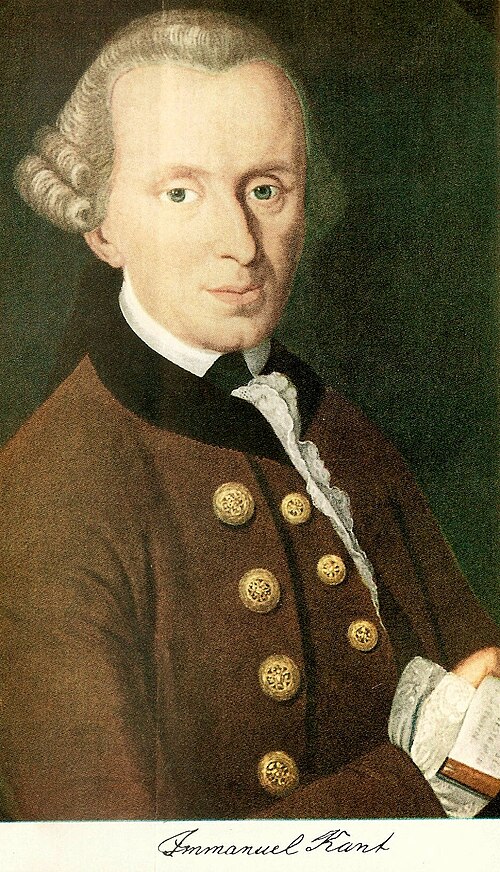
Immanuel Kant was born about three hundred years ago in Königsberg, a port city on the Baltic Sea that belonged to Prussia. His father made leather straps and saddles for horses. The family was not rich, but his parents cared a lot about being honest and hard-working.
Kant almost never left his home region. Yet his mind travelled everywhere—to the stars, to the edges of human knowledge and to the question of right and wrong. People say he was so regular that neighbours could set their clocks by his afternoon walk.
One of his big ideas is like wearing glasses you can never take off. Everything you see comes through the glasses. Kant said our minds work a bit like that: we always experience the world through built-in ways of thinking, such as space, time and cause and effect. So we can know the world as it appears to us, but not as it is completely apart from us.
Kant also thought about how to be good. He said: before you do something, ask yourself, “What if everyone did this?” If you tell a lie to get what you want, and everyone did the same, no one could trust anyone. He also said we must never treat people merely as tools; every person has a special worth, called dignity.
Late in life he wrote about how countries could stop fighting wars forever and live in “perpetual peace.” Some of his ideas helped inspire the international organizations that try to keep peace today. He also held some unfair views about people of other races, which scholars now study and criticize.
At a glance
- Lived
- 22 April 1724 – 12 February 1804
- Place
- Königsberg, Kingdom of Prussia (today Kaliningrad, Russia)
- Roles
- University lecturer, Professor of Logic and Metaphysics at the University of Königsberg
- Language
- German (early dissertations in Latin)
- Major works
- Critique of Pure Reason (1781; 2nd ed. 1787), Groundwork of the Metaphysics of Morals (1785), Critique of Practical Reason (1788), Critique of the Power of Judgment (1790), Toward Perpetual Peace (1795)
- Key ideas
- Transcendental idealism, synthetic a priori knowledge, the categorical imperative, autonomy, human dignity, perpetual peace
- Movement
- Late Enlightenment; founder of “critical philosophy,” starting point of German idealism
Easy
Who was Kant?
Immanuel Kant is often ranked with Plato and Aristotle among the most influential philosophers in the Western tradition. He lived his whole life in and around Königsberg, a Baltic port in East Prussia, where he taught at the university for more than four decades. His writing is famously difficult, but his questions are simple: What can I know? What ought I to do? What may I hope?
Kant stood at the end of a long argument in European philosophy. Rationalists such as Descartes, Spinoza and Leibniz trusted pure reason to reveal the deepest truths about God, the soul and the world. Empiricists such as Locke and Hume insisted that all knowledge comes from experience—and Hume concluded that many things we take for granted, even the necessity of cause and effect, cannot be proven. Kant tried to show what was right and what was wrong in both camps.
His solution, which he called critical philosophy, examined reason itself: its powers and its limits. The results reshaped not only the theory of knowledge but also ethics, political thought, aesthetics and the philosophy of religion. Much of later philosophy, whether it followed him or rebelled against him, began from Kant.
Easy
A quiet life in Königsberg
Kant was born on 22 April 1724, the fourth of nine children of a harness maker. His parents were devout Pietists, members of a Lutheran movement that stressed inner faith and moral seriousness. He attended the Pietist Collegium Fridericianum, where he disliked the religious drill but received a strong education in Latin, and entered the University of Königsberg in 1740, drawn to mathematics and natural science.
After his father died in 1746, Kant left the university and worked for several years as a private tutor to families in the countryside. He returned in the mid-1750s, earned his degree, and in 1755 began teaching as a Privatdozent, a lecturer paid directly by students. To make a living he lectured on an extraordinary range of subjects: logic, metaphysics, ethics, mathematics, physics, physical geography and later anthropology. During the Seven Years’ War, Königsberg was occupied by Russian forces (1758–1762), and Russian officers attended his classes.
Only in 1770, at the age of 46, did Kant become Professor of Logic and Metaphysics. He never married. He was sociable, a witty host at long lunches with friends, and famous for the regularity of his habits, though some anecdotes about him have been exaggerated. He served twice as rector of the university, stopped lecturing in 1796 and, after years of declining health, died on 12 February 1804. He is buried in a mausoleum beside Königsberg Cathedral.
Easy
From the stars to the silent decade
Kant’s early writings were largely about science. In the Universal Natural History and Theory of the Heavens (1755) he proposed that the solar system formed from a rotating cloud of matter, a “nebular hypothesis” that Pierre-Simon Laplace later developed independently. He also suggested that the Milky Way is a disk of stars and that some faint nebulae are other such systems—ideas far ahead of their time.
In the 1760s Kant wrote on metaphysics, God and ethics, increasingly uneasy about the claims of traditional metaphysics. Two influences were decisive. Reading Rousseau, he later wrote, cured him of the arrogance of thinking that learning alone made someone valuable and taught him to honour ordinary people. Reading Hume, he said, interrupted his “dogmatic slumber” and gave his investigations a new direction.
His inaugural dissertation of 1770 already separated knowledge through the senses from knowledge through the intellect and treated space and time as forms of our sensibility. Then followed about eleven years in which he published almost nothing—the “silent decade”—while he worked out the Critique of Pure Reason, published in 1781 when he was 57.
Intermediate
The Critique of Pure Reason
The first Critique begins with a puzzle. Some judgments are “analytic”: their truth follows from the meaning of the words (“all bachelors are unmarried”). Others are “synthetic”: they add information. Some judgments are known “a priori,” independent of experience; others only “a posteriori,” through experience. Kant argued that mathematics, the basic principles of natural science (such as “every event has a cause”) and the claims of metaphysics seem to be both synthetic and a priori. How can we know something new about the world without first experiencing it?
His answer is what he compared to Copernicus’s revolution in astronomy. Instead of assuming that our knowledge must conform to objects, suppose that objects, as we experience them, must conform to the structure of our minds. Space and time are the forms of our sensibility, the way anything must appear to us. The understanding supplies concepts called categories—such as substance and cause—that unify experience. Because experience must fit these forms, we can know certain things about it in advance.
The price of this solution is a limit. We can know things only as they appear to us (“phenomena”), not as they are in themselves (“noumena” or “things in themselves”). Kant called this position transcendental idealism, combined with “empirical realism”: the world of experience is fully real and knowable by science, but it is not the whole of what there may be.
The second half of the book, the “Transcendental Dialectic,” shows what happens when reason ignores this limit. When it tries to prove the immortality of the soul, the beginning of the world in time, or the existence of God, it falls into illusions and contradictions—the famous “antinomies,” where equally strong arguments prove opposite conclusions. Kant wrote that he had to deny knowledge in order to make room for faith: he removed these questions from theoretical proof so that they could be approached through moral reason.
Intermediate
Duty, dignity and the categorical imperative
In the Groundwork of the Metaphysics of Morals (1785) and the Critique of Practical Reason (1788), Kant built a moral philosophy based on reason rather than on happiness, feeling or divine command. The Groundwork opens by claiming that nothing in the world can be called good without qualification except a good will. Talents, wealth and even happiness can be misused; a good will is good in itself, even if it fails to achieve its aims.
Moral rules, for Kant, are “categorical imperatives”: they command unconditionally, unlike “hypothetical imperatives” (“if you want X, do Y”). He gave several formulations of the supreme principle. The first: act only according to a maxim that you can at the same time will to become a universal law. A person who makes a false promise to get money is acting on a maxim that, if everyone followed it, would make promising impossible. The second: treat humanity, in your own person and in others, always at the same time as an end and never merely as a means.
Behind these formulas lies the idea of autonomy—giving the moral law to oneself as a rational being—which Kant saw as the source of human dignity. Things have a price and can be exchanged; persons have dignity, a worth beyond all price. This idea has had enormous influence on modern thinking about human rights, consent and respect for persons.
Kant also argued that morality leads to religion, though not the other way round. Because we are commanded to pursue the “highest good”—virtue rewarded with proportionate happiness—we must hope that the soul is immortal and that God exists. These are “postulates of practical reason,” not objects of knowledge. The Critique of Practical Reason ends with his best-known sentence: two things fill the mind with ever-new admiration and awe, the starry heavens above me and the moral law within me.
Intermediate
Beauty, purpose and the third Critique
The Critique of the Power of Judgment (1790) links the world of nature, known by science, with the world of freedom, governed by the moral law. It has two parts. The first treats aesthetic judgment. When we call something beautiful, Kant argued, we are not reporting a private pleasure like enjoying a favourite food; we speak as if everyone ought to agree, even though no rule or proof can compel agreement. Beauty arises from a “free play” of imagination and understanding and is enjoyed without any interest in possessing or using the object.
Kant also analysed the sublime: the feeling we have before overwhelming nature—storms, mountains, the ocean—when our senses fail but our reason feels its own superiority. The second part examines teleological judgment, our tendency to understand living organisms as if they were purposive, their parts existing for the sake of the whole. Kant held that biology could not do without this way of thinking, though it is a guiding principle rather than proven knowledge.
The third Critique became a founding text of modern aesthetics and deeply affected Romantic writers and artists, including Friedrich Schiller, whose letters on aesthetic education built on Kant’s ideas.
Intermediate
Enlightenment, religion and perpetual peace
In his 1784 essay “An Answer to the Question: What Is Enlightenment?” Kant defined enlightenment as humanity’s emergence from its self-incurred immaturity—the inability to use one’s own understanding without guidance from another. Its motto, he wrote, is Sapere aude: “Dare to use your own understanding.” He argued that the public use of reason—scholars addressing the reading public—must always be free.
Kant’s own freedom was soon tested. Under King Frederick William II, Prussia tightened religious censorship. After Kant published Religion within the Boundaries of Mere Reason (1793), which interpreted Christianity as a vehicle of moral faith, he received a royal order in 1794 reprimanding him. He promised, as “Your Majesty’s most loyal subject,” not to write publicly on religion—a promise he considered void after the king’s death in 1797.
In Toward Perpetual Peace (1795), written after the Peace of Basel, Kant set out the conditions for ending war: every state should have a republican constitution, in which citizens consent to war; international law should be based on a federation of free states; and a “cosmopolitan right” should guarantee strangers hospitality. Later readers have seen in this essay an early vision of the League of Nations, the United Nations and the “democratic peace” thesis. His Metaphysics of Morals (1797) laid out a full theory of rights and of virtue.
Intermediate
Influence and legacy
Almost immediately, Kant’s philosophy became the centre of German intellectual life. Reinhold popularized it; Fichte, Schelling and Hegel tried to overcome the gap between appearances and things in themselves, creating German idealism. Schopenhauer called himself Kant’s true heir. In the late nineteenth century, the call “back to Kant” launched Neo-Kantianism, which shaped philosophy of science and the humanities in Germany.
In the twentieth century, analytic philosophers such as P. F. Strawson reinterpreted the first Critique, and John Rawls’s A Theory of Justice (1971) revived Kantian ideas of autonomy and fairness in political philosophy. Kantian ethics remains one of the main frameworks in moral philosophy, alongside consequentialism and virtue ethics, and the concept of human dignity appears in modern constitutions and human rights documents.
Kant’s thought also spread across the world. It was studied intensively in Meiji and Taishō Japan, influenced thinkers of the Kyoto School, and became a standard subject in philosophy departments in Korea and China. Translators in East Asia have debated how to render terms like a priori and transcendental, a sign of how seriously his vocabulary is taken. In 2024 the three-hundredth anniversary of his birth was marked by conferences worldwide.
Advanced
Interpretive debates: idealism, freedom and formalism
What exactly is transcendental idealism? On a “two-worlds” reading, appearances and things in themselves are distinct sets of entities, and Kant is close to Berkeley’s idealism—a charge made already in the first review of the Critique, which prompted Kant to add a “Refutation of Idealism” in the 1787 edition. On a “two-aspects” reading, associated especially with Henry Allison, the distinction is between two ways of considering the same things: as they appear under the conditions of human knowledge, and as they might be considered apart from those conditions. Others question whether either reading can make sense of Kant’s claim that things in themselves affect our senses.
A second debate concerns freedom. Kant held that in the world of appearances every event is causally determined, yet morality requires that we act freely. His solution—that we can think of ourselves as free as noumenal agents while being determined as phenomena—has been defended as a subtle distinction between standpoints and attacked as obscure. How this bears on moral responsibility for evil actions, which Kant took up in the Religion, remains contested.
Critics since Hegel have charged that the categorical imperative is empty formalism: that the universalizability test cannot by itself generate concrete duties, or that it yields rigid conclusions, as in Kant’s notorious claim that one may not lie even to a murderer asking where one’s friend is hiding. Defenders, among them scholars such as Christine Korsgaard and Onora O’Neill, have developed interpretations in which the formulas work together and are applied with judgment.
Advanced
Race, universalism and the sources
Kant’s lectures on physical geography and anthropology, and his essays on the concept of race (1775, 1785, 1788), contain hierarchical and demeaning claims about non-European peoples, and his writings include sexist views about women. Since the 1990s scholars such as Emmanuel Chukwudi Eze and Charles Mills have argued that these views are not marginal but show that Kant’s universal “humanity” was implicitly limited. Others, notably Pauline Kleingeld, have argued that Kant changed his mind in the 1790s, criticizing colonialism in Toward Perpetual Peace and extending cosmopolitan right to all peoples. How to weigh these texts—and whether his moral theory can be separated from his prejudices—is an active area of research.
The sources for Kant are unusually rich. The Academy Edition (Akademie-Ausgabe), begun in 1900 under the Prussian Academy of Sciences, collects his published works, correspondence, handwritten notes and student transcripts of his lectures; scholars cite passages by its volume and page numbers, and cite the first Critique by the pagination of the 1781 (A) and 1787 (B) editions. The lecture transcripts are valuable but uneven, since they were copied and sometimes compiled by students.
Biographically, early accounts by his friends Ludwig Ernst Borowski, Reinhold Bernhard Jachmann and Ehregott Andreas Wasianski, all published in 1804, shaped the image of a clockwork bachelor. Modern biographers, especially Manfred Kuehn, have used letters and other evidence to present a more sociable and changing figure, and have treated some famous anecdotes with caution.
Key ideas
- Copernican revolution
- Kant’s proposal that objects as we experience them conform to the structures of our mind, rather than our knowledge simply copying objects.
- Synthetic a priori judgments
- Judgments that add real information yet are known independently of experience, such as truths of mathematics and the principle that every event has a cause.
- Transcendental idealism
- The view that we know things only as they appear to us under the forms of space, time and the categories, not as things in themselves.
- Categorical imperative
- The supreme moral principle, commanding unconditionally; for example, act only on maxims you could will as universal laws, and treat humanity never merely as a means.
- Autonomy and dignity
- Rational beings give the moral law to themselves; this capacity gives persons a dignity that is beyond any price.
- Aesthetic judgment
- Judgments of beauty are based on feeling but claim universal agreement, arising from a free play of imagination and understanding.
- Perpetual peace
- A lasting peace secured by republican constitutions, a federation of free states and a cosmopolitan right of hospitality.
Records
- 1724 — Born in Königsberg, East Prussia, on 22 April.
- 1740 — Enters the University of Königsberg.
- 1755 — Publishes Universal Natural History and Theory of the Heavens; begins lecturing as a Privatdozent.
- 1758 — Russian forces occupy Königsberg during the Seven Years’ War (until 1762).
- 1770 — Appointed Professor of Logic and Metaphysics; defends his Inaugural Dissertation.
- 1781 — Critique of Pure Reason (first edition) is published.
- 1784 — Publishes the essay “What Is Enlightenment?”
- 1785 — Groundwork of the Metaphysics of Morals.
- 1787 — Second, heavily revised edition of the Critique of Pure Reason; followed by the Critique of Practical Reason (1788).
- 1790 — Critique of the Power of Judgment.
- 1795 — Toward Perpetual Peace, after a royal rebuke over his writings on religion in 1794.
- 1804 — Dies in Königsberg on 12 February.
Glossary
- A priori / a posteriori
- Known independently of experience / known only through experience.
- Analytic / synthetic
- True by the meaning of its terms / adding information not contained in the subject concept.
- Categories
- Basic concepts of the understanding, such as substance and causality, through which experience is organized.
- Phenomena and noumena
- Things as they appear to us, and things considered as they may be in themselves, beyond possible experience.
- Antinomy
- A pair of opposed conclusions that reason seems able to prove equally well, such as that the world has, and has no, beginning in time.
- Maxim
- The personal rule or policy behind an action, which Kant tests for universalizability.
- Pietism
- A Lutheran reform movement emphasizing personal devotion and moral conduct, in which Kant was raised.
- Privatdozent
- A university lecturer licensed to teach but paid by student fees rather than a salary.
- German idealism
- The philosophical movement of Fichte, Schelling and Hegel that grew out of responses to Kant.
Questions and answers
Did Kant really never travel?
He never left East Prussia and rarely went far from Königsberg. But Königsberg was a busy port and university town, and Kant read travel reports eagerly; he even taught a popular course on physical geography about the whole world.
Is it true people set their watches by his walk?
This is a popular story based on accounts of his very regular daily routine. Like many anecdotes about him, it has probably been polished in the retelling, but his orderly habits were real, especially in old age.
Would Kant really say you must not lie to save a friend?
In a 1797 essay replying to Benjamin Constant, Kant argued that truthfulness is a duty even toward someone who asks where a friend is hiding. Many Kantians find this conclusion wrong and argue that it does not follow from his best principles; the case is one of the most debated in ethics.
Why is Kant so hard to read?
He was inventing a new technical vocabulary for new problems, wrote long sentences in academic German, and in the first Critique admitted that he sacrificed readability to thoroughness. Starting with shorter works such as the Prolegomena, the Groundwork or the Enlightenment essay helps.
Does Kant think we can never know reality?
He thinks we can know the world of experience—what science studies—fully and objectively. What we cannot know is what things are like independent of any possible experience. Whether that amounts to a kind of skepticism is itself debated.
Where is Königsberg now?
After the Second World War the city became part of the Soviet Union and was renamed Kaliningrad; it is now in Russia. Kant’s tomb survived beside the rebuilt cathedral, and the local university bears his name.
How did Kant influence ideas about human rights?
His claim that every person has dignity and must never be treated merely as a means became one of the philosophical foundations for modern ideas of human dignity, which appear, for example, in post-war constitutions and human rights declarations. Historians caution that this influence worked through many intermediaries.
Sources and further reading
- Immanuel Kant. Stanford Encyclopedia of Philosophy
- Kant’s Moral Philosophy. Stanford Encyclopedia of Philosophy
- Kant’s Aesthetics and Teleology. Stanford Encyclopedia of Philosophy
- Kant, Immanuel. Internet Encyclopedia of Philosophy
- Immanuel Kant. Wikipedia
- Critique of Pure Reason. Wikipedia
- Groundwork of the Metaphysics of Morals. Wikipedia
- Perpetual Peace: A Philosophical Sketch. Wikipedia
- Manfred Kuehn, Kant: A Biography. Cambridge University Press, 2001
- Immanuel Kant; trans. and ed. Paul Guyer and Allen W. Wood, Critique of Pure Reason (Cambridge Edition of the Works of Immanuel Kant). Cambridge University Press, 1998
Related
- René DescartesFrench philosopher and mathematician whose method of systematic doubt became central to early modern philosophy.
- Baruch SpinozaDutch philosopher who developed a rigorous account of nature, human freedom and the relation between reason and religion.
- Jean-Jacques RousseauGeneva-born writer whose arguments about inequality, political authority and education influenced European thought.
- Georg Wilhelm Friedrich HegelGerman philosopher whose account of history, thought and social institutions profoundly influenced later philosophy.
- Friedrich NietzscheGerman philosopher and classical scholar who challenged inherited moral values and examined culture, power and the meaning of life.
- AristotlePlato's student and Alexander's tutor. He founded the Lyceum and wrote on logic, ethics, politics and the natural world.
Written with AI assistance from the published sources listed above, and revised as new research appears.