Start at the top for an easy introduction. Go further down for more detail and scholarship.
- Easy
- Intermediate
- Advanced
For young readers
René Descartes was born in France in 1596. He was a curious boy who was often sick, so his teachers at school let him stay in bed in the mornings to think. He kept that habit all his life, and he said some of his best ideas came to him lying in bed.
Descartes noticed that many things he had learned as a child turned out to be wrong. So he had a bold idea. Imagine a basket of apples, and you are worried that some are rotten. The best thing is to tip all the apples out, check each one, and put back only the good ones. Descartes decided to do that with everything he believed.
He asked: Can I trust my eyes? Sometimes they trick me, like a straight stick that looks bent in water. Can I be sure I am awake? Sometimes dreams feel real. Could a powerful trickster be fooling me about everything? Then he found something no trickster could take away: even while he was doubting, he was thinking. And if he was thinking, he must exist. In Latin this idea is often written “cogito, ergo sum”: I think, therefore I am.
Descartes was also a great mathematician. He showed how to describe shapes like lines and circles with numbers and equations, using a grid. That is why the grid you draw graphs on is sometimes called a Cartesian grid, after his Latin name, Cartesius.
He lived for about twenty years in the Netherlands, where he could think and write freely. At the end of his life he went to Sweden to teach Queen Christina, but the cold winter made him ill, and he died there in 1650. Philosophers still argue about his ideas today, especially about how the mind and the body are connected.
At a glance
- Lived
- 31 March 1596, La Haye, Touraine, France (now Descartes) – 11 February 1650, Stockholm, Sweden
- Active
- Mainly in the Dutch Republic, c. 1628–1649
- Fields
- Philosophy (metaphysics, epistemology), mathematics, physics, optics, physiology
- Main works
- Discourse on the Method (1637), Meditations on First Philosophy (1641), Principles of Philosophy (1644), The Passions of the Soul (1649)
- Languages
- French and Latin
- Key ideas
- Method of doubt; the cogito; mind–body dualism; mechanical physics; analytic geometry
- Education
- Jesuit college of La Flèche; law degree, University of Poitiers (1616)
- Legacy
- Often called the father of modern philosophy; founder of the Cartesian tradition
Easy
Who was Descartes?
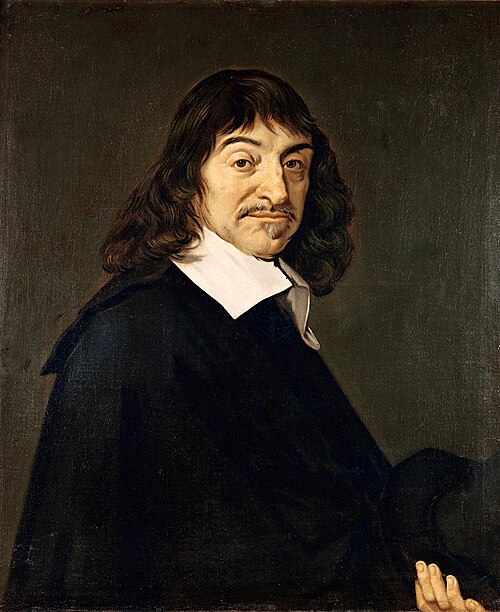
René Descartes (1596–1650) was a French philosopher, mathematician and scientist. He is often called the “father of modern philosophy” because he tried to put all knowledge on new, certain foundations, starting not from the authority of ancient books but from what a single thinking mind could clearly know.
He is most famous for the sentence “I think, therefore I am” and for the view that the mind and the body are two very different kinds of thing. But he also worked in mathematics, where he helped create analytic geometry, and in physics, optics, astronomy and physiology. For Descartes these were all branches of a single tree of knowledge.
Descartes lived during the Scientific Revolution, the age of Galileo and Kepler, when old ideas about nature inherited from Aristotle were being challenged. He wanted to give the new science a philosophical foundation that would also be compatible with belief in God and the soul.
Easy
His life
Descartes was born on 31 March 1596 in La Haye in Touraine, a town now renamed Descartes in his honour. His mother died when he was an infant, and he was raised largely by his grandmother. In 1606 or 1607 he entered the new Jesuit college of La Flèche, where he studied classical languages, mathematics and Aristotelian philosophy. In 1616 he took a law degree at Poitiers.
In 1618 he went to the Netherlands as a gentleman volunteer in the army of Maurice of Nassau. In Breda he met Isaac Beeckman, a Dutch scholar who encouraged him to apply mathematics to physical problems. On the night of 10 November 1619, while staying in Germany, he had three vivid dreams that he took as a sign that he should devote his life to building a unified science.
After years of travel and study, including a period in Paris, Descartes settled in the Dutch Republic at the end of 1628. He lived there for about twenty years, moving often between towns such as Amsterdam, Leiden, Utrecht and Egmond, because he valued quiet and freedom. He had a daughter, Francine, with Helena Jans van der Strom, a servant; Francine died of a fever in 1640 at the age of five, a loss he felt deeply.
In 1649 Queen Christina of Sweden invited him to Stockholm to teach her philosophy. The queen liked to have lessons very early in the morning during the harsh Swedish winter. Descartes caught what was probably pneumonia and died on 11 February 1650. His remains were later taken back to France.
Easy
The method: starting again from zero
In the Discourse on the Method (1637), Descartes tells the story of his own education and explains why he was dissatisfied. His teachers had taught many opinions, but philosophers disagreed about almost everything. Only mathematics seemed to give certain answers. He decided to look for a method that would bring the certainty of mathematics to every field.
He summarized his method in four rules: accept nothing as true unless it is so clear and distinct that there is no reason to doubt it; divide each problem into as many parts as possible; think in order, from the simplest things to the most complex; and make complete reviews so that nothing is left out.
The Discourse was written in French, not Latin, so that ordinary educated readers, including women who had not been taught Latin, could read it. It was published together with three scientific essays, on optics, on meteorology and on geometry, which were meant to show the method at work.
While he was doubting and rebuilding, Descartes also needed a way to live. In Part Three of the Discourse he describes a “provisional morality”: to obey the laws and customs of his country and keep the religion he was raised in; to be as firm and resolute in action as possible, like a traveller lost in a forest who keeps walking in one direction; and to try to master himself rather than fortune, changing his desires rather than the order of the world.
Intermediate
The Meditations: doubt, the cogito and God
Descartes’s most important philosophical work, the Meditations on First Philosophy (Latin, 1641), is written as six meditations over six days. In the First Meditation he looks for reasons to doubt everything he believes. The senses sometimes deceive; he might be dreaming; and he imagines an all-powerful “evil genius” (genius malignus) who deceives him even about simple truths such as 2 + 3 = 5. This radical doubt is a tool, not a conclusion: the aim is to find something that survives it.
In the Second Meditation he discovers that, however much he is deceived, he must exist in order to be deceived. “I am, I exist” is true whenever he thinks it. The famous formula “I think, therefore I am” appears in French in the Discourse (je pense, donc je suis) and in Latin in the Principles (ego cogito, ergo sum). He then asks what this “I” is, and answers: a thing that thinks, which doubts, understands, affirms, denies, wills, imagines and senses. Using the example of a piece of wax that changes all its sensory qualities when melted, he argues that we know even bodies through the intellect rather than the senses.
In the Third and Fifth Meditations Descartes offers proofs that God exists: from the idea of an infinite, perfect being, which he argues he could not have produced himself, and from the idea that existence belongs to the essence of a perfect being (a version of the ontological argument). Because God is perfect, God is no deceiver, and so what we perceive clearly and distinctly can be trusted. The Fourth Meditation explains error as a result of our will reaching further than our understanding.
In the Sixth Meditation he argues that mind and body are really distinct: he can clearly conceive himself as a thinking thing without extension, and body as an extended thing without thought. Yet he also says the mind is not in the body like a pilot in a ship, but closely joined to it, as pain and hunger show.
Intermediate
Mathematics and the mechanical universe
In La Géométrie (1637), Descartes showed how geometric problems could be translated into algebraic equations and solved, and how equations could be represented as curves. This joining of algebra and geometry laid foundations for analytic geometry and later for calculus. He also introduced notational habits still used today, such as using letters from the end of the alphabet (x, y, z) for unknown quantities and superscripts for powers. The modern “Cartesian” coordinate system developed from this work, although its fully modern form came later.
In physics Descartes wanted to explain all of nature by matter in motion. For him, matter is simply extension: there is no empty space, and bodies interact only by contact. He formulated laws of motion, including a version of the principle of inertia, and explained the motions of the planets by vast whirlpools of matter (vortices). Isaac Newton’s theory of universal gravitation later replaced the vortex theory, but Descartes’s program of mechanical explanation shaped seventeenth-century science.
In optics he published the law of refraction (in the form of a ratio of sines) and gave an explanation of the rainbow. He also studied anatomy and physiology, dissecting animals and describing the body as a machine operated by the flow of “animal spirits” through the nerves. He argued that animals are complex machines without minds, a view that was controversial in his own time and has remained so.
Intermediate
Descartes in his time: Galileo, the Church and the Dutch Republic
In the early 1630s Descartes was working on a large treatise called The World, describing a universe built from matter in motion, in which the Earth moves around the Sun. When he learned in 1633 that the Roman Inquisition had condemned Galileo for teaching that the Earth moves, he decided not to publish it. It appeared only after his death.
Descartes was a Catholic who hoped that his philosophy would be accepted in Catholic schools, and he dedicated the Meditations to the theologians of the Sorbonne. But his ideas also caused conflict. In the Dutch Republic, the Reformed theologian Gisbertus Voetius, rector of the University of Utrecht, attacked Cartesian philosophy as dangerous to faith; in 1642 the university condemned it, and a bitter pamphlet war followed. In 1663, after his death, his works were placed on the Catholic Index of Forbidden Books.
The Dutch Republic, with its printing houses, universities and relative tolerance, was nevertheless the place where Descartes could work best. It was also a centre of trade and science, where he corresponded with scholars throughout Europe, often through the French friar Marin Mersenne in Paris, who acted as a clearing-house for letters among scientists.
Intermediate
Objections, replies and the correspondence with Elisabeth
Descartes did something unusual: before the Meditations were published, he had them circulated to other thinkers and printed their objections together with his replies. The objectors included the theologian Johannes Caterus, Mersenne, the English philosopher Thomas Hobbes, the theologian Antoine Arnauld, the philosopher Pierre Gassendi and the Jesuit Pierre Bourdin. The Objections and Replies are an important part of the work.
Arnauld raised what is now called the “Cartesian circle”: Descartes seems to prove God’s existence using clear and distinct perceptions, and then to use God’s existence to guarantee that clear and distinct perceptions are true. Hobbes and Gassendi questioned whether the mind could really be an immaterial thing. Arnauld also noted a resemblance between the cogito and an argument of Augustine.
From 1643 Descartes corresponded with Princess Elisabeth of Bohemia, a gifted philosopher living in exile in The Hague. She asked a sharp question: if the mind is not extended and the body moves only by contact, how can the mind move the body? Descartes’s answers, and her follow-up questions, are among the most discussed exchanges in the history of philosophy. Their discussions also led him to write The Passions of the Soul (1649), on the emotions and how to govern them.
Intermediate
Influence and legacy
Cartesianism spread quickly through European universities and salons in the later seventeenth century, despite official condemnations. Philosophers such as Nicolas Malebranche, Baruch Spinoza and Gottfried Wilhelm Leibniz developed, criticized and transformed his ideas. Spinoza wrote an exposition of Descartes’s Principles before building his own system, and Leibniz developed his philosophy partly in debate with Cartesian physics.
In the eighteenth century John Locke and David Hume in Britain challenged Descartes’s belief in innate ideas and knowledge through pure reason, and Immanuel Kant later tried to settle the conflict between rationalism and empiricism. Philosophy textbooks have often taught this story as a contest between “Continental rationalists” (Descartes, Spinoza, Leibniz) and “British empiricists” (Locke, Berkeley, Hume), although many historians now regard this division as too simple.
In the twentieth century Descartes remained a central figure, often as a target. Edmund Husserl called his phenomenology a kind of new “Cartesian meditations”; Gilbert Ryle mocked dualism as the doctrine of “the ghost in the machine”; and debates in cognitive science and the philosophy of mind about consciousness and artificial intelligence still often start from the Cartesian division between mind and matter. His mathematics, meanwhile, became part of the basic toolkit of science and engineering.
Advanced
Scholarly debates: the cogito, the circle and dualism
Is the cogito an inference? The formula “I think, therefore I am” looks like a syllogism with a hidden premise (“whatever thinks exists”). In the Second Replies, however, Descartes denied that it was deduced from a syllogism, describing it instead as recognized by a simple intuition of the mind. Philosophers continue to debate whether it is an inference, an intuition or a performative act, and whether it establishes a substantial self or only that thinking is going on.
How does Descartes escape the circle? Interpreters have proposed several answers: that the divine guarantee applies only to remembered demonstrations and not to present clear perceptions; that Descartes seeks only a stable, psychologically indubitable system rather than absolute truth; or that the circle is real and damaging. The literature on this question is large, and no solution commands universal agreement.
What exactly is Cartesian dualism? Some scholars read Descartes as a strict “substance dualist” for whom mind and body interact causally, mediated in the brain by the pineal gland, which he thought was the principal seat of the soul. Others emphasize his statements about the “substantial union” of mind and body and argue that the human being is, for him, a genuine unity, or even a third kind of notion alongside mind and body. How to understand interaction remains the most famous open problem in his philosophy.
Advanced
Sources, biography and method
The standard edition of Descartes’s writings is the Œuvres de Descartes edited by Charles Adam and Paul Tannery (1897–1913), and scholars cite passages by its volume and page numbers (“AT”). Widely used English translations include the three-volume The Philosophical Writings of Descartes by John Cottingham, Robert Stoothoff and Dugald Murdoch (with Anthony Kenny for the correspondence). Descartes’s large correspondence is an essential source, since he often clarified or revised his views in letters.
Some of the most famous biographical details come from Adrien Baillet’s La Vie de Monsieur Des-Cartes (1691). Baillet had access to papers that are now lost, including a notebook describing the dreams of 1619, but he also idealized his subject, so historians use his account with caution. Stephen Gaukroger’s Descartes: An Intellectual Biography (1995) is a widely used modern study that places Descartes’s philosophy in the context of his scientific work.
Questions about his death show how uncertain even well-known facts can be. The traditional account is pneumonia caught in the Swedish winter. A hypothesis, published in 2009, that he was poisoned with arsenic has attracted attention but has not been widely accepted. His remains were moved to France in the 1660s and later reburied; a skull preserved in Paris is traditionally identified as his, though this is not certain.
Advanced
Reading Descartes today
Historians of philosophy now read Descartes less as a lonely founder who broke completely with the past and more as a figure in dialogue with late scholastic philosophy, which he had learned from the Jesuits. Many of his terms, such as substance, mode and “formal” and “objective” reality, come from scholastic vocabulary even when he uses them in new ways.
Historians of science stress that for Descartes metaphysics was the root of a tree whose trunk was physics and whose branches were medicine, mechanics and morals, as he wrote in the preface to the French edition of the Principles. Reading the Meditations apart from his scientific work, as philosophy courses often do, can obscure this aim.
Recent scholarship has also brought attention to the women who engaged with his philosophy, including Elisabeth of Bohemia, Queen Christina and later Cartesian thinkers, and to how his ideas about the mind, the body, animals and reason have shaped debates on medicine, ethics and artificial intelligence. Critics from many traditions have questioned the Cartesian picture of an isolated, disembodied self, while others defend its insight that the first-person point of view cannot be eliminated.
Key ideas
- Method of doubt
- Deliberately doubting everything that can be doubted, in order to find what is absolutely certain.
- Cogito
- “I think, therefore I am”: the certainty that I exist whenever I am thinking, even if I am deceived about everything else.
- Clear and distinct perception
- Descartes’s criterion of truth: what the mind grasps with full clarity and without confusion can be trusted, guaranteed by a non-deceiving God.
- Mind–body dualism
- The view that the mind (a thinking, unextended thing) and the body (an extended, unthinking thing) are distinct substances.
- Mechanical philosophy
- Explaining natural phenomena, including living bodies, by the size, shape and motion of particles of matter.
- Analytic geometry
- Joining algebra and geometry so that curves can be described by equations and equations by curves.
- Rationalism
- The view that reason, rather than sense experience, is the main source of certain knowledge.
Records
- 1596 — Born on 31 March in La Haye, Touraine, France.
- c. 1606 — Enters the Jesuit college of La Flèche (1606 or 1607).
- 1616 — Receives a law degree from the University of Poitiers.
- 1618 — Joins the army of Maurice of Nassau and meets Isaac Beeckman in Breda.
- 1619 — On 10 November has three dreams that inspire his project of a unified science.
- 1628 — Settles in the Dutch Republic at the end of the year.
- 1633 — Hearing of Galileo’s condemnation, withholds his treatise The World.
- 1637 — Publishes the Discourse on the Method with the Optics, Meteorology and Geometry.
- 1641 — Publishes the Meditations on First Philosophy with Objections and Replies.
- 1644 — Publishes the Principles of Philosophy.
- 1649 — Publishes The Passions of the Soul and travels to Stockholm.
- 1650 — Dies in Stockholm on 11 February.
Glossary
- Epistemology
- The branch of philosophy that studies knowledge: what we can know and how.
- Metaphysics
- The branch of philosophy that studies the basic nature of reality, such as God, mind and matter.
- Substance
- For Descartes, a thing that can exist by itself; mind and body are two kinds of created substance.
- Extension
- Having length, breadth and depth; for Descartes, the essence of matter.
- Evil genius
- A hypothetical all-powerful deceiver Descartes imagines in order to push his doubt as far as possible.
- Ontological argument
- An argument that God exists because existence is part of the very idea of a perfect being.
- Pineal gland
- A small gland in the centre of the brain, which Descartes thought was the main seat of the soul’s interaction with the body.
- Scholasticism
- The philosophy taught in medieval and early modern universities, largely based on Aristotle and Christian theology.
- Cartesian
- Relating to Descartes (from his Latin name, Cartesius), as in “Cartesian coordinates” or “Cartesian dualism”.
Questions and answers
What does “I think, therefore I am” mean?
Even if I doubt everything, I cannot doubt that I am doubting, and doubting is a kind of thinking. So whenever I think, I must exist.
Did Descartes invent the graph?
He showed how to connect equations with shapes, which led to the coordinate graphs we use today, named “Cartesian” after him. The fully modern form was developed by later mathematicians.
Why did Descartes live in the Netherlands?
He valued the quiet, freedom and printing facilities of the Dutch Republic, and he could avoid distractions and some religious controversy in France.
Did Descartes think animals have feelings?
He argued that animals are complex machines without minds or thought. Scholars debate how far he denied them any kind of feeling, and the view was controversial even in his time.
What is the Cartesian circle?
An objection, raised by Arnauld, that Descartes uses clear and distinct perception to prove God, and God to guarantee clear and distinct perception.
How does the mind move the body, according to Descartes?
He held that mind and body interact through the pineal gland in the brain, but Elisabeth of Bohemia pressed him on how an unextended mind can cause motion, and his answer is still debated.
Was Descartes poisoned?
The traditional view is that he died of pneumonia. A poisoning hypothesis was proposed in 2009 but has not been generally accepted.
Sources and further reading
- Gary Hatfield, René Descartes. Stanford Encyclopedia of Philosophy
- Descartes’ Epistemology. Stanford Encyclopedia of Philosophy
- Descartes’ Physics. Stanford Encyclopedia of Philosophy
- Descartes and the Pineal Gland. Stanford Encyclopedia of Philosophy
- Descartes, Rene: Mind-Body Distinction. Internet Encyclopedia of Philosophy
- René Descartes. Wikipedia
- Discourse on the Method. Wikipedia
- Elisabeth of the Palatinate. Wikipedia
- John Cottingham, Robert Stoothoff, Dugald Murdoch (and Anthony Kenny, vol. 3) (trans.), The Philosophical Writings of Descartes (3 vols.). Cambridge University Press, 1984–1991
- Stephen Gaukroger, Descartes: An Intellectual Biography. Clarendon Press, 1995
Related
- Baruch SpinozaDutch philosopher who developed a rigorous account of nature, human freedom and the relation between reason and religion.
- Immanuel KantPrussian philosopher whose accounts of knowledge, moral duty and judgment reshaped modern philosophy.
- Augustine of HippoA Christian bishop and thinker whose writings shaped Western theology and philosophy.
- AristotlePlato's student and Alexander's tutor. He founded the Lyceum and wrote on logic, ethics, politics and the natural world.
- Georg Wilhelm Friedrich HegelGerman philosopher whose account of history, thought and social institutions profoundly influenced later philosophy.
Written with AI assistance from the published sources listed above, and revised as new research appears.