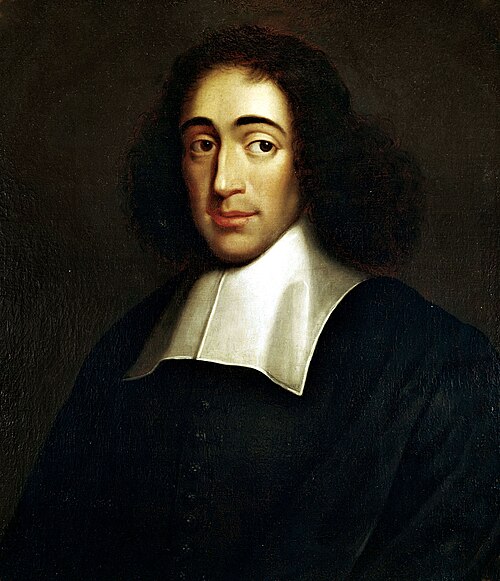
Start at the top for an easy introduction. Go further down for more detail and scholarship.
- Easy
- Intermediate
- Advanced
For young readers
Baruch Spinoza was born in Amsterdam in 1632. His family were Jews whose ancestors had fled from Portugal, where Jews were forced to become Christians or face punishment. In Amsterdam they could practise their religion openly, and young Baruch went to the community’s school and was a very good student.
As he grew up, Spinoza began to ask questions that worried his teachers and neighbours. Was the Bible really written by God word for word? Is God like a king who sits in heaven and gets angry? When he was 23, the leaders of his Jewish community expelled him, which meant nobody in the community was allowed to talk to him or read what he wrote.
Spinoza did not give up. He moved to small towns in the Netherlands and earned money by grinding glass lenses for microscopes and telescopes. He lived simply, in rented rooms, and spent his time thinking and writing. Scientists and thinkers from all over Europe wrote him letters.
His big idea was that God is not a person outside the world, but is the whole of Nature itself, everything that exists. Everything happens for a reason, like a long chain of dominoes. He thought we become free not by doing whatever we like, but by understanding why things happen, so that anger, fear and jealousy stop pushing us around.
His most famous book, the Ethics, is written like a geometry textbook, with definitions, rules and proofs. It was so controversial that it was only published after he died in 1677, aged 44. Today many people see him as one of the bravest and most original thinkers in history.
At a glance
- Lived
- 24 November 1632 – 21 February 1677
- Places
- Amsterdam; Rijnsburg (near Leiden); Voorburg; The Hague, Dutch Republic
- Background
- Portuguese-Jewish (Sephardic) merchant family in Amsterdam; expelled from the community in 1656
- Occupation
- Philosopher; earned his living partly by grinding optical lenses
- Main works
- Ethics (1677, posthumous); Theological-Political Treatise (1670, anonymous); Political Treatise (unfinished); Treatise on the Emendation of the Intellect
- Key ideas
- God or Nature (Deus sive Natura); one substance; necessity; conatus; the three kinds of knowledge; freedom through understanding; freedom of thought
- Language
- Latin (also Dutch, Portuguese, Spanish and Hebrew)
- Influence
- Radical Enlightenment, German Idealism and Romanticism, biblical criticism, liberal political thought, modern philosophy of mind
Easy
Who was Spinoza?
Baruch Spinoza (in Portuguese Bento, in Latin Benedictus: all three names mean “blessed”) was one of the great philosophers of the seventeenth century, alongside René Descartes and Gottfried Wilhelm Leibniz. He is often grouped with them as a “rationalist”, because he believed that reason can grasp the true structure of reality.
Spinoza is remembered for several bold claims. There is only one substance, which can be called God or Nature. Everything that happens follows necessarily from the nature of this substance; nothing is truly random, and there is no free will in the sense of an uncaused choice. The mind and the body are not two different things but one thing seen in two ways. And the highest human good is to understand this, which brings a calm joy he called the “intellectual love of God”.
He was also a political thinker who argued, in the Theological-Political Treatise of 1670, that the state should allow its citizens to think what they like and say what they think. Because his views on God and the Bible were considered deeply dangerous, he was denounced as an atheist for more than a century after his death. Later generations came to admire him as a pioneer of modern secular thought, biblical scholarship and democratic theory.
Easy
Early life in Amsterdam
Spinoza was born in Amsterdam on 24 November 1632. His father, Michael, was a merchant who imported goods such as dried fruit from Portugal and Spain. The family belonged to the city’s Portuguese-Jewish community, made up of people whose ancestors had been forced to convert to Christianity in Spain and Portugal (so-called conversos) and who had returned to Judaism in the more tolerant Dutch Republic. His mother, Hanna Deborah, died when he was six.
Spinoza studied at the community’s Talmud Torah school, where he learned Hebrew, the Bible and Jewish commentary. He did not, however, complete the higher rabbinical studies; after his older brother died he worked in the family business, which he ran with his brother Gabriel after their father’s death in 1654.
In the early 1650s he began to study Latin with Franciscus van den Enden, a former Jesuit with radical political opinions who ran a school in Amsterdam. Through Latin, Spinoza gained access to the philosophy of Descartes, to classical literature and to the new science. He also came into contact with Mennonites and Collegiants, groups of Christians who rejected church hierarchy and met to discuss religion freely.
Easy
The herem: expulsion from the community
On 27 July 1656 the leaders of Amsterdam’s Portuguese-Jewish community pronounced a herem, a writ of expulsion, against Spinoza, then 23 years old. The text, which survives, is unusually harsh. It speaks of his “abominable heresies” and “monstrous deeds” without saying exactly what they were, curses him, and forbids members of the community to communicate with him, stay under the same roof, come close to him or read anything he wrote.
Historians think the heresies probably included ideas later found in his books: that the soul is not immortal in the traditional sense, that God is not a lawgiver who reveals commandments, and that the Law of Moses is no longer binding. The community also had practical reasons to act. Its members depended on the tolerance of the Dutch authorities, and open religious radicalism among them could threaten that tolerance.
Spinoza apparently did not seek reconciliation. He left the Jewish community and never joined any Christian church. He adopted the Latin form of his name, Benedictus, and began a quiet life devoted to philosophy. The herem was never lifted; in the twenty-first century, proposals to reconsider it have been discussed but not adopted.
Intermediate
A philosopher’s life: Rijnsburg, Voorburg and The Hague
Around 1661 Spinoza moved to Rijnsburg, a village near Leiden that was a centre of the Collegiants. There he wrote the Short Treatise on God, Man and His Well-Being and worked on the Treatise on the Emendation of the Intellect, and began the Ethics. In 1663 he moved to Voorburg, near The Hague, and published the only book to appear under his own name in his lifetime: an exposition of Descartes’ Principles of Philosophy, with an appendix of Metaphysical Thoughts.
Spinoza earned money by grinding lenses, a skilled craft connected with the new science of optics; he was respected for it by scientists such as Christiaan Huygens. He was also supported by friends, including Simon Joosten de Vries and Jarig Jelles. His circle of admirers discussed drafts of the Ethics, and he corresponded with Henry Oldenburg, secretary of the Royal Society in London, about science, religion and philosophy.
In 1670 he moved to The Hague, where he lived as a lodger for the rest of his life. In 1672, the “Disaster Year”, France invaded the Republic and a mob in The Hague murdered the statesman Johan de Witt and his brother Cornelis. According to a story later told by Leibniz, Spinoza wanted to put up a placard reading “ultimi barbarorum” (“the lowest of barbarians”) near the scene and was restrained by his landlord. In 1673 he declined an offer of a professorship of philosophy at the University of Heidelberg, fearing it would limit his freedom to philosophise.
In 1676 Leibniz visited him in The Hague and they talked for several days. Spinoza died on 21 February 1677, aged 44, probably of a lung disease such as tuberculosis, possibly worsened by the glass dust from lens grinding. His friends quickly published his unpublished writings in Latin (Opera Posthuma) and in Dutch translation (De Nagelate Schriften) later that year, with only his initials, B.D.S., on the title page.
Intermediate
Historical context: the Dutch Golden Age
Spinoza lived during the Dutch Golden Age. The Dutch Republic, having won independence from Spain, had become Europe’s leading commercial power, with a global trading empire, thriving printing presses and relative religious tolerance. Amsterdam welcomed Sephardic Jews, Protestant dissidents and refugees of many kinds. This was the world of Rembrandt, Vermeer and Huygens.
Tolerance had limits, however. The official Reformed Church was powerful, and many of its preachers wanted strict control over religious opinion. Politics was divided between the republican regime of Johan de Witt, which favoured toleration and the dominance of the merchant elite, and supporters of the House of Orange, who were allied with orthodox Calvinist clergy. Spinoza’s friend Adriaan Koerbagh, who published radical religious views in Dutch, was imprisoned in 1668 and died in prison in 1669, a warning of what could happen to open freethinkers.
Intellectually, Spinoza’s generation was shaped by the new science and by Descartes, who had lived in the Netherlands for many years. Cartesian philosophy promised to rebuild knowledge on clear and distinct ideas, and it provoked fierce controversy in Dutch universities. Spinoza took up Descartes’ method and vocabulary but drew radically different conclusions.
Intermediate
The Ethics I: God or Nature
The Ethics is written “in the geometrical order” (ordine geometrico demonstrata). Like Euclid’s Elements, each of its five parts begins with definitions and axioms, from which propositions are demonstrated, with corollaries and explanatory notes (scholia). Spinoza hoped this form would force readers to follow reasons rather than rhetoric. The five parts treat God; the nature and origin of the mind; the origin and nature of the emotions (affects); human bondage, or the power of the emotions; and the power of the intellect, or human freedom.
Part One argues that there can be only one substance, something that exists in itself and is conceived through itself, and that this substance is God, an absolutely infinite being. Everything else is a “mode”, a way in which this substance exists. Stars, rocks, people and thoughts are not separate things standing outside God, but modifications of the one God. Spinoza sometimes writes “God, or Nature” (Deus, sive Natura), which is why his view is often called pantheism, though scholars debate whether that label fits.
God, for Spinoza, has infinitely many attributes, of which humans know two: extension (being physical) and thought. God does not act for purposes, does not choose among possibilities and does not reward or punish; everything follows from God’s nature as necessarily as the properties of a triangle follow from its definition. In the appendix to Part One, Spinoza argues that the belief that nature serves human purposes, and that God sends storms and diseases as punishments, comes from human ignorance and self-centred imagination.
Intermediate
The Ethics II: mind, emotions and freedom
Mind and body. Because thought and extension are two attributes of one substance, the human mind and the human body are “one and the same thing, conceived now under the attribute of thought, now under the attribute of extension”. The mind is the idea of the body. This is often called parallelism: for every physical event there is a corresponding mental one, but neither causes the other. Spinoza thereby avoided Descartes’ problem of how an immaterial soul could move a material body.
Emotions. Every thing strives to persevere in its being; Spinoza calls this striving conatus, and in humans it is the essence of desire. Joy is the passage to greater power of acting, sadness the passage to lesser power, and all other emotions, such as love, hatred, hope, fear, envy and pity, are built from desire, joy and sadness together with ideas of their causes. Spinoza promises to treat human actions and appetites “as if it were a question of lines, planes and bodies”.
Bondage and freedom. When we are driven by external causes we do not understand, our emotions are “passions” and we are in bondage. We become freer as we form adequate ideas, true understanding of the causes of things. Spinoza distinguishes three kinds of knowledge: imagination (opinion, hearsay, vague experience), reason (knowledge of common properties and laws) and intuitive knowledge (seeing how particular things follow from God’s nature). The more we understand, the less we are dominated by passions.
Blessedness. The last part of the Ethics describes the “intellectual love of God”, the joy that accompanies understanding everything as following from God, and a sense in which the mind is eternal. Blessedness is not a reward for virtue but virtue itself. The book ends: “all things excellent are as difficult as they are rare”.
Intermediate
Religion and politics: the Theological-Political Treatise
The Theological-Political Treatise (Tractatus Theologico-Politicus) was published anonymously in 1670 with a false place of publication. Its aim, as its subtitle announces, is to show that freedom to philosophise can be granted without harm to piety or public peace, and indeed that it cannot be abolished without destroying both.
Spinoza argues that Scripture must be interpreted from Scripture itself, by studying its language, history and authors, like any other ancient text. On this basis he concluded that Moses did not write the whole Pentateuch, that the prophets were people of vivid imagination rather than superior intellect, and that miracles, understood as violations of natural law, are impossible. The core message of Scripture, he held, is simply to love God and one’s neighbour through justice and charity; it does not teach philosophical truths.
In politics he followed Thomas Hobbes in basing the state on natural right and power, but drew more liberal conclusions. Since no one can surrender their judgement, a government that tries to control thought only breeds hypocrisy and rebellion; “the purpose of the state is really freedom”. He regarded democracy as the most natural form of government. His unfinished Political Treatise analyses monarchy, aristocracy and democracy; it breaks off in the chapter on democracy.
The book caused an uproar. It was condemned by Reformed synods and banned by the authorities of Holland in 1674, and it was attacked across Europe as an atheist manifesto. Yet it circulated widely and laid foundations for modern historical criticism of the Bible and for arguments for freedom of expression.
Intermediate
Influence: from “atheist” to “God-intoxicated man”
For about a century after his death, “Spinozist” was a term of abuse meaning atheist or materialist. Pierre Bayle’s influential Historical and Critical Dictionary praised Spinoza’s personal virtue but attacked his system as absurd. At the same time, his ideas circulated underground among freethinkers, and the historian Jonathan Israel has argued that Spinoza stood at the centre of a “Radical Enlightenment” that championed democracy, equality and secular reason.
In 1785 a public dispute known as the Pantheism Controversy broke out in Germany after Friedrich Heinrich Jacobi reported that the admired writer Gotthold Ephraim Lessing had confessed himself a Spinozist. The debate made Spinoza central to German philosophy and literature. Goethe, Herder, Schelling and Hegel all engaged deeply with him; Hegel declared that one must first be a Spinozist to philosophise at all, and the poet Novalis called him a “God-intoxicated man”.
Later thinkers found very different Spinozas. Nineteenth-century scientists admired his naturalism; Albert Einstein said that he believed in “Spinoza’s God”, who reveals himself in the orderly harmony of what exists, rather than a God concerned with human fate and actions. Nietzsche saw a precursor; Marxist philosophers read him as a materialist; Gilles Deleuze made him a philosopher of joy and power. In modern philosophy of mind, his view of mind and body is compared with dual-aspect and neutral monist theories, and neuroscientists such as Antonio Damasio have drawn on his account of emotion.
Jewish responses have also changed. Some Jewish thinkers regarded him as a traitor, while others, especially from the nineteenth century onward, reclaimed him as a secular Jewish hero and a founder of modern Jewish thought. Debates about his relation to Judaism continue.
Advanced
Interpretive debates
Substance and modes. How do finite things “inhere” in God? Pierre Bayle took Spinoza to mean that things are properties of God, which led to absurdities (God would be both happy and sad, both Turk and German). Edwin Curley proposed instead that modes depend on God causally rather than as properties of a subject, which removes Bayle’s objection but has been criticised as too far from Spinoza’s own language. Other scholars, such as Yitzhak Melamed, defend a reading in which modes do inhere in substance and argue that the resulting view is coherent.
Attributes. Are the attributes objectively real features of substance, or only ways in which the intellect perceives it? The “subjectivist” reading, associated with Harry Austryn Wolfson, stresses Spinoza’s definition of attribute as what the intellect perceives of substance; most recent interpreters favour an “objectivist” reading. The question matters for how the one substance can have many really distinct attributes.
Pantheism, acosmism or naturalism? Some read Spinoza as divinising nature (pantheism), others as dissolving God into nature (atheism or naturalism). Hegel accused him of “acosmism”, of making the finite world vanish into God. Whether “God” in Spinoza is a religious term used strategically or a sincere metaphysical claim remains disputed, as does how far he wrote cautiously to avoid persecution, a question raised by Leo Strauss’s thesis about “writing between the lines”.
Eternity of the mind. The closing propositions of the Ethics, claiming that “something of the mind remains which is eternal”, have puzzled readers. Some see a doctrine of personal immortality; most see an impersonal eternity of the mind’s true ideas; others find the passage in tension with the rest of the system. Similar debates surround his determinism and the possibility of moral responsibility, and whether his politics is fundamentally democratic or a realist theory of power.
Advanced
Biographical sources and the texts
Our knowledge of Spinoza’s life depends on a limited set of sources: the herem and other records of the Amsterdam community and the city; his correspondence (some 88 letters to and from him survive, mostly on philosophical questions, many edited for publication by his friends); the preface to the Opera Posthuma by Jarig Jelles and others; an early French biography attributed to Jean-Maximilien Lucas, written by an admirer; and the 1705 biography by the Lutheran minister Johannes Colerus, who lodged in the same house in The Hague and interviewed people who had known Spinoza. Anecdotes such as the “ultimi barbarorum” story and the attempted stabbing outside the synagogue come from later reports and should be treated with caution.
The texts also raise problems. The chronology of the Ethics is only partly known; letters show that a version existed in the early 1660s and that Spinoza abandoned plans to publish it in 1675. The Short Treatise survives only in Dutch manuscripts discovered in the nineteenth century. In 2010 the scholars Leen Spruit and Pina Totaro identified in the Vatican Library a manuscript copy of the Ethics, the only known manuscript of the work, which had been passed to the Catholic authorities in the 1670s; it differs in details from the printed text and helps show how the work was revised.
Modern scholarship relies on critical editions (Carl Gebhardt’s edition of 1925 and the newer Presses Universitaires de France edition) and translations such as Edwin Curley’s Collected Works. Steven Nadler’s biography, Spinoza: A Life (1999), synthesised archival research on the Amsterdam community. Historians now stress reading Spinoza in his Dutch, Jewish and Cartesian contexts rather than as a lonely genius outside history.
Key ideas
- God or Nature (Deus sive Natura)
- There is one infinite reality; calling it God or Nature names the same thing.
- Substance monism
- Only one substance exists; all individual things are modes, or ways of being, of that substance.
- Necessity
- Everything follows necessarily from God’s nature; there is no chance and no uncaused free will.
- Mind–body identity
- Mind and body are one thing seen under two attributes, thought and extension.
- Conatus
- Each thing’s striving to persevere in its being; in humans it is desire, the root of all emotions.
- Freedom through understanding
- We become free by forming adequate ideas of the causes of our emotions, turning passions into actions.
- Freedom to philosophise
- The state should allow freedom of thought and speech; suppressing it harms both piety and peace.
- Historical reading of Scripture
- The Bible should be interpreted from its own language, history and authorship, like any text.
Records
- 1632 — Spinoza is born in Amsterdam on 24 November.
- 1654 — His father Michael dies; Spinoza runs the family business with his brother Gabriel.
- 1656 — On 27 July the Portuguese-Jewish community of Amsterdam pronounces a herem against him.
- c. 1661 — He moves to Rijnsburg and works on the Short Treatise and early drafts of the Ethics.
- 1663 — He moves to Voorburg and publishes his exposition of Descartes’ Principles of Philosophy.
- 1670 — The Theological-Political Treatise is published anonymously; Spinoza moves to The Hague.
- 1672 — The “Disaster Year”: Johan and Cornelis de Witt are murdered by a mob in The Hague.
- 1673 — He declines a professorship at Heidelberg.
- 1674 — The authorities of Holland ban the Theological-Political Treatise.
- 1676 — Leibniz visits Spinoza in The Hague.
- 1677 — Spinoza dies on 21 February; the Opera Posthuma, including the Ethics, appears later that year.
- 1785 — The Pantheism Controversy in Germany puts Spinoza at the centre of philosophical debate.
Glossary
- Herem
- A formal ban or expulsion from a Jewish community.
- Sephardic Jews
- Jews whose ancestors lived in Spain and Portugal.
- Substance
- In Spinoza, what exists in itself and is conceived through itself; only God qualifies.
- Attribute
- What the intellect perceives as the essence of substance; humans know thought and extension.
- Mode
- A modification or way of being of substance, such as a particular body or idea.
- Affect
- An emotion: a change in the body’s power of acting together with the idea of that change.
- Conatus
- The striving of each thing to persevere in its being.
- Adequate idea
- An idea that fully grasps its object through its causes; the basis of true knowledge and freedom.
- Geometrical method
- Setting out philosophy as definitions, axioms and demonstrated propositions, like Euclid.
- Pantheism
- The view that God and the universe are identical.
- Rationalism
- The view that reason, rather than sense experience alone, is the main source of knowledge.
Questions and answers
Why was Spinoza expelled from his community?
The document says he held “abominable heresies” without naming them. Historians think they included denying the soul’s immortality, denying that God gave the Law, and rejecting the authority of Jewish law.
Did Spinoza believe in God?
Yes, but not in a personal God who makes choices, answers prayers or judges people. For him God is the one infinite reality, which he also called Nature. Critics called this atheism; admirers called it a deeply religious view.
Why is the Ethics written like a maths book?
Spinoza wanted every claim to be proved step by step from clear starting points, so that readers would be convinced by reasons, not by eloquence or authority.
Did Spinoza really grind lenses?
Yes. It was a skilled craft linked to the new science of optics, and scientists respected his work. It gave him some income, although he also relied on friends’ support.
If everything is necessary, can we be free?
Spinoza says we are not free to do otherwise, but we can be free in a different sense: acting from our own understanding rather than being pushed by passions we do not understand.
What is the Bayle–Curley debate about?
It concerns how finite things relate to God: Bayle read modes as properties of God and found absurdities; Curley read them as causally dependent effects; others defend a refined inherence reading.
Was Spinoza a democrat?
He called democracy the most natural form of government and defended freedom of thought, but his political theory is also realist, grounding right in power. Scholars debate how democratic his thought is.
Sources and further reading
- Steven Nadler, Baruch Spinoza. Stanford Encyclopedia of Philosophy
- Justin Steinberg, Spinoza’s Political Philosophy. Stanford Encyclopedia of Philosophy
- Spinoza, Benedict De. Internet Encyclopedia of Philosophy
- Baruch Spinoza. Wikipedia
- Ethics (Spinoza book). Wikipedia
- Theologico-Political Treatise. Wikipedia
- Pantheism controversy. Wikipedia
- Steven Nadler, Spinoza: A Life. Cambridge University Press, 1999
- Jonathan I. Israel, Radical Enlightenment: Philosophy and the Making of Modernity, 1650–1750. Oxford University Press, 2001
- Edwin Curley (ed. and trans.), The Collected Works of Spinoza, Volume I. Princeton University Press, 1985
Related
- René DescartesFrench philosopher and mathematician whose method of systematic doubt became central to early modern philosophy.
- VoltaireFrench writer and Enlightenment thinker known for satire, religious criticism and public campaigns against judicial injustice.
- Immanuel KantPrussian philosopher whose accounts of knowledge, moral duty and judgment reshaped modern philosophy.
- Georg Wilhelm Friedrich HegelGerman philosopher whose account of history, thought and social institutions profoundly influenced later philosophy.
- Friedrich NietzscheGerman philosopher and classical scholar who challenged inherited moral values and examined culture, power and the meaning of life.
Written with AI assistance from the published sources listed above, and revised as new research appears.