Start at the top for an easy introduction. Go further down for more detail and scholarship.
- Easy
- Intermediate
- Advanced
For young readers
About 400 years ago, in the land that is now Angola in southern Africa, there lived a princess named Njinga. Her father was the king of Ndongo. He trained her to fight with a battle axe and let her sit in on important meetings, so she learned how to rule.
At that time, Portuguese soldiers and traders had built forts on Ndongo’s land and were capturing people to sell as slaves across the ocean. When Njinga’s brother became king, he sent her to talk with the Portuguese governor in the city of Luanda.
A famous story says that when she arrived, the Portuguese had chairs for themselves but only a mat on the floor for her. Instead of sitting lower than the governor, one of her attendants knelt down so that Njinga could sit on her back and talk to him eye to eye. Whether or not every detail is true, the story shows how proud and clever she was.
Later Njinga became the ruler herself. When the Portuguese attacked, she moved east, made new friends and enemies, took over another kingdom called Matamba, and fought for many years. She even teamed up with Dutch soldiers against the Portuguese.
Njinga was a complicated person. She was brave and very smart, but she could also be harsh, and her kingdom, like her enemies, sold captives into the slave trade. Today many Angolans call her the “Mother of Angola,” and there is a statue of her in the capital city, Luanda.
At a glance
- Lived
- c. 1583 – 17 December 1663
- Ruled
- Ndongo from 1624 and Matamba from 1631 until her death in 1663
- Place
- The Mbundu (Ambundu) highlands of what is now northern Angola; capitals included Kabasa in Ndongo and later the town of Matamba
- People and language
- Mbundu; Kimbundu language. She also read and wrote Portuguese
- Names
- Njinga Mbandi, Nzinga, Ginga or Jinga; royal title Ngola (the root of the name ‘Angola’); Christian name Ana de Sousa after her baptism in Luanda in 1622
- Main opponents
- The Portuguese colony of Angola and their African allies, including the puppet king Ngola Hari; at times the Imbangala leader Kasanje and the Kingdom of Kongo
- Key allies
- Imbangala warbands (from c. 1629–1631) and the Dutch West India Company, which held Luanda from 1641 to 1648
- Written traces
- About a dozen of her own letters survive, alongside Portuguese governors’ correspondence and accounts by Capuchin missionaries who lived at her court
Easy
Who was Nzinga?
Nzinga, whose name is also written Njinga, was a queen of two neighbouring kingdoms in west-central Africa: Ndongo and Matamba, in the region that is now northern Angola. She was born around 1583 into the royal family of Ndongo and died in 1663 at about eighty years of age, after ruling for almost four decades.
She lived at a dangerous time. The Portuguese had arrived on the coast in 1575, founded the town of Luanda, and were pushing inland with soldiers, forts and slave traders. Much of Nzinga’s life was a struggle to stop them from taking over her people’s land. She did this in many ways: by negotiating, by fighting, by changing religion, by marrying for alliances and by moving her kingdom when she had to.
Today Nzinga is one of Africa’s most famous historical rulers. In Angola she is honoured as a symbol of resistance against colonialism. Historians also stress that she was a complex ruler of her time, who took part in the slave trade and used force against rivals, and they try to understand her without turning her into either a pure hero or a villain.
Easy
A princess trained to rule
Nzinga’s father became king (ngola) of Ndongo when she was about ten. Her mother, Kengela ka Nkombe, was one of the king’s enslaved wives. Tradition says that Nzinga was born with the umbilical cord wrapped around her neck, and that her name comes from the Kimbundu verb kujinga, “to twist” or “to turn.” Children who survived difficult births were believed to have special spiritual gifts.
Because she was not expected to inherit the throne, her father could favour her without upsetting the male heirs. She trained as a warrior, learning to use the battle axe, the traditional weapon of Ndongo’s fighters. She also attended councils on law and war and important rituals. Portuguese missionaries taught her to read and write Portuguese, a skill that later made her a valuable diplomat.
She had a brother, Mbandi, who was the heir, and two sisters, Kambu and Funji, who later stood by her through war and captivity. These family relationships shaped her life deeply, in both loyalty and bitter rivalry.
Easy
Ndongo, the Portuguese and the slave trade
Ndongo was a kingdom of the Mbundu people with its capital at Kabasa, a large town in the highlands. Its kings bore the title ngola, which the Portuguese used to name their colony “Angola.” To the north lay the powerful Christian Kingdom of Kongo, and to the east Matamba, a kingdom where women had sometimes ruled.
From 1575 the Portuguese, based at Luanda, fought a long series of wars against Ndongo. They burned villages, built forts inside Ndongo’s territory and captured very large numbers of people, many of whom were shipped across the Atlantic to Brazil and Spanish America as slaves. Ndongo won a major victory at the Battle of the Lukala in 1590, but it lost much land, and many local lords, called sobas, stopped paying tribute to the king.
In the early seventeenth century a new force appeared: the Imbangala, highly militarised warbands whose members were recruited by initiation rather than birth. They were feared for their ferocity, and the Portuguese hired some of them as mercenaries. In 1618 Portuguese and Imbangala forces sacked Ndongo’s capital. This was the crisis into which Nzinga stepped.
Intermediate
The embassy to Luanda (1621–1622)
When her father died in 1617, her brother Mbandi became king. He killed rival claimants, and according to the sources he had Nzinga’s young son killed and Nzinga and her sisters forcibly sterilised. Nzinga seems to have left the court for a time. Yet in 1621, facing Portuguese pressure, Mbandi asked her to be his ambassador to the Portuguese governor, João Correia de Sousa, in Luanda. She agreed on condition that she could negotiate with full authority.
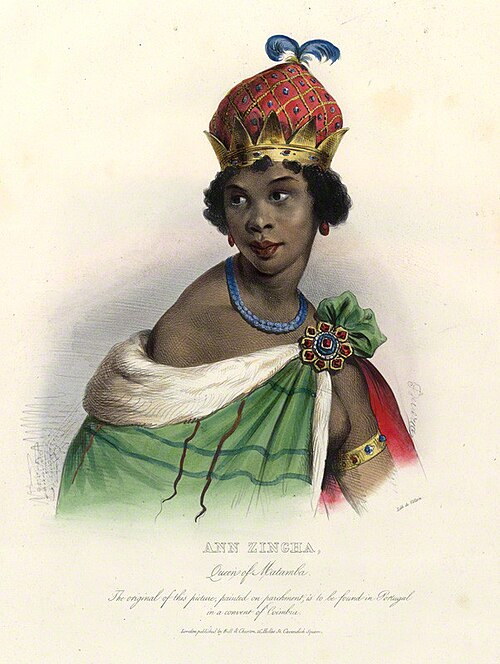
In Luanda she deliberately wore splendid Ndongo dress with feathers and jewels, not European clothing, to show that her culture was not inferior. The famous story of the chair belongs to this visit: finding only a mat for her while the Portuguese sat on chairs, she had an attendant kneel to form a seat so that she could speak to the governor as an equal. The story comes from later accounts and may have grown in the telling, but it captures the political meaning of the meeting.
Her negotiating position was firm. She offered peace, access for traders and the return of runaway slaves who had joined Ndongo’s army, but she insisted that the Portuguese remove their forts from Ndongo and refused to pay tribute, arguing that only conquered peoples paid tribute. To demonstrate goodwill she was publicly baptised, taking the name Ana de Sousa after her godparents, the governor and his wife. A treaty was agreed, and she returned to Kabasa in 1622.
The peace did not hold. The Portuguese failed to withdraw from their forts and continued to raid for captives, while Imbangala groups attacked Ndongo. Mbandi grew depressed and increasingly handed his duties to his sister.
Intermediate
Becoming queen and losing Ndongo (1624–1628)
Mbandi died in 1624 in unclear circumstances; some said suicide, others poison. Nzinga moved quickly to take power. Her supporters seized the royal ritual objects, she took the title ngola, and she eliminated opponents. The sources say she married the Imbangala chief who was guarding her young nephew, a rival heir, and then had the boy killed.
Her claim was fiercely contested. Some nobles argued that neither she nor her brother had a proper right to rule because their mothers were enslaved wives, and that a woman could not be ngola at all. The Portuguese exploited these divisions. They demanded that she become a vassal of Portugal and pay tribute, which she refused, and they encouraged sobas to switch allegiance. Nzinga in turn sent agents to persuade enslaved people on Portuguese-held lands to flee and join her.
In 1626 the Portuguese declared war and recognised a rival, first Hari a Kiluanje and then Ngola Hari, as king of Ndongo. Nzinga’s forces were defeated in a series of battles. Her offer in 1627 to become a Portuguese vassal in return for recognition was rejected, and her ambassador was executed. In an ambush her two sisters were captured. By late 1628 she had only a small force left and had been driven from her kingdom.
Intermediate
Alliance with the Imbangala and the conquest of Matamba
In exile Nzinga made a surprising choice. The Imbangala leader Kasanje, formerly an enemy, offered an alliance. She accepted, married him and was initiated into Imbangala society, adopting many of its rites and its military organisation while keeping her Mbundu identity. The historian Linda Heywood has argued that her genius lay in combining Mbundu royal traditions with the Imbangala military system to create a new and effective army. She welcomed runaway slaves and exiled Ndongans, rewarding them with freedom, land and titles.
European sources describe Imbangala initiation as involving extreme rituals, including infanticide and cannibalism, and some claim that Nzinga took part. These accounts come largely from outsiders who were hostile or had their own agendas, and historians disagree about how literally to read them. What is clear is that joining the Imbangala gave Nzinga a powerful, merit-based military community that did not depend on the lineage arguments used against her in Ndongo.
Between 1631 and 1635 she invaded the neighbouring Kingdom of Matamba, captured its queen, Mwongo Matamba, and made Matamba her base. Because Matamba had a tradition of female rulers, it gave her a more secure foundation than Ndongo. She settled her followers there and used the region’s position on trade routes to the interior to gain control of the slave trade, using the profits to fund her wars.
During these war years she adopted the role of a male ruler, taking masculine titles and dress, keeping a female bodyguard and requiring her male concubines to dress as women. Historians interpret this as a deliberate political strategy in a society where rulership was associated with men.
Intermediate
The Dutch alliance and the war of the 1640s
In August 1641 a fleet of the Dutch West India Company, allied with the Kingdom of Kongo, captured Luanda, and the Portuguese retreated inland to their fort at Massangano. Nzinga immediately sent envoys to the Dutch and formed an alliance, offering them trade, including in slaves. Dutch envoys and soldiers came to her court. She moved her capital west to Kavanga and built a huge war camp that, including non-combatants, reportedly numbered some 80,000 people.
Between 1641 and 1644 she recovered large parts of Ndongo. She defeated the Portuguese at the Battle of Ngoleme in 1644 but was defeated at Kavanga in 1646, where her archives and her sister Kambu were captured. The documents revealed that her other captive sister, Funji, had been secretly sending her information, and the Portuguese reportedly drowned Funji in the Kwanza River. In 1647, with Dutch reinforcements, Nzinga won a major victory at the Battle of Kombi and besieged Massangano.
She could not take the fortress, however, because she lacked artillery. In August 1648 a Portuguese expedition from Brazil under Salvador Correia de Sá recaptured Luanda, and the Dutch agreed to leave Angola. Nzinga withdrew to Matamba. From then on she concentrated on defending Matamba and preventing Portuguese expansion inland rather than reconquering Ndongo.
Intermediate
Christianity, peace and final years
In the 1640s and 1650s Nzinga turned increasingly toward Christianity. Italian and Spanish Capuchin missionaries, who were less tied to the Portuguese colonial government than earlier Jesuits and parish priests, came to her court; one, Calisto Zelotes, became her secretary. She used them as intermediaries with Rome and in 1661 received a letter from Pope Alexander VII. She built churches and placed crosses in her court. She also suppressed opponents of her religious policy, and some traditional priests were sold to the Portuguese as slaves.
Exhausted by decades of war, Nzinga and the Portuguese negotiated through the early 1650s and signed a peace treaty in 1656. The Lucala River became the border between Portuguese Angola and Matamba, Portuguese traders were allowed into Matamba, and a slave market was concentrated at her capital, effectively giving her a monopoly. Missionaries could reside in her kingdom. A clause requiring tribute was proposed but never ratified. Her sister Kambu, known as Dona Barbara, was released and returned to her.
In her last years Nzinga worked to rebuild Matamba and secure the succession. She resettled freed people, allowed women in the war camp to bear children, which Imbangala custom had forbidden, reformed laws, abolished concubinage and married her favourite partner in a Christian ceremony. She named Kambu as her heir. Nzinga died on 17 December 1663 and was buried with both Catholic and Mbundu rites. Kambu succeeded her, and in the century after her death queens ruled Matamba for much of the time.
Intermediate
Memory and legacy
Oral traditions celebrating Nzinga began soon after her death. Matamba eventually became part of Portuguese Angola in the nineteenth century, but her memory survived. During the Angolan War of Independence (1961–1974) she became a powerful symbol of resistance, and she has remained a national heroine since independence. A statue of her was erected in Kinaxixi Square in Luanda in 2002, a major street is named after her, and the National Bank of Angola issued a coin in her honour in 2014.
Her image has travelled across the Atlantic world too. Writers of the African diaspora, such as the Afro-Cuban poet Georgina Herrera, have claimed her as an ancestor figure; the historian John Thornton has argued that her reputation helped shape a wider Atlantic Creole culture. She has appeared in films, including the Angolan film Njinga: Queen of Angola (2013), in documentary dramas and in video games. Local tradition also identifies footprints in the Black Rocks at Pungo Andongo, in Malanje Province, as hers.
European portrayals were very different. Eighteenth- and nineteenth-century writers, drawing on hostile or embellished accounts, focused on stories of cruelty, sexuality and cannibalism; the Marquis de Sade and G. W. F. Hegel both used her, directly or indirectly, as an example of disorder. Twentieth-century scholarship, spurred partly by Angolan independence, took a more careful approach.
Advanced
The sources and their reliability
Nzinga is one of the best-documented African rulers of the early modern period, but almost all the documentation was produced by outsiders or through them. The richest material includes about a dozen of her own letters, most published in António Brásio’s Monumenta Missionaria Africana; the correspondence of governor Fernão de Sousa, who served from 1624 to 1631 and described her early reign in detail (edited by Beatrix Heintze); the chronicle of António de Oliveira de Cadornega (1680–1681); and the works of two Italian Capuchins who lived at her court from 1658, Antonio Gaeta da Napoli and Giovanni Antonio Cavazzi da Montecuccolo.
Each has its biases. Portuguese officials wrote to justify policy and war. Gaeta’s biography (1669) celebrates her conversion as a triumph of providence and compares her to heroines of antiquity. Cavazzi, who presided at her funeral, praised her political skill but also described her as a ruler who had ruined the land, and made pejorative claims, such as about cannibalism, without offering evidence. His work, freely adapted into French by Jean-Baptiste Labat in 1732, became the main source for later European images of Nzinga, magnifying sensational elements.
Popular stories, such as the claim that she executed lovers after one night, rest on even weaker ground; one comes from Olfert Dapper’s seventeenth-century compilation and has no independent support. The famous chair episode, although widely believed, is also known through later narrative sources. Historians therefore read the documents against the grain, compare them with Mbundu oral traditions and with patterns in Central African political culture, and treat claims about ritual violence with particular care.
Advanced
Interpretations: resistance, legitimacy and the slave trade
Modern scholarship has offered several frames. Joseph C. Miller’s 1975 article in The Journal of African History highlighted her political innovations but also criticised her autocratic methods, reading her career in terms of competition among Mbundu political institutions. John Thornton, in a 1991 article on “Legitimacy and Political Power,” emphasised her long struggle to establish legitimacy as a woman and as the child of an enslaved mother, showing how she drew on Ndongo precedents, Imbangala institutions and Christian kingship as they suited her. Linda Heywood’s 2017 biography, Njinga of Angola: Africa’s Warrior Queen, portrays her as a great political strategist and cautions against casting her as either a populist hero or a tyrant.
Gender is central to these debates. Nzinga did not overturn the idea that rulers of Ndongo should be male during her lifetime; instead she adopted male roles and titles when useful and later reshaped her court in a more feminine, Christian style. Yet her success changed precedent: in the century after her death, queens ruled Matamba for at least eighty of the following 104 years. Feminist writers have praised her challenge to patriarchy while noting that she ruled as an elite over others.
The hardest question is the slave trade. Nzinga fought Portuguese conquest and at times encouraged enslaved people to escape from Portuguese plantations. At the same time she captured, bought and sold people, supplied the Dutch with thousands of captives a year and negotiated control of the slave market in the 1656 treaty. Historians see no contradiction in terms of seventeenth-century politics: control of the trade was a source of revenue and power that every regional state sought. But for modern readers, remembering Nzinga as a symbol of freedom requires facing this part of her record honestly, alongside her real achievement of preserving an independent African kingdom against a European empire.
Key ideas
- Diplomacy as a weapon
- Nzinga used negotiation, dress, ceremony, baptism and letters as tools of power, not only armies.
- Shifting alliances
- She allied with former enemies such as the Imbangala and with the Dutch, changing partners as circumstances required.
- Legitimacy
- As a woman and the child of an enslaved mother, she had to build her right to rule from several traditions at once.
- Gender and power
- She adopted male titles and dress in wartime and later reshaped her court, opening the way for later queens in Matamba.
- Resistance and the slave trade
- She resisted Portuguese conquest while also taking part in the Atlantic slave trade, a tension central to her legacy.
- Religious strategy
- She moved between Mbundu religion, Imbangala rites and Catholic Christianity, using each to strengthen her position.
- National symbol
- In Angola she became a symbol of anti-colonial resistance and of women’s leadership.
Records
- c. 1583 — Nzinga is born into the royal family of Ndongo.
- 1590 — Ndongo, aided by Matamba, defeats the Portuguese at the Battle of the Lukala.
- 1617 — Her father dies; her brother Mbandi becomes king and kills rivals, including Nzinga’s son.
- 1622 — As ambassador in Luanda, Nzinga negotiates a treaty and is baptised Ana de Sousa.
- 1624 — Mbandi dies; Nzinga takes power in Ndongo.
- 1626 — Portugal declares war and backs a rival king; Nzinga is driven from Ndongo by 1628.
- 1631 — Allied with the Imbangala, she conquers Matamba and makes it her base (campaigns until 1635).
- 1641 — The Dutch capture Luanda; Nzinga allies with them.
- 1647 — She defeats the Portuguese at the Battle of Kombi and besieges Massangano.
- 1648 — The Portuguese retake Luanda; the Dutch leave and Nzinga withdraws to Matamba.
- 1656 — Peace treaty with Portugal; her sister Kambu is released.
- 1663 — Nzinga dies on 17 December; Kambu (Dona Barbara) succeeds her.
Glossary
- Ngola
- The title of the ruler of Ndongo; the origin of the name Angola.
- Mbundu (Ambundu)
- The people of Ndongo, who speak Kimbundu.
- Soba
- A local lord in Ndongo who owed tribute to the king.
- Imbangala
- Militarised warbands of seventeenth-century Angola, organised by initiation rather than kinship.
- Kilombo
- An Imbangala war camp; known in Portuguese as quilombo.
- Kabasa
- The capital of the Kingdom of Ndongo, in the highlands of today’s Cuanza Norte.
- Matamba
- A kingdom east of Ndongo that Nzinga conquered and made her base from 1631.
- Capuchins
- A Catholic religious order whose Italian and Spanish missionaries lived at Nzinga’s court and wrote about her.
- Massangano
- A Portuguese fort on the Kwanza River that served as their inland capital when Luanda was lost.
Questions and answers
Did Nzinga really sit on a servant’s back?
That is the famous story of her 1622 meeting with the Portuguese governor. It is told in later accounts and may be exaggerated, but it shows how she refused to accept a lower position.
Why is she called the Mother of Angola?
Because she resisted Portuguese conquest for decades, and during Angola’s fight for independence people saw her as a symbol of freedom.
Was Nzinga a Christian?
She was baptised in 1622, later turned to Imbangala religious practices during war, and from the 1640s–1650s again embraced Christianity, using it in diplomacy and at her court.
Did she oppose slavery?
No. She fought the Portuguese and sometimes helped enslaved people escape from them, but she also sold captives into the Atlantic slave trade, as other rulers of the region did.
Why did she dress as a man?
In wartime she adopted male titles and clothing, probably to strengthen her authority in a society where rulers were expected to be men.
How do we know about her?
From her own letters, Portuguese governors’ reports and books by missionaries who lived at her court. Historians read these carefully because many writers were hostile to her or wanted to make a point.
What happened to her kingdom after her death?
Her sister Kambu became queen, and Matamba remained independent for a long time, often ruled by women, before being absorbed into Portuguese Angola in the nineteenth century.
Sources and further reading
- Nzinga of Ndongo and Matamba. Wikipedia
- Kingdom of Ndongo. Wikipedia
- Kingdom of Matamba. Wikipedia
- Imbangala. Wikipedia
- Dutch Loango-Angola. Wikipedia
- Black Rocks at Pungo Andongo. Wikipedia
- Linda M. Heywood, Njinga of Angola: Africa’s Warrior Queen. Harvard University Press, 2017
- John K. Thornton, Legitimacy and Political Power: Queen Njinga, 1624–1663. The Journal of African History 32(1), 1991
- Joseph C. Miller, Nzinga of Matamba in a New Perspective. The Journal of African History 16(2), 1975
Related
- Trưng SistersTwo Lạc Việt noblewomen, Trưng Trắc and Trưng Nhị, who led a revolt against Han rule in 40 CE and are honoured as national heroines of Vietnam.
- Haitian RevolutionA revolution beginning with an uprising of enslaved people in Saint-Domingue led to the abolition of slavery there and Haiti’s independence in 1804.
- Benin BronzesThousands of brass plaques, royal heads and other court artworks made for the Oba of Benin, looted by British forces in 1897 and now at the centre of restitution debates.
- Columbus's First VoyageChristopher Columbus's 1492 Atlantic voyage for the Spanish Crown reached islands inhabited by Indigenous peoples.
- Túpac Amaru IIAndean kuraka of Inca descent who in 1780 led the largest anti-colonial uprising of 18th-century Spanish America, executed in Cusco in 1781.
- Suleiman the MagnificentTenth Ottoman sultan (r. 1520–1566), whose long reign combined conquests from Hungary to Iraq, the harmonisation of Ottoman law, and a flowering of architecture and poetry.
Written with AI assistance from the published sources listed above, and revised as new research appears.