Start at the top for an easy introduction. Go further down for more detail and scholarship.
- Easy
- Intermediate
- Advanced
For young readers
About two thousand years ago, the land around the Red River in today's northern Vietnam was ruled by the Han empire of China, far to the north. The local people, called the Lạc Việt, had their own lords and customs, but they had to obey Chinese governors.
Two sisters, Trưng Trắc and her younger sister Trưng Nhị, were daughters of a Lạc lord. When a harsh Chinese governor named Su Ding (Tô Định in Vietnamese) punished and, according to Vietnamese tradition, killed Trưng Trắc's husband, the sisters called on the people to rise up.
Many local leaders joined them. The governor ran away, and the rebels took about sixty-five towns. Trưng Trắc was proclaimed queen, and she ruled from her home town of Mê Linh.
But the Han emperor sent a famous general, Ma Yuan, with a large army and many ships. After hard fighting, the sisters were defeated in 43 CE. Chinese history books say they were captured and killed; Vietnamese stories say they chose to die by throwing themselves into a river rather than surrender.
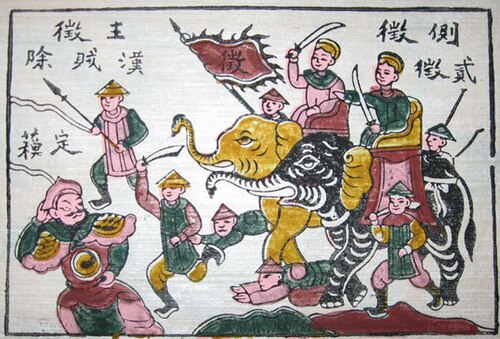
Today, Vietnamese children learn about the Two Ladies Trưng at school. There are temples where people honour them, streets and schools named after them, and a festival for them every spring. Artists often show them riding war elephants into battle.
At a glance
- Who
- Trưng Trắc and her younger sister Trưng Nhị, daughters of a Lạc lord of Mê Linh; known together as Hai Bà Trưng, "the Two Ladies Trưng"
- When
- Uprising began in 40 CE; suppressed in 43 CE. Birth dates are unknown.
- Where
- Jiaozhi (Giao Chỉ) commandery of the Han empire, centred on the Red River Delta; support spread to Jiuzhen, Rinan and Hepu
- Opponent
- The Eastern Han dynasty under Emperor Guangwu; governor Su Ding (Tô Định); general Ma Yuan
- Result
- About 65 strongholds taken and Trưng Trắc proclaimed queen; Han rule restored by Ma Yuan in 43 CE
- Main sources
- Book of the Later Han (5th century, Chinese); Complete Annals of Đại Việt (1479, Vietnamese); later temple traditions
- Legacy
- National heroines of Vietnam; temples in Hanoi and Mê Linh; annual commemoration; symbol of independence
Easy
Who were the Trưng sisters?
The Trưng sisters, Trưng Trắc and Trưng Nhị, were women of the Lạc Việt aristocracy in the Red River Delta, the heartland of today's northern Vietnam. In Vietnamese they are called Hai Bà Trưng, "the Two Ladies Trưng". In 40 CE they led a revolt against the Han empire of China, which had ruled the region for about a century and a half.
Their father is described as a Lạc lord (Lạc tướng) of Mê Linh, a district now within the city of Hanoi. Trưng Trắc married Thi Sách, the son of another Lạc lord, from Chu Diên. This marriage joined two powerful local families, a detail that helps explain how the sisters were able to rally other lords so quickly.
The revolt succeeded at first. Trưng Trắc was proclaimed queen and ruled for about three years. She is regarded in Vietnamese tradition as the first queen in Vietnamese history, and the 15th-century Complete Annals of Đại Việt lists her reign as "Queen Trưng" (Trưng Nữ Vương).
Even though the rebellion was defeated, the sisters became some of the most important symbols of Vietnamese identity. They stand for resistance to foreign rule and for the courage of women in a history mostly written about men.
Easy
Background: how the Red River came under Han rule
Before the Han arrived, the Red River Delta was home to Bronze Age societies known for their great bronze drums, and to the kingdom that Vietnamese tradition calls Âu Lạc. Around 180 BCE Zhao Tuo (Triệu Đà in Vietnamese), a former Qin commander who had founded the kingdom of Nanyue in what is now southern China, brought Âu Lạc under his control.
In 111 BCE Emperor Wu of Han conquered Nanyue and divided its lands into commanderies. Three of them lay in what is now northern and central Vietnam: Jiaozhi (Giao Chỉ) around the Red River Delta, Jiuzhen (Cửu Chân) to the south, and Rinan (Nhật Nam) further south still. Vietnamese historians call the following centuries the era of "Northern domination" (Bắc thuộc).
At first Han rule was fairly indirect. Local Lạc lords kept much of their authority, collected tribute and followed local customs, while a small number of Chinese officials oversaw them. In the early 1st century CE this began to change: Han officials pushed for more direct control, Chinese settlers and refugees moved south, and Chinese laws and marriage customs were promoted. Historians such as Keith Taylor see these pressures on the local aristocracy as a key cause of the revolt.
Easy
The uprising of 40 CE
The spark came from the governor of Jiaozhi, Su Ding (Tô Định). Chinese and Vietnamese sources agree that he tried to restrain Trưng Trắc or her husband "with the law". The Book of the Later Han describes Trưng Trắc as fierce and brave; Vietnamese histories say Su Ding was greedy and cruel and that he had Thi Sách killed. The sisters rose in revolt in the spring of 40 CE.
The uprising spread quickly. According to the Book of the Later Han, the "barbarians" (the Chinese term for non-Han peoples) of Jiuzhen, Rinan and Hepu all supported it, and the rebels took sixty-five strongholds. Su Ding fled. The Han officials who remained could only defend themselves inside their walls.
Trưng Trắc made herself queen, with her capital at Mê Linh. The Records of Jiao Province's Outer Territories, an early Chinese source, says she controlled Jiaozhi and Jiuzhen and collected taxes from the people for two years. Later Vietnamese writings describe Trưng Nhị as co-ruler or deputy, but the earliest chronicles say little about her role.
Popular tradition adds that many of the sisters' commanders were also women. Temples in northern Vietnam honour dozens of female generals said to have fought with them. These traditions are important for understanding how the sisters are remembered, although they are not recorded in the earliest written sources.
Intermediate
The world of the Lạc Việt
To understand the revolt, it helps to picture the society the sisters came from. Archaeologists call the Bronze Age culture of the Red River Delta the Đông Sơn culture, after a village in Thanh Hóa Province where many objects were found from 1924 onwards. Vietnamese historians link it to the traditional kingdoms of Văn Lang and Âu Lạc, and it flourished from roughly 1000 BCE until the 1st century CE, the very time of the Trưng sisters.
The Đông Sơn people grew wet rice, kept water buffalo and pigs, fished and travelled in long dugout canoes. They are most famous for their bronze drums, cast with great skill and decorated with scenes of warriors in feathered headdresses, boats, dancers, birds and a star or sun at the centre. Drums were used to summon warriors, at funerals and at feasts, and they were symbols of the power of local chiefs. Similar drums have been found in Yunnan and Guangxi in southern China and across Southeast Asia.
Chinese texts describe the delta as organised under hereditary Lạc lords and Lạc generals, who controlled land and people and passed their offices down in their families. The Trưng sisters belonged to this elite. Their revolt can therefore be read not only as a popular uprising but as the last great effort of the old Lạc aristocracy to keep its own way of life, before Han administration, law and settlers reshaped the region.
Archaeology and genetics show that the people of the delta were themselves diverse, with links to Austroasiatic and Tai-Kadai speaking populations. Terms like "Vietnamese" and "Chinese" should be used carefully for this period: they describe later identities that grew partly out of the events of these centuries.
Intermediate
Ma Yuan's campaign and the end of the revolt
Emperor Guangwu of the Eastern Han took the revolt seriously. He ordered the commanderies of Changsha, Hepu and Jiaozhi to prepare carts and boats, repair roads and bridges and store grain. In 42 CE he appointed Ma Yuan (14 BCE – 49 CE), one of his most experienced generals, with the title "Wave-Subduing General" (Phục Ba tướng quân in Vietnamese), to lead the expedition.
Ma Yuan marched along the coast and cut roads through the mountains. According to his biography, he reached Lãng Bạc, near the later site of Hanoi, in the spring of 42 and defeated the rebels there, killing thousands and receiving the surrender of many more. The sisters retreated to a place the sources call Jinxi (Cấm Khê, the "Forbidden Stream"), where they held out until the following year.
Early in 43 CE the resistance collapsed. The Book of the Later Han says that Ma Yuan beheaded Trưng Trắc and Trưng Nhị and sent their heads to the capital, Luoyang. Vietnamese tradition tells a different ending: the sisters threw themselves into the Hát River (Hát Giang) rather than be captured. A temple at Hát Môn, near the river, has long been dedicated to them.
Ma Yuan then pursued remaining rebels south into Jiuzhen, reorganised the administration, built walls and irrigation canals, and reported that Yue customary law differed from Han law in more than ten points. The Han brought local society under much tighter control. More than three hundred rebel leaders were exiled north, and many historians see the defeat as the end of the old Lạc aristocracy. Ma Yuan's army also suffered heavily from disease; his biography says four or five soldiers in ten died.
Intermediate
Temples, festivals and popular memory
The sisters were worshipped locally long before they became national symbols. Vietnamese chronicles say that the people mourned them and built a temple on the Hát River. Under the Lý dynasty in the 12th century, the royal court formally honoured them after, according to tradition, prayers at their temple were followed by rain that ended a drought.
Today the best-known temples are the Hai Bà Trưng Temple at Đồng Nhân in Hanoi's Hai Bà Trưng District and the temple at Hạ Lôi in Mê Linh, the sisters' home. Every year, around the sixth day of the second lunar month, festivals and ceremonies are held in their memory, and many Vietnamese mark the date.
In art and popular culture the sisters are often shown riding war elephants and leading their troops. Streets in almost every Vietnamese city, many schools and a central district of Hanoi carry their name. In the 1940s the composer Lưu Hữu Phước wrote the patriotic song "Hát Giang trường hận" (Long Sorrow of the Hát River) in their honour.
In worship, the sisters are honoured as protective spirits rather than as historical figures alone. People come to their temples to pray for peace, rain or family blessings. This religious dimension is part of their story and deserves the same respect as the historical one.
Intermediate
From local heroines to national symbol
The meaning of the Trưng sisters has changed with Vietnamese history. The first Vietnamese historian whose comments survive, Lê Văn Hưu of the 13th-century Trần dynasty, praised them for rallying sixty-five strongholds "as easily as turning over a hand", and used their example to shame the men who had submitted to northern rule for a thousand years. His praise was also a rebuke: it assumed that leadership by women was remarkable precisely because it was unexpected.
In the 20th century the sisters became central to modern nationalism. Anti-colonial writers under French rule held them up as models of resistance, and both North and South Vietnam used their image. In South Vietnam in 1962, Trần Lệ Xuân (Madame Nhu) sponsored a statue of the sisters in Saigon and founded a women's paramilitary movement using them as a rallying symbol; the statue was pulled down after the fall of the Ngô Đình Diệm government in 1963.
In the socialist historiography of North Vietnam and later unified Vietnam, the revolt became the first chapter in a long story of national resistance to foreign invasion, followed by figures such as Lady Triệu (248 CE), Lý Bí and Ngô Quyền. The sisters also became symbols of the Vietnam Women's Union and of women's contribution to the nation.
Some historians have used the Trưng sisters and Lady Triệu as evidence that women held higher status in early Vietnamese society than in Han China, and that this changed under Chinese influence. This idea is widely repeated, but it rests on limited evidence and remains debated.
Intermediate
Chinese and Vietnamese perspectives
Chinese imperial histories told the story from the point of view of the Han state. For them it was a rebellion by a "barbarian" woman on the southern frontier, and Ma Yuan was a loyal general who restored order. Ma Yuan became a celebrated figure in China; temples to the Wave-Subduing General were built in southern China, and legends spread about bronze columns he supposedly set up to mark the Han frontier.
Vietnamese histories tell the story as a struggle for independence against a foreign occupier. Here Su Ding is a tyrant, the sisters are patriots, and their defeat is a national tragedy. The contrast is clear in how each tradition describes their deaths: execution in the Chinese account, a chosen death in the river in the Vietnamese one.
Memory on the ground was more complicated than either official story. Ma Yuan himself was worshipped in some Vietnamese villages, including temples recorded in Cổ Loa, Thanh Hóa and Bắc Ninh in the 19th and 20th centuries, and a 1938 report from Bắc Ninh described a village that honoured Ma Yuan alongside the Trưng sisters, who were its main guardian spirits. Such overlapping cults show that popular religion did not always follow the lines of national history.
Both perspectives are shaped by later ideas. The notion of "China" and "Vietnam" as nations facing each other did not exist in 40 CE in the modern sense; the conflict was between an expanding empire and a local aristocracy. Recognising this does not diminish the sisters' significance but helps explain why the same events can be told so differently.
Advanced
The sources and their problems
Everything known about the sisters comes from a small number of written sources, none contemporary. The main one is the Book of the Later Han (Hou Hanshu), compiled by Fan Ye in the 5th century CE, about four hundred years after the events. It mentions the revolt briefly in the chapter on the "Southern and Southwestern Barbarians" (chapter 86) and in the biography of Ma Yuan (chapter 24). These passages give the key facts: the names, the father's position as Lạc general of Mê Linh, the marriage to Thi Sách, the sixty-five strongholds, the proclamation of Trưng Trắc as queen, and the defeat and beheading in 43 CE.
An older but fragmentary account comes from the lost Records of Jiao Province's Outer Territories (Jiaozhou waiyu ji), probably of the 4th century, quoted in the 6th-century Commentary on the Water Classic (Shuijing zhu) by Li Daoyuan. It differs in interesting ways: it says Thi Sách was alive and rebelled alongside his wife, and that the pair fled together before being captured.
The major Vietnamese sources are much later. Lê Văn Hưu's Annals of Đại Việt (1272) survives only through the Complete Annals of Đại Việt (Đại Việt sử ký toàn thư), compiled by Ngô Sĩ Liên and completed in 1479. It relies on the Chinese histories for events but adds moral commentary and some details, such as Su Ding's greed and the killing of Thi Sách, that do not appear in the Hou Hanshu. Temple records and folk legends, many written down only in recent centuries, supply the stories of female generals and of the sisters' suicide.
The historian must therefore separate three layers: brief imperial Chinese records written from the conqueror's side; later Vietnamese chronicles written to support an independent Vietnamese monarchy; and a rich popular tradition shaped by centuries of worship. Each has its own purposes, and none gives direct access to what the sisters themselves thought.
Advanced
Debates: husband, motives, ending and meaning
Was Thi Sách killed before the revolt? The Vietnamese chronicle says so, and makes revenge for his death Trưng Trắc's motive. The Hou Hanshu does not mention his death, and the Records of Jiao Province's Outer Territories presents him as a co-leader who fled with her. The Hou Hanshu wording is ambiguous about whether Su Ding restrained Trưng Trắc or her husband, and translators have read it differently. Some modern historians have therefore argued that the Vietnamese version reshaped the story, while others accept the tradition. The question cannot be settled with the surviving evidence.
What were the causes? Keith Taylor's The Birth of Vietnam (1983) interprets the revolt as a reaction of the Lạc aristocracy to Han policies that threatened its hereditary privileges, marriage customs and control of land, especially after the arrival of Chinese officials and settlers in the early 1st century. Other scholars stress economic exploitation or the personal grievances recorded in the sources. These explanations can complement one another.
How did the sisters die? The Chinese account of beheading is the older written source, but it was also in the Han state's interest to record a clear victory. The Vietnamese tradition of suicide in the Hát River is later but deeply rooted. Historians generally regard the circumstances of their deaths as uncertain.
Finally, scholars debate the political uses of the sisters. Their image has been used by medieval monarchs, colonial-era nationalists, the South Vietnamese government, the Communist Party and the women's movement. Studying these uses tells us much about modern Vietnam, and it reminds readers that even well-loved heroines are seen through the needs of each generation.
Key ideas
- Hai Bà Trưng
- "The Two Ladies Trưng", the usual Vietnamese name for the sisters, showing respect and affection.
- Lạc lords (Lạc tướng)
- Hereditary local leaders of the Red River Delta, whose power the Han at first left in place.
- Northern domination (Bắc thuộc)
- The Vietnamese name for the long periods when the region was ruled by Chinese dynasties.
- Resistance tradition
- The modern Vietnamese view of history as a series of struggles against foreign rule, which begins with the Trưng sisters.
- Competing memories
- Chinese and Vietnamese sources tell the same events differently, especially the causes and the sisters' deaths.
- Women's leadership
- The sisters are central to discussions of women's roles in early Vietnamese society and in modern Vietnamese identity.
Records
- 111 BCE — The Han empire conquers Nanyue (111 BCE) and sets up commanderies including Jiaozhi in the Red River Delta.
- c. 14 CE — Approximate birth date sometimes given for Trưng Trắc; the real date is unknown.
- 40 CE — The sisters rise against governor Su Ding; about 65 strongholds join them and Trưng Trắc is proclaimed queen at Mê Linh.
- 41 CE — Emperor Guangwu orders the southern commanderies to prepare carts, boats, roads and grain for a campaign.
- 42 CE — Ma Yuan defeats the rebels at Lãng Bạc; the sisters retreat to Cấm Khê.
- 43 CE — The sisters are defeated and die: beheaded according to Chinese sources, by drowning in the Hát River according to Vietnamese tradition.
- 44 CE — Ma Yuan returns north after reorganising the administration of Jiaozhi and Jiuzhen.
- c. 445 CE — Fan Ye compiles the Book of the Later Han, the main written source for the revolt.
- 1272 — Lê Văn Hưu completes the Annals of Đại Việt, the first Vietnamese history to comment on the sisters.
- 1479 — Ngô Sĩ Liên completes the Complete Annals of Đại Việt, recording Trưng Trắc as a queen of Vietnam.
- 1962 — A statue of the sisters is erected in Saigon; it is torn down after the 1963 coup.
Glossary
- Commandery
- A province-like unit of government in the Han empire.
- Jiaozhi (Giao Chỉ)
- The Han commandery centred on the Red River Delta in northern Vietnam.
- Lạc Việt
- The people of the Red River Delta at the time, ancestors of many Vietnamese.
- Mê Linh
- The sisters' home district and capital, now part of Hanoi.
- Ma Yuan
- Han general (14 BCE – 49 CE) who suppressed the revolt.
- Book of the Later Han
- Chinese dynastic history of the Eastern Han, compiled in the 5th century by Fan Ye.
- Complete Annals of Đại Việt
- Official Vietnamese chronicle completed in 1479.
- Hát River
- A branch of the Red River where, in Vietnamese tradition, the sisters ended their lives.
Questions and answers
Were the Trưng sisters real?
Yes. They are recorded in Chinese histories written a few centuries later, as well as in Vietnamese chronicles, though many details come from later tradition.
Why did they rebel?
The sources say the governor Su Ding tried to restrain them with the law, and Vietnamese tradition says he killed Trưng Trắc's husband. Historians also point to Han pressure on the local nobility.
Did they ride elephants?
They are often shown on war elephants in art and legend. Elephants were used in the region, but the early sources do not describe the sisters' mounts.
How long did they rule?
About three years, from 40 to 43 CE.
How did they die?
Chinese sources say they were beheaded by Ma Yuan's forces; Vietnamese tradition says they drowned themselves in the Hát River. The truth is uncertain.
Why is the Chinese and Vietnamese version of the story different?
Each was written for a different state and audience: the Chinese histories celebrated imperial order, the Vietnamese chronicles supported an independent kingdom's identity.
What do we know about Trưng Nhị's role?
Very little from early sources, which name her as joining the revolt. Later texts make her co-ruler or deputy.
Sources and further reading
- Trưng sisters. Wikipedia
- First Chinese domination of Vietnam. Wikipedia
- Ma Yuan (Han dynasty). Wikipedia
- Book of the Later Han. Wikipedia
- Hai Bà Trưng Temple. Wikipedia
- Lady Triệu. Wikipedia
- Đông Sơn culture. Wikipedia
- Keith Weller Taylor, The Birth of Vietnam. University of California Press, 1983
Related
- Temple of Literature, HanoiTemple to Confucius founded in Hanoi in 1070, beside which Vietnam’s first royal academy was established in 1076.
- Qin's Wars of UnificationA series of Qin campaigns that conquered six rival states between 230 and 221 BCE.
- The Tale of KiềuNguyễn Du's 3,254-line verse narrative in Vietnamese about Thúy Kiều, a gifted young woman who sacrifices herself for her family and endures fifteen years of hardship; it is widely regarded as the masterpiece of Vietnamese literature.
- Yi Sun-sinJoseon naval commander who defeated Japanese fleets during the invasions of 1592–1598 and kept the war diary Nanjung ilgi.
- Nzinga of Ndongo and MatambaMbundu queen who ruled Ndongo and Matamba for nearly forty years, resisting Portuguese conquest through diplomacy, war and shifting alliances.
Written with AI assistance from the published sources listed above, and revised as new research appears.