Start at the top for an easy introduction. Go further down for more detail and scholarship.
- Easy
- Intermediate
- Advanced
For young readers
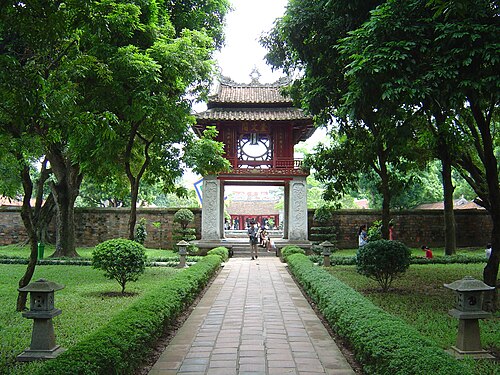
Imagine a school that is almost a thousand years old. In the middle of Hanoi, the capital of Vietnam, there is a long garden surrounded by old brick walls. Inside are ponds, big shady trees, red gates and quiet halls. This place is called Văn Miếu, the Temple of Literature.
It was built to honour Confucius, a teacher from ancient China who said that people should study hard, respect their families and rule with kindness. A few years after the temple was built, the king opened a school next to it. At first only princes and children of important families could study there. Later, clever students from ordinary families could come too.
To walk through the temple, you pass through five courtyards, one after another, like opening the doors of a set of boxes. In the middle stands a small red pavilion with round windows that look like shining stars. In front of it is a square pond called the Well of Heavenly Clarity, where the sky is reflected in the water.
Beside the pond stand 82 big stone turtles. Each turtle carries a tall stone slab on its back. Carved on each slab are the names of the students who passed the hardest exam in the kingdom, the one where the king himself asked the questions. The turtle was chosen because people believed it lives a very long time, so the names would be remembered for ever.
Today, Vietnamese students still visit before important exams to wish for good luck, and at the New Year calligraphers sit outside and write beautiful characters for visitors to take home.
At a glance
- Founded
- 1070, under King Lý Thánh Tông (Lý dynasty); royal academy (Quốc Tử Giám) added in 1076 under King Lý Nhân Tông
- Place
- 58 Quốc Tử Giám Street, Hanoi, Vietnam — south of the old Thăng Long citadel
- Dedicated to
- Confucius, his leading disciples and later Confucian scholars, including the Vietnamese teacher Chu Văn An
- Layout
- A walled complex of about 54,000 m² (including Văn Lake and Giám Park) with five successive courtyards on a north–south axis
- Doctors’ stelae
- 82 surviving stone stelae on turtle bases (erected 1484–1780) recording laureates of court examinations held 1442–1779
- Symbol
- Khuê Văn Các (Pavilion of the Constellation of Literature), built 1805, officially chosen as the symbol of Hanoi
- Status
- Special National Monument of Vietnam (2012); the stelae are on UNESCO’s Memory of the World registers (Asia-Pacific regional register 2010; International Register 2011)
Easy
What is the Temple of Literature?
The Temple of Literature, in Vietnamese Văn Miếu (文廟, literally “temple of culture” or “temple of letters”), is a temple dedicated to Confucius in the centre of Hanoi. It was first built in 1070, when Hanoi was called Thăng Long and was the capital of the Lý dynasty of Đại Việt. Similar Confucian temples, often also called Văn Miếu, were built in other Vietnamese provinces and in China, Korea and Japan, but the Hanoi temple is the oldest and most famous in Vietnam.
The site has two linked identities, reflected in its usual Vietnamese name, Văn Miếu – Quốc Tử Giám. Văn Miếu is the temple where Confucius and other sages were honoured with rituals. Quốc Tử Giám (國子監, “Directorate of the Sons of the State”) was the royal academy founded beside it in 1076. Vietnamese sources often call the academy the country’s first university, and it trained officials and scholars, with interruptions, for about seven centuries.
Today the complex covers a little more than 54,000 square metres, including Văn Lake in front and Giám Park beside it. The inner temple area is enclosed by old brick walls and divided into five courtyards. Visitors walk from the busy streets of Hanoi through gates, gardens and ponds to the ceremonial halls at the back, a journey designed to calm the mind and lead it toward learning.
The temple is one of Hanoi’s best-loved landmarks. It appears on the back of the 100,000 đồng banknote, its Khuê Văn pavilion is the official symbol of the city, and it remains a living place: students come to pray for success before exams, schools hold award ceremonies there, and poets and calligraphers gather at the lunar New Year.
Easy
Reading the layout: five courtyards on the road to learning
Before the main gate stand four brick pillars and two small stelae that once ordered riders to dismount: everyone, however important, had to walk past the temple on foot. The main gate, Văn Miếu Môn, has three openings. By tradition the central path was reserved for the monarch, while officials used the side paths. The whole plan runs north–south in a straight line and is often compared with the Temple of Confucius at Qufu in China, Confucius’s birthplace, although the Hanoi temple is smaller and simpler, and its carpentry and decoration follow Vietnamese traditions.
The first two courtyards are gardens of old trees, lawns and rectangular ponds. They separate the outside world from the sacred area. The first ends at the Great Middle Gate (Đại Trung Môn), flanked by two side gates whose names mean “Attaining Talent” and “Achieving Virtue”. The second ends at the Khuê Văn Các, the Pavilion of the Constellation of Literature, built in 1805. It stands on four white brick pillars; the upper storey is a small wooden room with a round window on each side, whose wooden spokes represent the rays of Khuê, a star constellation linked with literature. Scholars are said to have gathered there to read and judge fine compositions.
Behind the pavilion lies the third courtyard, centred on a square pond called Thiên Quang Tỉnh, the Well of Heavenly Clarity (also translated “Well of Heavenly Light”). A traditional interpretation sees the square pond as the earth and the round windows of the pavilion as heaven, so that the courtyard gathers the finest energies of heaven and earth in one place of learning. On either side of the pond, in two long rows of pavilions, stand the doctors’ stelae: 82 stone slabs mounted on stone turtles, 41 on each side, all facing the water.
Through the Gate of Great Achievement (Đại Thành Môn) the visitor enters the fourth courtyard, the ceremonial heart of the temple. Across a brick-paved court stands the House of Ceremonies (Đại Bái Đường), open at front and back, and behind it the sanctuary (Thượng Điện), dark and enclosed, which holds altars to Confucius, his four closest followers (Yan Hui, Zengzi, Zisi and Mencius) and ten further honoured philosophers. Long side halls once held tablets for other sages and scholars.
The fifth and last courtyard, called Thái Học (“Great Learning”), stands on the ground of the old royal academy. Its present buildings date from 1999–2000. The upper floor of the rear hall honours the three monarchs most associated with the site — Lý Thánh Tông, Lý Nhân Tông and Lê Thánh Tông — and the ground floor honours the teacher Chu Văn An and displays the history of Confucian education in Vietnam.
Easy
The doctors’ stelae: names carved in stone
The stone slabs beside the Well of Heavenly Clarity are the temple’s greatest treasure. Each one records a single court examination (thi Đình), the highest level of the state examinations, where successful candidates received the title tiến sĩ, often translated “doctor” or “doctoral laureate”. The stelae give the year of the exam, the officials who organised it, and the names, ranks and home villages of those who passed, together with an essay praising learning and the ruler who promoted it.
The first stelae were set up in 1484 by King Lê Thánh Tông, who ordered monuments for the examinations held since 1442. Others were added in later centuries, especially in two great campaigns in 1653 and 1717, and then more regularly after each examination. The last surviving stele was erected in 1780 for the examination of 1779. Together the 82 survivors cover more than three centuries and record roughly 1,300 laureates; sources differ slightly on the exact number, with figures such as 1,304 and 1,307 commonly given.
The most quoted line comes from the stele for the examination of 1442, composed in 1484 by the scholar-official Thân Nhân Trung: 賢才者國家之元氣 — “Worthy talents are the vital energy of the nation.” The text goes on to say that when this energy is strong the country flourishes, and when it is weak the country declines. The phrase is widely quoted in Vietnam today.
Why turtles? In Vietnamese tradition the turtle is one of four sacred creatures, together with the dragon, the unicorn-like lân and the phoenix, and it stands for long life and wisdom. Carrying the stelae on turtles was a way of saying that the names of scholars should endure. The shapes of the turtles and the decoration of the slabs changed over time, so the stelae also form a unique record of Vietnamese stone carving from the fifteenth to the eighteenth century.
Intermediate
Building and rebuilding: how old is what we see?
According to the Complete Annals of Đại Việt (Đại Việt sử ký toàn thư), in 1070 King Lý Thánh Tông had the Văn Miếu built, with sculpted images of Confucius, the Duke of Zhou and Confucius’s four leading followers, and painted images of the seventy-two worthies, to receive offerings in all four seasons; the crown prince studied there. A board over the Đại Thành gate, made during a major repair in 1888, also states that the temple was founded in the second year of the Thần Vũ era (1070). The sources differ on the month (the eighth or the tenth lunar month).
Very little of the eleventh-century temple can be seen today. The chronicles do not describe the Lý and Trần buildings in detail, and their scale and exact layout are unknown. The temple was repaired in 1156 and was rebuilt on a large scale in 1483 under Lê Thánh Tông, when the chronicles list a main hall for Confucius, side halls for later worthies, a hall of Great Learning, lecture halls, a store for printing blocks and dormitories for students in rows of twenty-five rooms. A description by the scholar Lê Quý Đôn, written in the 1770s, also records tiled halls, stele houses and teaching buildings.
Most of the surviving structures date from the late Lê and early Nguyễn periods (seventeenth to nineteenth centuries), with later repairs. The brick perimeter walls are generally attributed to the Lê period. Khuê Văn Các was added in 1805 by Nguyễn Văn Thành, governor of the northern region (Bắc Thành) under the new Nguyễn dynasty. The stele houses were rebuilt in 1863 and repaired many times since, and the Thái Học courtyard is a reconstruction of 1999–2000.
The buildings use the materials of traditional northern Vietnamese architecture: ironwood (lim) columns and roof frames on stone bases, curved tiled roofs, bricks from the Bát Tràng pottery villages near Hanoi, and carved and lacquered boards with Chinese-character inscriptions. The stelae are carved from blue-grey stone. Vietnamese architectural historians stress that although the building names repeat those at Qufu, the carpentry, bracket systems and proportions are recognisably Vietnamese.
Intermediate
The society that built it: from the Lý to the Lê dynasty
Đại Việt became independent from Chinese rule in the tenth century. The Lý dynasty (1009–1225) moved the capital to Thăng Long in 1010 and built a stable state. Buddhism was then the dominant religion at court, but the Lý kings also needed literate officials who could draft documents, manage taxes and deal with China. In 1075 King Lý Nhân Tông held the first court examination, and in 1076 he founded the Quốc Tử Giám beside the temple, staffing it with literate officials. At first the academy mainly served the sons of the royal family and high officials.
Under the Trần dynasty (1225–1400) examinations became more regular, and in 1253 King Trần Thái Tông renamed the academy the Quốc Học Viện and summoned scholars from across the country to lecture on the Confucian classics. Its most famous teacher was Chu Văn An (1292–c. 1370), who taught at the academy under King Trần Minh Tông. Tradition says he later resigned after the king refused his petition to execute seven corrupt officials. After his death he was honoured in the temple, and Vietnamese people still remember him as a model teacher.
The great age of the academy came under the Later Lê dynasty (1428–1789), after the country had recovered from twenty years of Ming Chinese occupation. King Lê Thánh Tông (r. 1460–1497) held court examinations every three years, rebuilt the academy and began the stelae. Students (giám sinh) usually came after passing the regional examination; they studied the Four Books and Five Classics, history and composition, took monthly and seasonal tests, and prepared for the national (thi Hội) and court (thi Đình) examinations. At the court examination the ruler set the policy question and ranked those who passed.
The Mạc dynasty, which seized the throne in 1527, continued to hold examinations, but only one Mạc stele survives in Hanoi. After the Lê restoration the real power in the north was held by the Trịnh lords, while the Lê emperors reigned in name, and the examinations and stelae continued under their joint authority until 1779. In 1762 the institution was again officially named Quốc Tử Giám.
Intermediate
Religious and cultural meaning: Confucian learning in Vietnam
Confucianism (in Vietnamese Nho giáo) is a tradition of ethics and government based on the teachings of Confucius and his followers. It stresses self-cultivation through study, respect for parents and teachers, proper ritual, and government by morally educated officials. In a Văn Miếu, Confucius is honoured not as a god who grants miracles but as the “Ultimate Sage and First Teacher” (Chí thánh tiên sư), whose tablet is placed on the central altar. Offerings were made at spring and autumn ceremonies, and scholars bowed before the altars as a sign of gratitude and commitment.
The temple also made a political statement. By honouring Confucius and linking the academy and examinations to him, Vietnamese rulers claimed to govern according to the same classical civilisation as China while ruling an independent kingdom. The stelae express this idea clearly: they praise the ruler for seeking talent, and present the laureates as people whose learning serves the state. For families and villages, having a name carved on a stele brought lasting honour, and today many Vietnamese still visit to look for ancestors among the laureates.
Confucianism did not replace other beliefs. In the Lý and Trần periods it coexisted with Buddhism and Daoism, and one early examination even tested knowledge of the “three teachings”. Only in the fifteenth century did Neo-Confucianism, the form systematised by the Song scholar Zhu Xi, become the dominant state ideology. Zhu Xi himself is among the ten philosophers honoured in the sanctuary.
For many Vietnamese the temple is also a symbol of a national love of learning (hiếu học) and of respect for teachers (tôn sư trọng đạo). Customs at the site today mix commemoration and hope: students leave offerings or prayers before exams, and at the lunar New Year people ask calligraphers for a character such as “virtue” or “patience”. These practices are part of a living tradition and deserve the same respect as the older rituals.
Intermediate
Later history: the move to Huế, the French period and the wars
In the late eighteenth century the Tây Sơn uprising overthrew both the Lê and the Trịnh, and the temple was damaged during the fighting. When the Nguyễn dynasty unified the country in 1802, it made Huế the capital, and in 1803 a new academy was established there, later called the Quốc Tử Giám of Huế. The Hanoi temple became a regional Văn Miếu, and its academy was turned into a school for the local prefecture. On the old academy grounds a shrine, Khải Thánh, was built to honour Confucius’s parents. New doctors’ stelae were erected at the Temple of Literature in Huế from the 1820s onwards.
Even so, the Nguyễn cared for the Hanoi temple. Khuê Văn Các was added in 1805; in 1863 local officials rebuilt the stele houses, rearranged fallen stelae and re-cut worn inscriptions, recording their work on stelae that still stand; and in 1888 the temple was substantially repaired under Emperor Đồng Khánh.
After France made Tonkin a protectorate, the temple was registered as a historic monument in 1906. The École française d’Extrême-Orient (EFEO) carried out studies and repairs, and in 1951 the Vietnamese scholar Trần Hàm Tấn published a detailed study of the temple in the EFEO bulletin. Photographs of the period show mandarins in ceremonial dress at the temple.
The First Indochina War brought serious damage. In 1946–47 French shelling destroyed the Khải Thánh buildings on the old academy ground, leaving only foundations, column bases and stone ink-slabs, and parts of the grounds were taken for the expansion of the nearby Saint Paul Hospital. After 1954 the new government in Hanoi began repairs, and in 1962 the temple was listed as a national historic site. The stelae gardens, which had become overgrown, were gradually restored.
Intermediate
Restoration, recognition and the question of touching the turtles
A centre for managing and restoring the site was set up in 1988, and a major campaign followed in the 1990s: the Đại Thành hall and drainage were repaired, the ponds dredged, the stele houses rebuilt in 1994 and the stelae rearranged in rows, with the two earliest (for 1442 and 1448) placed in the central pavilions. Between 1999 and 2000 the Thái Học courtyard was rebuilt on the site of the old academy to mark 990 years of Thăng Long–Hanoi; it was inaugurated in October 2000.
International and national recognition followed. The 82 stelae were first inscribed on UNESCO’s Memory of the World Register for Asia and the Pacific on 9 March 2010, at a meeting in Macau, and then on the International Memory of the World Register in 2011, which is why both dates appear in reference works. They were Vietnam’s second entry on the register, after the woodblocks of the Nguyễn dynasty. In 2012 the complex was classified as a Special National Monument, and Khuê Văn Các was chosen as the symbol of Hanoi.
Popularity brings problems. For many years visitors, especially students hoping for good luck in exams, rubbed the heads of the stone turtles, polishing and wearing the stone. To protect them, the stelae are now fenced off, and visitors are asked not to touch or climb on them. The case is a small but clear example of a wider conservation dilemma: how to protect fragile heritage without cutting it off from the living customs that give it meaning.
Other debates concern authenticity. A recurring question is how far a newly designed building like the Thái Học courtyard, built in a traditional style on ancient foundations, should be presented as part of an eleventh-century monument. Another concern is pressure from mass tourism, events and the surrounding city. A common answer is that Vietnamese temples have always been repaired and rebuilt, and that continuity of use and meaning matters as much as the age of each timber.
Advanced
Scholarly questions: dates, counts and the idea of a “first university”
The foundation date of 1070 rests on the Complete Annals, compiled in the fifteenth century from earlier chronicles, and on later inscriptions such as the 1888 board over the Đại Thành gate. There is no doubt that a Văn Miếu existed in Thăng Long under the Lý, but whether the eleventh-century temple stood on exactly the present plot, and how its layout related to the present one, cannot be demonstrated from the written sources alone. Secondary accounts also differ over whether academy buildings date from 1076 or 1077, a reminder that even modern summaries repeat the chronicles unevenly.
The description of the Quốc Tử Giám as “Vietnam’s first university” is common in Vietnamese and tourist literature. Historians note that the term is an analogy: the academy was a court institution for training officials in the classics, closer to the Chinese Guozijian than to a medieval European university, and its intake, curriculum and continuity changed greatly between the Lý, Trần and Lê periods. Its role also coexisted with private teaching, such as the school Chu Văn An ran in his village.
The number of examinations and stelae is another open problem. Counting all court examinations from 1442 to the last Lê examination of 1787 gives about 124; counting only the regular doctoral examinations gives about 117. The Vietnamese Wikipedia article on the stelae, drawing on published research, argues that 91 examinations are known to have received stelae, of which 82 survive, and that the chronicles record stelae for nine examinations (including 1469 and 1472) that are now lost. A stone turtle base found in April 1976 at the bottom of a pond in the grounds has led some researchers, among them the Hanoi historian Nguyễn Vinh Phúc, to speak of an 83rd stele, though its slab has not been found. Counts of laureates therefore range between about 1,303 and 1,323 depending on the method.
Finally, historians debate how to read the stelae as evidence. Their essays present an idealised picture of rulers who valued talent; they were composed by court officials, sometimes decades after the examinations they record, and some slabs were re-cut or rearranged in later repairs such as that of 1863. The stelae are therefore both primary documents and later reconstructions, and each inscription must be dated and assessed individually.
Advanced
Evidence and methods: chronicles, inscriptions and architecture
Written sources. The main narrative sources are the official chronicles, above all the Complete Annals of Đại Việt and the nineteenth-century official history Khâm định Việt sử thông giám cương mục, which record the founding of the temple and academy, the examinations and repairs. Lê Quý Đôn’s Kiến văn tiểu lục (1770s) describes the eighteenth-century buildings. Examination records such as the lists of laureates (đăng khoa lục) allow the stelae to be cross-checked.
Epigraphy. The stelae and other inscriptions on the site — the 1863 repair stelae, the boards and couplets on gates and halls, and a stele of 1942 about Văn Lake found when the lake was dredged in 1998 — are documents in their own right. Since the early twentieth century scholars at the EFEO and later at Vietnam’s Institute of Hán-Nôm Studies have transcribed and translated them. Trần Hàm Tấn’s 1951 study, for example, published full translations of two stelae and traced the administrative history of the site.
Art history. The turtles and the decoration of the slabs change in recognisable ways between the early Lê, Mạc and restored Lê periods, so style can help date undated or re-cut pieces. At the same time, because stelae were moved, remounted on different turtles and repaired, apparent style differences must be checked against inscriptions and records of repair.
Architecture and landscape. Comparison with Qufu and with other Vietnamese Confucian temples helps separate borrowed names and ideas from local building practice. Analysis of timber frames and repair inscriptions shows that most standing structures are no older than the seventeenth to nineteenth centuries. The methodological lesson of the Temple of Literature is that a monument’s claimed date (1070) and the date of its visible fabric are different things, and both belong to its history.
Key ideas
- Temple and academy
- The site combined a temple for Confucian rituals (Văn Miếu) with a royal academy for training officials (Quốc Tử Giám), joining worship and study.
- Talent as the nation’s vital energy
- The idea, carved on the 1442 stele, that the strength of the state depends on educated, virtuous people; it is still central to how Vietnamese remember the site.
- Examination state
- From 1075 to 1919 Vietnamese dynasties used examinations in the Confucian classics to recruit officials, and the stelae celebrate the highest level of that system.
- Heaven and earth
- The square Well of Heavenly Clarity and the round windows of Khuê Văn Các are traditionally read as earth and heaven meeting in a place of learning.
- Commemoration in stone
- Carving laureates’ names on turtle-borne stelae turned individual success into lasting public honour for families, villages and the state.
- Living heritage
- The temple is both a protected monument and a place of ongoing custom, which creates tension between conservation and use.
- Layers of rebuilding
- The site’s founding date is 1070, but most visible structures are much later; understanding the repairs is part of understanding the monument.
Records
- 1070 — King Lý Thánh Tông founds the Văn Miếu in Thăng Long, with images of Confucius and his followers.
- 1076 — King Lý Nhân Tông establishes the Quốc Tử Giám, the royal academy, beside the temple.
- 1253 — King Trần Thái Tông renames the academy Quốc Học Viện and summons scholars to lecture on the classics.
- c. 1370 — Death of the teacher Chu Văn An, who is afterwards honoured in the temple.
- 1484 — King Lê Thánh Tông orders the first doctors’ stelae, for examinations held since 1442.
- 1653 — The largest single campaign of stele erection, covering examinations from 1554 onwards.
- 1780 — The last surviving stele is erected, for the examination of 1779.
- 1803 — The Nguyễn dynasty, now ruling from Huế, founds a new academy there; the Hanoi temple becomes a regional Văn Miếu.
- 1805 — Khuê Văn Các is built by the northern governor Nguyễn Văn Thành.
- 1906 — The French colonial administration registers the temple as a historic monument.
- c. 1947 — French shelling during the First Indochina War destroys the buildings on the old academy ground (1946–47).
- 2010 — The 82 stelae are inscribed on UNESCO’s Memory of the World Register for Asia and the Pacific; the International Register follows in 2011.
Glossary
- Văn Miếu
- “Temple of letters”: a temple dedicated to Confucius, found in many towns of premodern Vietnam.
- Quốc Tử Giám
- The royal academy for training scholars and officials, from the Chinese Guozijian; founded in Hanoi in 1076.
- Tiến sĩ
- The title given to those who passed the highest examinations; usually translated “doctor” or “doctoral laureate”.
- Thi Đình
- The court examination, the final stage of the examination system, at which the ruler set the question and ranked the candidates.
- Stele (plural stelae)
- An upright stone slab carrying an inscription.
- Khuê Văn Các
- The Pavilion of the Constellation of Literature (1805), the emblem of the temple and of Hanoi.
- Thiên Quang Tỉnh
- The Well of Heavenly Clarity: the square pond in the third courtyard, flanked by the stelae.
- Confucianism (Nho giáo)
- The ethical and political tradition based on Confucius and the classics, stressing learning, ritual and moral government.
- Neo-Confucianism
- The reinterpretation of Confucianism associated with Zhu Xi, which became state orthodoxy in fifteenth-century Vietnam.
- Special National Monument
- Vietnam’s highest category of protected historic site; the temple received it in 2012.
Questions and answers
Was the Temple of Literature really a university?
It was a royal academy for training officials in the Confucian classics. Vietnamese sources call it the country’s first university, but historians note it was quite different from a modern or European university.
Why do the stone slabs sit on turtles?
In Vietnamese tradition the turtle is a sacred creature symbolising long life and wisdom, so it was chosen to carry the names of scholars so that they would be remembered for ever.
Can I touch the turtles for good luck?
Touching used to be common, but rubbing wore the stone down, so the stelae are now fenced off and visitors are asked not to touch them.
Is anything left from 1070?
Very little can be securely identified. The site dates from 1070, but most buildings were rebuilt between the seventeenth and nineteenth centuries, and the fifth courtyard dates from 2000.
How many examinations do the stelae record?
The 82 surviving stelae each record one court examination between 1442 and 1779; historians estimate that more stelae once existed and that some are lost.
When were the stelae added to UNESCO’s Memory of the World Register?
They entered UNESCO’s regional register for Asia and the Pacific on 9 March 2010, at a meeting in Macau, and the International Memory of the World Register in 2011. That is why you will see both years.
Why did the academy lose its importance in the nineteenth century?
The Nguyễn dynasty moved the capital to Huế and founded a new academy there in 1803, so the Hanoi temple became a regional Confucian temple.
Sources and further reading
- Temple of Literature, Hanoi. Wikipedia
- Văn Miếu – Quốc Tử Giám. Wikipedia (Vietnamese)
- Stone stele records of imperial examinations of the Lê and Mạc dynasties. Wikipedia
- Bia tiến sĩ Văn Miếu Thăng Long. Wikipedia (Vietnamese)
- Confucian court examination system in Vietnam. Wikipedia
- Chu Văn An. Wikipedia
- Imperial Academy, Huế. Wikipedia
- 문묘 (하노이). Wikipedia (Korean)
- Trần Hàm Tấn, Étude sur le Văn-miếu de Hanoi (Temple de la Littérature). Bulletin de l’École française d’Extrême-Orient 45 (1), 1951
- Văn Miếu – Quốc Tử Giám (official site). Trung tâm Hoạt động Văn hóa Khoa học Văn Miếu – Quốc Tử Giám
- Stone Stele Records of Royal Examinations of the Le and Mac Dynasties (1442–1779). UNESCO Memory of the World Committee for Asia and the Pacific (MOWCAP)
Related
- ConfuciusTeacher from the state of Lu whose sayings, gathered in the Analects, shaped ethics and government across East Asia.
- MenciusA Confucian thinker who argued that people have the beginnings of moral goodness and that rulers must care for their subjects.
- Zhu XiSong philosopher who gave enduring form to Neo-Confucian learning.
- AnalectsA collection of sayings and short dialogues of Confucius and his disciples, compiled after his death and read across East Asia for two thousand years.
- The Tale of KiềuNguyễn Du's 3,254-line verse narrative in Vietnamese about Thúy Kiều, a gifted young woman who sacrifices herself for her family and endures fifteen years of hardship; it is widely regarded as the masterpiece of Vietnamese literature.
Written with AI assistance from the published sources listed above, and revised as new research appears.