Start at the top for an easy introduction. Go further down for more detail and scholarship.
- Easy
- Intermediate
- Advanced
For young readers
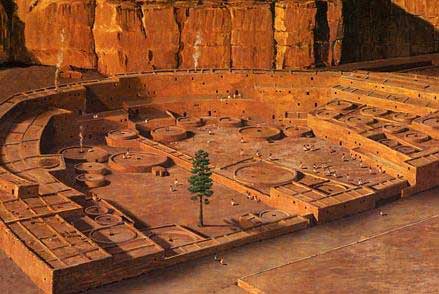
In a dry canyon in New Mexico stands an enormous stone building shaped like the letter D. It has hundreds of rooms, and parts of it were once four or five storeys tall. People call it Pueblo Bonito, which means “beautiful village” in Spanish. It was built by the ancestors of the Pueblo peoples who still live in New Mexico and Arizona today.
The builders had no metal tools, no wheels and no horses. They cut sandstone into thin slabs and fitted them together into neat, patterned walls. For the roofs they carried tens of thousands of big logs from forests many kilometres away, walking all the way.
Inside the curve of the D there were round rooms dug into the ground, called kivas. Some of them, the great kivas, were big enough for large gatherings. Many Pueblo people today still use kivas for prayer and ceremonies.
In a few rooms archaeologists found wonderful things: thousands of beads of blue-green turquoise, shells from the ocean, tall painted jars that once held chocolate drinks made from cacao grown far away in Mexico, and the feathers and bones of bright tropical parrots called macaws. So Chaco was connected to places very far away.
Pueblo people say that Chaco was not a place that was simply abandoned. Their ancestors moved on to new homes, carrying their knowledge with them, and they believe the spirits of the ancestors are still present there. That is why many ask visitors to treat Chaco with deep respect.
At a glance
- Built
- In stages c. AD 850–1150, over roughly 300 years (earliest tree-ring dates in the 800s)
- Place
- North side of Chaco Canyon, Chaco Culture National Historical Park, San Juan County, New Mexico, USA
- Builders
- Ancestral Pueblo people (Ancestral Puebloans), ancestors of today’s Pueblo peoples, including the Hopi, Zuni, Acoma, Laguna and Rio Grande Pueblos
- Size
- About 1–1.2 hectares (2–3 acres); estimates of 650–800 rooms; up to four or five storeys; dozens of kivas, including two great kivas
- Plan
- D-shaped great house, divided by a north–south wall across its central plaza
- Notable finds
- Rich burials in Room 33 with thousands of turquoise and shell ornaments; over 100 cylinder jars, some with cacao residue; macaw remains
- Status
- Part of Chaco Culture, UNESCO World Heritage Site (1987); sacred to many Pueblo and other Indigenous nations
Easy
What is Pueblo Bonito?
Pueblo Bonito is the largest and best known of the “great houses” of Chaco Canyon in northwestern New Mexico. These massive, multi-storey masonry buildings were built by Ancestral Pueblo people between the mid-800s and the mid-1100s, when Chaco became the centre of a network of communities spread across much of the Four Corners region, where today’s New Mexico, Arizona, Colorado and Utah meet.
The building is shaped like a giant letter D. Its curved back wall faces north toward the canyon cliff, and its straight front faces south across the canyon. Within its walls are hundreds of rectangular rooms, stacked up to four or five storeys high at the back, and dozens of round, partly underground rooms known as kivas, arranged around open plazas. The National Park Service calls it the most thoroughly investigated cultural site in Chaco Canyon.
The name is not an ancestral name. In 1849 a US Army expedition led by Lieutenant James H. Simpson was guided through the canyon by Carravahal, a man from San Ysidro, New Mexico, who gave several ruins their Spanish names, including Pueblo Bonito, “beautiful village”. Pueblo peoples have their own names and stories for Chaco and its places, some of which are kept within their communities.
For many Indigenous nations, Pueblo Bonito is not a ruin but part of a living ancestral landscape. The park recognizes more than two dozen tribes and pueblos with traditional ties to Chaco, and asks visitors to come with respect.
Easy
How to “read” the great house: rooms, kivas and plazas
Most of Pueblo Bonito’s rooms are rectangular, small and dark, connected by doorways rather than opening onto the outside. Many interior rooms had no hearths and seem to have been used for storage or for special purposes rather than as family homes. Some doorways are T-shaped, a distinctive feature of Chacoan architecture. The back rooms rise in terraces toward the cliff, so the building steps down toward the plaza.
The kivas are round rooms, usually set partly below ground, entered through the roof and furnished with a bench, a fire pit and a ventilation shaft. Pueblo Bonito has dozens of smaller kivas and two great kivas, which are much larger and could have held many people for community ceremonies. Among present-day Pueblo peoples, kivas remain important places of prayer and ceremony, so what is known of them from living tradition is shared or withheld at the communities’ discretion.
A straight wall runs north to south through the central plaza, dividing the building into two nearly symmetrical halves, each with its own great kiva. Some researchers link this division to the dual social organization found in several Pueblo communities today, in which a village is divided into two complementary groups, though such links across nine centuries are interpretive.
The building is aligned with remarkable precision. The north–south wall is close to true north, and the straight south wall runs nearly east–west, so it lines up with the rising and setting sun at the equinoxes. Other features of Chaco relate to the solstices and to the 18.6-year cycle of the Moon, showing careful long-term observation of the sky.
Easy
How it was built
Pueblo Bonito was planned and built in several major stages. It began in the 800s as a smaller arc of rooms and grew over three centuries, with the largest expansions in the eleventh and early twelfth centuries, when the D-shape was completed and the building reached its full height. Because wooden beams can be dated by counting their growth rings (dendrochronology), archaeologists know the dates of many construction phases unusually precisely.
The walls have a core of rough stone and mud mortar, faced on both sides with carefully laid sandstone. In later phases the masons used patterns of large blocks alternating with bands of thin tabular stones, creating beautiful textured surfaces. These walls were originally plastered over, so the patterns may not have been visible; their care suggests pride in the craft or meanings we do not fully understand.
Chaco Canyon has few trees, yet the great houses required enormous amounts of timber for beams and roofs. Studies of the wood show that many logs were cut in mountain forests tens of kilometres away and carried to the canyon, presumably on people’s shoulders, since there were no draft animals. The labour involved in quarrying stone, preparing mortar and transporting timber indicates a society capable of organizing large, sustained projects.
The canyon cliff behind Pueblo Bonito posed a danger. A huge slab of rock, known as Threatening Rock (in Navajo, tsé biyaa anii’áhí, “leaning rock gap”), leaned away from the cliff. The Chacoans built supports at its base. In January 1941 it finally fell, crushing part of the back wall and a number of rooms.
Intermediate
The Chacoan world: roads, great houses and exchange
Pueblo Bonito was one of about fifteen great houses in and around the central canyon, including Chetro Ketl, Pueblo Alto, Peñasco Blanco and Una Vida, together with smaller settlements. By about 1050, Chaco was connected to more than 150 great houses spread across the region, often called “outliers”, built in the same style.
Straight, engineered roads radiated from the canyon, some running for long distances across the landscape, with ramps and stairways cut into cliffs. Their exact purpose is debated: they may have been used for travel and transport, but their straightness, even where it is not practical, suggests ceremonial or symbolic meanings as well, perhaps linking places of importance.
Chaco was a centre of exchange. Around 200,000 pieces of turquoise have been recovered from Chaco sites, much of it worked in the canyon. Shells came from the Pacific coast and the Gulf of California. Pueblo Bonito also contained items from Mesoamerica, far to the south: copper bells, the remains of scarlet macaws, and cylinder jars with traces of cacao. These show that Chaco was part of networks extending more than 1,900 km.
Climate shaped Chaco’s history. The canyon is dry, with short growing seasons and unreliable rain. Chacoans farmed maize, beans and squash using water-control systems that captured runoff from the cliffs. A period of relatively favourable rainfall in the eleventh century coincided with the greatest building, and a severe drought beginning in the 1130s coincided with the end of major construction.
Intermediate
Who lived at Pueblo Bonito, and why was it built?
Early visitors imagined Pueblo Bonito as a crowded apartment building for over a thousand people. Most archaeologists now think far fewer people lived there year-round. Counts of hearths and living rooms suggest perhaps a few dozen households, roughly 50–100 people, although much larger numbers may have gathered at certain times for ceremonies, feasts or trade.
This has led many researchers to see Pueblo Bonito and the other great houses as ceremonial, political and storage centres rather than ordinary villages. Pilgrims from surrounding communities may have come to Chaco for seasonal gatherings, bringing goods and labour. Great mounds in front of Pueblo Bonito, containing broken pottery and other material, have been interpreted either as trash heaps or as the remains of ritual feasting and deliberate deposition.
The richest burials ever found in the American Southwest come from Room 33, in the oldest part of the building. Fourteen people were buried there over about 330 years. One early burial of a man was accompanied by thousands of turquoise and shell beads and pendants that once formed necklaces, anklets and bracelets. Another nearby room held more than a hundred tall cylinder jars, a form almost unique to Pueblo Bonito; chemical tests published in 2009 found residues of cacao, a Mesoamerican plant, in some of them, suggesting ritual consumption of chocolate drinks.
Pueblo descendants often describe Chaco as a special gathering place where many peoples and clans came together to share ceremonies, knowledge and traditions, including knowledge of the seasons and of the Sun and Moon. This perspective emphasizes cooperation and shared knowledge, and it fits well with archaeological evidence of periodic gatherings.
Intermediate
Descendant communities: Chaco as a living place
The people who built Pueblo Bonito did not vanish. Archaeology, oral tradition and genetics agree that their descendants are today’s Pueblo peoples, including the Hopi in Arizona, Zuni, Acoma and Laguna, and the Keres, Tewa, Tiwa and Towa-speaking pueblos of the Rio Grande valley. Hopi clan traditions, and traditions at Acoma, Zuni, Zia, Laguna and elsewhere, describe clans migrating through Chaco on their journeys. The Hopi call the ancestors Hisatsinom, “ancient people”.
Many Pueblo people object to the older archaeological term “Anasazi”, a Navajo word often translated as “ancestors of enemies”, and prefer “Ancestral Pueblo” or “Ancestral Puebloan”. They also reject the popular idea that Chaco was mysteriously “abandoned”. In their view, the ancestors deliberately moved on, as their migration traditions describe, and the place is still inhabited by ancestral spirits. As the Laguna and Zuni educator Jon Ghahate put it, Chaco “is not a ruin. It is not a park. It’s the beginning of who we are.”
Pueblo scholars also caution about the limits of outside knowledge. The Hopi researcher Phillip Tuwaletstiwa has observed that although Chaco has been “studied to death”, very little is actually known about its religion, governance, language and social organization. Some knowledge is held within communities and is not meant to be shared publicly, and outside researchers are expected to respect that.
The Navajo (Diné), whose homeland surrounds Chaco today, also have deep ties to the canyon. More than 750 Navajo archaeological sites are known in the park, from before the Spanish colonial period through the twentieth century, and Diné oral histories describe interactions between Diné ancestors and the people of the great houses, including a well-known story of a powerful Gambler associated with Chaco. Navajo families living in the canyon were removed during the twentieth century, but their descendants maintain relationships with the place. The park consults Navajo, Hopi, Pueblo and other tribes through an American Indian Consultation Committee established in 1991.
Intermediate
The end of building, excavation and protection
Major construction at Pueblo Bonito ended in the early twelfth century. During the long drought that began around 1130, Chaco’s role as a regional centre faded, and people increasingly moved to other places, including Aztec and Mesa Verde to the north and the Rio Grande, Rio Puerco, Little Colorado and Hopi areas to the south and west. Pottery shows that Pueblo Bonito was lightly used into the 1200s. Environmental stress, including deforestation and erosion of fields, probably combined with social and religious changes.
In 1896 Richard Wetherill, a rancher, and George H. Pepper, working for the American Museum of Natural History, began excavations at Pueblo Bonito funded by the New York collectors Talbot and Frederick Hyde (the Hyde Exploring Expedition). Over four seasons, to 1900, they cleared about 190 rooms and shipped many objects to New York. Concern about such digging helped lead to the US Antiquities Act of 1906 and the proclamation of Chaco Canyon National Monument in 1907.
In the 1920s Neil Judd led large excavations for the National Geographic Society, clearing much of the rest of the building and studying its architectural development. Later work by the National Park Service’s Chaco Project in the 1970s and 1980s, and more recent re-analysis of old collections, have transformed understanding of Chaco. In 1980 the monument became Chaco Culture National Historical Park, and in 1987 it was inscribed on the UNESCO World Heritage List.
Protecting Chaco remains a live issue. Oil and gas development in the surrounding San Juan Basin has threatened archaeological sites and sacred landscapes outside the park. The All Pueblo Council of Governors and other tribal leaders have campaigned for a buffer zone around the park; in 2023 the US Department of the Interior acted to withdraw federal lands within about 10 miles of the park from new oil and gas leasing. Views among Indigenous communities are not uniform, since some Navajo allottees hold mineral rights in the area.
Advanced
Scholarly debates: what kind of society was Chaco?
Hierarchy or communal ritual? Archaeologists have long disagreed about Chaco’s social organization. Some see a hierarchical society with a ruling elite, pointing to the monumental great houses, the road system, the concentration of turquoise and exotic goods, and the rich burials of Room 33. Others emphasize the absence of palaces, royal imagery or clear evidence of coercion, and interpret Chaco as a ritual centre sustained by pilgrimage, feasting and communal labour, more consistent with the relatively egalitarian values of historic Pueblo societies.
The matrilineal dynasty study. In 2017 a team led by Douglas Kennett and Stephen Plog published ancient DNA from the Room 33 burials in Nature Communications, finding that nine individuals shared the same mitochondrial DNA, inherited through the female line, over roughly 330 years (c. AD 800–1130). They argued this showed an elite matrilineal lineage, fitting with the importance of matrilineal clans in many Pueblo societies today. Critics questioned whether shared maternal ancestry proves inherited power.
Ethics of research. The same study became a focus of debate about research on ancestral remains. Because the museum holding the remains had concluded that the federal repatriation law (NAGPRA) did not apply, no formal consultation with descendant tribes took place before publication. Scholars such as the legal scholar Rebecca Tsosie and the archaeologist Ruth Van Dyke criticized this, arguing that legality did not make the research ethical; a team member later described efforts to engage Southwestern communities. The episode has encouraged more collaborative research in which descendant communities help shape questions and decide what may be studied.
Chaco’s wider reach. Proposals about Chaco’s regional significance range from modest to ambitious. Stephen Lekson’s “Chaco Meridian” hypothesis argued that Chaco, Aztec and the later centre of Paquimé in Chihuahua were deliberately aligned on a north–south line, reflecting continuity of political power; many archaeologists regard this as unproven. Similarly, the extent of Mesoamerican influence, evidenced by macaws, copper bells and cacao, is debated: were these signs of direct contact, of long-distance exchange through many intermediaries, or of Chacoan leaders drawing on distant prestige?
Advanced
Evidence and methods
Tree rings. Chaco is one of the best-dated archaeological regions in the world thanks to dendrochronology. Thousands of wooden beams give cutting dates, sometimes to the exact year, allowing researchers to reconstruct construction sequences at Pueblo Bonito in detail. Chemical analysis of the wood (strontium isotopes) has helped identify the distant mountain ranges where timber was cut.
Old excavations, new questions. Much of Pueblo Bonito was excavated between 1896 and the 1920s using methods that recorded far less context than modern archaeology. Researchers today re-examine archived notes, photographs and museum collections to answer new questions, for example about the cylinder jars, the macaws or the dates of burials. This work shows both the value and the limits of early excavation records.
Environmental data. Pollen, packrat middens, sediment cores and tree-ring climate records allow reconstruction of rainfall, vegetation and farming conditions, helping test theories about drought and environmental change. Such data show correlation between climate and Chaco’s history, but explaining human decisions requires more than climate alone.
Indigenous knowledge. Oral traditions, clan migration histories and continuing ceremonial relationships to Chaco are increasingly recognized as sources of historical knowledge in their own right. Descendant scholars point out that science and traditional narratives may sometimes agree, sometimes diverge, without one simply invalidating the other. Integrating them respectfully, including accepting that some knowledge is not shared, is one of the central challenges of Chacoan studies today.
Key ideas
- Great house
- A large, planned, multi-storey masonry building of the Chacoan world, used for ceremony, storage and elite residence as much as ordinary living.
- Kiva
- A round, often underground ceremonial room; great kivas served whole communities, and kivas remain important in Pueblo life.
- Chacoan network
- Roads, outlying great houses and exchange linked Chaco to communities across the Four Corners region and beyond.
- Sky watching
- Precise alignments to cardinal directions, equinoxes, solstices and lunar cycles reflect long-term astronomical knowledge.
- Migration, not disappearance
- Pueblo traditions and archaeology agree that Chaco’s people moved on and their descendants live today.
- Living ancestral place
- For many Indigenous nations Chaco is sacred and still inhabited by ancestral spirits, not a ruin.
- Research ethics
- Work on ancestral remains and sacred sites increasingly requires consultation and collaboration with descendant communities.
Records
- c. 828 CE — Earliest tree-ring dates associated with the first phase of Pueblo Bonito.
- c. 850 CE — Construction of the first arc of rooms begins.
- c. 1050 — Chaco is connected to more than 150 great houses across the region; major expansions of Pueblo Bonito.
- c. 1130 — A long drought begins; major construction at Chaco ends and people increasingly migrate elsewhere.
- 1849 — Lt. James H. Simpson’s expedition, guided by Carravahal, records Chaco’s ruins and names Pueblo Bonito.
- 1896 — The Hyde Exploring Expedition (Wetherill and Pepper) begins excavating Pueblo Bonito (to 1900).
- 1907 — Chaco Canyon National Monument is proclaimed.
- c. 1921 — Neil Judd begins National Geographic Society excavations at Pueblo Bonito (through the 1920s).
- 1941 — Threatening Rock collapses, destroying part of the back wall and rooms (January).
- 1980 — The monument is enlarged and becomes Chaco Culture National Historical Park.
- 1987 — Chaco Culture is inscribed on the UNESCO World Heritage List.
- 2017 — Ancient DNA study of Room 33 is published, prompting debate over consultation with descendant tribes.
Glossary
- Ancestral Puebloans
- The ancestors of today’s Pueblo peoples, who built Chaco and many other sites; preferred to the older term “Anasazi”.
- Pueblo
- Spanish for “village”; also the name of Indigenous nations of New Mexico and Arizona and their communities.
- Great house
- A large planned masonry building characteristic of the Chacoan world.
- Kiva
- A round ceremonial room, often partly underground.
- Great kiva
- An especially large kiva used for community-wide ceremonies.
- Dendrochronology
- Dating wood by matching patterns of annual tree rings.
- Outlier
- A great house outside Chaco Canyon built in Chacoan style and linked to the canyon.
- Matrilineal
- Tracing descent and inheritance through the mother’s line.
- NAGPRA
- The US Native American Graves Protection and Repatriation Act of 1990.
- Hisatsinom
- Hopi term for the ancestors, meaning “ancient people”.
- Cylinder jar
- A tall, narrow pottery vessel found mainly at Pueblo Bonito, some containing cacao residue.
Questions and answers
Did the people of Chaco disappear?
No. They moved to other places over time, and their descendants are today’s Pueblo peoples, including the Hopi, Zuni, Acoma, Laguna and the Rio Grande Pueblos.
How many people lived in Pueblo Bonito?
Probably far fewer than once thought, perhaps 50–100 people year-round, though many more may have gathered there for ceremonies.
What is a kiva?
A round, often underground room used for ceremonies. Kivas are still important in many Pueblo communities today.
Why shouldn’t we call the builders “Anasazi”?
The word comes from Navajo and is often translated as “ancestors of enemies”; many Pueblo people find it offensive and prefer “Ancestral Puebloans”.
Did the Chacoans drink chocolate?
Residues of cacao, which grows only far to the south in Mesoamerica, were found in cylinder jars from Pueblo Bonito, suggesting they did, probably in rituals.
Was Pueblo Bonito ruled by kings?
There is no evidence of kings in the usual sense. Rich burials and DNA suggest an important matrilineal family, but whether it held political power is debated.
Why was the 2017 DNA study controversial?
Descendant tribes were not consulted before it was carried out and published, which many scholars and Indigenous leaders considered unethical even if legal.
Can I visit Pueblo Bonito?
Yes. It lies in Chaco Culture National Historical Park, and visitors can walk through some original rooms, but they are asked to respect it as a sacred place.
Sources and further reading
- Pueblo Bonito. Wikipedia
- Pueblo Bonito. US National Park Service
- History & Culture, Chaco Culture National Historical Park. US National Park Service
- Chaco Culture National Historical Park. Wikipedia
- Ancestral Puebloans. Wikipedia
- Elizabeth Miller, Chaco Canyon’s Impact Continues to Expand. New Mexico Magazine, 2026
- Michael Balter, Ancient DNA Yields Unprecedented Insights into Mysterious Chaco Civilization. Scientific American, 2017
- Wade Campbell, The Diné History of Chaco Canyon. Archaeology Southwest, 2022
- Patricia L. Crown, W. Jeffrey Hurst, Evidence of cacao use in the Prehispanic American Southwest. Proceedings of the National Academy of Sciences 106, 2009
- Stephen H. Lekson, The Chaco Meridian: Centers of Political Power in the Ancient Southwest. AltaMira Press, 1999
Related
- CahokiaThe largest pre-Columbian city north of Mexico, a Mississippian centre of earthen mounds and plazas beside the Mississippi River.
- TeotihuacanA major ancient city in central Mexico, known for its monumental avenues, pyramids and extensive residential compounds.
- Chichén ItzáA major Maya city on the Yucatán Peninsula, with monuments built and used across several centuries.
- StonehengeA prehistoric monument of earthworks and standing stones in southern Britain, built and altered over many centuries.
- Maya scriptLogosyllabic writing system of the Maya, combining word signs and syllable signs, used from about 300 BC until the Spanish conquest and largely deciphered in the second half of the twentieth century.
Written with AI assistance from the published sources listed above, and revised as new research appears.