Start at the top for an easy introduction. Go further down for more detail and scholarship.
- Easy
- Intermediate
- Advanced
For young readers
Imagine a storybook so long that reading it out loud would take weeks. That is the Shahnameh, which means “The Book of Kings”. It is a poem written in Persian, the language of Iran, by a man named Ferdowsi. He worked on it for more than thirty years and finished it in the year 1010.
The poem begins long, long ago, with the very first king, who lived in the mountains and wore leopard skins. Then come kings who discover fire, teach people to make clothes, and build cities. There is also a terrible king called Zahhak, from whose shoulders grow two snakes that must be fed every day. A brave blacksmith named Kaveh raises his leather apron on a spear like a flag, and the people rise up to defeat Zahhak.
The most famous hero in the book is Rostam. He is enormously strong, he rides a loyal horse called Rakhsh, and he fights dragons, demons and whole armies. But the Shahnameh is not only about winning. One of its saddest stories tells how Rostam fights a young warrior without knowing that the young man is his own son, Sohrab.
Later in the book the stories become more like history. They tell of real kings of ancient Persia, of a clever minister who explains the game of chess, and finally of the end of the old Persian empire when Arab armies arrived in the 600s.
Ferdowsi wrote mostly with old Persian words, and people say his poem helped keep the Persian language alive. Even today, people in Iran, Afghanistan and Tajikistan learn its lines by heart, storytellers perform it in tea houses, and artists have painted its scenes for hundreds of years.
At a glance
- Author
- Abu'l-Qasem Ferdowsi of Tus (c. 940 – between 1019 and 1025)
- Composed
- Begun c. 977; a first version finished in 994; final version completed in 1010
- Place
- Tus, near modern Mashhad, in the region of Khorasan (northeastern Iran)
- Language
- Early New Persian, with comparatively few Arabic loanwords (roughly 9% of its vocabulary)
- Form
- Epic poem in rhyming couplets in the mutaqareb metre; traditionally said to have 60,000 couplets; modern critical editions have around 50,000
- Content
- Iran's legendary and historical past from the first king, Kayumars, to the Arab conquest of the Sasanian Empire in the 7th century
- Dedicated to
- Sultan Mahmud of Ghazni (r. 998–1030)
- Significance
- National epic of the Persian-speaking world and a model for Persian poetry, painting and storytelling
Easy
What is the Shahnameh?
The Shahnameh (Persian شاهنامه, “Book of Kings”) is an epic poem of Iran written by Abu'l-Qasem Ferdowsi, a poet from the town of Tus in Khorasan, in northeastern Iran. It tells the story of Iran from the creation of the first human kingdom to the collapse of the Sasanian Empire, the last pre-Islamic Persian state, after the Arab conquests of the seventh century.
It is one of the longest poems ever written by a single author. It is traditionally said to contain about 60,000 couplets, but more careful modern editions based on the oldest manuscripts contain around 50,000 or somewhat fewer. Each couplet (bayt) is a pair of rhyming half-lines in the same metre, which gives the whole poem a steady, marching rhythm well suited to being read aloud.
The Shahnameh is often called the national epic of Iran, but its world is wider than any modern country. Its heroes roam lands that today belong to Iran, Afghanistan, Tajikistan, Uzbekistan, Turkmenistan and beyond, and it has been loved for a thousand years by readers across the Persian-speaking and Persianate world, from the Ottoman Empire to Mughal India.
Easy
Who was Ferdowsi?
Ferdowsi was born around 940 in the village of Paj (or Bazh) near Tus. He came from the class of the dehqans, landowning families who saw themselves as guardians of Iran's pre-Islamic traditions, including the old stories of kings and heroes. That background helps explain why he devoted his life to this subject.
Very little about his life is certain. The poem itself contains passages in which he speaks of growing old, of losing his only son, and of poverty, but these are poetic statements, not a diary. The earliest prose account of his life, written by Nezami Aruzi in the Chahar Maqala (“Four Discourses”) about 150 years after his death, is a mixture of information and legend.
He probably began the Shahnameh around 977 and worked on it for more than three decades. He died sometime between about 1019 and 1025. According to the traditional story, a local cleric refused to allow him to be buried in the Muslim cemetery of Tus, so he was buried in his own garden. His tomb near Tus, rebuilt in the 1930s, has become one of Iran's best-known monuments.
Easy
What happens in the poem: three great ages
Scholars usually divide the Shahnameh into three parts. The first, the mythical age, is short. Kayumars, the first king, lives in the mountains dressed in leopard skins. His successors discover fire, tame animals, invent writing and crafts, and build a civilised world. The glorious king Jamshid rules for centuries until pride makes him claim to be divine; he loses his royal glory (farr) and is overthrown by the tyrant Zahhak, on whose shoulders grow two serpents that must be fed human brains. The blacksmith Kaveh leads a revolt, and the young prince Fereydun defeats Zahhak and chains him in a cave on Mount Damavand.
Fereydun divides the world among his three sons: Salm receives the West, Tur receives the lands of Turan in Central Asia, and the youngest, Iraj, receives Iran. The two elder brothers, jealous, murder Iraj. This family crime begins an age-long feud between Iran and Turan that drives much of the rest of the poem.
The second part, the heroic age, fills roughly two-thirds of the book. Here the great champions of Sistan in the east dominate: Zal, the white-haired child abandoned in the mountains and raised by the magical bird Simorgh, and his son Rostam. Rostam serves generations of kings, overcomes the Seven Trials (haft khan) on a perilous journey, and defends Iran against Turan and its crafty king Afrasiyab. Great stories of this age include Rostam and Sohrab, the tragedy of the innocent prince Siyavash, the reign of the ideal king Kay Khosrow, and the fatal combat between Rostam and the invulnerable prince Esfandiyar.
The third part, the historical age, begins with Alexander the Great (Eskandar) and moves on to the Sasanian kings (224–651), such as Ardashir, Bahram Gur and Khosrow Anushirvan with his wise minister Bozorgmehr. The poem ends with the defeat of the Sasanians by Arab Muslim armies and the death of the last king, Yazdegerd III, killed in 651 near Merv. Before the decisive battle, the Persian general Rostam Farrokhzad writes a letter foreseeing the end of the old order; it is one of the most moving passages in the poem.
Easy
The most famous story: Rostam and Sohrab
While hunting near the Turanian border, Rostam loses his horse Rakhsh and comes to the city of Samangan. There the princess Tahmineh asks to marry him. Before leaving, Rostam gives her a token, to be tied on the arm of their child if it is a son. Tahmineh bears a boy, Sohrab, who grows up astonishingly strong. When he learns who his father is, he sets out with a Turanian army, dreaming of making Rostam king of Iran.
Afrasiyab, the king of Turan, secretly arranges that father and son should not recognise each other. Rostam hides his identity on the battlefield, and the two fight over several days. On the last day Rostam overcomes Sohrab and fatally wounds him. Only then does the dying youth reveal the token on his arm. Rostam begs King Kay Kavus for a healing potion (nushdaru), but the king, fearing a hero as strong as Rostam and Sohrab together, delays until it is too late.
The story shows the Shahnameh's deep sense of tragedy: even the greatest hero cannot escape fate, and the mistakes of proud kings cost innocent lives. It inspired countless paintings and poems, including Matthew Arnold's English poem “Sohrab and Rustum” (1853).
Intermediate
Historical context: Persian culture after the Arab conquest
After the Arab conquest of the Sasanian Empire in the seventh century, Arabic became the language of religion, government and learning across the Islamic world. Middle Persian (Pahlavi), the literary language of the Sasanians, gradually fell out of use. From the ninth century, however, local dynasties in eastern Iran, above all the Samanids (819–999) in Bukhara, patronised a new literary language: New Persian, written in the Arabic script but grammatically Persian.
The old stories of Iran's kings had been gathered in the late Sasanian period into a Middle Persian chronicle known as the Khwaday-namag (“Book of Lords”), which does not survive but was translated into Arabic and used by historians. In 957 Abu Mansur Muhammad ibn Abd al-Razzaq, the governor of Tus, commissioned a group of dehqans to compile a New Persian prose version, the so-called Abu Mansuri Shahnameh. Only its preface survives, but it is generally thought to have been Ferdowsi's main source.
The Samanid court poet Daqiqi had begun a verse Shahnameh but was murdered after completing about a thousand couplets on the reign of King Goshtasp and the coming of the prophet Zoroaster. Ferdowsi took up the project, included Daqiqi's verses in his own poem with acknowledgment, and continued alone.
By the time Ferdowsi finished, the political world had changed. The Samanids fell in 999, and eastern Iran came under the Ghaznavids, a dynasty of Turkic origin. Ferdowsi dedicated the final version of 1010 to Sultan Mahmud of Ghazni. The famous legend, first told by Nezami Aruzi, says that Mahmud paid him in silver instead of the promised gold, that Ferdowsi gave the money away in disgust, and that when Mahmud finally sent the full reward, it arrived at one gate of Tus as Ferdowsi's body was carried out through another. Historians treat this story with caution, and a satire against Mahmud found in some manuscripts is of doubtful authenticity.
Intermediate
Key themes: kingship, fate, loyalty and the voice of wisdom
Kingship and royal glory. At the heart of the poem is the idea of farr (Middle Persian xwarrah), a divine radiance that marks a rightful king. A king keeps his farr through justice and humility; when he grows proud or cruel, as Jamshid does, it leaves him. The Shahnameh is thus not simple praise of monarchy: it is full of foolish, unjust and jealous kings, and its greatest heroes often suffer because of them.
Hero and king. Much of the drama comes from the tension between loyalty and conscience. Rostam serves the throne faithfully, yet he is repeatedly wronged by kings such as Kay Kavus. In the story of Rostam and Esfandiyar, both men are noble and neither wants to fight, but the demands of honour and a king's ambition force them into a combat that destroys them both.
Fate and time. The poem constantly reminds readers that the turning heavens bring every glory to an end. Ferdowsi often steps back from the story to reflect on death and the passing world, and these meditations give the epic much of its gravity.
Wisdom and ethics. The poem opens with praise of God and of wisdom (kherad), and many episodes present wise counsellors and moral sayings, such as the conversations of Bozorgmehr at the court of Anushirvan. The Shahnameh preserves pre-Islamic Iranian traditions, including stories connected with Zoroastrianism, while being written by a Muslim poet for a Muslim audience; how Ferdowsi balanced these heritages is a lively question for scholars.
Intermediate
Language, style and the survival of Persian
Ferdowsi wrote in Early New Persian and used relatively few words borrowed from Arabic, roughly 9% of his vocabulary, far fewer than many later Persian writers. This was probably partly the result of his sources, which went back to Middle Persian, and partly a deliberate choice of style. Later generations came to see the poem as the treasury of pure Persian.
The poem is written in the mutaqareb metre, a short, energetic line that became the standard metre for Persian epic. Its style is direct, vivid and formulaic in places, with recurring images of dawn, battle and feasting that help listeners follow the long narrative.
A couplet often quoted in Iran says, in close translation: “Much hardship I bore in these thirty years; I brought the Persians to life with this Persian.” It expresses how many readers understand Ferdowsi's achievement, although some scholars doubt that these particular lines are by Ferdowsi himself. It is widely believed that Persian has changed comparatively little in a thousand years in part because works like the Shahnameh remained so widely read and recited.
Intermediate
Manuscripts, paintings and editions
No manuscript from Ferdowsi's own time survives. The oldest known copy, dated 1217, is held in the National Central Library in Florence and predates the Mongol invasions of Iran. Another early manuscript, dated 1276, is in the British Library in London. Because the Shahnameh was so popular, it was copied hundreds of times, and copyists added, dropped and altered lines, so that later manuscripts often contain many verses that are not Ferdowsi's.
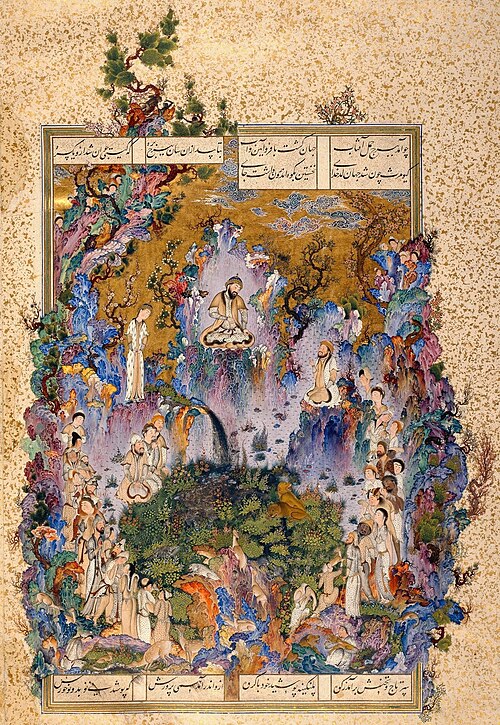
The Shahnameh also became the most frequently illustrated book in the Persian world. The Great Mongol Shahnameh, made at the Ilkhanid court in the 1330s, was broken up in the early twentieth century and its pages sold separately. The Baysonghori Shahnameh, completed in Herat in 1430 for the Timurid prince Baysonghor, survives at the Golestan Palace in Tehran and is inscribed in UNESCO's Memory of the World Register. The Shahnameh of Shah Tahmasp, begun under Shah Ismail I in Tabriz and completed under Tahmasp I, contained 258 paintings; it was presented to the Ottoman sultan Selim II in 1568, and in the twentieth century it too was dispersed, with part of it returning to Iran in 1994 in an exchange of artworks.
Modern scholarly editions have tried to recover Ferdowsi's original text. Jules Mohl published a French edition with translation (1838–1878) based on some thirty manuscripts. The Moscow edition (1960–1971) was the first to rely systematically on the oldest manuscripts. The critical edition led by Djalal Khaleghi-Motlagh, completed in 2008 and drawing on the Florence manuscript among others, is now widely regarded as the best text. Complete English translations include the verse version of Arthur and Edmond Warner (1905–1925) and, more recently, Dick Davis's translation in verse and prose (2006).
Intermediate
Influence and legacy
The Shahnameh shaped Persian literature for centuries. Later poets such as Nezami Ganjavi drew on its stories, and many imitators wrote epics in the same metre. Its tales spread into other languages and cultures: Georgian literature of the eleventh and twelfth centuries uses its heroes' names, Ottoman sultans commissioned Turkish translations and illustrated copies, and the Seljuk sultans of Anatolia decorated the walls of Konya with its verses.
In Iran the poem lives on in performance. Professional storytellers (naqqal) recite and act out its episodes in coffee houses, often in front of large painted scenes; the tradition of naqqali has been recognised by UNESCO as intangible cultural heritage in need of urgent safeguarding. In the traditional gymnasium called the zurkhaneh, athletes exercise to the rhythm of verses from the Shahnameh.
In the twentieth century the poem became a symbol of Iranian national identity. In 1934 Iran celebrated the millennium of Ferdowsi's birth with an international congress and the inauguration of a new tomb at Tus. Its themes have also been read in many different ways under different governments, as a celebration of kingship, as a critique of tyranny, or as a shared heritage of all Persian speakers. In Tajikistan and Afghanistan, too, the Shahnameh is honoured as a common classic.
Modern writers, filmmakers and illustrators continue to retell its stories, from children's books to graphic novels and stage productions, and Persian speakers around the world quote its lines as proverbs.
Advanced
Scholarly debates: written sources, oral tradition and the text
Written or oral? A central debate concerns how Ferdowsi worked. The dominant view, associated with scholars such as Theodor Nöldeke in his classic study of the Iranian national epic and, more recently, Djalal Khaleghi-Motlagh and Mahmoud Omidsalar, holds that Ferdowsi versified written sources, above all the Abu Mansuri prose Shahnameh, and that he was faithful to them. Ferdowsi himself repeatedly refers to an old book and to a dehqan who told him a story. Olga M. Davidson, drawing on comparative studies of oral epic, has argued instead that the poem reflects a living tradition of oral performance and that Ferdowsi's references to books are partly a traditional way of claiming authority. The debate has large consequences for how editors treat variant readings.
The problem of the text. Because scribes altered the poem freely, the manuscripts differ enormously. The Moscow edition relied mainly on manuscripts from 1276 and 1333, while the Florence manuscript of 1217, identified in the 1970s, provided an even earlier witness. Khaleghi-Motlagh's edition combines the evidence of many early manuscripts and of early Arabic and Persian works that quote the poem. Scholars continue to discuss how to weigh a single early manuscript against the agreement of later ones, and how many famous lines are later additions.
Dating the composition. Statements inside the poem suggest that Ferdowsi completed a first version in 994, while the Samanids still ruled, and a second, expanded version in 1010, dedicated to Mahmud of Ghazni. How much was revised between the two versions, and whether the praises of Mahmud were inserted into an existing work, remain open questions.
History and myth. The historical sections are an important, if literary, witness to Sasanian royal traditions, and they can be compared with Arabic histories such as those of al-Tabari that also used the Khwaday-namag tradition. The mythical and heroic sections preserve very old Indo-Iranian material: Jamshid corresponds to Yima in the Avesta and Yama in the Rigveda, and the dragon-king Zahhak descends from the Avestan monster Azhi Dahaka. The Sistani cycle of Rostam may derive from a separate, eastern Iranian tradition.
Advanced
Interpretation and politics of reading
Because the Shahnameh is so central to Persian culture, readings of it have often reflected the concerns of each age. Medieval rulers, including Turkic and Mongol dynasties, sponsored lavish copies to present themselves as heirs of the ancient Iranian kings, even though in the poem the Turanians are Iran's great enemies. Modern scholars stress that the Turanians of the epic are a mythic people of the steppe, not simply identical with later Turkic peoples.
Twentieth-century Iranian nationalism emphasised the poem's “pure Persian” and pre-Islamic heroes; some readers treated it as a charter of monarchy, while others stressed its many unjust kings and its sympathy for rebels such as Kaveh. After 1979 the poem went through a period of official unease before being widely reaffirmed as a national classic. Scholars today generally warn against reading the eleventh-century poem through modern nationalist categories.
Among the most discussed interpretive questions are Ferdowsi's religious position (the poem's opening includes praise of the Prophet and his family that many take to indicate Shi'i sympathies, though this passage has also been debated), the role of women (the Shahnameh contains remarkable female figures such as Tahmineh, Rudabeh, Gordafarid and Manizheh), and whether its tragic view of history is a lament for the lost Sasanian world or a universal reflection on power and mortality.
Key ideas
- Farr (royal glory)
- A divine radiance that marks a rightful king; it stays with the just and leaves the proud and cruel.
- Iran and Turan
- The age-long feud between two branches of Fereydun's family that drives much of the heroic age.
- Hero versus king
- Great champions such as Rostam serve the throne loyally but are often wronged by foolish or jealous kings.
- Tragedy and fate
- Even the greatest heroes cannot escape fate; the poem repeatedly reflects on death and the turning of time.
- Wisdom (kherad)
- The poem opens in praise of wisdom and is full of counsel on justice, moderation and good rule.
- Preserving memory
- The poem turned the fading traditions of pre-Islamic Iran into a lasting work of New Persian literature.
- Persian language
- Its sparing use of Arabic loanwords made it a model of Persian and helped fix the literary language.
Records
- 651 CE — Yazdegerd III, the last Sasanian king, is killed near Merv; the Arab conquest of Iran is completed.
- c. 940 CE — Ferdowsi is born in the village of Paj near Tus in Khorasan.
- 957 CE — Abu Mansur, governor of Tus, commissions a New Persian prose Shahnameh, Ferdowsi's main source.
- c. 977 CE — The poet Daqiqi is murdered after writing about 1,000 couplets; Ferdowsi begins his poem.
- 994 CE — Ferdowsi completes a first version of the Shahnameh under the Samanids.
- 999 CE — The Samanid dynasty falls; eastern Iran passes to the Ghaznavids.
- 1010 — Ferdowsi completes the final version and dedicates it to Sultan Mahmud of Ghazni.
- c. 1020 — Ferdowsi dies in Tus (dates between 1019 and 1025 are given).
- 1217 — The oldest surviving manuscript of the Shahnameh (now in Florence) is copied.
- 1430 — The Baysonghori Shahnameh is completed in Herat for the Timurid prince Baysonghor.
- 1568 — The Shahnameh of Shah Tahmasp is presented to the Ottoman sultan Selim II.
- 1934 — Iran celebrates Ferdowsi's millennium and inaugurates his new tomb at Tus.
Glossary
- Epic
- A long poem about heroes, wars and the history or legends of a people.
- Couplet (bayt)
- Two rhyming half-lines forming one unit of Persian verse.
- Mutaqareb
- The short, energetic metre used for the Shahnameh and later Persian epics.
- Dehqan
- A member of the Iranian landowning gentry who preserved pre-Islamic traditions after the Arab conquest.
- Khwaday-namag
- A lost Middle Persian “Book of Lords” compiled in the Sasanian period, the ultimate source of the royal history.
- Sasanian Empire
- The last pre-Islamic Persian empire (224–651).
- Samanids
- A dynasty in Bukhara and Khorasan (819–999) that patronised New Persian literature.
- Turan
- In the Shahnameh, the land of Iran's enemies in Central Asia, ruled by Afrasiyab.
- Simorgh
- A wise, magical bird who raises Zal and helps Rostam.
- Naqqali
- The Iranian art of dramatic storytelling, often performing episodes of the Shahnameh.
Questions and answers
How long is the Shahnameh?
Very long: traditionally about 60,000 couplets, and around 50,000 in modern critical editions. It is several times longer than the Iliad and Odyssey together.
Is Rostam a real person?
No. Rostam is a legendary hero. The later part of the poem is about real Sasanian kings, but even there it tells history in a literary way.
Why did Ferdowsi use so few Arabic words?
Partly because his sources went back to Middle Persian traditions, and partly as a matter of style. Later readers saw this as a deliberate defence of the Persian language.
Did Sultan Mahmud really cheat Ferdowsi?
The story of the silver coins comes from Nezami Aruzi, writing about 150 years later, and is probably at least partly legendary. We do not know for certain how Mahmud received the poem.
Did Ferdowsi work from books or from oral stories?
Most scholars think he versified written sources, especially the Abu Mansuri prose Shahnameh of 957; others, notably Olga M. Davidson, emphasise the role of oral tradition. The question is still debated.
Which manuscript is the oldest?
A manuscript dated 1217, now in the National Central Library in Florence.
Where can I see Shahnameh paintings?
Pages from famous illustrated copies are held in museums and libraries around the world; the Baysonghori Shahnameh is kept at the Golestan Palace in Tehran.
Sources and further reading
- Shahnameh. Wikipedia
- Ferdowsi. Wikipedia
- Rostam and Sohrab. Wikipedia
- Shahnameh of Shah Tahmasp. Wikipedia
- Great Mongol Shahnameh. Wikipedia
- 샤나메. 위키백과 (Korean Wikipedia)
- 페르도우시. 위키백과 (Korean Wikipedia)
- Abolqasem Ferdowsi, translated by Dick Davis, Shahnameh: The Persian Book of Kings. Viking, 2006
- Theodor Nöldeke, Das iranische Nationalepos, 1896
Related
- One Thousand and One NightsA collection of tales that developed over centuries from several storytelling traditions.
- AvicennaPhysician and philosopher whose writings shaped medicine and philosophy across the Islamic world and Europe.
- PersepolisA ceremonial and administrative center of the Achaemenid Empire in southwestern Iran, begun under Darius I.
- RumiPersian-language poet and Sufi teacher whose verse explores love and spiritual transformation.
- HafezPersian lyric poet especially known for ghazals of love, longing and spiritual ambiguity.
Written with AI assistance from the published sources listed above, and revised as new research appears.