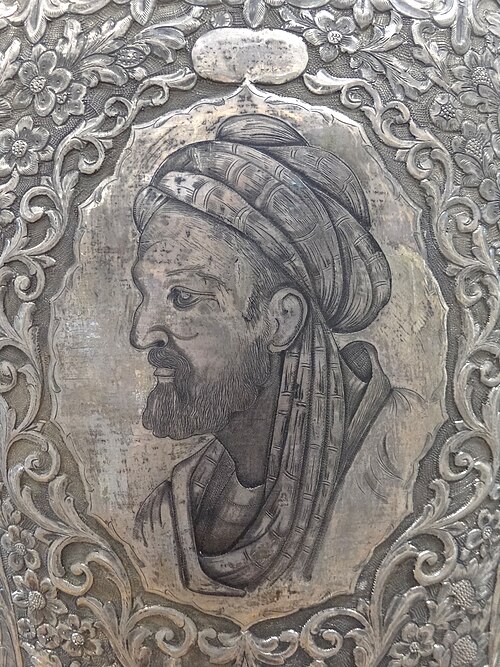
Start at the top for an easy introduction. Go further down for more detail and scholarship.
- Easy
- Intermediate
- Advanced
For young readers
About a thousand years ago, near the city of Bukhara in Central Asia (in today's Uzbekistan), a boy named Ibn Sina loved to read. By the age of ten he had learned the whole Qur'an by heart, and he kept on studying mathematics, science and medicine. As a teenager he was already treating sick people.
When he was about seventeen, the ruler of Bukhara fell ill, and his doctors could not cure him. Young Ibn Sina was called in and helped him get better. As a reward, he was allowed into the ruler's enormous library, full of rare books. He said later that he saw books there that he had never seen before, and never saw again.
Ibn Sina's life was not always calm. Wars and changing kings forced him to move from city to city. Sometimes he was an important adviser, sometimes he had to hide, and once he was even locked up in a castle. But wherever he went, he kept writing, often late at night, dictating to his students.
He wrote a giant book about medicine called The Canon of Medicine. It explained how the body works, what illnesses look like, and hundreds of medicines. Doctors in the Middle East, in Europe and in India used it for centuries, a bit like a medical textbook that stayed popular for five hundred years.
He also asked big questions: What does it mean to exist? What is the mind? He imagined a person floating in the air who cannot see or touch anything, and asked: would that person still know that they exist? Philosophers are still discussing his ideas today. In Europe he was known by the Latin name Avicenna.
At a glance
- Full name
- Abū ʿAlī al-Ḥusayn ibn ʿAbd Allāh ibn Sīnā; known in Latin as Avicenna; honoured as al-Shaykh al-Raʾīs ('the Chief Master')
- Lived
- Born c. 980 (some scholars argue c. 970) at Afshana near Bukhara; died 1037 in Hamadan
- Region
- Eastern Islamic world: Central Asia and Iran (Bukhara, Gurganj, Gorgan, Rayy, Hamadan, Isfahan)
- Languages
- Wrote mostly in Arabic, the scholarly language of the Islamic world, and also in Persian
- Fields
- Philosophy (logic, metaphysics, psychology, natural science), medicine, mathematics, astronomy, music theory
- Major works
- The Canon of Medicine (al-Qānūn fī al-ṭibb); The Cure / Book of Healing (Kitāb al-Shifāʾ); The Salvation (al-Najāt); Pointers and Reminders (al-Ishārāt wa-l-tanbīhāt); Dāneshnāme-ye ʿAlāʾī (in Persian)
- Significance
- The most influential philosopher of the Islamic world; his Canon was a standard medical textbook in the Middle East and Europe into the early modern period
Easy
Who was Avicenna?
Ibn Sina, known in Europe by the Latinised name Avicenna, was a physician and philosopher who lived around the turn of the first millennium CE in Central Asia and Iran. He wrote on almost every branch of knowledge of his time, and two of his works in particular became landmarks: The Canon of Medicine, a vast systematic encyclopedia of medicine, and The Cure (Kitāb al-Shifāʾ, often called The Book of Healing), a philosophical encyclopedia covering logic, natural science, mathematics and metaphysics.
He belonged to the tradition called falsafa, the Arabic word (from Greek philosophia) for philosophy in the Greek manner, especially that of Aristotle, as it had been translated into Arabic and developed in the Islamic world since the eighth and ninth centuries. Building on predecessors such as al-Kindi and al-Farabi, Avicenna created a comprehensive system so powerful that later thinkers, whether they agreed with him or not, largely argued in his terms. For this reason historians often describe philosophy in the Islamic world after him as 'post-Avicennian'.
He was born into a Persian-speaking family, wrote mostly in Arabic, and has been claimed as a national hero by several modern countries, including Iran, Uzbekistan and Tajikistan. It is most accurate to see him as a figure of the multilingual, multi-ethnic eastern Islamic world of his time, whose legacy belongs to many peoples.
Easy
Life: a scholar on the move
Most of what we know about Avicenna's life comes from a short autobiography that he dictated to his student and companion Abu ʿUbayd al-Juzjani, which al-Juzjani then continued after their meeting. According to it, Avicenna was born in Afshana, a village near Bukhara, where his father served the Samanid dynasty. The traditional birth year is 980 (370 in the Islamic calendar), though the historian of philosophy Dimitri Gutas has argued for an earlier date around 970.
The autobiography presents him as a prodigy who mastered the Qur'an and literature by ten, then studied arithmetic, Islamic law, logic, geometry and astronomy, and taught himself natural science, metaphysics and medicine. He famously writes that he read Aristotle's Metaphysics forty times without understanding its purpose until he chanced upon a small commentary by al-Farabi in a bookseller's market. Around the age of seventeen he treated the Samanid ruler Nuh ibn Mansur and gained access to the royal library.
The Samanid state collapsed in 999, and Avicenna spent the rest of his life seeking patrons in a politically fragmented region. He worked in Gurganj (Khwarazm), wandered through Khurasan, and reached Gorgan, where al-Juzjani joined him. He then served the Buyid rulers in Rayy and Hamadan, where he became vizier (chief minister) to the emir Shams al-Dawla. Court intrigues led to periods of hiding and to imprisonment in a fortress. Around 1024 he escaped to Isfahan, where the Kakuyid ruler ʿAla al-Dawla gave him about thirteen relatively stable, productive years.
Al-Juzjani describes how Avicenna worked by day in government and in the evening held study sessions with students, dictating his books, often accompanied by music and wine. He died in 1037 during a military campaign with ʿAla al-Dawla, of an intestinal illness that he had tried to treat himself, and he was buried in Hamadan, where a modern mausoleum now marks his grave.
Intermediate
Historical context: the eastern Islamic world around 1000 CE
By Avicenna's time, the Abbasid caliphs in Baghdad still held religious prestige, but real power in Iran and Central Asia had passed to regional dynasties. The Samanids of Bukhara, of Persian origin, sponsored a revival of Persian literature (Firdawsi began the Shahnameh under their rule) while also supporting Arabic scholarship. After 999 their lands were divided between the Turkic Qarakhanids and the Ghaznavids of Mahmud of Ghazna, and western Iran was ruled by branches of the Buyid dynasty and smaller houses like the Kakuyids.
This fragmentation was dangerous for a scholar, but it also created many rival courts competing for talent. Avicenna's contemporaries included the polymath al-Biruni, with whom he exchanged a famous set of letters disputing questions of Aristotelian physics and cosmology, and the scientist Ibn al-Haytham, working in Cairo. Mahmud of Ghazna's attempts to gather scholars at his own court are part of the story of why Avicenna kept moving.
Intellectually, Avicenna inherited the results of the Graeco-Arabic translation movement centred in Abbasid Baghdad, associated in popular memory with the House of Wisdom, which had rendered works of Aristotle, Galen, Ptolemy and Neoplatonist writers into Arabic. He also engaged with kalam, Islamic rational theology, and with questions raised by Islamic scripture. Elsewhere in the world at this time, Song dynasty China was expanding printing and scholarship, the Chola empire flourished in southern India, and in Japan Murasaki Shikibu was writing The Tale of Genji.
Intermediate
The Canon of Medicine
Avicenna's al-Qānūn fī al-ṭibb ('The Law of Medicine', known in Latin as the Canon), completed around 1025, is organised in five books. Book 1 covers general principles: the elements and humours, anatomy and physiology, the causes and symptoms of disease, and general therapy and hygiene. Book 2 lists roughly 800 simple drugs (single substances such as herbs and minerals) with their properties. Book 3 treats diseases of particular organs from head to toe; Book 4 treats conditions affecting the whole body, such as fevers, poisons and injuries; and Book 5 is a formulary of compound remedies.
The Canon's great strength was organisation. It systematically combined the Greek medical tradition of Hippocrates and Galen with Aristotelian natural philosophy and the clinical experience of physicians in the Islamic world, such as al-Razi (Rhazes). It is based on humoral theory, the idea that health depends on the balance of four bodily fluids (blood, phlegm, yellow bile and black bile), which modern medicine has abandoned. But it also contains careful clinical observations, for example on the contagious nature of some diseases, and a set of rules for testing drugs, including testing a drug on a simple, uncomplicated condition and observing whether its effect is consistent.
Translated into Latin in Toledo in the twelfth century by Gerard of Cremona (d. 1187), the Canon became a core text in the medical faculties of European universities such as Montpellier, Bologna and Padua. It was printed many times in Latin from the 1470s onward, and an Arabic edition was printed in Rome in 1593. In the Islamic world it was commented on, abridged and taught for centuries, and it influenced medical traditions in Iran, the Ottoman Empire and South Asia, where Unani (from the Arabic word for 'Greek') medicine still draws on Avicenna today.
Intermediate
Philosophy: existence, God and the soul
Essence and existence. Avicenna drew a sharp distinction between what a thing is (its essence or quiddity, for example 'being a triangle' or 'being a horse') and the fact that it exists. We can understand what something is without knowing whether it exists. For most things, then, existence is not part of their essence; it must come from outside. This distinction became one of the most discussed ideas in both Islamic and Latin philosophy.
The Necessary Existent. From this Avicenna developed a famous argument. Everything that exists is either 'possible in itself' (it could exist or not, and needs a cause) or 'necessary in itself' (it exists by its own nature). A world made up only of possible things, each dependent on another, cannot explain why anything exists at all. Therefore there must be a Necessary Existent, which is one, simple and uncaused, and which philosophers identified with God. From it, reality flows in an ordered series of emanations, through heavenly intellects down to our world.
The soul and the 'floating man'. To show that the human soul is distinct from the body, Avicenna proposed a thought experiment. Imagine a person created fully formed, but suspended in the air, blindfolded, limbs spread so they touch nothing, with no sensation at all. Such a person, he argued, would still affirm their own existence, even without affirming the existence of any body part. So the self that is aware of itself is not identical with the body. Avicenna also developed a detailed theory of the 'internal senses' (such as imagination and memory) and held that human intellects acquire knowledge through connection with the Active Intellect, a cosmic intelligence.
Logic and method. Avicenna reorganised Aristotelian logic, developing an influential theory of modal logic (reasoning about necessity and possibility) and treating conditional arguments in new ways. His aim was a complete, demonstrative system of knowledge, in which philosophy and science were unified and in which the rational order of the universe mirrored the mind of its first cause.
Intermediate
Natural science: motion, light, minerals and the soul's faculties
The natural-science parts of The Cure cover physics, the heavens, the elements, meteorology, minerals, plants, animals and the soul. In physics, Avicenna discussed why a thrown stone keeps moving after it leaves the hand. Rejecting Aristotle's view that the surrounding air pushes it along, he argued that the thrower imparts to the object an inclination (mayl) that persists unless resistance wears it away. Historians see this as one of the medieval theories of impetus that preceded later ideas about inertia, though it is not the same as the modern concept.
On vision, he rejected the ancient theory that the eye sends out rays to the object, favouring instead the view that something is received from the object into the eye. In his treatment of minerals and meteorology he gave an account of how mountains form, through uplift and through erosion by water and wind over very long periods, and discussed how stones and fossils form. A passage from this part, circulating in Latin as a separate treatise, famously denied that alchemists could truly transmute one metal species into another, saying that they could only imitate appearances.
These discussions show that for Avicenna, philosophy and science were not separate. His psychology, the study of the soul, linked medicine (the physiology of the brain and senses) with metaphysics (the nature of the intellect), and his natural philosophy served as a bridge between the physician's practical knowledge and the philosopher's search for first causes.
Intermediate
The major works and how they were written
Avicenna is credited with well over a hundred works, although the exact number and the authenticity of some are debated. The Cure (al-Shifāʾ), his philosophical masterpiece, is an encyclopedia of Aristotelian learning. In its modern Cairo edition it fills 22 large volumes. He wrote much of it during his years in Hamadan and Isfahan, reportedly at great speed, sometimes without books to hand.
The Salvation (al-Najāt) is a shorter summary drawn from earlier writings. Pointers and Reminders (al-Ishārāt wa-l-tanbīhāt), among his last works, presents his philosophy in a compressed, allusive style, ending with sections on the stations of the knowers that have often been read in connection with Sufism (Islamic mysticism). The Dāneshnāme-ye ʿAlāʾī ('Book of Knowledge for ʿAla al-Dawla') is one of the earliest works of philosophy in New Persian.
He also wrote a work called Eastern Philosophy (al-Ḥikma al-mashriqiyya), of which only parts survive, as well as symbolic narratives such as Hayy ibn Yaqzan, poems, including a long medical poem (al-Urjuza fi al-tibb), and treatises on music, astronomy and the soul. Many survive in numerous manuscripts across libraries from Istanbul to Tehran, Cairo, Oxford and beyond, reflecting how widely he was copied.
Intermediate
Influence and legacy
In the Islamic world, Avicenna's philosophy became the framework within which later thinkers worked. The theologian al-Ghazali (d. 1111) criticised him in The Incoherence of the Philosophers, arguing that some of his positions, such as the eternity of the world and the claim that God knows particulars only 'in a universal way', were incompatible with Islam. Yet al-Ghazali also absorbed Avicennian logic and psychology. Fakhr al-Din al-Razi wrote a critical commentary on the Pointers, and Nasir al-Din al-Tusi defended Avicenna in a response that became central to later teaching. Through figures such as Suhrawardi and, much later, Mulla Sadra, Avicennian ideas remained alive in Iranian philosophy into the modern era.
In Latin Europe, parts of The Cure were translated in twelfth-century Toledo, notably through the collaboration of Avendauth (Ibn Daud) and Dominicus Gundissalinus. Avicenna's accounts of the soul, the internal senses, essence and existence, and the intellect deeply shaped thinkers such as Albert the Great, Thomas Aquinas and John Duns Scotus. Aquinas's early work On Being and Essence cites him repeatedly. Dante placed Avicenna, together with Averroes, among the great non-Christian sages in Limbo.
Today Avicenna is honoured worldwide. Iran celebrates him as a national figure, and his mausoleum in Hamadan is a landmark; Uzbekistan and Tajikistan commemorate him as a son of Central Asia; hospitals, universities and prizes bear his name; and historians of medicine and philosophy continue to publish critical editions and translations of his works.
Advanced
Scholarly debates and open questions
Birth date and the autobiography. The traditional birth year of 980 (370 AH) comes from al-Juzjani's biography, but Dimitri Gutas has argued, from the chronology of the autobiography, for a date around 970 or even earlier. Scholars also debate how far the autobiography is a literal record and how far it is a carefully constructed portrait. Gutas reads it as presenting Avicenna as a model of how anyone might attain philosophical knowledge through study and intuition (ḥads, the capacity to hit on the middle term of a syllogism quickly), rather than through a teacher.
'Eastern Philosophy' and mysticism. What did Avicenna mean by his 'Eastern' philosophy, and how should the mystical-sounding passages at the end of the Pointers, or the symbolic tales, be read? Henry Corbin influentially read them as an esoteric, illuminationist wisdom. Gutas and others argue instead that 'Eastern' refers to Avicenna's own region and to his independent revision of Aristotelian philosophy against the Baghdad Aristotelians, and that his 'mystical' language describes rational knowledge. The question remains debated.
Essence and existence. Did Avicenna hold that existence is an 'accident' added to essence, as Averroes and some Latin readers claimed? Many recent interpreters argue that this is a misunderstanding, and that he meant that existence is not included in essence and must be conferred by a cause, not that it is a property like colour. The interpretation of his modal metaphysics and its relationship to kalam is an active research area.
Originality in medicine. The Canon is sometimes presented as largely original and sometimes as merely a synthesis of Galen and earlier Arabic authors. Historians of medicine increasingly emphasise that its originality lies in its systematic organisation, its integration of philosophy and medicine, and its pedagogical success, while its clinical content draws heavily on earlier writers. Popular claims that Avicenna 'discovered' quarantine or modern clinical trials should be treated with caution.
Advanced
Primary sources and methodological notes
Key primary sources include the autobiography and al-Juzjani's continuation (critically edited and translated by William E. Gohlman as The Life of Ibn Sina, 1974); the Arabic texts of Avicenna's works, many of them available in the Cairo edition of al-Shifāʾ (1952–1983) and other modern editions; his correspondence, including the exchange with al-Biruni and the 'Discussions' (al-Mubāḥathāt) with students; and the medieval Latin translations, published in the modern series Avicenna Latinus.
Several methodological issues stand out. First, the authenticity of many works attributed to Avicenna is uncertain, so bibliographies must be used critically. Second, because Avicenna often revised his views and wrote for different audiences, from brief summaries for patrons to technical treatises, scholars must be careful about which text represents his considered position. Third, the Latin Avicenna differs from the Arabic one: translators sometimes misunderstood or adapted terms, and European readers encountered only some works, so 'Avicenna's influence' in Europe partly means the influence of a translated and filtered Avicenna.
Finally, modern national and religious claims on Avicenna should be distinguished from historical analysis. He was a Muslim philosopher who wrote in Arabic and Persian, lived in a Persianate cultural world with Turkic rulers nearby, and drew on Greek sources. Describing him accurately means holding all these facts together rather than choosing one.
Key ideas
- Essence–existence distinction
- What a thing is differs from the fact that it exists; for created things, existence must come from a cause.
- Necessary Existent
- A being that exists by its own nature, needed to explain why any merely possible things exist; identified with God.
- Floating man
- A thought experiment arguing that self-awareness does not depend on awareness of the body, so the soul is distinct from the body.
- Emanation
- The idea that reality flows necessarily from the First Cause through a hierarchy of intellects and heavenly spheres.
- Active Intellect
- A cosmic intelligence through which human minds grasp universal concepts.
- Systematic medicine
- The Canon organised all medical knowledge into principles, drugs, localised diseases, general diseases and compound remedies.
- Intuition (ḥads)
- The ability to grasp the key step in an argument quickly; Avicenna held that it varies among people and can reach prophetic heights.
Records
- c. 980 CE — Born at Afshana near Bukhara (traditional date; some scholars argue c. 970).
- c. 997 CE — Treats the Samanid ruler Nuh ibn Mansur and gains access to the royal library.
- 999 CE — The Samanid state falls; Avicenna's years of wandering begin.
- c. 1012 — In Gorgan, meets al-Juzjani, his lifelong student and biographer.
- c. 1015 — Serves the Buyid emir Shams al-Dawla in Hamadan, becoming vizier.
- c. 1024 — Moves to Isfahan under the Kakuyid ruler ʿAla al-Dawla.
- c. 1025 — Completes The Canon of Medicine.
- 1037 — Dies during a campaign and is buried in Hamadan.
- c. 1150 — Parts of The Cure are translated into Latin in Toledo.
- 1187 — Death of Gerard of Cremona, who had translated the Canon into Latin in Toledo.
- 1593 — The Arabic text of the Canon is printed in Rome.
Glossary
- Falsafa
- Philosophy in the Greek (especially Aristotelian) tradition as practised in the Islamic world.
- Kalam
- Islamic rational theology, which used argument to defend and explain religious beliefs.
- Humoral theory
- The ancient medical idea that health depends on the balance of four bodily fluids: blood, phlegm, yellow bile and black bile.
- Vizier
- A chief minister serving a ruler in many Islamic states.
- Samanids
- A Persian dynasty that ruled Central Asia and eastern Iran from Bukhara in the ninth and tenth centuries.
- Essence (quiddity)
- What a thing is, its defining nature, as distinct from whether it exists.
- Modal logic
- Logic dealing with necessity, possibility and impossibility.
- Unani medicine
- A medical tradition, still practised especially in South Asia, descended from Greek and Islamic medicine, including Avicenna's Canon.
- Avicennism
- The tradition of thinkers who adopted, adapted or argued with Avicenna's philosophy.
Questions and answers
Why is Ibn Sina called Avicenna?
Avicenna is the Latin form of his name, which reached medieval Europe probably through Hebrew and Spanish pronunciations of 'Ibn Sina'.
Was Avicenna Arab or Persian?
He was from a Persian-speaking family near Bukhara and wrote mostly in Arabic, the international language of learning in the Islamic world. Iran, Uzbekistan and Tajikistan all honour him.
What is The Canon of Medicine?
A five-book medical encyclopedia completed around 1025, covering anatomy, diseases, drugs and treatments. It was a standard textbook in the Islamic world and in European universities for centuries.
What is the 'floating man' argument?
A thought experiment: a person suspended in the air with no sensations would still know that they exist, which Avicenna took to show that the soul is distinct from the body.
Did Avicenna really read Aristotle's Metaphysics 40 times?
That is what his autobiography says. It may be partly a literary device, but it shows how seriously he took the work and how much al-Farabi's commentary helped him.
Is Avicenna's medicine still used?
Modern medicine has replaced its theories, but the Canon remains a historical landmark, and the Unani tradition in South Asia still draws on it.
How did Avicenna influence European philosophy?
Latin translations of his works in the twelfth and thirteenth centuries shaped scholastic thinkers such as Albert the Great, Thomas Aquinas and Duns Scotus, especially on the soul, essence and existence.
Sources and further reading
- Dimitri Gutas, Ibn Sina [Avicenna]. Stanford Encyclopedia of Philosophy
- Ibn Sina's Metaphysics. Stanford Encyclopedia of Philosophy
- Ibn Sina's Natural Philosophy. Stanford Encyclopedia of Philosophy
- Ibn Sina's Logic. Stanford Encyclopedia of Philosophy
- Avicenna (Ibn Sina). Internet Encyclopedia of Philosophy
- Avicenna. Wikipedia
- The Canon of Medicine. Wikipedia
- The Book of Healing. Wikipedia
- Floating man. Wikipedia
- Dimitri Gutas, Avicenna and the Aristotelian Tradition: Introduction to Reading Avicenna's Philosophical Works. Brill, 1988 (2nd ed. 2014)
Related
- Al-FarabiPhilosopher of the Islamic world known for works on logic, political thought and music.
- AverroesAndalusian philosopher, jurist and physician renowned for his commentaries on Aristotle.
- AristotlePlato's student and Alexander's tutor. He founded the Lyceum and wrote on logic, ethics, politics and the natural world.
- House of WisdomName associated with Abbasid scholarly collections and translation activity in Baghdad.
- Thomas AquinasDominican theologian and philosopher whose writings became central to medieval Christian thought.
- ShahnamehPersian epic by Ferdowsi recounting Iran's legendary kings and historical past.
Written with AI assistance from the published sources listed above, and revised as new research appears.