Start at the top for an easy introduction. Go further down for more detail and scholarship.
- Easy
- Intermediate
- Advanced
For young readers
About 2,400 years ago, a boy named Aristotle was born in a small town called Stagira in the north of Greece. His father was a doctor for the king of Macedonia. When Aristotle was seventeen, he travelled to the big city of Athens to study at the school of the famous teacher Plato. He stayed there for twenty years!
Aristotle was curious about everything. He watched octopuses and fish by the sea, opened eggs to see how baby chicks grow, and wrote down what he saw. He asked questions like: Why do things happen? What is everything made of? What makes a person happy? He wanted to sort the whole world into neat boxes, the way you might sort your toys by colour and size.
For a few years he was the teacher of a Macedonian prince named Alexander. That boy grew up to become Alexander the Great, a king who conquered a huge empire. Later Aristotle came back to Athens and opened his own school, the Lyceum. He and his students liked to talk while walking along a covered path, so people called them the “walkers”.
Aristotle thought that being good is a bit like being a good musician or a good athlete: you get better by practising. If you keep doing brave things, you become brave. If you keep telling the truth, you become honest. He also said that the best way is usually in the middle: being brave is between being a coward and being reckless.
Aristotle made some mistakes too. He believed some things that scientists later showed were wrong. But he taught the world a way of thinking step by step, and for almost two thousand years people in Europe, the Middle East and beyond simply called him “the Philosopher”.
At a glance
- Lived
- 384–322 BCE
- Born
- Stagira, Chalcidice (northern Greece, then on the edge of the Macedonian kingdom)
- Died
- Chalcis, on the island of Euboea
- Language
- Ancient Greek
- Teacher / pupils
- Studied with Plato for about 20 years; tutored the young Alexander of Macedon; colleague and successor Theophrastus
- School
- The Lyceum in Athens, founded around 335 BCE (its members were called Peripatetics)
- Surviving works
- About thirty treatises, mostly lecture notes, on logic, nature, biology, metaphysics, ethics, politics, rhetoric and poetry
- Later titles
- “The Philosopher” in medieval Latin writing; “the First Teacher” in Arabic philosophy
Easy
Who was Aristotle?
Aristotle was a Greek philosopher and scientist of the fourth century BCE. He was a student of Plato, who had himself been a follower of Socrates, and these three are often seen as the founders of Western philosophy. But Aristotle was not just a philosopher in the modern, narrow sense. He wrote about logic, physics, astronomy, weather, animals, the soul, ethics, politics, speech-making and poetry. Many of these subjects were first organized as separate fields of study in his writings.
What made Aristotle special was his method. He liked to start from what people already believe and from careful observation, list the puzzles, and then work step by step toward a clear answer. He collected facts on a huge scale: descriptions of hundreds of kinds of animals and, with his students, the constitutions of 158 Greek cities.
His influence lasted an extraordinarily long time. His works were studied in Greek, Syriac, Arabic, Hebrew and Latin, and for many centuries scholars in Baghdad, Córdoba, Paris and Oxford read them as the basis of higher learning. Words we still use, such as “category”, “energy”, “substance” and “logic”, come from his vocabulary or its translations.
Easy
His life
Aristotle was born in 384 BCE in Stagira, a small Greek town in the Chalcidice peninsula. His father, Nicomachus, was a physician at the court of King Amyntas III of Macedon, the father of Philip II. Both his parents died while he was young, and he was raised by a guardian named Proxenus.
Around 367 BCE, aged about seventeen, he went to Athens and joined Plato’s Academy. He stayed for some twenty years, first as a student and then as a researcher and teacher. When Plato died in 347 BCE, Aristotle left Athens. He spent several years at Assos in Asia Minor, at the court of the ruler Hermias, whose relative Pythias he married, and then on the island of Lesbos. There, with his younger colleague Theophrastus, he seems to have done much of his research on marine animals.
Around 343 BCE King Philip II of Macedon invited Aristotle to tutor his thirteen-year-old son, Alexander. Very little is reliably known about what he taught the prince. In 335 BCE, after Alexander had become king, Aristotle returned to Athens and founded his own school in a public exercise ground called the Lyceum. For about twelve years he taught and wrote there. After Pythias died he lived with Herpyllis, the mother of his son Nicomachus.
When Alexander died in 323 BCE, anger against Macedon broke out in Athens, and Aristotle, known for his Macedonian connections, was reportedly threatened with a charge of impiety. He withdrew to Chalcis on the island of Euboea, where his mother’s family had property, and died there in 322 BCE at about sixty-two. His will, which survives in a later biography, provides for his children, his partner and even the freeing of some of his enslaved servants.
Intermediate
Historical context: between the polis and empire
Aristotle lived at a turning point. In his youth, Greek city-states (poleis) such as Athens, Sparta and Thebes were still independent and competing for power. During his lifetime Macedon, a kingdom on the northern fringe of the Greek world, rose to dominate them. Philip II defeated Athens and Thebes at Chaeronea in 338 BCE, and his son Alexander went on to conquer the Persian Empire, reaching Egypt, Central Asia and the Indus.
This gives Aristotle’s position a certain tension. He was a resident foreigner (metic) in Athens, without citizen rights, yet his philosophy of politics centres on the self-governing city. His Politics argues that the polis is the natural community in which human beings can live fully, at the very moment when such cities were losing their independence to large monarchies.
Intellectually, Aristotle inherited a lively tradition: the early natural philosophers who asked what the world is made of, the medical writers of the Hippocratic tradition, the Sophists who taught persuasion, the mathematicians and astronomers around Plato, and above all Plato’s own theory of Forms, which Aristotle both absorbed and criticized.
Intermediate
The works: lecture notes that survived
Ancient catalogues credit Aristotle with a very large number of writings. Some were polished works for the general public, including dialogues in Plato’s manner, which the Roman orator Cicero praised for their style. These are almost entirely lost. What survives, about thirty treatises, are the “esoteric” or school writings: dense, compressed texts that read like lecture notes or working drafts, often revised and sometimes repetitive.
The surviving corpus is traditionally arranged in groups. The logical works, later called the Organon (“tool”), include the Categories, On Interpretation, Prior and Posterior Analytics, Topics and Sophistical Refutations. The works on nature include the Physics, On the Heavens, On Generation and Corruption, Meteorology and On the Soul, together with major biological treatises such as the History of Animals, Parts of Animals and Generation of Animals. Then come the Metaphysics, the ethical works (Nicomachean Ethics and Eudemian Ethics), the Politics, the Rhetoric and the Poetics.
Aristotle himself divided knowledge into theoretical sciences, which seek truth for its own sake (physics, mathematics, and “first philosophy” or metaphysics); practical sciences, which concern action (ethics and politics); and productive sciences, which concern making things (such as rhetoric and poetry). Logic was treated not as a science with its own subject but as a tool for all of them.
The work that has survived only partly by luck is the Constitution of the Athenians, one of the 158 constitutions collected by the Lyceum. It was lost for centuries until a papyrus copy was acquired by the British Museum and published in 1891. Scholars debate whether Aristotle wrote it himself or whether it was written by a student under his direction.
Intermediate
Logic, causes and the study of nature
Aristotle is often called the founder of formal logic. In the Prior Analytics he analyzed the syllogism, an argument in which a conclusion follows necessarily from two premises, for example: every human is mortal; every Greek is human; therefore every Greek is mortal. He studied which combinations of premises are valid and which are not, using letters as variables, a remarkable step toward abstraction. His system remained the core of logic teaching until the development of modern mathematical logic in the nineteenth century.
To explain anything, Aristotle said, we must ask four kinds of “why” question, traditionally called the four causes. The material cause is what a thing is made of (the bronze of a statue); the formal cause is its structure or definition (the shape of the statue); the efficient cause is what brought it about (the sculptor); and the final cause is what it is for (to honour a god). For natural things, especially living beings, he held that the final cause, the purpose or end (telos), is essential: an eye is for seeing, roots are for nourishment.
His metaphysics rests on the idea of substance (ousia). The primary realities are individual things, such as this horse or this person, not abstract Forms existing apart from them as Plato taught. Each such thing is a compound of matter and form, a view later called hylomorphism. Change is explained as the passage from potentiality to actuality: an acorn is potentially an oak. At the top of his cosmos stands an eternal “unmoved mover”, a being of pure actuality that thinks and is the ultimate object of all motion.
Aristotle also explained the soul in these terms. The soul is not a separate ghost inside the body but the form of a living body, its capacities for nourishment, perception, movement and thought. Plants, animals and humans have different levels of soul. How human intellect relates to the body, especially the obscure passage on the “active intellect” in On the Soul, became one of the most debated questions in later philosophy.
Intermediate
Aristotle the biologist
Roughly a quarter of Aristotle’s surviving writings concern animals. He described more than five hundred kinds, from elephants to sea urchins, and tried to classify them by features such as blood, means of reproduction and way of life. Much of his information came from fishermen, farmers and hunters, and some from his own dissections.
Some of his observations were so accurate that later naturalists doubted them before confirming them. He described how a smooth dogfish nourishes its young through a placenta-like connection, which was confirmed by the German physiologist Johannes Müller in the nineteenth century, and he described the special arm that male octopuses use in mating. He followed the development of a chick embryo in eggs opened day by day.
He also made serious errors. He thought the heart, not the brain, was the seat of sensation and thought, believed that some small creatures arose spontaneously from mud or decaying matter, and made mistaken claims about women’s bodies that supported the social inequality of his time. Modern historians of science stress that his biology should be judged in its own context: it was the first systematic attempt to explain living things through observation and causes, and Charles Darwin is reported to have written admiringly of him after reading his work in translation.
Intermediate
Ethics and politics: living well together
The Nicomachean Ethics begins by observing that every activity aims at some good, and asks what the highest human good is. Aristotle’s answer is eudaimonia, often translated “happiness” but better understood as flourishing or living well. It is not a feeling but an activity: the life of a human being who exercises their distinctive abilities, above all reason, excellently over a complete life.
Excellence of character (aretē, “virtue”) is acquired by habit, as a person becomes a builder by building or a lyre player by playing. Each virtue is a settled disposition to feel and act in the right way, which usually lies in a mean between two vices: courage between cowardice and rashness, generosity between stinginess and extravagance. The mean is not a mathematical midpoint but what is right for this person in this situation, as judged by a person of practical wisdom (phronēsis). Aristotle devotes two whole books to friendship, which he thought essential to a good life.
“The human being is by nature a political animal,” Aristotle declares in the Politics. People fulfil their nature only in a community that aims at the good life, not just survival. He compared many types of constitution, distinguishing rule by one, by a few, or by many, each with a good and a corrupt form, and he tended to favour a mixed constitution in which a large middle class balances rich and poor.
His political thought also contains views that are rightly criticized today. He defended “natural slavery”, the idea that some people are by nature suited to be ruled as property, and he regarded women as naturally subordinate to men in the household. These arguments were later used to justify real oppression, including the enslavement of Indigenous peoples in the Americas, which was debated at Valladolid in 1550–51 with explicit reference to Aristotle. Modern readers study these passages both to understand him and to see how philosophy can rationalize injustice.
Intermediate
The Lyceum and the Peripatetics
The Lyceum was a public grove and gymnasium outside Athens, sacred to Apollo Lykeios. Aristotle, who as a foreigner could not own land in Athens, taught there. The school took its nickname, the Peripatetics, from the peripatos, a covered walkway where teaching took place; the later story that Aristotle lectured while walking may be an explanation of that name.
The Lyceum functioned as a research community. Its members collected constitutions, lists of victors in games, histories of earlier philosophy and medicine, and observations of plants and animals. Theophrastus, who succeeded Aristotle as head, wrote pioneering works on plants and on human “characters”. The idea of a library as a tool for research was important there, and some scholars see a line of influence from the Lyceum to the later Library of Alexandria, founded under the Ptolemies with the help of the Peripatetic Demetrius of Phalerum.
The archaeological remains of the Lyceum were uncovered in central Athens during construction work in 1996, and the site has been opened to visitors.
Intermediate
Transmission: from Athens to Baghdad, Córdoba and Paris
According to a story told by the geographer Strabo and by Plutarch, Aristotle’s manuscripts passed to Theophrastus, then to Neleus of Scepsis, whose heirs hid them in a cellar; they were later bought by a book collector, seized by the Roman general Sulla in 86 BCE and taken to Rome. There the scholar Andronicus of Rhodes produced an edition in the first century BCE that shaped the arrangement of the corpus we have today. Many scholars doubt that the treatises were really unavailable for two centuries, but the importance of Andronicus’s edition is widely accepted.
In late antiquity Greek commentators such as Alexander of Aphrodisias studied Aristotle in detail, and Neoplatonist schools made his logic the entrance to philosophy. In the sixth century Boethius translated parts of the logic into Latin. Christian scholars translated works into Syriac, and from the late eighth century, under the Abbasid caliphs, many of Aristotle’s works were translated into Arabic in Baghdad, often via Syriac, by translators such as Hunayn ibn Ishaq and his son Ishaq.
Arabic-writing philosophers built on this corpus. Al-Kindi, al-Farabi (who was called “the Second Teacher” after Aristotle, “the First Teacher”), Avicenna and Averroes created a rich tradition of commentary and independent thought. Averroes of Córdoba wrote so many commentaries that he became known in Latin simply as “the Commentator”. Jewish thinkers, notably Maimonides, also engaged deeply with Aristotle.
In the twelfth and thirteenth centuries almost the whole corpus was translated into Latin, from Greek and from Arabic, and became the core of the curriculum of the new universities. Thomas Aquinas combined Aristotelian philosophy with Christian theology. Aristotle’s physics and cosmology were overturned during the Scientific Revolution, and early modern thinkers often defined themselves against him. Yet his logic, ethics, political theory and theory of tragedy in the Poetics have never ceased to be studied, and in the twentieth century “virtue ethics” revived his approach to moral philosophy.
Advanced
Scholarly debates and open questions
Development or system? In 1923 Werner Jaeger argued that Aristotle’s thought developed from an early Platonist phase to a later empirical, scientific phase, and that the treatises contain layers from different periods. This “developmental” approach dominated scholarship for decades, but many of Jaeger’s specific datings have been rejected. Most scholars today accept that the treatises were revised over time, while doubting that a clear chronology can be reconstructed.
Which ethics? Two complete ethical treatises survive, the Nicomachean and the Eudemian Ethics, and three books are shared between them. Traditionally the Nicomachean was regarded as the mature version. Anthony Kenny’s The Aristotelian Ethics (1978) argued that the shared books originally belonged to the Eudemian Ethics, reopening the question of the relation between the two. The authenticity of the Magna Moralia remains disputed.
What is happiness? Book I of the Nicomachean Ethics seems to describe eudaimonia as a life of virtuous activity of many kinds, but Book X praises the life of contemplation as the happiest. Interpreters divide into “inclusivist” readings, in which flourishing includes many goods, and “intellectualist” or “dominant” readings, in which contemplation is the highest end. J. L. Ackrill’s essay “Aristotle on Eudaimonia” (1974) is a classic statement of the problem.
Substance and form. The central books of the Metaphysics (Zeta, Eta and Theta) are among the most difficult texts in philosophy. Scholars still debate whether forms are universal or particular, and how Aristotle’s different candidates for substance fit together. Other open questions include the meaning of the active intellect, the status of teleology in nature, and how far his defences of slavery and of women’s subordination are integral to his ethics and politics.
Advanced
Evidence: biography and text
Biographical sources. Our main ancient biography is in Book V of the Lives of Eminent Philosophers by Diogenes Laertius, written about five centuries after Aristotle’s death. It preserves valuable material, including his will and a list of works, but also anecdotes and hostile gossip that cannot be checked. Several later “Lives” derive from Neoplatonist schools and tend to idealize him. Details such as what he taught Alexander, or whether he said on leaving Athens that he would not let the city “sin twice against philosophy” (a reference to Socrates), should be treated as tradition rather than fact.
Textual transmission. No manuscripts from antiquity survive; the Greek text rests on Byzantine manuscripts, mostly from the ninth century onward, supplemented by ancient commentaries and medieval translations into Arabic and Latin, which sometimes reflect lost Greek readings. The standard reference system comes from the Berlin edition prepared by Immanuel Bekker, published in 1831: a citation such as “1094a1” gives page, column and line of that edition.
Reading the treatises. Because the surviving works were probably working texts, they contain abrupt transitions, cross-references and doublets. Interpreters must decide whether a tension reflects development, a change of topic, or editorial assembly by later hands. Aristotle’s own method, which begins from the reputable opinions (endoxa) and the puzzles (aporiai) they create, also means that not every statement in a treatise is his final view.
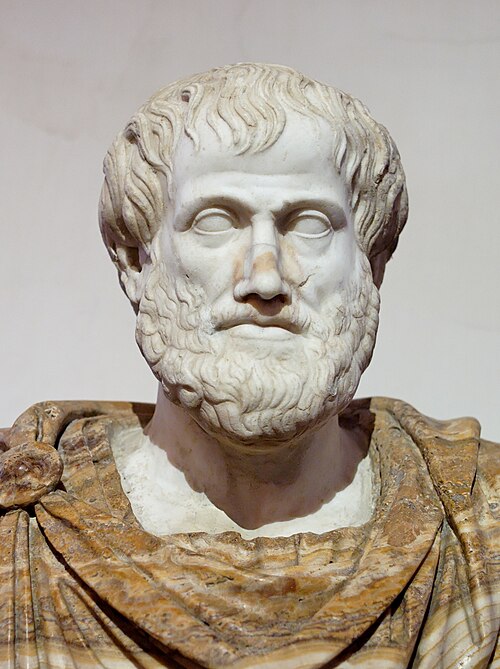
Physical evidence is sparse. Marble portrait busts of Aristotle survive as Roman copies of a lost Greek original, often thought to be a bronze from the circle of the sculptor Lysippus, and the excavated Lyceum offers context for his school. Otherwise, knowledge of Aristotle rests almost entirely on texts.
Key ideas
- Syllogism
- A form of argument in which a conclusion follows necessarily from two premises; Aristotle was the first to study such forms systematically.
- Four causes
- Four ways to answer “why?”: what a thing is made of, its form, what produced it, and what it is for.
- Substance and hylomorphism
- The basic realities are individual things, each a compound of matter and form, rather than separate Platonic Forms.
- Potentiality and actuality
- Change is the realization of a capacity, as an acorn becomes an oak.
- Eudaimonia
- Human flourishing: living well by exercising reason and the virtues over a whole life.
- The doctrine of the mean
- Virtues of character lie between excess and deficiency, relative to the person and situation.
- Political animal
- Humans realize their nature only in a community, the polis, that aims at the good life.
- Mimesis and catharsis
- In the Poetics, art is imitation, and tragedy arouses pity and fear to bring about a kind of catharsis, a term whose meaning is still debated.
Records
- 384 BCE — Aristotle is born in Stagira in the Chalcidice.
- c. 367 BCE — At about seventeen he joins Plato’s Academy in Athens.
- 347 BCE — Plato dies; Aristotle leaves Athens for Assos and later Lesbos.
- c. 343 BCE — Philip II invites him to tutor the young Alexander in Macedon.
- c. 335 BCE — He returns to Athens and founds his school at the Lyceum.
- 323 BCE — Alexander dies in Babylon; anti-Macedonian feeling rises in Athens and Aristotle withdraws to Chalcis.
- 322 BCE — Aristotle dies at Chalcis; Theophrastus leads the Lyceum.
- c. 60 BCE — Andronicus of Rhodes edits Aristotle’s treatises in Rome, shaping the corpus we know.
- c. 830 CE — Translation of Aristotle into Arabic flourishes in Abbasid Baghdad.
- c. 1265 — Thomas Aquinas, drawing on new Latin translations, integrates Aristotle into Christian theology.
- 1831 — Immanuel Bekker’s Berlin edition appears, the source of the standard reference numbers.
- 1891 — The papyrus of the Constitution of the Athenians is published by the British Museum.
Glossary
- Academy
- Plato’s school in Athens, where Aristotle studied and taught for about twenty years.
- Lyceum
- The gymnasium in Athens where Aristotle founded his school around 335 BCE.
- Peripatetic
- A member of Aristotle’s school, named after the covered walkway (peripatos) of the Lyceum.
- Organon
- The traditional name, meaning “tool”, for Aristotle’s collected logical works.
- Telos
- The end or purpose for the sake of which something exists or happens.
- Ousia
- Greek for “being” or “substance”: what fundamentally exists.
- Aretē
- Excellence or virtue: the quality that makes a thing, or a person, good at its function.
- Phronēsis
- Practical wisdom: the ability to see what is right to do in a particular situation.
- Polis
- The Greek city-state, a self-governing community of citizens.
- Bekker number
- A standard reference (e.g. 1094a1) to page, column and line of the 1831 Berlin edition of Aristotle.
Questions and answers
Was Aristotle really Alexander the Great’s teacher?
Yes. Ancient sources agree that Philip II hired him around 343 BCE to teach the young Alexander, though almost nothing reliable is known about what the lessons contained or how much they influenced the future king.
Did Aristotle get things wrong?
Yes, some. He thought heavy objects fall faster, that the heart is the seat of thought, and that some animals arise spontaneously. But many of his biological observations were accurate, and his methods of classification and reasoning were enormously influential.
Why are his books so hard to read?
What survives are mostly his teaching notes and working drafts, not polished books. His works written for the public, which ancient readers admired for their style, are almost all lost.
What is the “golden mean”?
Aristotle’s idea that a virtue lies between two extremes, such as courage between cowardice and recklessness. The right point depends on the person and the situation, not on a fixed formula.
How did Aristotle’s works reach medieval Europe?
Through several routes: Boethius’s Latin translations of the logic, Arabic translations and commentaries from Baghdad and al-Andalus, and new Latin translations from Greek and Arabic in the twelfth and thirteenth centuries.
Did Aristotle defend slavery?
Yes. In the Politics he argued that some people are slaves “by nature”. This view was criticized even in antiquity, was later used to justify colonial slavery, and is rejected today; scholars debate how it fits with the rest of his ethics.
How do scholars cite Aristotle?
By Bekker numbers, which refer to the page, column and line of Immanuel Bekker’s 1831 edition; for example, the Nicomachean Ethics begins at 1094a1.
Sources and further reading
- Christopher Shields, Aristotle. Stanford Encyclopedia of Philosophy
- Aristotle’s Ethics. Stanford Encyclopedia of Philosophy
- Aristotle’s Logic. Stanford Encyclopedia of Philosophy
- Aristotle’s Biology. Stanford Encyclopedia of Philosophy
- Aristotle. Internet Encyclopedia of Philosophy
- Aristotle. Wikipedia
- Corpus Aristotelicum. Wikipedia
- Aristotle, Nicomachean Ethics (Greek text and translation). Perseus Digital Library, Tufts University
- Diogenes Laertius, Lives of Eminent Philosophers. Perseus Digital Library, Tufts University
- Jonathan Barnes (ed.), The Complete Works of Aristotle: The Revised Oxford Translation. Princeton University Press, 1984
Related
- PlatoStudent of Socrates and founder of the Academy. His dialogues remain a cornerstone of Western philosophy.
- SocratesAthenian philosopher who wrote nothing himself. Known through Plato and Xenophon, he was tried and executed in 399 BCE.
- Battle of GaugamelaA battle in 331 BCE in which Alexander of Macedon's army defeated the forces of the Persian king Darius III.
- House of WisdomName associated with Abbasid scholarly collections and translation activity in Baghdad.
- AverroesAndalusian philosopher, jurist and physician renowned for his commentaries on Aristotle.
- Thomas AquinasDominican theologian and philosopher whose writings became central to medieval Christian thought.
Written with AI assistance from the published sources listed above, and revised as new research appears.