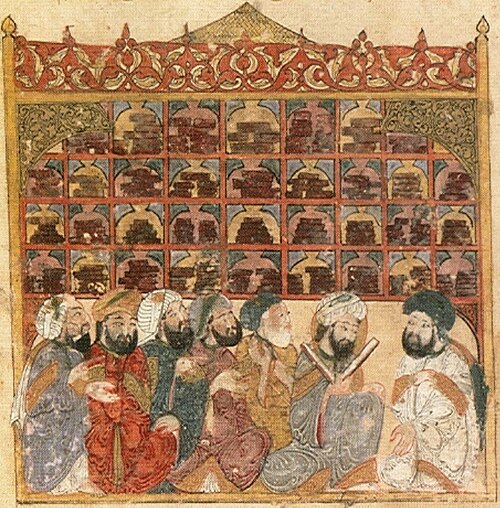
Start at the top for an easy introduction. Go further down for more detail and scholarship.
- Easy
- Intermediate
- Advanced
For young readers
About 1,200 years ago, Baghdad, in what is now Iraq, was one of the biggest and richest cities in the world. Its rulers, called caliphs, loved books. They collected books written in many languages: Greek, Persian, Syriac and Sanskrit.
But most people in Baghdad spoke and read Arabic. So the caliphs and other rich people paid translators to turn these books into Arabic. Imagine a room full of scholars bent over old pages, carefully turning the ideas of the Greek doctor Galen or the geometry of Euclid into new Arabic words. Many translators were Christians, some were Muslims, Jews or followers of other faiths, all working in the same city.
The caliph’s library, called the House of Wisdom, was part of this world. A famous mathematician named al-Khwarizmi worked in Baghdad at this time. The word “algebra” comes from the title of his book, and the word “algorithm”, which computer scientists use every day, comes from his name.
Scholars in Baghdad did not just copy old books. They checked them, argued with them and improved them. They built observatories to watch the stars, measured the size of the Earth, and wrote new books on medicine, optics and music.
Nobody today knows exactly what the House of Wisdom looked like, or even whether it was a big school or mainly a library. Historians still argue about it. But its name has become a symbol of a time when people from many cultures shared knowledge, and many of those books later travelled on to Europe.
At a glance
- What
- A palace library and centre of learning of the Abbasid caliphs; its Arabic names were Bayt al-Ḥikma or Khizānat al-Ḥikma (“House” or “Storehouse of Wisdom”)
- Where
- Baghdad, capital of the Abbasid Caliphate (present-day Iraq); its exact location is unknown and no building survives
- When
- Probably began as a court library under Harun al-Rashid (r. 786–809) or earlier; best documented under al-Ma’mun (r. 813–833). Its later history is unclear.
- Wider movement
- The Graeco-Arabic translation movement, from the mid-8th to the late 10th century
- Languages translated
- Greek (often via Syriac), Middle Persian (Pahlavi), Syriac and Sanskrit, into Arabic
- Associated scholars
- Sahl ibn Harun (librarian), al-Khwarizmi, the Banu Musa brothers; the wider Baghdad circle included Hunayn ibn Ishaq, al-Kindi and Thabit ibn Qurra
- End
- Uncertain. Baghdad’s libraries were devastated when the Mongols sacked the city in 1258, but the House of Wisdom as an institution may have faded long before
- Scholarly debate
- Whether it was a formal academy and translation bureau, or mainly a library and archive, is disputed
Easy
What was the House of Wisdom?
The House of Wisdom (Arabic Bayt al-Ḥikma) was a library and centre of scholarship attached to the court of the Abbasid caliphs in Baghdad. Medieval Arabic writers also called it the Khizānat al-Ḥikma, the “Storehouse” or “Treasury of Wisdom”. It is mentioned in connection with the caliphs Harun al-Rashid and, especially, his son al-Ma’mun, in the late eighth and early ninth centuries.
The House of Wisdom has become famous as the heart of one of history’s great exchanges of knowledge. Between about 750 and 1000, scholars in Baghdad translated into Arabic a large share of the Greek scientific and philosophical works that survived from antiquity, along with important Persian and Indian texts. They then used this knowledge to make original advances in mathematics, astronomy, medicine and philosophy.
Nothing of the House of Wisdom survives: no building, no foundation inscription and no catalogue. What we know comes from scattered mentions in later Arabic books. For this reason, modern historians disagree about how large and organised it really was. Some imagine a great academy with translators, astronomers and mathematicians working side by side; others think it was mainly a royal library and archive, and that the translation movement was spread across many patrons in the city.
Easy
Baghdad, the round city of peace
In 750 a new dynasty, the Abbasids, overthrew the Umayyad caliphs who had ruled from Damascus. The Abbasids drew much of their support from Khurasan in the east, in present-day Iran and Central Asia. In 762 the caliph al-Mansur founded a new capital on the Tigris River, close to where the Tigris and Euphrates come nearest together. He called it Madīnat al-Salām, the “City of Peace”, but everyone knew it as Baghdad.
Al-Mansur’s city was built as a great circle, with the caliph’s palace and the main mosque at its centre. Baghdad quickly grew far beyond these walls into one of the largest cities in the world. It sat at the crossroads of trade routes linking the Mediterranean, Iran, India, Central Asia and China, and its markets were full of merchants, craftsmen, officials and scholars.
Baghdad was also a city of many languages and religions. Muslims, Nestorian and other Christians, Jews, Zoroastrians and Sabians lived and worked there. Many of the most skilled translators came from Christian communities that had long studied Greek texts in Syriac. This mix of people is one reason why Baghdad became a place where knowledge from different traditions could meet.
Easy
Turning books into Arabic
Translating science is hard. When scholars in Baghdad began to translate Greek works on geometry, medicine or logic, Arabic did not yet have words for many of the ideas. Translators had to invent new technical terms, borrow words from Greek or Persian, or give old Arabic words new meanings. Over a few generations, they turned Arabic into a language that could express the most advanced science of the day.
Many Greek books were first translated into Syriac, a language used by Christians of the Middle East, and then from Syriac into Arabic. The best translators, such as Hunayn ibn Ishaq, collected several old manuscripts of the same work, compared them to find the most accurate text, and tried to translate the meaning of each sentence rather than word by word.
What did they translate? Greek authors included Aristotle, Plato (mostly in summaries), Euclid, Archimedes, Ptolemy, Hippocrates and Galen. From Middle Persian came works on astrology, history, statecraft and the animal fables of Kalila and Dimna. From Sanskrit came Indian astronomy and mathematics, including the decimal place-value numerals with zero that later spread to Europe as “Arabic numerals”.
Intermediate
Origins: Sasanian models and Abbasid ambitions
The idea of a royal library of wisdom had roots in the Sasanian Persian empire (224–651), whose kings kept archives and are said to have sponsored translations from Greek and Sanskrit into Middle Persian. The Abbasids, who ruled much of the former Sasanian territory and relied on Persian administrators, adopted many Sasanian customs of court and government. Some historians see the Khizānat al-Ḥikma as a deliberate continuation of this tradition.
Medieval sources credit different caliphs with its beginnings. Some modern accounts trace it to a private collection of al-Mansur (r. 754–775); many associate its founding with Harun al-Rashid (r. 786–809), made famous in later centuries by the stories of the Thousand and One Nights. The best-attested phase is under al-Ma’mun (r. 813–833). The tenth-century bookseller Ibn al-Nadim, in his catalogue of Arabic books, the Fihrist, names Sahl ibn Harun and a man called Salm as working in the House of Wisdom, and reports that al-Ma’mun sent Salm and others to the Byzantine emperor to obtain Greek manuscripts.
Why were caliphs interested? Practical needs mattered: astronomy for calendars, prayer times and astrology, which was taken seriously at court; medicine for the health of the caliph and his family; mathematics for surveying, taxation and inheritance law. Prestige and ideology mattered too. By presenting themselves as heirs to the learning of Persia and Greece, the Abbasids claimed a universal civilising mission, and could contrast themselves with the Byzantine emperors, whom Abbasid writers sometimes accused of having abandoned the wisdom of the ancient Greeks.
Ibn al-Nadim also preserves a famous story: al-Ma’mun dreamed that Aristotle appeared to him and told him that the good is what is good according to reason. The story may have been told to justify the caliph’s support for Greek learning and rational theology; historians treat it as evidence of Abbasid self-image rather than as a literal event.
Intermediate
How the translation movement worked
The translation movement lasted roughly two centuries, from the mid-eighth to the late tenth century. It was expensive: a good manuscript and a skilled translator cost a great deal, and translators could earn large sums. Patrons included not only caliphs but also princes, viziers, military commanders, physicians and wealthy families such as the Barmakids, and later the Banu Musa brothers, who themselves paid translators.
The work was made easier by a new writing material. Paper, a Chinese invention, had spread into the Islamic world through Central Asia, and by around 800 it was being made in Baghdad. Paper was cheaper than parchment or papyrus, which helped books and libraries multiply. A popular story links the arrival of papermaking to Chinese prisoners taken at the Battle of Talas in 751, but historians such as Jonathan Bloom consider the story legendary: paper was already known in Central Asia before then.
Translation methods improved over time. Early translations were often literal and hard to read. In the ninth century Hunayn ibn Ishaq (809–873), a Nestorian Christian physician from al-Hira, set new standards. He, his son Ishaq ibn Hunayn and his nephew Hubaysh translated much of Galen and Aristotle, sometimes first into Syriac for Christian patrons and then into Arabic for Muslim ones. Hunayn left a remarkable letter listing the works of Galen he knew of, which translator had rendered each and for whom.
The circle of the philosopher al-Kindi (c. 801–c. 873) produced some of the most influential philosophical translations and adaptations, including an Arabic paraphrase of parts of Plotinus’ Enneads that circulated under the misleading title Theology of Aristotle. In the tenth century, a group of mostly Christian scholars in Baghdad, including Abu Bishr Matta and Yahya ibn ‘Adi, continued translating and commenting on Aristotle. The philosopher al-Farabi studied in this milieu.
Intermediate
Discoveries: algebra, astronomy and more
Muhammad ibn Musa al-Khwarizmi (c. 780–c. 850) is the scholar most often linked with the House of Wisdom. His short book on calculation by al-jabr (“restoring”) and al-muqābala (“balancing”), dedicated to al-Ma’mun, set out systematic methods for solving linear and quadratic equations and gave the discipline of algebra its name. Another of his books explained Indian decimal numerals; its Latin translations made his name into the word “algorithm”. He also produced astronomical tables and a revised geography based on Ptolemy.
Al-Ma’mun sponsored astronomical observation. Observatories operated in Baghdad (at al-Shammasiyya) and on Mount Qasiyun near Damascus around 828–833, checking and correcting the values given in Ptolemy’s Almagest. His astronomers also measured the length of a degree of latitude on flat desert plains in northern Mesopotamia and Syria, in order to calculate the size of the Earth. These projects show a culture that did not simply accept ancient authority but tested it against observation.
The three Banu Musa brothers, sons of a former astronomer at the court, wrote works on geometry and a famous Book of Ingenious Devices describing some hundred mechanical inventions, including trick vessels and automatic controls. Thabit ibn Qurra (d. 901), a Sabian from Harran whom they brought to Baghdad, translated and improved works by Euclid, Archimedes, Apollonius and Ptolemy and made original contributions to number theory and mechanics.
In medicine, Arabic translations of Hippocrates and Galen became the basis of a flourishing medical tradition, which later produced great physicians such as al-Razi and Ibn Sina (Avicenna). In philosophy, the translations made possible the tradition of falsafa, from al-Kindi through al-Farabi to Ibn Sina and Ibn Rushd (Averroes).
Intermediate
Decline and the Mongol sack of 1258
After al-Ma’mun, his successors al-Mu’tasim and al-Wathiq continued to support learning. Al-Ma’mun had also launched the miḥna (833–c. 848), an inquisition requiring scholars to affirm that the Qur’an was created, a doctrine of the rationalist Mu’tazila theologians. Under al-Mutawakkil (r. 847–861) the miḥna was ended and the court turned toward traditionalist Sunni scholarship. Some accounts say the House of Wisdom lost support at this time, but the sources are thin.
Translation continued in Baghdad through the tenth century, supported by many private patrons, but the House of Wisdom itself is rarely mentioned after the ninth century. By the eleventh and twelfth centuries, other institutions dominated learning in Baghdad, such as the Nizamiyya madrasa (founded 1067) and, later, the Mustansiriyya madrasa (1234), as well as many private and mosque libraries.
In February 1258 a Mongol army under Hulagu, grandson of Genghis Khan, captured Baghdad after a short siege. The last Abbasid caliph in Baghdad, al-Musta’sim, was killed, and the city was sacked for days; a very large number of its inhabitants died. Libraries were destroyed along with mosques, palaces and homes. Later writers said the Tigris ran black with the ink of books thrown into it; historians regard this as a literary image expressing the scale of the catastrophe rather than a literal description.
It is often said that the House of Wisdom was destroyed in 1258. That is true of Baghdad’s libraries in general, but whether an institution called the House of Wisdom still existed by then is uncertain. The Persian scholar Nasir al-Din al-Tusi, who accompanied Hulagu, went on to found a great observatory and library at Maragha, where some books from Baghdad are said to have been taken; the numbers given in later sources are probably exaggerated.
Intermediate
Legacy: from Baghdad to Toledo and beyond
The Abbasid model inspired other rulers. In Cairo the Fatimid caliph al-Hakim founded the Dār al-‘Ilm (House of Knowledge) in 1005, and great libraries were built in Córdoba, Bukhara and elsewhere. Arabic became the main language of science from Spain to Central Asia for several centuries, and scholars of many faiths, including Jews like Maimonides, wrote in it.
From the twelfth century, European scholars travelled to Spain, Sicily and the Near East to translate Arabic books into Latin. In Toledo, Gerard of Cremona translated dozens of works, including Ptolemy’s Almagest and al-Khwarizmi’s algebra. Through these translations Europe received not only Greek science preserved in Arabic but also the original contributions of Arabic-writing scholars, which helped shape medieval universities and, later, the Renaissance.
Historians today stress that the story is not only one of “preservation”, as if Baghdad simply kept Greek books safe for Europe. Arabic-writing scholars corrected, criticised and extended what they received, and their work was an achievement of its own with its own goals.
In modern times the House of Wisdom has become a powerful symbol: of a golden age of Islamic civilisation, of dialogue between cultures, and of the value of translation and libraries. Universities, libraries and cultural programmes around the world have taken its name. This symbolic role sometimes runs ahead of the historical evidence, which is why scholars are careful to distinguish the legend from what the sources actually say.
Advanced
Academy or library? The historiographical debate
In much twentieth-century writing, and in popular books today, the House of Wisdom appears as a great state academy: a kind of medieval research university with a translation bureau, observatories, and salaried scholars in many disciplines, founded or expanded by al-Ma’mun. This image draws on genuine features of the period, but it often combines reports about many different people and places into one institution.
The most influential critique comes from Dimitri Gutas in Greek Thought, Arabic Culture (1998). Gutas argues that the sources describe the Bayt al-Ḥikma or Khizānat al-Ḥikma as a library, modelled on Sasanian royal libraries, whose staff are associated mainly with translating and copying Persian works and with astronomy, not with the translation of Greek science and philosophy. He finds no evidence that it organised the Greek translation movement, which he sees as a society-wide phenomenon sponsored by many patrons for many reasons, rooted in early Abbasid politics and ideology, including an inherited Sasanian imperial ideology that regarded the recovery of ancient knowledge as a royal duty.
Other scholars accept that the evidence is limited but argue that the court library was nevertheless a real focus of learned activity, where scholars such as al-Khwarizmi and the Banu Musa worked under caliphal patronage, and that the Abbasid court did play a leading role. The Stanford Encyclopedia of Philosophy’s article on Greek sources in Arabic philosophy likewise concludes that the Bayt al-Ḥikma cannot be regarded as the institutional centre of Greek-Arabic translation, even though translators had close ties to the court.
The debate also has a political dimension. The image of the House of Wisdom has been used both to celebrate Islamic civilisation and, in older Western accounts, to reduce it to a passive transmitter of Greek learning. A careful reading of the sources avoids both myth and dismissal.
Advanced
Sources and methods
No archive of the House of Wisdom survives. The key evidence comes from later Arabic works: above all the Fihrist of Ibn al-Nadim (completed 987/988), a catalogue of books and authors compiled by a Baghdad bookseller; biographical dictionaries of scholars and physicians such as those of Ibn al-Qifti and Ibn Abi Usaybi‘a (thirteenth century); and chronicles. These writers lived one to four centuries after al-Ma’mun and sometimes projected later institutions back onto the past.
Another rich source is the translations themselves. Surviving manuscripts often name the translator, the patron and sometimes the reviser, allowing historians to reconstruct networks of patronage. Hunayn ibn Ishaq’s letter on the Galen translations is a precious first-hand document of how translators worked, how they searched for manuscripts and who paid them.
Modern research combines philology (comparing Arabic translations with Greek and Syriac originals), history of science (studying what was done with the translated texts), and social history (asking who funded the work and why). Critical editions of many Arabic translations are still lacking, and many manuscripts remain unstudied in libraries from Istanbul to Tehran, so our picture of the movement continues to change.
For readers, the key methodological lesson is to distinguish three things that are often blurred: the specific institution called the House of Wisdom, the wider translation movement, and the modern symbol. Each has its own history, and the evidence for each is different.
Key ideas
- Translation movement
- The sustained effort, from the mid-8th to the late 10th century, to translate Greek, Persian and Indian works into Arabic.
- Patronage
- Caliphs, officials, physicians and wealthy families paid for manuscripts and translations for practical, religious and political reasons.
- Creating a scientific language
- Translators built a new technical vocabulary that made Arabic a leading language of science for centuries.
- Criticism, not just copying
- Baghdad scholars tested ancient works against observation and argument, producing new mathematics and astronomy.
- Multicultural scholarship
- Muslims, Christians, Jews, Sabians and others worked together, drawing on Greek, Syriac, Persian and Indian traditions.
- Transmission to Europe
- Arabic science and philosophy, and Greek works preserved in Arabic, reached Latin Europe through translations from the 12th century onward.
- Myth and evidence
- The modern symbol of the House of Wisdom is larger than what the limited sources can confirm about the institution itself.
Records
- 750 CE — The Abbasid dynasty overthrows the Umayyads and takes over the caliphate.
- 762 CE — Caliph al-Mansur founds Baghdad as the new Abbasid capital.
- 786 CE — Harun al-Rashid becomes caliph (to 809); the court library is often traced to his reign.
- c. 800 CE — Paper is being made in Baghdad, making books cheaper and more plentiful.
- 813 CE — Al-Ma’mun becomes caliph (to 833); the best-documented period of the House of Wisdom begins.
- c. 828 CE — Al-Ma’mun’s astronomers begin observations in Baghdad and later near Damascus.
- c. 830 CE — Al-Khwarizmi writes his book on al-jabr, dedicated to al-Ma’mun.
- 847 CE — Al-Mutawakkil becomes caliph and soon ends the miḥna; court patronage shifts.
- 873 CE — Death of Hunayn ibn Ishaq, the greatest translator of the movement.
- c. 987 CE — Ibn al-Nadim completes the Fihrist, a key source for the House of Wisdom.
- 1258 — The Mongols under Hulagu sack Baghdad; the city’s libraries are devastated and the Abbasid caliph is killed.
Glossary
- Caliph
- The ruler of the Islamic community, seen as the successor of the Prophet Muhammad in political leadership.
- Abbasids
- The dynasty of caliphs that ruled from Baghdad from 750 until 1258.
- Bayt al-Ḥikma
- Arabic for “House of Wisdom”; also called Khizānat al-Ḥikma, “Storehouse of Wisdom”.
- Syriac
- A form of Aramaic used by Middle Eastern Christians, and an important bridge between Greek and Arabic.
- Sasanians
- The Persian dynasty (224–651) whose empire the early Muslim conquests overthrew.
- Algebra
- Branch of mathematics named after al-jabr in the title of al-Khwarizmi’s book.
- Falsafa
- Arabic for philosophy in the Greek tradition.
- Miḥna
- The inquisition (833–c. 848) begun by al-Ma’mun requiring scholars to accept that the Qur’an was created.
- Fihrist
- The “Catalogue” of Arabic books compiled by Ibn al-Nadim in the late 10th century.
- Almagest
- Ptolemy’s great work of astronomy; the name comes from its Arabic title.
Questions and answers
Can I visit the House of Wisdom today?
No. No building survives, and we do not even know exactly where in Baghdad it stood.
Who worked there?
The sources name librarians such as Sahl ibn Harun, and scholars such as al-Khwarizmi and the Banu Musa brothers are linked with it. Many famous translators worked in Baghdad, but not all of them can be placed in the House of Wisdom itself.
Why did they translate Greek books into Arabic?
For useful knowledge in medicine, astronomy and mathematics, for the prestige of the caliphs, and because scholars wanted to explore big questions in philosophy and science.
Is it true that the Tigris ran black with ink in 1258?
Medieval writers said so, and libraries really were destroyed, but historians treat the image as a way of expressing the catastrophe rather than an exact description.
Was the House of Wisdom a university?
Probably not in the modern sense. Many historians think it was mainly a royal library and archive, while the translation movement was supported by many patrons across Baghdad.
What is Dimitri Gutas’s argument about the House of Wisdom?
Gutas argues that it was a Sasanian-style palace library, not the organising centre of Greek translation, and that the translation movement was a broad social phenomenon rooted in early Abbasid politics and ideology.
Did Arabic scholars only preserve Greek knowledge?
No. They corrected and extended it, creating new work in algebra, astronomy, optics, medicine and philosophy.
Sources and further reading
- House of Wisdom. Wikipedia
- Graeco-Arabic translation movement. Wikipedia
- Greek Sources in Arabic and Islamic Philosophy. Stanford Encyclopedia of Philosophy
- Hunayn ibn Ishaq. Wikipedia
- Al-Khwarizmi. Wikipedia
- Banu Musa. Wikipedia
- Al-Ma’mun. Wikipedia
- Siege of Baghdad (1258). Wikipedia
- Dimitri Gutas, Greek Thought, Arabic Culture: The Graeco-Arabic Translation Movement in Baghdad and Early ‘Abbāsid Society (2nd–4th/8th–10th centuries). Routledge, 1998
- Jonathan M. Bloom, Paper Before Print: The History and Impact of Paper in the Islamic World. Yale University Press, 2001
Related
- Library of AlexandriaAn ancient center for collecting and studying texts in Ptolemaic Alexandria.
- AristotlePlato's student and Alexander's tutor. He founded the Lyceum and wrote on logic, ethics, politics and the natural world.
- Al-FarabiPhilosopher of the Islamic world known for works on logic, political thought and music.
- AvicennaPhysician and philosopher whose writings shaped medicine and philosophy across the Islamic world and Europe.
- One Thousand and One NightsA collection of tales that developed over centuries from several storytelling traditions.
- Battle of TalasBattle in 751 between forces of the Abbasid Caliphate and Tang China, with Central Asian groups taking part.
Written with AI assistance from the published sources listed above, and revised as new research appears.