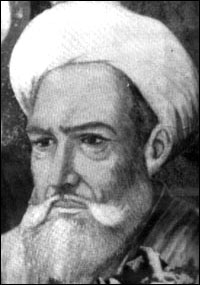
Start at the top for an easy introduction. Go further down for more detail and scholarship.
- Easy
- Intermediate
- Advanced
For young readers
Long ago, the Greek philosopher Aristotle was so respected that people in the Islamic world called him “the First Teacher”. About 1,100 years ago, a quiet scholar named Abu Nasr al-Farabi studied Aristotle’s books so carefully that people started calling him “the Second Teacher”.
Al-Farabi was probably born far to the east, in Central Asia, around the year 870. As a young man he travelled to Baghdad, a huge city full of libraries, where Christian and Muslim scholars read Greek books that had been translated into Arabic. He spent most of his life there, learning and teaching, and at the end of his life he moved to Syria.
One of his big questions was: what would a really good city look like? He compared a city to a healthy body. In a body, the heart leads and every part does its job so the whole body can live well. In a good city, he said, a wise ruler leads, and everyone works together so that all the people can become good and truly happy.
Al-Farabi also loved music. He wrote a huge book explaining how musical notes and rhythms work, and he said that your ears, not just your calculations, should be the judge of what sounds right. A famous story says he once played an instrument at a prince’s court and made everyone laugh, then cry, and then fall asleep.
His books were read for centuries by later thinkers, including the great doctor and philosopher Ibn Sina (Avicenna), the Jewish philosopher Maimonides, and scholars in Europe who translated some of his works into Latin.
At a glance
- Full name
- Abū Naṣr Muḥammad ibn Muḥammad al-Fārābī
- Lived
- c. 870 – December 950 or January 951 CE
- Birthplace
- Uncertain: Farab (Otrar) on the Syr Darya in present-day Kazakhstan, or Faryab in present-day Afghanistan
- Worked in
- Baghdad for most of his career; Syria (Aleppo, Damascus) from about 943; possibly Egypt; died in Damascus
- Language
- Arabic
- Title
- “The Second Teacher” (al-muʿallim al-thānī), after Aristotle, “the First Teacher”
- Main fields
- Logic, philosophy of language, metaphysics and cosmology, psychology of the intellect, political philosophy, music theory
- Key works
- The Opinions of the People of the Virtuous City; The Political Regime; The Attainment of Happiness; Enumeration of the Sciences; Book of Letters; Great Book of Music; commentaries on Aristotle’s logic
Easy
Who was al-Farabi?
Abu Nasr al-Farabi (c. 870–950/951) was one of the founders of the philosophical tradition of the Islamic world, known in Arabic as falsafa. He wrote in Arabic and worked mainly in Baghdad, the capital of the Abbasid caliphate. Later generations gave him the honorific title “the Second Teacher”, placing him right after Aristotle, “the First Teacher”.
Al-Farabi was a builder of systems. He wanted to show how all knowledge fits together: from grammar and logic to mathematics, the natural sciences, the study of God and the heavens, and finally ethics and politics. For him, all these sciences led to one goal: true human happiness, which could be reached only in a well-ordered community guided by wisdom.
He is especially remembered for three things. First, his commentaries and handbooks on Aristotle’s logic, which set the standard for later Arabic philosophers. Second, his political philosophy, above all his picture of the “virtuous city”. Third, his Great Book of Music, the most important medieval treatise on music written in the Islamic world.
Easy
A life between Central Asia, Baghdad and Damascus
Very little is known for certain about al-Farabi’s life. His name means “from Farab”. Many sources identify this with Farab, also called Otrar, a town on the Syr Darya River in present-day southern Kazakhstan; others point to Faryab in present-day northern Afghanistan. He was probably born around 870.
As a young man he moved to Iraq and settled in Baghdad, where he spent most of his life. There he studied logic with a Christian scholar, Yuhanna ibn Haylan, and was part of a circle of Aristotelian philosophers, many of them Syriac-speaking Christians, such as Abu Bishr Matta ibn Yunus. The Christian philosopher Yahya ibn ‘Adi, who later led the Baghdad school, is said to have studied with him.
Around 943, when Baghdad was troubled by political chaos, al-Farabi left for Syria. He spent time in Aleppo and Damascus and enjoyed the patronage of the Hamdanid prince Sayf al-Dawla, ruler of Aleppo. He may also have visited Egypt. He died in Damascus in December 950 or January 951, at about eighty.
Later biographers describe him as a modest, unworldly man who cared little for money or fine clothes. One story says that in Damascus he worked as a garden watchman and read philosophy at night by the watchman’s lamp. Such stories fit the ideal of the philosopher and cannot be checked, but they show how he was remembered.
Easy
The big idea: a city that makes people happy
Al-Farabi’s most famous book is usually called The Opinions of the People of the Virtuous City (Mabādiʾ ārāʾ ahl al-madīna al-fāḍila). It begins with God and the order of the universe and ends with the best way to organise a human community. The idea is that people can only become fully good and happy by living together in the right way.
He compared the virtuous city to a healthy body. Just as the heart rules the body and each organ serves the whole, in the best city a wise ruler guides the community, and every person, according to his or her abilities, helps everyone reach happiness. The ruler must be someone who truly understands what is good, like the philosopher-king in Plato’s Republic.
Al-Farabi also described the opposite kinds of cities. Some are “ignorant”: their people do not know what true happiness is, and chase only wealth, pleasure, honour or power. Some are “immoral”: their people know what is good but do not act on it. Others are “erring”: they have been given false ideas about happiness. These comparisons were a way of asking what a society is really for.
Intermediate
Background: Greek philosophy in Arabic Baghdad
Al-Farabi was born into a world already transformed by the Graeco-Arabic translation movement. By the late ninth century, most of Aristotle’s works, much of Galen and many other Greek texts were available in Arabic, often translated via Syriac by Christian scholars. The philosopher al-Kindi (d. c. 873) had begun to write original philosophy in Arabic.
In Baghdad, a school of Christian Aristotelians continued the teaching methods of late antique Alexandria, reading Aristotle’s logical works (the Organon) in a fixed order with commentaries. Al-Farabi himself told a story, preserved by the biographer Ibn Abi Usaybi‘a, of how philosophical teaching had passed from Alexandria to Antioch, then to Harran and finally to Baghdad, placing himself at the end of this chain. Scholars treat the story with caution, but it shows how al-Farabi saw his own role: as heir to an unbroken Greek tradition.
Greek logic was controversial. In 932 a famous public debate took place in Baghdad before the vizier Ibn al-Furat, between al-Farabi’s associate Abu Bishr Matta and the grammarian Abu Sa‘id al-Sirafi. Sirafi argued that logic was just Greek grammar in disguise and that Arabic speakers needed Arabic grammar, not a foreign tool. The debate, recorded later by Abu Hayyan al-Tawhidi, forms an important background to al-Farabi’s careful discussions of how logic and grammar differ.
Intermediate
Logic and language
Al-Farabi wrote commentaries on nearly every part of Aristotle’s Organon; his large commentary on On Interpretation survives, while many others are lost or fragmentary. He also wrote shorter introductions and paraphrases that made logic accessible. For him, logic was the “tool” (ālā) of philosophy, and the path to certainty.
His answer to critics like Sirafi was subtle. Grammar, he argued, gives the rules for the correct use of a particular language, such as Arabic or Greek; logic gives rules for correct thinking that apply to the meanings behind all languages. Logic therefore shares something with grammar, since it studies expressions, but its concern is universal. This made logic a science for everyone, not a Greek import.
In the Book of Letters (Kitāb al-ḥurūf), al-Farabi discussed the meanings of basic philosophical terms, such as “being” and “substance”, and how they are expressed in Arabic, where some Greek grammatical structures have no direct equivalent. He also offered a remarkable account of the origins of language: people first create words for things they perceive, then develop rhetoric and poetry, later dialectic and finally demonstrative science. In the same work he argued that philosophy, in the natural order, comes before religion, which expresses philosophical truths in images for the whole community.
His Enumeration of the Sciences (Iḥṣāʾ al-ʿulūm) classified all branches of knowledge: the science of language, logic, the mathematical sciences (including optics, astronomy, music, the science of weights and mechanics), natural science and metaphysics, and finally political science together with jurisprudence and theology (kalām). It was translated into Latin in the twelfth century and helped shape how medieval Europeans organised learning.
Intermediate
The cosmos, the intellect and happiness
Al-Farabi combined Aristotle’s physics and astronomy with Neoplatonic ideas that had reached Arabic partly through texts misattributed to Aristotle. At the top of reality is the First Cause, God, perfectly one and perfectly intellect. From the First, reality proceeds, or “emanates”, not by choice or effort but necessarily, like light from the sun.
From the First comes a Second Intellect, and from it a series of further intellects, each associated with one of the heavenly spheres: the outermost sphere, the sphere of the fixed stars, and the spheres of Saturn, Jupiter, Mars, the Sun, Venus, Mercury and the Moon. The tenth and last intellect is the Active (or Agent) Intellect, which governs the world below the Moon, the world of change, where humans live.
In his Letter on the Intellect and other works, al-Farabi explained human knowledge in terms of this structure. The human mind begins as a potential intellect, able to receive the forms of things. When it actually thinks them, it becomes an actual intellect; when it has made them its own, it becomes an “acquired intellect”. The Active Intellect makes this process possible, like light that makes colours visible. The highest human happiness is a kind of closeness or conjunction with the Active Intellect, when the soul becomes like the pure intellects above it.
This was a grand, hierarchical vision in which cosmology, psychology and ethics were joined. It also had a political side: just as the First Cause orders the heavens, the ruler of the virtuous city orders the community, and just as the universe forms a hierarchy, so does the ideal city.
Intermediate
Political philosophy: ruler, prophet and lawgiver
Al-Farabi was the first major philosopher of the Islamic world to make political philosophy central. He knew Plato’s Republic and Laws, at least in summaries (he wrote a Summary of Plato’s Laws), as well as Aristotle’s ethics. His main political works are The Virtuous City, The Political Regime (al-Siyāsa al-madaniyya), The Attainment of Happiness (Taḥṣīl al-saʿāda), The Book of Religion (Kitāb al-milla) and the Selected Aphorisms (Fuṣūl muntazaʿa).
The first ruler of the virtuous city must be a person of exceptional gifts: a philosopher whose intellect is joined to the Active Intellect, and whose imagination is so powerful that he can express truths in images, symbols and persuasive speech. Such a person is at once philosopher, prophet, lawgiver and imam. In this way al-Farabi connected Plato’s philosopher-king with the Islamic ideas of prophecy and religious leadership, without naming any particular prophet.
Religion, in this account, presents the same truths that philosophy knows by demonstration, but in a form that everyone can grasp: through symbols, stories and laws suited to a particular people. Philosophy speaks in proofs; theology uses dialectical arguments; scripture speaks rhetorically and poetically to ordinary people. Because different nations have different symbols, there can be several virtuous religions that express the same truth in different ways.
Al-Farabi did not think only in terms of small city-states. He wrote of the virtuous nation and even of a virtuous world community made up of many nations. Some scholars see here a reflection of the vast, multi-ethnic and multi-religious Abbasid world in which he lived.
Intermediate
Music theory
The Great Book of Music (Kitāb al-mūsīqā al-kabīr) is one of al-Farabi’s most original achievements and is considered the most important medieval treatise on music in the Islamic lands. It covers the nature of musical sound, intervals, scales, rhythm, composition and the instruments of his time, especially the ‘ūd (lute), whose frets and tunings he described in detail.
Al-Farabi drew on Greek harmonic theory but did not simply repeat it. He insisted that the ear, rather than purely theoretical reasoning, is the final judge of musical principles, and he was aware, for example, that a semitone is not exactly half of a whole tone. He also connected music with poetry and speech, seeing melody as a way to strengthen the effect of words on the soul.
Later tradition turned al-Farabi into a legendary musician. The biographer Ibn Khallikan tells how, at the court of Sayf al-Dawla, he took out an instrument and played so that everyone laughed, then played again so that everyone wept, and finally played so that everyone fell asleep, after which he quietly left. The story is almost certainly legend, but it shows how deeply his musical reputation impressed later generations.
Intermediate
Influence: from Avicenna to Europe
Al-Farabi’s most famous reader was Ibn Sina (Avicenna, 980–1037). In his autobiography, Ibn Sina says that he read Aristotle’s Metaphysics forty times and knew it by heart without understanding its purpose, until he bought a short treatise by al-Farabi on the aims of the Metaphysics from a bookseller for three dirhams, and suddenly understood. Much of Ibn Sina’s metaphysics and psychology develops ideas that al-Farabi had set out.
In al-Andalus, philosophers such as Ibn Bajja (Avempace), Ibn Tufayl and Ibn Rushd (Averroes) read al-Farabi closely, especially his logic and his political philosophy. They also reported that in his lost commentary on Aristotle’s Nicomachean Ethics he had expressed doubts about the survival of the soul after death and the possibility of union with the Active Intellect, ideas that seemed to conflict with his other works.
The Jewish philosopher Maimonides (1138–1204) held al-Farabi in very high esteem, especially for logic, and recommended his works to his translator Samuel ibn Tibbon. Through Hebrew translations, al-Farabi became part of medieval Jewish philosophy. In Latin Europe, known as Alpharabius, he was read mainly through translations of the Enumeration of the Sciences (as De scientiis) and a few shorter works, which influenced the classification of sciences in medieval schools.
Today al-Farabi is honoured across many countries. Kazakhstan, which claims his birthplace at Otrar, has named its leading national university in Almaty after him; Iran, Afghanistan, Turkey, Uzbekistan and the Arab world also celebrate him as part of their heritage. He is increasingly studied as a philosopher of language and politics in his own right, not only as a link between Greek and later thinkers.
Advanced
Biographical sources and the question of origins
The earliest notices of al-Farabi are brief. The Fihrist of Ibn al-Nadim (987/988) mentions him in the context of Baghdad’s logicians. Fuller biographies come from later writers such as Sa‘id al-Andalusi (eleventh century), Ibn al-Qifti and Ibn Abi Usaybi‘a (thirteenth century), and Ibn Khallikan (thirteenth century), who lived two to three centuries after him and sometimes disagree. Many details, including his teachers, travels and anecdotes, rest on these late accounts.
His origin is disputed. Ibn Khallikan describes him as a Turk and gives a genealogy that includes Turkic-sounding names, while other sources are silent or suggest a Persian background. Some modern scholars, noting that his writings contain glosses in Persian and Sogdian but not in Turkish, have argued for an Iranian (Persian or Sogdian) origin; the Stanford Encyclopedia entry notes that more recent research points in this direction. Others continue to support a Turkic origin. The location of Farab itself, in Transoxiana or in Khurasan, is also uncertain.
These questions have acquired modern political weight, since several nations claim al-Farabi as part of their national heritage. Historians caution that ethnic categories of the tenth century do not map neatly onto modern nations, and that al-Farabi wrote entirely in Arabic within a cosmopolitan scholarly culture. The limited evidence allows no final answer.
Advanced
How to read al-Farabi: scholarly debates
Esoteric or sincere? The political philosopher Leo Strauss argued in the mid-twentieth century that al-Farabi, like other medieval philosophers living under religious authorities, sometimes wrote “between the lines”, presenting unorthodox views cautiously and leaving his true teaching for careful readers. Scholars influenced by Strauss, notably Muhsin Mahdi and Charles Butterworth, emphasised al-Farabi’s political works and read his Neoplatonic metaphysics partly as a rhetorical accommodation. Other scholars, including Dimitri Gutas, Stephen Menn and Thérèse-Anne Druart, reject this approach and treat al-Farabi’s metaphysics and emanation scheme as central and sincerely held.
Which works are his? The Harmonization of the Opinions of the Two Sages, which argues that Plato and Aristotle agree on essential points, was long taken as a key text of al-Farabi’s thought. In 2009 Marwan Rashed questioned its authenticity, arguing that it belongs to a different milieu; Cecilia Martini Bonadeo and others have defended al-Farabi’s authorship. The answer affects how we understand his relationship to Neoplatonism.
Consistency across works. The reports that his lost commentary on the Nicomachean Ethics denied individual immortality, together with differences between The Virtuous City and The Political Regime, raise the question of whether al-Farabi changed his mind, adapted his message to different audiences, or has been misreported. Debates also continue about whether, for al-Farabi, human beings acquire universal concepts by abstraction from sense experience or by an emanation from the Active Intellect.
The state of the texts. Since the 1980s scholarship on al-Farabi has advanced greatly, but many works still lack reliable critical editions or full English translations, including important parts of the logical corpus and the Great Book of Music. New editions, such as recent work on the Book of Letters, continue to change the picture. Richard Walzer’s edition and translation of The Virtuous City (1985) and Muhsin Mahdi’s studies of his political philosophy remain standard reference points.
Key ideas
- The Second Teacher
- Al-Farabi’s title, recognising him as the greatest interpreter of Aristotle after Aristotle himself.
- Logic as universal grammar of thought
- Logic gives rules for correct reasoning that hold for the meanings behind all languages, unlike the grammar of one language.
- Emanation
- Reality flows necessarily from the First Cause through a series of ten intellects down to the world of change.
- Active Intellect
- The tenth intellect, which enables human understanding; union with it is the highest happiness.
- The virtuous city
- A community in which everyone cooperates, under a wise ruler, to reach true happiness.
- Philosopher-prophet
- The ideal first ruler combines philosophical wisdom with the imaginative power to express truths in symbols and laws.
- Religion as image of philosophy
- Religion conveys philosophical truths through symbols and persuasion suited to a whole people.
Records
- c. 870 CE — Al-Farabi is born, probably at Farab in Transoxiana or Faryab in Khurasan.
- c. 873 CE — Deaths of the philosopher al-Kindi and the translator Hunayn ibn Ishaq.
- c. 900 CE — Al-Farabi is studying and teaching in Baghdad among Aristotelian logicians.
- 932 CE — Debate in Baghdad between the logician Abu Bishr Matta and the grammarian Abu Sa‘id al-Sirafi on logic and grammar.
- c. 943 CE — Al-Farabi leaves Baghdad for Syria.
- c. 945 CE — Sayf al-Dawla establishes Hamdanid rule in Aleppo; al-Farabi enjoys his patronage.
- 950 CE — Al-Farabi dies in Damascus (December 950 or January 951).
- c. 987 CE — Ibn al-Nadim’s Fihrist mentions al-Farabi among Baghdad’s logicians.
- c. 1000 — The young Ibn Sina understands Aristotle’s Metaphysics with the help of al-Farabi’s treatise.
- c. 1150 — The Enumeration of the Sciences is translated into Latin in Toledo.
Glossary
- Falsafa
- Philosophy in the Greek tradition as practised in Arabic.
- Organon
- The collection of Aristotle’s works on logic.
- Emanation
- The necessary flowing-out of reality from a higher principle, like light from the sun.
- Active (Agent) Intellect
- The last of the heavenly intellects, which actualises human understanding.
- Acquired intellect
- The stage at which the human mind has fully made intelligible forms its own.
- Virtuous city
- Al-Farabi’s ideal community, organised to lead its members to true happiness.
- Imam
- In al-Farabi’s usage, the supreme leader of the virtuous community.
- Kalām
- Islamic dialectical theology, which defends religious beliefs with arguments.
- Hamdanids
- An Arab dynasty that ruled northern Syria and upper Mesopotamia in the 10th century; Sayf al-Dawla ruled Aleppo.
- ‘Ūd
- A short-necked lute, the central instrument in al-Farabi’s music theory.
Questions and answers
Why was al-Farabi called the Second Teacher?
Because people thought he understood and taught Aristotle, “the First Teacher”, better than anyone else.
Where was he from?
Probably from a place called Farab. Many think it is Otrar in today’s Kazakhstan, others think it is Faryab in Afghanistan. Nobody knows for sure.
Did he really make people laugh, cry and sleep with music?
That is a famous story told centuries later. It is almost certainly a legend, but he really did write one of the most important books on music.
Was al-Farabi Turkish or Persian?
Medieval sources disagree, and modern scholars are divided; recent research leans toward an Iranian background, while others support a Turkic origin. He wrote only in Arabic.
How is his virtuous city different from Plato’s republic?
It draws on Plato, but its ruler is also a prophet and lawgiver, religion plays a central role, and al-Farabi imagines virtuous nations and even a virtuous world community, not only a single city.
Did al-Farabi think religion and philosophy conflict?
No. He held that religion expresses the truths of philosophy in symbols and persuasive language suited to a whole people, though this view made philosophy the higher form of knowledge.
What is the “esoteric” reading of al-Farabi?
Leo Strauss and his followers argued that al-Farabi hid some unorthodox views behind cautious language; others reject this and take his metaphysics at face value.
Sources and further reading
- Thérèse-Anne Druart, al-Farabi. Stanford Encyclopedia of Philosophy
- Luis Xavier López-Farjeat, al-Farabi’s Psychology and Epistemology. Stanford Encyclopedia of Philosophy
- Greek Sources in Arabic and Islamic Philosophy. Stanford Encyclopedia of Philosophy
- Al-Farabi. Wikipedia
- House of Wisdom. Wikipedia
- Richard Walzer, Al-Farabi on the Perfect State: Abū Naṣr al-Fārābī’s Mabādiʾ ārāʾ ahl al-madīna al-fāḍila. Clarendon Press, Oxford, 1985
- Muhsin S. Mahdi, Alfarabi and the Foundation of Islamic Political Philosophy. University of Chicago Press, 2001
Related
- AristotlePlato's student and Alexander's tutor. He founded the Lyceum and wrote on logic, ethics, politics and the natural world.
- PlatoStudent of Socrates and founder of the Academy. His dialogues remain a cornerstone of Western philosophy.
- AvicennaPhysician and philosopher whose writings shaped medicine and philosophy across the Islamic world and Europe.
- AverroesAndalusian philosopher, jurist and physician renowned for his commentaries on Aristotle.
- House of WisdomName associated with Abbasid scholarly collections and translation activity in Baghdad.
- Thomas AquinasDominican theologian and philosopher whose writings became central to medieval Christian thought.
Written with AI assistance from the published sources listed above, and revised as new research appears.