Start at the top for an easy introduction. Go further down for more detail and scholarship.
- Easy
- Intermediate
- Advanced
For young readers
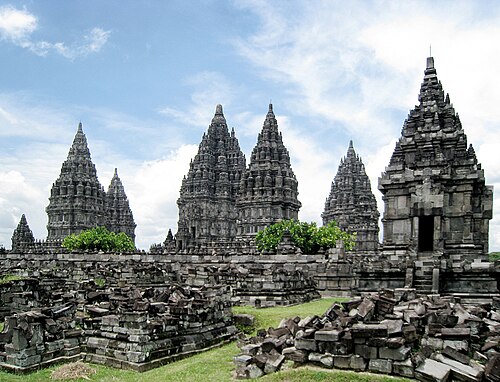
Imagine a stone mountain made by people. That is what Prambanan looks like: a cluster of tall, pointed towers rising out of the green rice fields of central Java. The tallest tower is 47 metres high, about as tall as a 15-storey building.
It was built more than 1,100 years ago by the kings of a Javanese kingdom called Mataram. They made it as a home for the Hindu gods. The biggest temple belongs to Shiva, and two smaller ones beside it belong to Vishnu and Brahma. Inside Shiva’s temple stands a statue of the god three metres tall.
Around the outside of the temples there are hundreds of carved pictures in stone, one after another, like a comic strip. They tell the famous story of Prince Rama, whose wife Sita is kidnapped by the demon king Ravana, and how the monkey hero Hanuman helps to rescue her. To read the story in the right order, you walk around the temple with the building always on your right-hand side.
Local people tell a legend about the temples. A prince wanted to marry a princess called Rara Jonggrang, but she did not want to marry him. She said he must build a thousand temples in one night. With the help of spirits he almost finished, but she tricked him by making it look as if the sun was rising. The angry prince turned her into a stone statue, and people say she is still standing inside the great temple.
Earthquakes and volcanoes later knocked most of the temples down. For about 100 years, people have been putting them back together stone by stone, like a gigantic jigsaw puzzle. The work is still going on today.
At a glance
- Built
- Mid-9th century; the Shiva temple was inaugurated in 856 CE according to the Shivagrha inscription, and the complex was enlarged into the early 10th century
- Place
- Prambanan Plain, about 17 km north-east of Yogyakarta, on the border of the Special Region of Yogyakarta and Central Java, Indonesia
- Builders
- Kings of the Mataram (Medang) kingdom; begun under Rakai Pikatan, inaugurated under Dyah Lokapala, expanded by later kings such as Balitung
- Dedicated to
- The Hindu Trimurti (Shiva, Vishnu, Brahma), with Shiva as the principal deity
- Size
- Originally 240 temples: 16 in the central court and 224 small ‘pervara’ shrines in four rows; main tower 47 m high
- Reliefs
- Ramayana (Shiva and Brahma temples) and Krishna stories from the Bhagavata Purana tradition (Vishnu temple)
- Status
- UNESCO World Heritage Site “Prambanan Temple Compounds”, inscribed 1991 together with nearby Sewu, Lumbung and Bubrah
- Significance
- The largest Hindu temple complex of ancient Java and a masterpiece of classical Indonesian architecture and relief carving
Easy
What is Prambanan?
Prambanan is a ninth-century Hindu temple complex on the island of Java, in present-day Indonesia. It stands on a fertile plain between the volcano Merapi to the north and a range of low limestone hills to the south, about 17 km north-east of the city of Yogyakarta. In Indonesian it is called Candi Prambanan, after the nearby village; candi is the general Indonesian word for an ancient temple. Javanese people also call it Rara (or Loro) Jonggrang, after the heroine of a local legend.
The complex is dedicated to the Trimurti, the three great gods of Hinduism in one of their best-known groupings: Brahma the creator, Vishnu the preserver and Shiva the destroyer and renewer. Shiva is the most important of the three here. An inscription dated 856 CE, which most historians connect with Prambanan, calls the sanctuary Śiwagṛha, “the House of Shiva”.
Prambanan is famous for its tall, slender towers, very different from the broad, stepped Buddhist monument of Borobudur about 40 km away. The central Shiva temple rises 47 metres. Originally the complex contained 240 separate temples, most of them small shrines arranged in neat rows around the three main towers.
In 1991 UNESCO inscribed the “Prambanan Temple Compounds” on the World Heritage List. The listed property includes not only Prambanan itself but also the nearby Buddhist temples of Sewu, Lumbung and Bubrah. UNESCO describes the whole group as a masterpiece of Shiva art of the classical period and as evidence of the peaceful coexistence of Hindu and Buddhist communities in ancient Java.
Easy
How to “read” the temple plan: three squares, three worlds
Seen from above, Prambanan is made of three squares, one inside the other. The outermost enclosure, about 390 metres on each side, has almost disappeared; its purpose is uncertain, and it may have held buildings of wood and thatch for priests, which have left no trace. Inside it lies a second walled square, about 225 metres on each side, which once held 224 small shrines called candi perwara (ancillary or guardian temples), arranged in four concentric rows of 44, 52, 60 and 68. Each row stands slightly higher than the one outside it. At the centre, on a raised stone platform, is the holiest court.
The central court contains sixteen buildings. In the western row stand the three main temples: Shiva in the middle, Vishnu to the north and Brahma to the south. Facing them in the eastern row are three smaller temples for the animals on which the gods ride (vahana): the bull Nandi for Shiva, the eagle-like bird Garuda for Vishnu and the sacred goose Hamsa for Brahma. Two “flanking” temples (candi apit) stand at the north and south ends of the court, and eight tiny shrines mark the four gateways and the four corners.
This arrangement expresses Hindu ideas about the universe. The outer court, the middle court and the inner court are often explained as three levels of existence: the world of ordinary mortals (bhurloka), a middle world of holy people and ascetics (bhuvarloka), and the highest world of the gods (svarloka). The same three levels are repeated vertically in each temple: the base, the body with its chamber, and the roof rising to a jewel-shaped finial (ratna). The whole complex is thus a model of the cosmos, and each tower is an image of Mount Meru, the mountain at the centre of the world where the gods live.
A visitor is meant to approach from the east, climb the steep stairs of the Shiva temple and walk clockwise along its gallery, keeping the sanctuary on the right. This ritual walk, pradakshina, leads the worshipper past the story reliefs and, step by step, toward the god in the centre.
Easy
The gods inside the towers
The Shiva temple, 47 metres high and 34 metres wide, has five rooms: a large central chamber and four smaller chambers facing the four directions. The central chamber, reached from the east, holds a statue of Shiva Mahadeva (“the great god”) about three metres tall, standing on a lotus above a pedestal. He has four arms and carries his traditional symbols, such as prayer beads, a fly-whisk and a trident, and he wears a crescent moon and a skull in his crown and a third eye on his forehead.
The other three chambers hold gods closely linked with Shiva. The sage Agastya, a teacher revered in Java as a bringer of Shiva worship, stands in the south chamber. The elephant-headed Ganesha, Shiva’s son and remover of obstacles, sits in the west chamber. In the north chamber is the goddess Durga killing the buffalo demon (Durga Mahishasuramardini). It is this Durga statue that local tradition identifies with the princess Rara Jonggrang, so the north chamber is sometimes called the Rara Jonggrang temple.
The Vishnu and Brahma temples are each about 33 metres high, with a single chamber containing a statue of their god. Of the vahana temples, only the one facing Shiva still contains its animal: a large statue of the bull Nandi, accompanied by statues of the sun god Surya and the moon god Chandra standing on chariots. The Garuda and Hamsa temples are empty today.
The outer walls of the temples are decorated with a repeated motif that scholars call the “Prambanan panel”: a lion in a small niche, framed on each side by a wish-granting tree (kalpataru) flanked by pairs of animals or heavenly beings. This cheerful, orderly pattern, repeated many times, gives the lower walls their typical rhythm.
Intermediate
Stories in stone: the Ramayana and Krishna reliefs
On the inner side of the balustrades that line the galleries of the three main temples runs a continuous series of narrative reliefs. On the Shiva temple and continuing onto the Brahma temple, they tell the Ramayana: the exile of Prince Rama, the abduction of his wife Sita by Ravana, king of Lanka, the search for her with the help of the monkey army of Hanuman and Sugriva, and the war that follows. On the Vishnu temple the panels tell stories of Krishna, another form of Vishnu, related to the Bhagavata Purana tradition.
The reliefs are read from left to right as the visitor walks clockwise. They are full of lively details of daily life: houses on stilts, animals, musicians and courtly scenes, which art historians have used as evidence for the material culture of ninth-century Java. Against the calm, idealized figures of Borobudur’s Buddhist reliefs, the Prambanan panels are often praised for their dramatic movement and crowded compositions.
The Prambanan Ramayana does not follow the Sanskrit epic of Valmiki exactly. Scholars have compared its episodes with the Old Javanese Kakawin Ramayana, a long poem in Sanskrit-derived metres that was probably composed in the same period, between the mid-ninth and early tenth centuries. Some details of the reliefs seem closer to other Indian or local versions, and how exactly the carvings relate to written texts remains a subject of research.
The inner walls opposite the story panels carry figures of the guardian gods of the directions (lokapala) on the Shiva temple, sages associated with the Vedas on the Brahma temple, and male deities flanked by celestial dancers (apsara) on the Vishnu temple. Together, the story on one side and the divine company on the other turn the walk around the temple into a journey through sacred history.
Intermediate
How it was built: stone, water and royal labour
Like other classical temples of central Java, Prambanan was built of blocks of volcanic stone (andesite) cut to shape and fitted together, with the carving done after the blocks were in place. The volcanic landscape that provided the stone also threatened the buildings: Merapi, about 25 km to the north, repeatedly sent down volcanic mudflows (lahar), and earthquakes are frequent in the region.
The Shivagrha inscription records a remarkable piece of engineering carried out when the temple was completed: the course of a river was changed so that it flowed along the temple grounds. Historians identify it with the Opak River, which now runs straight from north to south along the western side of the complex. The old, curving bed seems to have been filled in and levelled to make room for the rows of small shrines, and the new course may also have been intended to protect the site from floods and volcanic debris.
The same inscription speaks of the labour of many people, including “simple people”, and of surveyors working “by the hundreds”. The small pervara shrines, all of identical design, may have been contributed by regional lords and nobles as signs of loyalty to the king; this is one interpretation among several. Short painted inscriptions found on the monument, including one bearing the name “Pikatan” on a finial of the Shiva temple’s balustrade, give rare glimpses of the building process.
Beneath the centre of the Shiva temple, restorers found a shaft 5.75 metres deep containing a stone casket (pripih) set above charcoal, earth and burnt animal bones. The casket held copper sheets, coins, jewels, pieces of gold and silver leaf, shells and small gold plates cut into shapes such as a turtle, a serpent (naga) and a lotus, some inscribed with names of gods such as Varuna and Parvata. Such foundation deposits were meant to consecrate the ground and give the building its sacred power.
Intermediate
Who built it? The Mataram kingdom in the ninth century
Prambanan was built by the rulers of the kingdom that historians call Mataram or Medang, which dominated central Java from the eighth century. During the late eighth and early ninth centuries, its kings, of the Shailendra lineage, were great patrons of Mahayana Buddhism: they built Sewu (whose original name was probably Manjusrigrha, dedicated in 792), Borobudur and many other Buddhist monuments on the same plain and in the Kedu valley to the west.
The shift to monumental Hindu building is associated with Rakai Pikatan (personal name dyah Saladu), a Shaiva king who reigned from about 847 to after 856 and who married Pramodhawardhani, the Buddhist daughter of the Shailendra king Samaratungga. The Shivagrha inscription of 856 describes a king who was a Shaiva “in contrast to the queen”, a war over the succession in which an enemy took refuge in a fortress of heaped stones, and the handing of the throne to Dyah Lokapala, under whom the Shiva sanctuary was inaugurated.
Later kings, notably Balitung (reigned around 899–911), and after him Daksa and Tulodong, enlarged the complex, especially by adding the rows of small shrines. For several decades Prambanan was the royal temple of the kingdom, where major state ceremonies were held, and the court itself was probably located somewhere on the Prambanan plain.
Prambanan did not replace Buddhism. The great Buddhist foundations nearby continued to be used, and Sewu seems to have been enlarged in the same period. The juxtaposition of Hindu and Buddhist monuments only a few hundred metres apart is one of the most striking features of the Prambanan plain, and it is the basis of UNESCO’s description of the site as evidence of religious coexistence.
Intermediate
Religious meaning: Shiva’s mountain and the deified king
Prambanan belongs to the Shaiva tradition of Hinduism, in which Shiva is worshipped as the supreme god and the Trimurti as his three aspects. The Shivagrha inscription describes the dwelling of the god, its gateways and guardians, a sacred tree to the east “where the god would descend”, and many smaller buildings serving as hermitages. It also records that rice fields were assigned to the temple as a tax-free endowment (sima) so that daily worship could continue “forever”.
In Javanese temples, as in Indian ones, the main tower is an image of Mount Meru, and the dark inner chamber (garbhagriha, “womb-house”) is the place where the divine becomes present in the statue. The worshipper moves from the open, busy outer courts toward this concentrated centre, passing through a sequence of increasingly sacred spaces.
Some archaeologists have suggested that the great Shiva statue was also meant to represent a king, perhaps Balitung, in deified form, following the widespread idea in Southeast Asia that a ruler could be united with a god after death. Others are cautious, because no inscription on the statue says so. What is clear is that the temple tied royal power to divine order: the king who built Shiva’s house presented himself as the protector of the world that the temple modelled.
Prambanan is also a living religious site. Since the reconstruction of the main temples, Hindu communities of Java and Bali, who today form a minority in largely Muslim Indonesia, have again held major ceremonies there, such as rituals connected with Nyepi, the Balinese day of silence, and night-long vigils for Shivaratri. In November 2019 a great consecration ceremony (abhisheka) was held to purify the temple, marking its return as a place of worship and not only a monument.
Intermediate
Abandonment, collapse and the legend of Rara Jonggrang
Around 929 the centre of the Mataram kingdom moved from central to eastern Java under Mpu Sindok. The reason is still debated: volcanic eruptions, epidemics, political conflict, the threat of the Sumatran kingdom of Srivijaya and the economic attraction of the Brantas River valley, with its access to the sea and the spice trade, have all been proposed. After this move Prambanan lost royal support and gradually fell out of use.
Without maintenance, the temples were exposed to earthquakes and volcanic activity. A major earthquake in the sixteenth century is thought to have brought down much of the complex, leaving the towers as heaps of stone overgrown with vegetation. Yet the ruins were never entirely forgotten by the people living around them.
Not knowing who had built them, local people explained the temples through the legend of Rara Jonggrang. In the story, Prince Bandung Bondowoso kills King Boko and demands to marry his daughter, the slender maiden Rara Jonggrang. She sets the impossible condition of a thousand temples in one night. When he has finished 999 with the help of spirits, she has the village women pound rice and light a fire in the east so that the cocks crow as if dawn had come; the spirits flee, and the furious prince turns her into the thousandth statue, the Durga image in the Shiva temple. The unfinished temples became Sewu (“thousand”), and King Boko’s palace is identified with the hilltop site of Ratu Boko to the south.
The legend is not history, but it is historically interesting. It links several real monuments of the plain into one story, and it may have protected the ruins: villagers were reluctant to take stones from temples believed to be the work of spirits.
Intermediate
Rediscovery and a century of reconstruction
The first European report of the ruins comes from Cornelis Antonie Lons, an employee of the Dutch East India Company (VOC), who visited in 1733 and described “Brahmin temples” like a mountain of stones. After the division of the Javanese Mataram Sultanate in 1755, the ruins and the Opak River were used to mark the boundary between Yogyakarta and Surakarta, a line that still forms the provincial border today.
In the early nineteenth century the site attracted colonial interest. In 1805 the Dutch official Nicolaus Engelhard had it cleared, measured and drawn by the engineer H. C. Cornelius, and in 1811, during the brief British occupation of Java, the surveyor Colin Mackenzie visited the ruins for Thomas Stamford Raffles. But for most of the century the site was neglected: sculptures were carried off as garden ornaments, villagers reused the stones, and poorly controlled excavations in the 1880s encouraged looting.
Systematic reconstruction began under the Archaeological Service of the Dutch East Indies in 1918, with proper restoration from 1930. It was interrupted by the Second World War and the Indonesian National Revolution, and resumed in 1949. The Shiva temple was completed in 1953 and inaugurated by President Sukarno. The Brahma temple followed in 1978–87, the Vishnu temple in 1982–91 and the vahana temples by 1993, when President Suharto inaugurated the completed central court.
The small pervara shrines are a much slower task. Only a handful of the 224 have been rebuilt, in the colonial period and in recent decades; one restoration takes many months, and at that rate completing all of them would take a very long time. Most of them are visible today only as foundations and piles of numbered stones.
Intermediate
Prambanan today: dance, disasters and heritage management
Since the 1960s the Ramayana has been performed as a dance-drama on an open-air stage west of the temples, across the Opak River, with the illuminated towers as a backdrop. The performances draw on Javanese court dance traditions and have become one of the best-known cultural events in Indonesia, bringing the stories of the reliefs back to life for modern audiences.
The site has been damaged repeatedly by natural disasters. The earthquake of 27 May 2006 near Yogyakarta left the main temples standing but scattered carved stones across the ground, and the complex was closed for assessment. Ash from the eruption of Kelud in East Java forced a temporary closure in 2014. UNESCO notes that earthquakes and eruptions remain the main threats to the property.
In the early 1990s the Indonesian government cleared a market that had grown up around the temples and created an archaeological park. A state-owned company manages tourism at Borobudur, Prambanan and Ratu Boko, while government heritage offices are responsible for conservation. Prambanan is one of the most visited monuments in Indonesia, with hundreds of thousands of domestic and foreign visitors a year.
Heritage officials have also proposed treating the wider Prambanan plain, with Sewu, Plaosan, Kalasan, Sari, Ratu Boko and other sites, as a protected sanctuary landscape, limiting tall modern buildings. This reflects a broader understanding that Prambanan cannot be understood alone: it was one monument in a dense sacred and royal landscape.
Advanced
Debates: dynasties, dates and what the inscription really describes
The identification of Prambanan with the Śiwagṛha of the 856 inscription rests on the close fit between the text and the site: a Shiva sanctuary with gateways, many small shrines of equal size and a river diverted along its grounds. The inscription, now in the National Museum in Jakarta, was translated by J. G. de Casparis in the 1950s; its first five stanzas are illegible, and many readings in the rest are marked as uncertain. The identification is accepted by most scholars, but the fragmentary state of the text means that details, such as who fought whom in the succession war, remain open.
A long-standing debate concerns the dynasties of central Java. The “dual dynasty” theory associated with F. D. K. Bosch and de Casparis held that a Hindu Sanjaya dynasty and a Buddhist Shailendra dynasty competed for power, and that Prambanan was a Hindu answer to Borobudur. Scholars following Poerbatjaraka argued instead for a single royal house whose members changed religious allegiance. The enemy in the Shivagrha inscription was traditionally identified as the Shailendra prince Balaputra, who later ruled in Srivijaya; more recent interpretations propose Rakai Walaing pu Kumbhayoni, a local lord claiming royal descent. How these questions are answered affects whether Prambanan is read as a monument of dynastic rivalry or of continuity.
The dating of the complex is also layered. The core may have been started under Pikatan in the 840s–850s and inaugurated in 856, but the pervara rows and other additions belong to the reigns of later kings into the early tenth century. UNESCO’s own texts speak variously of the eighth, ninth and tenth centuries, because the listed property mixes eighth-century Buddhist foundations with the ninth-century Hindu complex. Precise construction phases are still being refined by architectural study.
Interpretations of the pervara rows illustrate how easily modern assumptions enter the discussion. One popular explanation holds that the four rows corresponded to the four social classes (varna), with priests nearest the centre; another sees them as gifts from subordinate lords; others simply as places for meditation and worship. None of these is confirmed by an inscription, and specialists treat them as hypotheses rather than facts.
Advanced
Anastylosis and authenticity: rebuilding a ruin
Prambanan has been a testing ground for the method of anastylosis, the reconstruction of a ruined building using its original stones in their original positions. The Indonesian authorities adopted the rule that a shrine should be rebuilt only if at least about 75 per cent of its original masonry survives; where stones are missing, new blocks may be inserted, but the aim is to avoid inventing forms for which there is no evidence.
This cautious approach explains why so many small shrines remain in ruins: large numbers of stones were removed over the centuries and reused in villages, roads and buildings, and many cannot be traced. It also explains the long time scale of the work, which involves identifying, numbering and test-fitting thousands of blocks.
UNESCO’s statement on authenticity notes that restoration since 1918 has combined traditional interlocking stonework with modern methods, including concrete to strengthen the structures, and that great care has been taken to retain authenticity, including after the 2006 earthquake. Heritage specialists continue to discuss the balance between structural safety in an earthquake zone and fidelity to the original construction, a debate familiar from other great Asian monuments such as Borobudur and Angkor.
For historians, the restoration record is itself a historical source. Photographs, drawings and reports from the colonial period, partly damaged or lost during the Second World War, and the Indonesian work since 1949 document not only what Prambanan was but how successive generations, colonial and national, chose to present it. The essays collected by Roy Jordaan in In Praise of Prambanan make earlier Dutch scholarship accessible and show how interpretations of the site developed alongside its reconstruction.
Key ideas
- Trimurti
- The grouping of Brahma, Vishnu and Shiva as creator, preserver and destroyer; Prambanan’s three main towers embody it, with Shiva supreme.
- Temple as cosmic mountain
- Each tower represents Mount Meru, home of the gods, and the whole plan models the Hindu universe.
- Three realms
- Outer, middle and inner courts (and base, body and roof of each temple) stand for the worlds of mortals, holy beings and gods.
- Narrative reliefs and pradakshina
- The Ramayana and Krishna stories are read by walking clockwise around the temples, making the story part of the ritual.
- Royal Shaivism
- The kings of Mataram tied their authority to Shiva; the temple was the kingdom’s state sanctuary.
- Religious coexistence
- Hindu Prambanan stands beside Buddhist Sewu and other temples of the same plain, built and used in the same era.
- Anastylosis
- Rebuilding with original stones in their original places, the method that governs Prambanan’s slow reconstruction.
Records
- 792 CE — The Manjusrigrha inscription records the Buddhist temple complex now called Sewu, about 800 m north of Prambanan.
- c. 847 CE — Rakai Pikatan, a Shaiva king married to the Buddhist princess Pramodhawardhani, begins his reign; work on Prambanan is associated with him.
- 856 CE — According to the Shivagrha inscription, the Shiva sanctuary is inaugurated under Dyah Lokapala on 12 November, and the river is diverted.
- c. 900 CE — King Balitung and his successors enlarge the complex with rows of small shrines.
- c. 929 CE — Mpu Sindok moves the royal centre to East Java; Prambanan gradually falls out of use.
- c. 1550 — A major earthquake in the 16th century is thought to have toppled much of the complex.
- 1733 — VOC employee Cornelis Antonie Lons writes the first known European description of the ruins.
- 1805 — Nicolaus Engelhard has the site cleared and drawn by the engineer H. C. Cornelius.
- 1918 — The Dutch colonial Archaeological Service begins reconstruction; systematic restoration follows from 1930.
- 1953 — The rebuilt Shiva temple is inaugurated by President Sukarno.
- 1991 — The Prambanan Temple Compounds are inscribed on the UNESCO World Heritage List.
- 2006 — The Yogyakarta earthquake damages the temples; the site is temporarily closed.
Glossary
- Candi
- Indonesian word for an ancient Hindu or Buddhist temple or shrine.
- Shiva
- One of the principal Hindu gods, worshipped in Shaivism as the supreme deity; associated with destruction and renewal.
- Vahana
- The animal mount of a Hindu god, such as Shiva’s bull Nandi or Vishnu’s Garuda.
- Pervara (perwara)
- Small ancillary shrines surrounding a main temple; Prambanan originally had 224.
- Garbhagriha
- The inner sanctum of a Hindu temple, where the main image is kept.
- Ratna
- The jewel-shaped finial crowning Javanese Hindu temples, the counterpart of the Buddhist stupa finial.
- Pradakshina
- Walking clockwise around a sacred object or building, keeping it on the right.
- Ramayana
- Hindu epic of Prince Rama, the abduction of Sita and her rescue; told in Prambanan’s reliefs.
- Sima
- In ancient Java, land granted tax-free to support a religious foundation.
- Lahar
- A mudflow of volcanic debris and water, a recurring danger from Mount Merapi.
- Anastylosis
- A restoration method that reassembles a ruined structure from its original parts.
Questions and answers
Is Prambanan Hindu or Buddhist?
Prambanan itself is Hindu, dedicated mainly to Shiva. But the protected World Heritage area also includes Buddhist temples such as Sewu, built nearby in the same period.
How old is Prambanan?
About 1,150 years old. Its main Shiva temple was inaugurated in 856 CE, according to an inscription, and the complex was enlarged until the early 10th century.
Did someone really build a thousand temples in one night?
No. That is the legend of Rara Jonggrang, which local people told to explain the ruins. The temples were built over decades by the kings of Mataram.
Why did people stop using Prambanan?
In the 10th century the royal court moved to East Java, probably for a mix of economic, political and natural reasons, and the temple lost its royal support. Later earthquakes brought many buildings down.
Is Prambanan still a place of worship?
Yes. Hindu communities from Java and Bali hold ceremonies there, and a major consecration ritual was performed in 2019.
Why are most of the small shrines still in ruins?
Many stones were taken away over the centuries. Restorers only rebuild a shrine when most of its original stones can be found, so progress is slow.
Is the identification of Prambanan with the Śiwagṛha of the 856 inscription certain?
It is widely accepted because the inscription’s description, including a diverted river and many equal shrines, fits the site closely, but the text is damaged and some details of its historical narrative remain disputed.
Sources and further reading
- Prambanan Temple Compounds. UNESCO World Heritage Centre
- Prambanan. Wikipedia
- Shivagrha inscription. Wikipedia
- Sewu. Wikipedia
- Rakai Pikatan. Wikipedia
- Mataram kingdom. Wikipedia
- Kakawin Ramayana. Wikipedia
- Jacques Dumarçay (ed. and trans. Michael Smithies), The Temples of Java. Oxford University Press
- Roy E. Jordaan (ed.), In Praise of Prambanan: Dutch Essays on the Loro Jonggrang Temple Complex. KITLV Press, 1996
Related
- BorobudurLarge Buddhist monument in Central Java, built around the eighth and ninth centuries.
- Angkor WatMonumental temple complex built in the Khmer Empire under King Suryavarman II.
- RamayanaA Sanskrit epic about Rama, Sita and their exile, preserved in many versions across South and Southeast Asia.
- Brihadisvara Temple, ThanjavurA colossal granite Shiva temple built by the Chola emperor Rajaraja I and completed in 1010, still in active worship.
- Nagarakretagama (Desawarnana)Old Javanese kakawin poem completed in 1365 by the Buddhist poet Prapañca, praising King Hayam Wuruk and describing the Majapahit court, royal tours and realm.
Written with AI assistance from the published sources listed above, and revised as new research appears.