Start at the top for an easy introduction. Go further down for more detail and scholarship.
- Easy
- Intermediate
- Advanced
For young readers
Near the oasis town of Dunhuang, at the edge of the Gobi Desert in China, there is a long cliff full of doorways. Behind them are hundreds of caves that people carved out by hand, one after another, for about a thousand years, starting around 1,650 years ago.
The caves are like little temples. Their walls and ceilings are covered in bright paintings of the Buddha, of floating heavenly musicians, of palaces in paradise, and of everyday life: farmers, merchants, camels and dancers. Inside there are clay statues painted in many colours, including a Buddha as tall as a ten-storey building.
Dunhuang was a stop on the Silk Road, the network of routes where traders, monks and travellers crossed between China, India, Central Asia and Persia. Rich families, officials and ordinary people paid for caves to be made, hoping to earn good fortune and to show their faith.
In the year 1900, a Daoist priest who was looking after the caves found a secret room hidden behind a wall. It was packed from floor to ceiling with tens of thousands of old scrolls and paintings, which had been sealed inside about nine hundred years earlier. Among them was the oldest printed book with a date that survives anywhere in the world.
Today the caves are a World Heritage Site. Because breath, light and crowds can damage the old paintings, only a limited number of visitors may go inside, and scientists use computers to make digital copies so everyone can explore them online.
At a glance
- Location
- About 25 km southeast of Dunhuang, Gansu Province, China, on the Silk Road
- Period of use
- From 366 CE (traditional founding) to the 14th century
- Caves
- 735 surviving caves along a cliff about 1.6–1.7 km long: 492 decorated caves in the southern section, and plain living and meditation caves in the north
- Art
- About 45,000 square metres of wall paintings and over 2,000 painted clay sculptures
- Largest statue
- Seated Maitreya Buddha in Cave 96, about 35.5 m high, made in 695 CE
- Library Cave
- Cave 17, sealed in the early 11th century and rediscovered in 1900; held about 50,000 documents dated from the 5th to the early 11th century
- Status
- UNESCO World Heritage Site (1987); managed by the Dunhuang Academy
Easy
What are the Mogao Caves?
The Mogao Caves are a complex of Buddhist cave temples cut into the eastern face of a cliff above a dry river valley, about 25 km southeast of the oasis city of Dunhuang in Gansu Province, China. They are also called the Caves of the Thousand Buddhas (Qianfo dong). The name Mogao was used in the Tang dynasty and is usually explained as "peerless" (literally "none higher").
Caves were dug here for about a thousand years, from the 4th to the 14th century. At its height in the Tang dynasty the site had more than a thousand caves. Today 735 survive. The 492 decorated caves are concentrated in the southern part of the cliff; the northern caves are mostly plain rooms where monks lived, meditated and were buried.
Together the decorated caves contain around 45,000 square metres of wall paintings and more than two thousand painted clay sculptures, making Mogao the largest body of Buddhist art in China. With the Yungang and Longmen grottoes, it is counted as one of China's three great Buddhist cave sites.
Mogao is also famous for the Library Cave, a small chamber sealed around the year 1000 and rediscovered in 1900, which held one of the greatest caches of ancient manuscripts ever found. The Mogao Caves were inscribed on the UNESCO World Heritage List in 1987.
Easy
An oasis at the crossroads of the Silk Road
Dunhuang lies where the Hexi Corridor, the narrow route leading west from central China, meets the deserts of the Tarim Basin. The Han emperor Wu set up a garrison here in the late 2nd century BCE to guard against the Xiongnu. The name Dunhuang is often explained as "blazing beacon", recalling the fire signals used on the frontier.
From Dunhuang, caravan routes split to pass north and south of the Taklamakan Desert. Merchants carried silk, paper and ceramics westward, and horses, glassware, spices and precious metals eastward. Along with goods travelled people and ideas: Buddhist monks from India and Central Asia, Sogdian traders, Manichaeans, Christians of the Church of the East and later Muslims.
Buddhism reached China along these routes, and Dunhuang became one of the first places where it took root. The caves were a place where travellers could pray for a safe journey across the desert and give thanks for arriving, and where local people worshipped for generations.
Easy
How to "read" a Mogao cave
The cliff is made of soft conglomerate, a mixture of gravel and sand cemented together, which is easy to dig but too crumbly for fine carving. So instead of carving statues from the rock, as at Yungang or Longmen, the builders dug out rooms, covered the rough walls with layers of mud plaster, and painted them. Statues were built of clay over wooden frames and reed padding, then painted.
Many early caves have a square central pillar with niches for statues. This pillar stands for a stupa, a Buddhist monument, and worshippers walked around it in prayer, as in the rock-cut halls of India such as the Ajanta Caves. Later caves are more often single halls with a ceiling shaped like an upturned funnel, sometimes painted to look like a canopy or tent, and a main niche with a group of statues facing the entrance.
The paintings follow a pattern. The ceiling is often covered with tiny repeating Buddhas, the "thousand Buddhas" that gave the site its name, made with stencils. Flying celestial beings (apsaras) float near the top of the walls. The main walls show Buddhas, bodhisattvas and large narrative scenes. Along the bottom, rows of donors, the men and women who paid for the cave, stand in their best clothes, often labelled with their names.
A good way to look at a cave is to start at the central statue group, then turn to the great paintings on the side walls, and finish with the donors near the floor. Together they show both the religious world the patrons hoped for and the real society they lived in.
Intermediate
A thousand years of building
According to a stele dated 698, in the reign of Empress Wu Zetian, a monk named Le Zun (also read Yuezun) had a vision of a thousand Buddhas bathed in golden light on the cliff in 366 and dug the first cave for meditation; another monk, Faliang, soon followed. None of these earliest caves can be identified today. The oldest surviving decorated caves (Caves 268, 272 and 275) date from the Northern Liang period, around 420–439, and share features with the Kizil Caves of Central Asia.
Under the Northern Wei, Western Wei and Northern Zhou dynasties (5th–6th centuries), members of ruling families sponsored caves, and a distinctive Dunhuang style developed that mixed Indian, Central Asian and Chinese elements. Building boomed under the Sui (581–618), which produced around seventy caves in less than forty years, and the Tang (618–907), the golden age of Mogao art.
In the 780s (dates between 781 and 787 are given in different sources) Dunhuang was taken by the Tibetan Empire and remained under Tibetan rule until 848. Because it was outside Tang control, the site escaped the great persecution of Buddhism ordered by Emperor Wuzong in 845. In 848 a local leader, Zhang Yichao, drove out the Tibetans and founded the Guiyijun ("Return-to-Allegiance Army") regime, later led by the Cao family, which governed Dunhuang semi-independently for nearly two centuries and sponsored many large caves.
Dunhuang then passed to the Tangut state of Western Xia (from 1036) and later to the Mongol Yuan dynasty. Many older caves were repainted in these periods, and some new ones built, including Tantric Buddhist caves of the Yuan. After the 14th century, as sea routes replaced the overland Silk Road and the Ming dynasty withdrew its frontier eastward, the site declined, although local people continued to worship there.
Intermediate
Murals and sculpture: a history of Buddhist art in one place
Because the caves span a thousand years, they form a unique record of how Buddhist art changed in China. Early paintings show strong Indian and Central Asian influence in style, costume and technique, including shading used to model bodies in three dimensions. Many of these shaded areas have since darkened as the lead-based pigments oxidised, giving early figures heavy dark outlines that the painters never intended.
Early murals often depict jataka tales, stories of the Buddha's previous lives. In the Sui and Tang periods large "sutra illustrations" (bianxiang) became common: whole scriptures turned into huge panoramic paintings. The most famous are the Pure Land paradises of the Buddha Amitabha, with palaces, lotus ponds, musicians and dancers; the western paradise in Cave 220, dated to the 640s, is one of the best preserved.
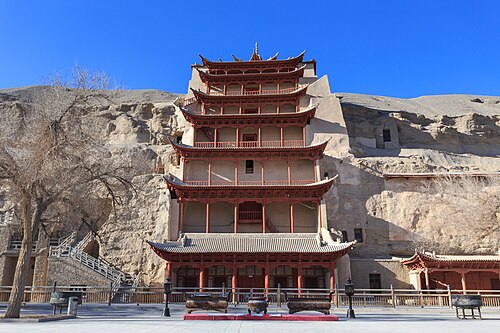
The sculpture shows a similar development, from simple groups of a Buddha and two bodhisattvas to large ensembles of seven or nine figures, including disciples and guardian kings. Two giant seated Maitreya Buddhas were built in the Tang: the northern one in Cave 96, about 35.5 m high, in 695 after edicts of Empress Wu Zetian, and a southern one, about 27 m high, in the early 8th century. The Great Buddha is housed in a multi-storey wooden façade, now nine storeys, that has been rebuilt several times. Cave 158, from the Tibetan period, holds a reclining Buddha entering nirvana, 15.6 m long, surrounded by painted mourners.
Donor portraits grew larger over time. Under the Guiyijun rulers, patrons such as Zhang Yichao appear in huge processions, and the Cao family appear alongside their allies, the royal families of Khotan and the Uyghur kingdoms. These paintings are an important source for costume, music, dance, architecture and daily life.
Intermediate
The Library Cave and its treasures
Cave 17, now called the Library Cave, is a small room off the corridor of Cave 16. It was originally a memorial chapel for the monk Hongbian, a senior Buddhist leader of Dunhuang who died around 862, and contained his portrait statue. At some point in the early 11th century it was filled with manuscripts, paintings and textiles, and its entrance was plastered over and painted so that it could not be seen.
On 25 June 1900 the Daoist priest Wang Yuanlu, who had made himself caretaker of the caves and was clearing sand from Cave 16, discovered the hidden door. Inside, according to the archaeologist Aurel Stein, bundles of manuscripts were piled in layers nearly three metres high, leaving only enough space for two people to stand.
The cache held around 50,000 items dated from the early 5th century to 1002. Most are Buddhist texts in Chinese, but there are also documents in Tibetan, Sanskrit, Khotanese, Sogdian, Old Uyghur and other languages, and texts of Confucianism, Daoism, Manichaeism and the Church of the East, as well as a Hebrew prayer. Alongside scriptures are contracts, letters, census and tax records, school exercises, poems, popular stories, calendars, medical texts, music and dance notation, a star chart and a manual of the board game Go.
The most famous single item is a printed copy of the Diamond Sutra dated to 868 CE, generally considered the oldest surviving printed book with a date. Its colophon says it was made "for universal free distribution" by a man named Wang Jie on behalf of his parents. The cave also contained more than a thousand paintings on silk and paper and many textiles, which transformed knowledge of Tang painting, since almost no original works had survived elsewhere.
Intermediate
Explorers, dispersal and a contested legacy
Wang Yuanlu reported his find to local officials, but they showed little interest and in 1904 ordered the cave resealed. In 1907 Aurel Stein, a Hungarian-born British archaeologist working for the British and Indian governments, persuaded Wang to let him take around seven thousand complete manuscripts and six thousand fragments, together with many paintings and textiles, in exchange for a donation toward Wang's restoration work. Stein could not read Chinese and chose largely at random.
In 1908 the French sinologist Paul Pelliot, who read Chinese fluently, spent weeks examining the remaining manuscripts and selected nearly ten thousand, including many rare secular documents. Japanese (Ōtani expedition, 1911–1912) and Russian (Sergei Oldenburg, 1914–1915) expeditions acquired more. When Chinese scholars such as Luo Zhenyu saw Pelliot's samples in Beijing in 1909, they recognised their value, and in 1910 the government ordered the rest sent to the capital, though many items were stolen on the way.
Other damage followed. In 1921 Russian soldiers fleeing the civil war were interned in some caves and damaged murals. In 1924 the American Langdon Warner removed several mural fragments and a sculpture, now at Harvard. Today the largest collections of Dunhuang material are in Beijing, London, Paris and St Petersburg, with others in Japan, India and elsewhere.
The dispersal remains a painful subject. In China it is often described as a national loss and a symbol of foreign exploitation in a weak era. Wang Yuanlu is "both revered and reviled": he found the library and protected the caves as best he could, but he sold the manuscripts cheaply. Western institutions have argued that the items were preserved and studied when they might otherwise have been lost. Since 1994 the International Dunhuang Project (now Programme), led by the British Library with partners in China and elsewhere, has worked to digitise the scattered collections and reunite them online.
Intermediate
Protecting the caves today
Modern care of the site began in the 1940s. The painter Zhang Daqian spent more than two years copying murals from 1941, and his exhibitions made Dunhuang art famous in China, although he was later criticised for removing later paint layers to reach older ones. In 1944 the National Research Institute of Dunhuang Art was founded at Mogao; it became the Dunhuang Academy. In 1961 the caves were listed among China's first nationally protected monuments, and the cliff face was reinforced in the 1960s.
The main threats are natural and human. Wind-blown sand erodes the cliff and fills the caves; salts in the rock and plaster move with moisture and cause the paint to flake and blister; and the humidity and carbon dioxide from large numbers of visitors speed up this damage. From 1989 the Dunhuang Academy worked with the Getty Conservation Institute on sand control, environmental monitoring, the conservation of the paintings in Cave 85 and a sustainable visitor policy.
Mogao now receives very large numbers of visitors, so access is managed carefully: only a selection of caves is open at any time, entry is by timed ticket, and visitors first watch films in a visitor centre. The Academy has also led the digitisation of the caves since the 1990s, producing high-resolution photographs and panoramic models so that the art can be studied and enjoyed without further harm.
Advanced
Debate: why was the Library Cave sealed?
No document explains why the Library Cave was filled and sealed, and because it was opened without scientific recording, and disturbed by Wang, Stein and Pelliot before anyone described it carefully, much evidence was lost. The latest dated document is from 1002, so most scholars place the sealing shortly after that, though a few, such as Susan Huntington, have argued for a later date.
Stein proposed that the cave was a repository for sacred waste: worn-out, incomplete or obsolete manuscripts that could not be thrown away because they contained holy words. Some have linked this to the spread of printed scriptures, which made old hand-copied ones redundant. The many fragments, duplicates and reused sheets support this view.
Pelliot proposed instead that the monks hid their library in an emergency, perhaps before the Tangut (Western Xia) conquest of the 1030s. The historian Rong Xinjiang has argued that the collection was the library of the nearby Sanjie monastery, and that it was sealed around 1006 in response to news that the Buddhist kingdom of Khotan had fallen to the Muslim Karakhanids, who were destroying Buddhist sites. Others have suggested that the sealing was a pious act connected with fears of the end of the Buddhist Dharma.
These theories are not mutually exclusive, and the question remains open. It matters because the nature of the collection, whether a curated library, a store of discarded texts or an emergency hoard, affects how historians interpret what it tells us about Dunhuang society.
Advanced
Dunhuangology: what the caves changed in scholarship
The study of Dunhuang material became a field of its own, known in Chinese as Dunhuangxue ("Dunhuangology"). The manuscripts have transformed the study of Chinese Buddhism, preserving early Chan (Zen) texts, apocryphal scriptures composed in China, and popular genres such as "transformation texts" (bianwen), prose-and-verse retellings of Buddhist stories performed for audiences, which are important for the history of Chinese vernacular literature.
They are equally important for social and economic history. Contracts, household registers, loan documents, association rules and monastery accounts reveal how ordinary people borrowed grain, hired labour, organised funerals and paid taxes in a frontier society under Tang, Tibetan and Guiyijun rule. The Tibetan documents are among the oldest substantial sources for the history of the Tibetan Empire, and Khotanese and Sogdian texts have helped reconstruct those languages.
Art historians face their own questions. How were the cave paintings planned, and did painters use pattern books? How did the "international" Tang style relate to painting in the capital, Chang'an, of which almost nothing survives? Scholars also debate how far local patrons, rather than distant dynasties, shaped the programme of each cave, and how the caves were actually used in ritual.
Finally, Mogao raises questions about heritage itself: who owns objects dispersed in the colonial era, how to balance tourism with preservation, and how digital technology can share fragile heritage. The site has become a model for these debates, and the international cooperation around it, from the International Dunhuang Programme to conservation partnerships, is an important part of its modern story.
Key ideas
- Cave temple
- A Buddhist shrine dug into a cliff, used for worship, meditation and pilgrimage.
- Silk Road
- The network of trade routes linking China with Central Asia, India, Persia and the Mediterranean, along which Buddhism travelled.
- Sutra illustration (bianxiang)
- A large painting that turns a Buddhist scripture into a detailed visual scene, such as a paradise.
- Donor portraits
- Images of the people who paid for a cave, showing their names, families and status.
- Library Cave
- Cave 17, a sealed chamber holding about 50,000 documents from the 5th to 11th centuries.
- Dispersal
- The removal of Dunhuang manuscripts and art to collections around the world in the early 20th century.
- Preventive conservation
- Protecting heritage by controlling its environment and use rather than only repairing damage.
Records
- c. 111 BCE — The Han dynasty establishes a frontier garrison at Dunhuang.
- 366 CE — According to tradition, the monk Le Zun digs the first cave after a vision of a thousand Buddhas.
- c. 420 CE — The oldest surviving decorated caves (268, 272, 275) are made under the Northern Liang.
- 695 CE — The giant Maitreya Buddha of Cave 96, about 35.5 m high, is completed.
- c. 786 CE — Dunhuang comes under Tibetan rule (until 848).
- 848 CE — Zhang Yichao expels the Tibetans and founds the Guiyijun regime.
- 868 CE — The Diamond Sutra, later found in the Library Cave, is printed.
- 1002 — Date of the latest document in the Library Cave; the cave is sealed soon afterwards.
- 1900 — Wang Yuanlu discovers the Library Cave on 25 June.
- 1907 — Aurel Stein acquires thousands of manuscripts; Paul Pelliot follows in 1908.
- 1944 — The Dunhuang Art Research Institute (later the Dunhuang Academy) is founded.
- 1987 — The Mogao Caves are inscribed on the UNESCO World Heritage List.
Glossary
- Oasis
- A green, watered place in a desert where people can live and travellers can rest.
- Mural
- A painting made directly on a wall.
- Bodhisattva
- In Mahayana Buddhism, a being who seeks enlightenment in order to help all others reach it.
- Apsara
- A flying celestial being, often shown playing music or scattering flowers.
- Stupa
- A Buddhist monument, originally a mound holding relics, around which worshippers walk.
- Maitreya
- The Buddha of the future, expected to appear in a later age.
- Conglomerate
- Rock made of pebbles and sand cemented together; soft and crumbly at Mogao.
- Colophon
- A note at the end of a manuscript or book recording who made it, when and why.
- Dunhuang Academy
- The institution that has cared for and studied the caves since 1944.
Questions and answers
How many caves are there?
735 survive, of which 492 are decorated with paintings and sculpture. In the Tang dynasty there were more than a thousand.
Who made the caves?
Monks, craftsmen and painters, paid for by donors ranging from royal families and local rulers to merchants, officials and groups of ordinary villagers.
Why are they called the Caves of the Thousand Buddhas?
Perhaps from the founding legend of a vision of a thousand Buddhas, or from the many tiny Buddha images painted in rows on the walls.
What was the most important thing found in the Library Cave?
Many would say the Diamond Sutra of 868, the oldest surviving dated printed book, but historians value the everyday documents just as much.
Why are so many Dunhuang manuscripts outside China?
Foreign expeditions bought or removed them between 1907 and the 1920s, when the Chinese government did little to protect them.
Why was the Library Cave sealed?
No one knows for certain. Theories include storing sacred waste, hiding a library from invaders, and a religious response to fears of the decline of Buddhism.
Can I visit all the caves?
No. To protect the paintings, only some caves are open at a time, with limited, timed entry. Many can be explored through digital tours.
Sources and further reading
- Mogao Caves. Wikipedia
- Mogao Caves. UNESCO World Heritage Centre
- Wall Paintings Conservation at Mogao Grottoes. Getty Conservation Institute
- Library Cave. Wikipedia
- Dunhuang manuscripts. Wikipedia
- Diamond Sutra. Wikipedia
- Wang Yuanlu. Wikipedia
- Roderick Whitfield, Susan Whitfield and Neville Agnew, Cave Temples of Mogao: Art and History on the Silk Road. Getty Conservation Institute, 2000
Related
- Ajanta CavesA group of Buddhist rock-cut caves in western India, known for monasteries, shrines and paintings.
- SeokguramEighth-century Buddhist grotto near Gyeongju, known for its granite Buddha and surrounding sculptures.
- JikjiKorean anthology of Seon (Zen) Buddhist teachings printed in 1377 at Heungdeoksa, the oldest surviving book printed with movable metal type.
- Siddhartha Gautama (the Buddha)Founder of Buddhism, who taught a path to liberation from suffering on the Ganges plain. His dates are disputed.
- Battle of TalasBattle in 751 between forces of the Abbasid Caliphate and Tang China, with Central Asian groups taking part.
- BorobudurLarge Buddhist monument in Central Java, built around the eighth and ninth centuries.
Written with AI assistance from the published sources listed above, and revised as new research appears.