Start at the top for an easy introduction. Go further down for more detail and scholarship.
- Easy
- Intermediate
- Advanced
For young readers
Imagine you want to make many copies of a book, but there are no photocopiers and no computers. You could copy it by hand, page after page, but that takes a very long time. Printers in Korea found a clever answer: they made each written character as a tiny block of metal, like a stamp.
They could line up the little metal stamps to make a page, cover them with ink, press paper on top, and get a printed page. When the page was finished, they could take the stamps apart and use them again to make a different page. This is called “movable type”, because the letters can be moved around.
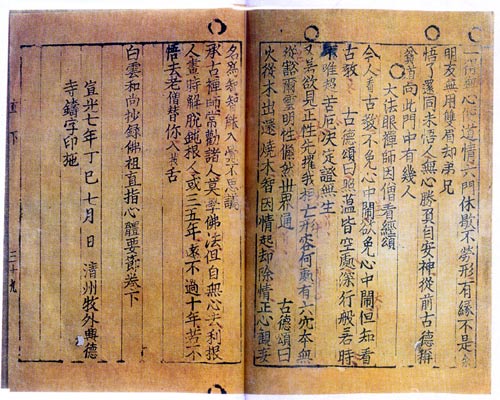
In the year 1377, Buddhist monks at a temple called Heungdeoksa, near the city of Cheongju in Korea, used metal type like this to print a book of wise teachings. Its short name is Jikji, which means “pointing directly”. The book collects sayings of famous Buddhist teachers about how to find the calm, clear mind that Buddhists call the mind of the Buddha.
Jikji was printed about 78 years before Johannes Gutenberg printed his famous Bible in Germany. The monks printed two volumes, but only the second one has survived. Today it is kept in the National Library of France in Paris.
Many people in Korea would like the book to come home, while the library in France says it should stay there as a treasure for everyone. Wherever it is kept, Jikji reminds us that the idea of printing with metal letters grew in more than one part of the world.
At a glance
- Full title
- Baegun hwasang chorok buljo jikji simche yojeol (“Selected teachings of the Buddhas and patriarchs pointing directly to the essence of mind, excerpted by the monk Baegun”)
- Compiler
- The Seon (Zen) monk Baegun Gyeonghan (1298–1374), who put the collection together in 1372
- Printed
- Seventh lunar month of 1377 (third year of King U of Goryeo), with cast metal type
- Place
- Heungdeoksa temple, outside the walls of Cheongju, Goryeo (today Cheongju, North Chungcheong Province, South Korea)
- Surviving copy
- Volume 2 only (first leaf missing), about 24.6 × 17 cm; Bibliothèque nationale de France, Paris
- Woodblock edition
- Printed 1378 at Chwiamsa, Yeoju; complete copies survive in Korea (Treasure No. 1132)
- Recognition
- UNESCO Memory of the World Register, 2001; namesake of the UNESCO/Jikji Memory of the World Prize (from 2004)
Easy
What is Jikji?
Jikji is the short name of a Korean Buddhist book whose full title is Baegun hwasang chorok buljo jikji simche yojeol. Put simply, it is an anthology: a collection of short passages, sayings and verses by Buddhas and famous Chan (in Korean, Seon; in Japanese, Zen) masters, chosen to help students understand how to awaken to their own true nature. The word jikji, “pointing directly”, comes from a well-known Seon phrase that means “point directly at the human mind; see its nature and become a Buddha”.
Jikji is famous not mainly for what it says but for how it was made. According to the note printed at the end of the book, it was printed in the seventh month of 1377 at Heungdeoksa, a temple outside the town of Cheongju, using cast metal type. No older book printed with movable metal type is known to survive anywhere in the world. UNESCO recognised this when it added the book to the Memory of the World Register in 2001.
The monks printed the work in two volumes. The first volume is lost. The second survives, missing its first leaf, and belongs to the Bibliothèque nationale de France (BnF) in Paris, which has made a digital copy available online. A year after the metal-type printing, in 1378, another group of disciples carved the text onto wooden blocks and printed it again; copies of that woodblock edition survive in Korea.
Easy
How do you print a book with metal letters?
Written Chinese characters, which educated Koreans used for books at the time, are not an alphabet of a few dozen letters. Each character stands for a word or part of a word, so a printer needs thousands of different ones. To print with movable type, workers had to make a separate little piece of metal for every character that appeared on a page, and often several copies of common characters.
One method described for early Korean type is wax casting. A craftsman carved a character in beeswax, packed fine clay or sand around it, and heated it so the wax melted away and left a hollow mould. Molten metal was poured into the hollow, and when it cooled and the mould was broken, out came a small metal block with the character standing up in reverse, like a stamp.
The printer then arranged the pieces of type in a frame, line by line, to match the text. The pieces were held steady, inked with a brush, and a sheet of thin paper was laid on top and rubbed gently from behind. Korean printers did not use a screw press like the one Gutenberg later used in Europe. After enough copies were made, the frame was taken apart and the same type could be reused for the next page.
Jikji shows that this was hard work for a temple workshop. Its lines are sometimes crooked, the ink is darker in some places than others, and a few characters are printed upside down or only partly. These little mistakes are actually useful: they help scholars prove that the book was printed from movable pieces and not carved on a single woodblock.
Easy
What is inside the book?
Jikji is a textbook for Buddhist practice. Its compiler, the monk Baegun, selected passages from the lives and sayings of earlier teachers, starting with the seven Buddhas of the past and continuing through Indian and Chinese masters of the Chan lineage. Many passages are short stories of a student and a teacher meeting, in which the teacher’s surprising answer helps the student suddenly understand.
The central idea is that the Buddha is not somewhere far away. Seon teaching holds that every person’s mind is originally pure, and that by seeing one’s own nature clearly a person discovers that his or her mind is the mind of the Buddha. The book’s title, “pointing directly to the essence of mind”, sums up this message.
People sometimes call the book Jikji simgyeong, “the Jikji sutra”, but Korean scholars point out that this is a mistake. A sutra (gyeong) is a scripture believed to record the Buddha’s own teaching, whereas Jikji is a yojeol, a set of selected essential passages compiled by a later monk.
Intermediate
Baegun and the world of Goryeo Buddhism
Baegun Gyeonghan (1298–1374) was a Seon monk of the late Goryeo dynasty (918–1392). In 1351 he travelled to China, then ruled by the Mongol Yuan dynasty, and studied with the Chan master Shiwu Qinggong (石屋淸珙), a teacher in the Linji (Korean: Imje) lineage. According to Korean accounts, Shiwu gave Baegun a collection of Chan sayings, and Baegun later expanded it into the two-volume anthology we call Jikji. He completed the compilation in 1372, when he was about 75, and died two years later at Chwiamsa temple in Yeoju.
Buddhism was the leading religion of Goryeo and enjoyed royal patronage. Temples were major centres of learning, and they had long experience with printing. Goryeo had carved the entire Buddhist canon on woodblocks twice, most famously in the thirteenth century, when the Tripitaka Koreana was produced during the Mongol invasions. Printing Buddhist texts was also considered an act of merit, a good deed that could benefit the sponsor and others.
The colophon at the end of Jikji records that the printing at Heungdeoksa was carried out by Baegun’s disciples, the monks Seokchan and Daljam, with support from a Buddhist nun named Myodeok. The involvement of a nun as patron is a reminder that women took an active part in Goryeo religious life and in sponsoring books.
The 1370s were a troubled time. Goryeo was trying to free itself from Mongol control, pirates raided its coasts, and the political turmoil that would lead to the founding of the Joseon dynasty in 1392 was already building. Printing a book of meditation teachings with the newest technology in this period shows how seriously the monks took the preservation of their tradition.
Intermediate
Where Jikji fits in the history of printing
Printing began in East Asia with woodblocks, where a whole page is carved in reverse on a single board. Korea preserves one of the oldest known woodblock prints, a Buddhist dharani sutra found inside the Seokgatap pagoda at Bulguksa and dated to before 751. Movable type came later. The Chinese scholar Shen Kuo described how a craftsman named Bi Sheng made movable type from baked clay in the 1040s, and wooden movable type was also used in China and among the Uyghurs.
Goryeo appears to have taken the next step by casting type in metal. Written sources mention a ritual text, the Sangjeong gogeum yemun, printed with cast type in the first half of the thirteenth century, but no copy survives. Another text, a Buddhist song of enlightenment (Nammyeong cheonhwasang songjeungdoga), survives in a woodblock edition of 1239 whose colophon says it was recut from a metal-type edition. These records show that metal type existed in Korea more than a century before Jikji, even though Jikji is the oldest surviving book actually printed with it.
After the founding of Joseon, the state took up metal type on a large scale. The royal foundry cast a font in 1403 (the Gyemija type) and a much improved one in 1434 (the Gabinja type) under King Sejong. Official type was more uniform and better cast than the temple type used for Jikji, and it was used to print government, Confucian and historical books, including the Veritable Records of the Joseon Dynasty.
In Europe, Johannes Gutenberg developed printing with cast metal type in Mainz in the mid-fifteenth century; his 42-line Bible was completed around 1454–1455, roughly 78 years after Jikji. Gutenberg’s system combined a type mould for rapid casting, a metal alloy, oil-based ink and a screw press, and it suited an alphabet of a few dozen letters. It spread rapidly and transformed European society. Korean metal-type printing remained mostly a tool of the state and of temples, producing smaller numbers of copies.
Intermediate
How Jikji travelled to Paris
Almost nothing is known about the metal-printed Jikji for the five centuries after 1377. It reappears at the end of the nineteenth century in the collection of Victor Collin de Plancy, the first French diplomatic representative in Korea, who served in Seoul from 1888 to 1891 and again from 1896 to 1906. Collin de Plancy collected Korean books and ceramics; exactly how and where he acquired Jikji is not recorded. By the time he owned it, the first volume was already gone and the second had lost its first leaf.
His secretary and fellow scholar Maurice Courant (1865–1935) catalogued Korean books in the monumental Bibliographie coréenne, and in a supplement published in 1901 he included Jikji and noted its 1377 date and metal-type printing. A note in French on the cover, attributed to Courant, describes it as the oldest known Korean book printed with cast type.
In 1911 Collin de Plancy sold much of his collection at auction in Paris. Jikji was bought for 180 francs by Henri Vever, a jeweller and collector. After Vever’s death his collection passed on, and Jikji entered the Bibliothèque nationale de France in 1950, where it is kept in the department of manuscripts among the oriental collections.
Intermediate
Rediscovery: Park Byeong-seon and the temple site
For decades the book sat quietly in the library. Its importance became widely known through Park Byeong-seon (1923–2011), a Korean historian who worked as a librarian at the BnF. She studied the volume, confirmed the significance of its colophon, and in 1972 it was displayed at the library’s exhibition for the International Book Year organised with UNESCO, where it drew worldwide attention as the oldest surviving book printed with metal type.
One question remained: where exactly was Heungdeoksa? The colophon said only that the temple lay outside Cheongju, and the temple had long disappeared. In 1985 archaeologists from Cheongju University excavated a site in Uncheon-dong, Cheongju, and found objects inscribed with the name Heungdeoksa, confirming the location.
The site was restored in the early 1990s, and the Cheongju Early Printing Museum opened next to it in 1992. Since 2000 the museum has made Jikji its central theme. Cheongju has built its identity as a “city of Jikji”, hosting festivals and supporting projects to reconstruct the lost type.
Park Byeong-seon also located, in the same library, the royal protocol books (uigwe) that French troops had taken from the Oegyujanggak archive on Ganghwa Island in 1866. Her work helped start the long campaign that brought those books back to Korea in 2011.
Intermediate
Jikji today: memory, pride and a world prize
On 4 September 2001 the second volume of Jikji was inscribed on UNESCO’s Memory of the World Register, which lists documentary heritage of world significance. In 2004 UNESCO created the UNESCO/Jikji Memory of the World Prize, funded by the Korean government and awarded to institutions that preserve documentary heritage and make it accessible.
In Korea, Jikji is taught in schools as a symbol of the country’s early achievements in science and technology, alongside the Tripitaka Koreana woodblocks and the creation of the Korean alphabet in the fifteenth century. Replicas and digital facsimiles are displayed in museums, and a typeface based on the Jikji characters has been released for public use.
From 2011 to 2016 the city of Cheongju funded a project to recreate the lost metal type of both volumes. Using wax casting and the 1378 woodblock edition as a guide for missing text, craftsmen reproduced tens of thousands of characters. Such reconstructions are experiments: they test how the monks might have worked, but they cannot tell us for certain what the lost first volume looked like.
The book also plays a part in public debates about global history. It is often used to challenge the idea that printing with movable type was a purely European invention, and to encourage a more connected, many-centred picture of how technologies developed.
Advanced
Who should keep Jikji? The ownership debate
Jikji is at the centre of a long-running dispute. Many Korean groups argue that it is an essential part of Korean heritage and should return to the country where it was made. The BnF, supported by French law on the inalienability of national collections, maintains that Jikji was acquired lawfully, that it now belongs to the shared heritage of humanity, and that it is properly conserved and accessible in Paris.
The case differs from that of the Oegyujanggak uigwe. Those books were seized by French forces during a military expedition in 1866, and after long negotiations they were returned in 2011 through a renewable loan arrangement. Jikji, by contrast, appears to have been bought by a diplomat and then sold at a public auction, so the legal grounds for a claim are much weaker. Korean commentators have therefore tended to focus on loans for exhibition, research access and digital sharing rather than on legal restitution.
The debate raises broader questions that museums worldwide now face: how to weigh legal title against the cultural ties of source communities, what it means for an object to be “world heritage” while it is held in one country, and whether digital access can reduce the need for physical return. There is no consensus answer, and readers will find passionate and reasonable arguments on both sides.
Advanced
“Oldest surviving” versus “first”: questions scholars ask
Specialists are careful to call Jikji the oldest extant book printed with movable metal type, not the first. Written evidence suggests that Goryeo printers used cast type at least as early as the 1230s, in the Ganghwa period of the Mongol wars, and possibly earlier. The Sangjeong gogeum yemun is known only through a record by the scholar-official Yi Gyu-bo, and the 1239 songjeungdoga woodblock edition only tells us that a metal-type edition once existed. Jikji’s value lies in being physical proof, with a precise date and place in its own colophon.
Claims of earlier surviving metal type have been controversial. In 2010 a set of metal characters called the jeungdoga-ja was presented as Goryeo type that might predate Jikji. After years of analysis, the national heritage authority decided in 2017 not to designate them as cultural heritage, citing unresolved doubts about their origin and date. Most scholars therefore continue to regard Jikji as the earliest securely dated survivor.
Another question is whether Korean metal-type printing influenced Gutenberg. Some writers have suggested that knowledge travelled across Eurasia along trade and diplomatic routes during the Mongol era. However, there is no documentary evidence of such a transfer, and the technical differences between the Korean and European methods (casting technique, ink, press, the kind of script) are substantial. The prevailing view is that the two developments were independent, although research into Eurasian exchanges continues.
Finally, scholars discuss why metal type in Korea did not produce the kind of “printing revolution” seen in early modern Europe. Explanations include the large number of characters needed for Classical Chinese, the smaller book market, state and temple control over printing, and the continued efficiency of woodblock printing for texts reprinted over long periods. Some historians argue that comparing the two cases through a single model of “revolution” is itself misleading, because the social uses of printing differed.
Advanced
Reading the evidence: colophon, paper and type
The key primary evidence is the colophon (ganggi) on the last leaf, which states that the book was printed with cast type (juja) at Heungdeoksa outside Cheongju in the seventh month of the third year of King U’s reign (1377), and names the monks and patron involved. Because the rest of the surviving volume is printed, and the colophon is part of the same printing, its date is generally accepted as reliable.
Physical features support the claim of movable-type printing. The same characters recur with identical shapes on different leaves, but not on the same leaf, as one would expect when a limited stock of type is reused. Lines are slightly askew, ink density varies, some characters are inverted or incomplete, and there are smudges around the edges of pieces of type. The woodblock edition of 1378, by contrast, shows the steadier lines typical of carved blocks. The 1378 edition also adds a preface by the scholar Yi Saek, and its colophon explains that it was made by the disciple Beomnin at Chwiamsa.
The surviving metal-type volume measures about 24.6 by 17 cm and is printed on thin paper folded double in the East Asian manner, with a cover that appears to be a later replacement. Conservation and imaging by the BnF, and comparison with other Goryeo books printed with type from Heungdeoksa, allow scholars to study the shapes and sizes of individual characters. Questions about the precise casting method, whether wax casting or sand casting, remain under discussion, and reconstructions such as Cheongju’s wax-casting project should be seen as informed hypotheses.
Key ideas
- Movable type
- Printing from individual pieces, one for each character, that can be arranged into a page and then reused for other pages.
- Oldest extant, not first
- Jikji is the oldest surviving book printed with metal type; written records show Korean metal type was used earlier, but those books are lost.
- Seon (Zen) teaching
- The book’s message is that one’s own mind, seen clearly, is the mind of the Buddha: “point directly at the mind, see its nature and become a Buddha”.
- Colophon as evidence
- The printer’s note at the end of the book gives the date, place and method of printing, making it a precise historical document.
- Temple printing
- Jikji was printed by monks in a temple workshop with support from a nun, showing that Goryeo Buddhist communities were centres of technology and learning.
- Many-centred history of technology
- Jikji is often used to show that printing developed in several places, in East Asia and Europe, rather than being invented once.
- Heritage and ownership
- The book raises the question of who should keep cultural objects that left their country of origin through purchase rather than war.
Records
- 1239 — A woodblock edition of the songjeungdoga is recut from an earlier metal-type edition, showing that Goryeo already used metal type.
- 1351 — The monk Baegun studies in Yuan China with the Chan master Shiwu Qinggong.
- 1372 — Baegun completes his two-volume anthology of Seon teachings.
- 1377 — Seventh lunar month: his disciples print Jikji with metal type at Heungdeoksa, outside Cheongju.
- 1378 — A woodblock edition is printed at Chwiamsa, with a preface by Yi Saek.
- c. 1455 — Gutenberg’s 42-line Bible is completed in Mainz, about 78 years after Jikji.
- 1901 — Maurice Courant lists Jikji in a supplement to his Bibliographie coréenne.
- 1911 — Henri Vever buys Jikji at auction in Paris for 180 francs.
- 1950 — Jikji enters the Bibliothèque nationale de France.
- 1972 — Exhibited in Paris for the International Book Year after study by Park Byeong-seon.
- 1985 — Excavations confirm the location of Heungdeoksa in Cheongju.
- 2001 — Inscribed on UNESCO’s Memory of the World Register.
Glossary
- Goryeo
- The Korean dynasty that ruled from 918 to 1392; the English name “Korea” comes from it.
- Seon
- The Korean form of Chan Buddhism, known in Japan as Zen, which emphasises meditation and direct insight.
- Colophon (ganggi)
- A note at the end of a book recording when, where, how and by whom it was printed.
- Wax casting
- Making a mould around a wax model that is melted out, then pouring molten metal into the hollow.
- Woodblock printing
- Printing from a whole page carved in reverse on a wooden board.
- Yojeol
- A collection of essential selected passages, as opposed to a sutra, which records the Buddha’s teaching.
- Uigwe
- Illustrated Joseon royal protocol books; some taken by France in 1866 were returned to Korea in 2011.
- Memory of the World
- A UNESCO programme that registers and helps preserve documentary heritage of global significance.
- Bibliothèque nationale de France (BnF)
- The national library of France in Paris, which holds the surviving metal-type volume of Jikji.
Questions and answers
Is Jikji older than the Gutenberg Bible?
Yes. Jikji was printed in 1377, and the Gutenberg Bible was completed around 1454–1455, about 78 years later.
Did Korea invent printing?
No single country invented printing. Woodblock printing and early movable type developed in China, and Korea pioneered metal movable type. Jikji is the oldest surviving book printed that way.
Why is only one volume left?
The first volume was already missing when the French diplomat Collin de Plancy acquired the book in the late nineteenth century. What happened to it is unknown.
Can I see Jikji?
The original belongs to the National Library of France and is rarely displayed, but the library offers a digital copy online, and the Cheongju Early Printing Museum shows replicas.
Why hasn’t France returned Jikji?
The library holds that it was acquired legally and belongs to the world’s shared heritage; French law also makes national collections inalienable. Many Koreans disagree and continue to call for its return.
Is there any older metal type still in existence?
Some metal characters have been claimed as older Goryeo type, notably the jeungdoga-ja, but their authenticity and date have not been accepted by the national heritage authority. Jikji remains the earliest securely dated evidence.
How do scholars know Jikji was printed with movable type rather than a carved block?
Its colophon says so, and physical clues agree: identical characters recur on different leaves, lines are uneven, and some characters are inverted or partially printed.
Sources and further reading
- Baegun hwasang chorok buljo jikji simche yojeol (vol. II), the second volume of “Anthology of Great Buddhist Priests’ Zen Teachings”. UNESCO Memory of the World Register, 2001
- 백운화상초록불조직지심체요절 (白雲和尙抄錄佛祖直指心體要節). Encyclopedia of Korean Culture, Academy of Korean Studies
- 금속활자 (Metal movable type). Encyclopedia of Korean Culture, Academy of Korean Studies
- Jikji. Wikipedia
- 직지심체요절. 위키백과
- Movable type. Wikipedia
- Heungdeoksa. Wikipedia
Related
- Gutenberg BibleLatin Bible printed in Mainz in the 1450s using movable metal type.
- Tripitaka KoreanaGoryeo Buddhist canon carved on woodblocks in the thirteenth century.
- HunminjeongeumThe Korean alphabet promulgated by King Sejong in 1446, and the title of the text explaining it.
- Veritable Records of the Joseon DynastyOfficial day-by-day chronicles of 25 Joseon kings from 1392 to 1863, compiled in the capital from court historians’ drafts.
- Cai LunAn Eastern Han court official traditionally credited with presenting an improved method of making paper in 105 CE.
- SeokguramEighth-century Buddhist grotto near Gyeongju, known for its granite Buddha and surrounding sculptures.
Written with AI assistance from the published sources listed above, and revised as new research appears.