Start at the top for an easy introduction. Go further down for more detail and scholarship.
- Easy
- Intermediate
- Advanced
For young readers
Before paper, people in China wrote on strips of bamboo or wood tied together with string, or on silk cloth. Bamboo books were very heavy: a long book could fill a cart. Silk was light, but it cost a lot of money. People needed something light, cheap and easy to write on.
Cai Lun worked in the palace of the emperor in the capital city, Luoyang, nearly two thousand years ago. He was in charge of the palace workshops, where skilled craftsmen made swords, tools and fine objects for the emperor.
An old history book says that Cai Lun had a clever idea. He took the inner bark of trees, scraps of hemp, worn-out cloth and old fishing nets, soaked and boiled them, and pounded them into a soft mush of tiny fibres. When this mush was mixed with water and scooped up on a fine screen, the fibres made a thin sheet. When it dried, it was paper!
In the year 105 he showed his paper to the emperor, who was delighted. Soon people everywhere were using it and called it “Marquis Cai’s paper”. Later, archaeologists dug up pieces of even older paper, so Cai Lun did not make the very first paper. But he made it better and helped it spread, a bit like someone who takes a clever gadget and turns it into something everyone can use.
From China, papermaking slowly travelled to Korea, Japan, Central Asia, the Middle East and finally Europe. Every book, notebook and newspaper you have ever seen is part of the story that Cai Lun helped to start.
At a glance
- Lived
- Born c. 50–62 CE (exact year unknown); died 121 CE
- Birthplace
- Guiyang Commandery, traditionally identified with modern Leiyang, Hunan Province, China
- Worked
- Imperial palace at Luoyang, capital of the Eastern Han dynasty
- Position
- Palace eunuch; Regular Palace Attendant (zhongchang shi) and Director of the Imperial Workshops (shangfang ling)
- Achievement
- Presented an improved papermaking method to Emperor He in 105 CE (first year of the Yuanxing era)
- Materials
- Tree bark, hemp waste, old rags and fishing nets
- Title
- Marquis of Longting (114 CE); his paper was called “Marquis Cai’s paper” (蔡侯紙)
- Main source
- His biography in the Book of the Later Han (Hou Hanshu), chapter 78, Biographies of Eunuchs
Easy
Who was Cai Lun?
Cai Lun (蔡倫), courtesy name Jingzhong, was a eunuch official at the court of the Eastern Han dynasty (25–220 CE) in China. Chinese tradition has long honoured him as the inventor of paper. Modern historians describe his role more precisely: paper already existed before him, but he developed and presented an improved method that used new, cheaper raw materials and produced paper good enough for writing. His report to the throne in 105 CE is the first official record of papermaking in Chinese history.
Almost everything we know about him comes from a short biography of about three hundred Chinese characters in the Book of the Later Han, compiled in the fifth century from earlier Han records. It tells of his career, his skill as a craftsman-administrator, his involvement in palace politics and his dramatic death.
Although he lived nearly two thousand years ago, Cai Lun is still a well-known figure in China and beyond. He was worshipped as a patron god by papermakers, and modern lists of the most influential people in history often include him.
Easy
Why the world needed paper
In early China, most writing was done on bamboo or wooden slips: thin strips, each holding a single column of characters, tied together with cords into rolls. Government records, letters, laws and books were all written this way. Slips were cheap to make but bulky and heavy. Wealthy people could write on silk, which was light and smooth but very expensive.
The Book of the Later Han puts the problem neatly: “Since ancient times, writings were mostly on bundled bamboo slips; those on silk were called zhi. Silk was costly and slips were heavy, so neither was convenient.” Interestingly, the word zhi, which today means paper, first referred to writing material made of silk.
Writing on slips shaped the whole culture of the scribe. A clerk kept a brush for writing and a small knife for scraping away mistakes from the wood or bamboo, which is why junior officials were sometimes called “knife-and-brush clerks”. A single long text needed hundreds or thousands of slips, and when the cords rotted the slips could fall out of order, causing confusion that later scholars still struggle to sort out. Sending a long report to the capital meant carrying a heavy load.
The Han empire was a huge bureaucratic state, with officials sending reports, registers and orders across thousands of kilometres. A light, cheap writing material that could be made in large quantities would change how information was stored and moved. This is the need that paper met.
Easy
How Han paper was made
According to his biography, Cai Lun “used tree bark, hemp ends, worn-out cloth and fishing nets to make paper”. All of these contain plant fibres. Hemp and ramie were used for cloth and ropes; the bark was probably the inner bark of trees such as the paper mulberry, whose long, strong fibres later became the classic material of East Asian paper.
The general process, known from later Chinese descriptions and from experiments with Han-period techniques, went like this. The raw materials were cut up, soaked in water, and boiled, probably with plant ash or lime, which helps break them down. Then they were pounded with mallets or in a mortar until the fibres separated into a pulp. The pulp was stirred into a vat of water. A worker dipped a screen stretched on a frame into the vat, or poured pulp onto it, and lifted it out so that the water drained through, leaving a thin, even mat of fibres. The sheet was pressed and dried in the sun or on a wall.
The key idea is that paper is not woven. Unlike cloth, it is made of countless tiny fibres that lock together as they dry. Recycled rags and nets were especially valuable because their fibres had already been processed, and using bark opened up a nearly unlimited supply.
Intermediate
Life and career at the Han court
Cai Lun came from Guiyang Commandery in the south, traditionally identified with modern Leiyang in Hunan. Nothing is known of his family; he was probably from a humble background. He entered palace service as a eunuch at the end of the Yongping era (58–75 CE) under Emperor Ming, and in the Jianchu era (76–84) under Emperor Zhang became a Junior Attendant of the Yellow Gates (xiao huangmen).
When the ten-year-old Emperor He came to the throne in 88 CE, Cai Lun was promoted to Regular Palace Attendant (zhongchang shi), the highest post reserved for eunuchs, and took part in confidential deliberations. His biography praises him as talented and learned, devoted and careful, often daring to criticize the emperor’s mistakes. On his days off he shut his door to visitors and went out to the fields.
He was also appointed Director of the Imperial Workshops (shangfang ling), which produced weapons, instruments and luxury goods for the palace. In 97 CE he supervised the making of swords and other implements that, the history says, were so finely made they became models for later generations. It was probably in this setting, with skilled artisans and materials at his disposal, that the improved papermaking method was developed. In 105 CE (the first year of Yuanxing) he presented it to Emperor He, who praised his ability, and from then on, the history says, it was used everywhere.
Emperor He died early in 106. Real power passed to his widow, Empress Dowager Deng Sui, who governed as regent. She rewarded Cai Lun: in 114 he was made Marquis of Longting with the revenue of 300 households, and later became Grand Coachman of the Changle Palace, the dowager’s household. In 117 she placed him in charge of a project in which scholars at the Eastern Pavilion (Dongguan) library collated and corrected the texts of the Confucian classics and histories.
Intermediate
Palace intrigue and a tragic end
The Eastern Han court was a dangerous place. Emperors often came to the throne as children, and power was fought over by the families of empresses (the consort clans) and by palace eunuchs. Cai Lun rose through this world and was also stained by it.
Years earlier, under Emperor Zhang, Empress Dou had schemed to remove a rival, Consort Song, whose son was the heir apparent. According to the Book of the Later Han, Cai Lun, acting on Empress Dou’s hints, took part in falsely accusing Consort Song, who then took her own life, and her son was demoted. That son’s son later became Emperor An.
When Empress Dowager Deng died in 121 CE and Emperor An took personal control of the government, he ordered Cai Lun to present himself to the Commandant of Justice. Ashamed to face humiliation, Cai Lun bathed, put on his formal robes and cap, and drank poison. His marquisate was abolished. His tomb is traditionally located at Longting in Yang County, Shaanxi Province, the site of his former fief.
Intermediate
Paper before Cai Lun: what archaeology shows
For centuries Cai Lun was simply credited with inventing paper. Twentieth-century archaeology changed that picture. Fragments of paper-like material have been found in tombs and military sites from the Western Han dynasty (206 BCE–9 CE), more than a century before his report.
The most famous find comes from Fangmatan, near Tianshui in Gansu Province, where excavators in 1986 found a fragment of paper with a map drawn on it in a tomb of the early Western Han, around the early second century BCE. It is often described as the oldest surviving piece of paper. Other finds include material from Baqiao near Xi’an (found in 1957) and thousands of fragments from the Han postal station at Xuanquan near Dunhuang, some of them with written characters. Paper with legible writing has been dated to the late first century BCE.
Most of this early paper was made from hemp and was often coarse and uneven. It was used for wrapping, padding and occasionally for writing. Some scholars have questioned whether all these finds are true paper made from pulp, or whether some are felted fibres or mis-dated. The historian of science Pan Jixing was a leading advocate of the view that paper existed well before Cai Lun; others have been more cautious. But the overall conclusion is widely accepted: paper was not invented in a single moment by one person.
Intermediate
How paper spread across the world
In China, paper gradually replaced bamboo slips and silk over the following centuries. By the third century it was a common writing material, and, according to later records, in 404 the warlord Huan Xuan ordered that official documents use paper instead of slips. Paper made possible the growth of written culture: official archives, copies of Buddhist scriptures, calligraphy and painting, and eventually woodblock printing in the Tang dynasty.
Papermaking reached Korea by around the fourth century and Japan by the early seventh; the Japanese chronicle Nihon shoki records that the Goguryeo monk Damjing brought techniques of paper and ink in 610. Along the Silk Roads, paper appears in Central Asia, and by the mid-eighth century it was being made in Samarkand. A famous story says that Chinese prisoners captured at the Battle of Talas in 751 taught the Arabs papermaking, but many historians doubt this, since paper was known in the region earlier.
From Samarkand the craft spread to Baghdad, where a paper mill is recorded around 794–795, then to Syria, Egypt and North Africa. The Islamic world used paper on a vast scale for administration, scholarship and the Qur’an. Paper reached Europe through Muslim Spain, where the town of Xàtiva was a centre of production by the twelfth century, and then Italy, where Fabriano mills in the thirteenth century introduced improvements such as watermarks. Without cheap paper, the European printing revolution of the fifteenth century would hardly have been possible.
Intermediate
Legacy and memory
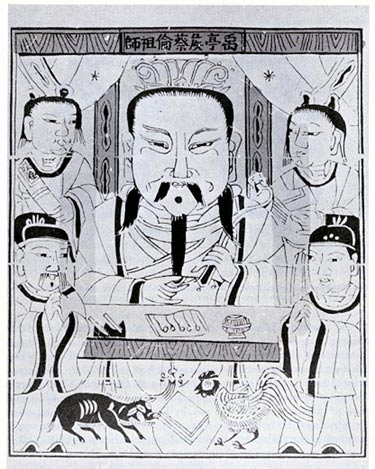
Paper was later counted among China’s “Four Great Inventions”, together with printing, the compass and gunpowder, a modern grouping that has become a symbol of Chinese contributions to world technology. Cai Lun is its human face. In imperial China, papermakers honoured him as the patron deity of their craft, offering sacrifices at shrines and temples, and paper guilds bore his name.
Leiyang, his traditional birthplace, and Yang County in Shaanxi, the site of his fief and tomb, both preserve memorials to him. He appears on Chinese stamps and in school textbooks. In the West, he became better known through popular books; Michael H. Hart’s The 100, a ranking of the most influential people in history, placed him seventh.
His story also carries a lesson about how history remembers invention. The name of a single official, recorded because he reported to the emperor, came to stand for the work of countless anonymous craftspeople before and after him. Later papermakers such as Zuo Bo, at the end of the Han, were famous for refining paper further.
Historians of technology also use Cai Lun’s story to show that inventions rarely spread simply because they are better. Paper coexisted with bamboo slips for about three centuries in China, because slips were durable, familiar and cheap in bamboo-growing regions, and old habits of record-keeping were slow to change. Adoption depended on supply, cost, trust in the new material and the decisions of the state.
Advanced
Scholarly debates: inventor, improver or organizer?
Historians now distinguish several questions. Did Cai Lun invent paper? No: the archaeological record shows paper-like material in the Western Han. Did he invent paper for writing? Also not strictly, since some Western Han fragments carry writing. What, then, was new? Most scholars point to two things: the introduction of tree bark as a raw material alongside recycled hemp, rags and nets, and the organization of a reliable production process in the imperial workshops that produced paper of consistent quality suitable for official use. The phrase in his biography, “Cai Lun conceived the idea” (倫乃造意), can be read either as original invention or as the design of a new method.
Some scholars also emphasize Cai Lun’s role as a manager rather than a craftsman. As Director of the Imperial Workshops he commanded artisans, and his report may have presented to the throne a process developed collectively. In a bureaucratic culture, credit naturally flowed to the official who submitted the memorial. The later name “Marquis Cai’s paper”, which uses a title he received only in 114, shows how quickly the invention became attached to his person.
A further debate concerns the identification and dating of early finds. Critics of some early claims, such as the Baqiao material, have argued that it may be unprocessed fibre rather than true paper, or that its dating depends on uncertain tomb contexts. Supporters point to fibre analysis showing pulped, randomly oriented fibres, the defining feature of paper. The scholarly consensus accepts that paper existed before 105 CE but remains cautious about specific dates.
Advanced
Evidence: texts, archaeology and laboratory analysis
Texts. The principal source is the biography in chapter 78 of the Book of the Later Han (Hou Hanshu), compiled by Fan Ye in the fifth century from earlier histories, including the Eastern Han court’s own Records of the Eastern Pavilion (Dongguan Hanji), which survives only in fragments. Because Fan Ye wrote about three centuries after the events, and the biography sits within a chapter on eunuchs, a group Confucian historians generally viewed with suspicion, historians read it both for facts and for moral framing. Some important later chronicles, such as the eleventh-century Comprehensive Mirror (Zizhi tongjian), do not mention his papermaking at all.
Archaeology. Paper fragments from Han tombs, watchtowers and postal stations in the dry northwest, especially Gansu and Inner Mongolia, provide direct physical evidence. Their dating depends on context: associated wooden slips with dates, coins, or tomb furnishings. Documents on dated wooden slips found alongside paper at Xuanquan have been especially important.
Laboratory analysis. Microscopy and fibre analysis identify plant species (hemp, ramie, paper mulberry) and show whether fibres were beaten and dispersed in water, as in true paper, or merely matted. Such studies, pioneered in the twentieth century and continued with modern techniques, allow historians to compare pre-Cai paper with later Han paper and test whether the material changed around his time.
Standard reference works include Tsien Tsuen-hsuin’s volume on paper and printing in Joseph Needham’s Science and Civilisation in China (1985), and, for the westward spread, Jonathan Bloom’s Paper Before Print (2001), which critically examines the Talas story and the role of the Islamic world.
Key ideas
- Improvement, not first invention
- Paper existed before Cai Lun; his contribution was a better, cheaper and officially recognized method.
- New raw materials
- Using tree bark, rags and fishing nets gave papermakers an abundant supply of fibre.
- State workshop innovation
- The improved paper came out of the imperial workshops, where skilled artisans worked under official direction.
- Writing materials and power
- Light, cheap paper strengthened bureaucracy, scholarship and religion by making records and books easier to produce and move.
- Transmission across Eurasia
- Papermaking travelled from China through Korea and Japan and along the Silk Roads to the Islamic world and Europe.
- Credit and memory
- History tends to credit a single named official for the collective work of anonymous craftspeople.
- Slow adoption
- Even a superior technology spread gradually: paper and bamboo slips were used side by side for centuries.
Records
- c. 179 BCE — Paper map fragment buried at Fangmatan, Gansu, one of the oldest surviving pieces of paper (early 2nd century BCE).
- 25 CE — The Eastern Han dynasty is founded; the capital is at Luoyang.
- c. 57 CE — Cai Lun is born in Guiyang Commandery (sometime c. 50–62 CE).
- c. 75 CE — He enters palace service as a eunuch at the end of Emperor Ming’s reign.
- 88 CE — Emperor He accedes; Cai Lun becomes Regular Palace Attendant.
- 97 CE — As Director of the Imperial Workshops he supervises the making of fine swords and implements.
- 105 CE — He presents his improved method of papermaking to Emperor He.
- 114 CE — Empress Dowager Deng makes him Marquis of Longting.
- 117 CE — He supervises the collation of classical texts at the Eastern Pavilion library.
- 121 CE — After the Dowager’s death, Emperor An summons him; he takes poison.
- 610 CE — The Goguryeo monk Damjing brings papermaking and inkmaking techniques to Japan, according to the Nihon shoki.
- c. 794 CE — A paper mill is established in Baghdad, spreading paper through the Islamic world.
Glossary
- Eastern Han
- The second half of the Han dynasty (25–220 CE), with its capital at Luoyang.
- Eunuch
- A castrated man serving in the imperial palace; eunuchs could gain great political power at the Han court.
- Bamboo slips
- Thin strips of bamboo or wood used as writing material, tied together into rolls.
- Pulp
- A wet mass of separated plant fibres from which paper is formed.
- Paper mulberry
- A tree whose inner bark provides long, strong fibres, widely used for East Asian paper.
- Mould (screen)
- A frame with a screen used to lift a thin layer of pulp out of water to form a sheet.
- Marquis
- A noble title granting income from a fief; Cai Lun was Marquis of Longting.
- Book of the Later Han
- The official history of the Eastern Han dynasty, compiled by Fan Ye in the fifth century.
- Empress Dowager
- The mother or widow of an emperor, who often acted as regent for a young ruler.
- Memorial
- A formal written report or proposal submitted by an official to the emperor.
Questions and answers
Did Cai Lun invent paper?
Not the very first paper. Older paper has been found from more than a century earlier. He improved the method and presented it to the emperor, which made paper widely used.
What did he make paper from?
According to the Book of the Later Han, from tree bark, hemp waste, old rags and fishing nets.
What did people write on before paper?
Mostly on strips of bamboo or wood tied together, and sometimes on silk, which was expensive.
Why was a eunuch in charge of workshops?
At the Han court, eunuchs served inside the palace and often managed palace offices, including the workshops that made goods for the emperor.
How did Cai Lun die?
When Emperor An took power in 121 CE, he ordered Cai Lun to answer for his part in a plot decades earlier against the emperor’s grandmother. Cai Lun took poison rather than face trial.
Is the story of paper reaching the Arabs after the Battle of Talas true?
It is a famous story, but many historians doubt it, because paper was already known in Central Asia before 751. The battle may at most have coincided with the growth of papermaking in Samarkand.
How do scientists know whether an ancient fragment is real paper?
They examine its fibres under a microscope. True paper has fibres that were beaten and dispersed in water, then settled randomly into a sheet.
Sources and further reading
- Cai Lun. Wikipedia
- 채륜. 위키백과
- 范曄 (Fan Ye), 後漢書 卷78 宦者列傳 (Book of the Later Han, ch. 78, Biographies of Eunuchs). Wikisource (Chinese)
- Book of the Later Han. Wikipedia
- History of paper. Wikipedia
- Papermaking. Wikipedia
- Fangmatan. Wikipedia
- 종이. 위키백과
- Tsien Tsuen-hsuin, Science and Civilisation in China, Vol. 5, Part 1: Paper and Printing. Cambridge University Press, 1985
- Jonathan M. Bloom, Paper Before Print: The History and Impact of Paper in the Islamic World. Yale University Press, 2001
Related
- Sima QianA Han dynasty historian who compiled the Records of the Grand Historian, a broad history of the ancient Chinese world.
- Qin's Wars of UnificationA series of Qin campaigns that conquered six rival states between 230 and 221 BCE.
- Battle of TalasBattle in 751 between forces of the Abbasid Caliphate and Tang China, with Central Asian groups taking part.
- House of WisdomName associated with Abbasid scholarly collections and translation activity in Baghdad.
- Gutenberg BibleLatin Bible printed in Mainz in the 1450s using movable metal type.
Written with AI assistance from the published sources listed above, and revised as new research appears.