Start at the top for an easy introduction. Go further down for more detail and scholarship.
- Easy
- Intermediate
- Advanced
For young readers
Most people think of Egypt when they hear the word "pyramid". But the country with the most pyramids is actually Sudan, Egypt's southern neighbour. Many of them stand near an ancient city called Meroë, on the edge of the desert close to the river Nile.
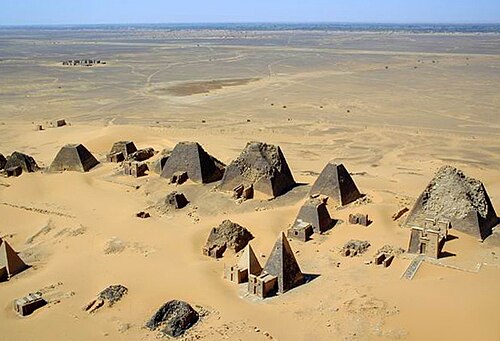
The pyramids of Meroë are much smaller than the Great Pyramid of Egypt. Most are between about the height of a three-storey house and a ten-storey building. They are also much steeper, like tall, pointed tents made of stone. Standing together in rows on sandy ridges, they look like a small city of pyramids.
They were built by the people of Kush, a powerful African kingdom. Kush was rich in gold, iron, ivory and trade. Its rulers included many strong queens, called kandake. One of them fought against the army of Rome and then made peace with the Roman emperor.
The kings and queens were not buried inside the pyramids. Their tombs were rooms cut into the rock underneath. On the eastern side of each pyramid there was a small chapel with pictures carved on the walls, where people could bring food and gifts for the dead.
About two hundred years ago, an Italian treasure hunter knocked the tops off many of the pyramids while searching for gold. That is why a lot of them look broken today. Since 2011 the pyramids have been a UNESCO World Heritage Site, protected as treasures for the whole world.
At a glance
- Place
- Near Begrawiya (al-Bajrawiya), a few kilometres east of the Nile and roughly 200 km north-east of Khartoum, River Nile State, Sudan
- Built by
- The Kingdom of Kush during its Meroitic period
- Dates
- Royal burials from about the early 3rd century BCE to the mid-4th century CE; the South Cemetery was used for elite burials earlier
- Cemeteries
- North (41 pyramids, mostly rulers), South (about 24, early rulers and elite) and West (80 or more, elite and family members)
- Size and shape
- Usually about 6–30 m high, with steep sides of about 70°; built of local sandstone blocks around a rubble core
- Tomb design
- Burial chambers cut into the bedrock beneath the pyramid, reached by a stairway; a decorated offering chapel on the east side
- Writing
- Egyptian hieroglyphs and the Meroitic script, whose language is still only partly understood
- Status
- Part of the UNESCO World Heritage Site "Archaeological Sites of the Island of Meroe" (2011)
Easy
What are the pyramids of Meroë?
The pyramids of Meroë are the royal cemeteries of the Kingdom of Kush, one of the great states of ancient Africa. They stand on low sandstone ridges near the village of Begrawiya in present-day Sudan, a few kilometres east of the Nile and of the ruins of the city of Meroë, which was the kingdom's main royal centre for many centuries.
There are three main cemeteries. The North Cemetery holds the pyramids of most of the kings and ruling queens from the 3rd century BCE to the 4th century CE. The South Cemetery contains the tombs of the first rulers buried at Meroë and of earlier members of the elite. The West Cemetery, the largest in number of graves, was used by members of the royal family and high officials. Together they contain well over a hundred pyramids among more than a thousand graves.
Sudan as a whole has more pyramids than Egypt, since Kushite rulers built them at several earlier sites too, such as El-Kurru and Nuri. The pyramids of Meroë are the latest and most numerous group, and they are the best-known symbol of ancient Sudan today.
Easy
How to "read" a Meroitic pyramid
A Meroitic pyramid is not a solid mountain of stone like the Great Pyramid. It is usually a shell of neatly cut sandstone blocks around a core of rubble. The sides are steep, around 70 degrees, compared with about 52 degrees at Giza, and many pyramids have a smooth band or raised edging at the corners. Some later pyramids were built partly of brick and covered with plaster.
The most important difference from Egypt is where the body lies. In Egypt the burial chambers were often inside or directly under the pyramid mass. At Meroë the dead were placed in rooms cut into the bedrock beneath, reached by a long stairway coming down from the east. After the burial, the stairway was filled in and the pyramid stood above the tomb as a marker.
On the east side of most pyramids stands a small offering chapel with a doorway shaped like an Egyptian temple gateway (pylon). Inside, the walls were carved with scenes: the dead ruler seated on a throne, receiving offerings; gods such as Isis, Osiris and Anubis; and processions of attendants. Offering tables inscribed in Meroitic script invoked Isis and Osiris for the dead person. Statues of the ba, the soul shown as a bird with a human head, were also placed at some tombs.
So when you look at a pyramid of Meroë, imagine three parts working together: a hidden tomb under the ground, a pyramid that marks it and raises it toward the sky, and a chapel where the living could continue to feed and honour the dead.
Easy
The Kingdom of Kush
Kush was the name that ancient Egyptians gave to the lands of the middle Nile to their south, in what is now Sudan. Here African states rose and fell over thousands of years. The earliest great kingdom was centred at Kerma, which flourished in the 2nd millennium BCE before Egypt conquered the region during its New Kingdom.
In the 8th century BCE a new Kushite kingdom based around Napata, near the holy mountain of Jebel Barkal, became so powerful that its kings conquered Egypt itself. Rulers such as Piye and Taharqa governed Egypt as its 25th Dynasty for nearly a century, until they were pushed out by the Assyrians. These kings revived the Egyptian custom of pyramid burial, building pyramids at El-Kurru and Nuri.
Later the centre of the kingdom moved south to Meroë, where the land was better watered by summer rains and rich in iron ore and timber. From about the 3rd century BCE, the rulers were buried at Meroë instead of Nuri, and historians call this last and longest phase of Kush the Meroitic period. It lasted until the 4th century CE.
The pyramids were only one part of a larger royal landscape. The city of Meroë itself, beside the Nile a few kilometres to the west, had a walled royal enclosure with palaces, a great temple of Amun, and a building with water channels and statues that excavators called the "Royal Baths". Further out stood other temples and large mounds of iron slag. Rulers were crowned and worshipped the gods in this city, and after death they were carried to the cemeteries on the ridges to the east, where the pyramids could be seen from far across the plain.
Intermediate
Meroitic society: iron, trade and queens
Meroë stood at a crossroads. The Nile connected it to Egypt and the Mediterranean; caravan routes led east to the Red Sea and south and west into Africa. Kush exported gold, ivory, ebony, animal skins and exotic animals, and it imported fine goods from Ptolemaic and Roman Egypt. Great heaps of iron slag around the city show that iron was smelted there on a large scale, though archaeologists are still measuring how large the industry really was.
The culture of Meroë combined Egyptian traditions with its own. The gods Amun and Isis were worshipped alongside the Kushite lion-headed war god Apedemak, whose temples stand at Naqa and Musawwarat es-Sufra, the two other parts of the World Heritage Site. From around the 3rd or 2nd century BCE the Kushites wrote their own language in a new Meroitic script, rather than only in Egyptian.
Women held unusual power. The title kandake (Candace in Greek and Latin) referred to a royal woman, often the king's mother or sister, and several women ruled in their own right. Rulers such as Shanakdakhete, Amanirenas, Amanishakheto and Amanitore were shown in reliefs as powerful, heavy-set figures, sometimes smiting enemies, and some of the largest pyramids in the North Cemetery belong to queens. The New Testament's Book of Acts mentions an official of "Candace, queen of the Ethiopians", reflecting the fame of these queens in the Roman world.
In about 25 BCE, after Rome annexed Egypt, Kushite forces attacked the Roman frontier at Aswan, and the Romans under the prefect Gaius Petronius struck back deep into Kushite territory. Negotiations followed, and a treaty concluded with Augustus around 21–20 BCE was favourable to Kush. A bronze head of Augustus, apparently taken from a Roman statue in the raid, was found buried beneath the steps of a temple at Meroë in 1910 and is now in the British Museum.
Intermediate
How the pyramids were built and used
The builders quarried sandstone from the ridges nearby and cut it into blocks, which were laid in stepped courses and then dressed to a smooth or finely stepped face. Because the pyramids were small, they did not need the vast workforces of Old Kingdom Egypt; they could be raised in a relatively short time after a ruler's death or during his or her lifetime.
The German architect Friedrich Hinkel, who studied and restored the Meroë pyramids over decades, proposed that builders used a shaduf-like lever, a pole on a pivot with a counterweight, set up in the centre of the rising pyramid to lift blocks. Evidence for central posts in some pyramids has been cited in support. This explanation is widely repeated, but details of the building process are still studied.
Burial practices changed over time. Early tombs followed Egyptian models, with mummification and shabti figurines, while later burials often placed the body on a bed, a Kushite tradition going back to Kerma. Tombs were furnished with jewellery, bronze vessels, imported glass, pottery, weapons and objects for the afterlife. Almost all were robbed in antiquity or later, so most of what survives comes from the few that escaped.
The chapels remained places of ritual after burial. Offerings of food and drink were laid on inscribed offering tables, and priests or relatives maintained the cult of the dead ruler. This emphasis on continuing care for royal ancestors was central to the ideology of Kushite kingship.
Intermediate
The end of Meroë
In the 3rd and 4th centuries CE the Kingdom of Kush weakened. Trade routes shifted toward the Red Sea kingdom of Aksum in the Ethiopian highlands, desert peoples such as the Blemmyes pressed on the northern frontier, and a people called the Noba moved into the Nile valley. The pyramids of the last rulers became smaller and more poorly built.
Around 350 CE King Ezana of Aksum left an inscription describing a campaign along the Nile against the Noba and the Kasu (probably the people of Kush). Historians debate whether Aksum destroyed Meroë or only struck a kingdom that was already collapsing. The last royal pyramids and the latest non-royal burials at Meroë are dated to about the mid-4th century CE.
After Meroë, new Nubian kingdoms, Nobadia, Makuria and Alodia, emerged and adopted Christianity in the 6th century. The Meroitic script fell out of use, replaced by Greek, Coptic and Old Nubian. The pyramids stood abandoned in the desert, though they were never forgotten by local people.
Intermediate
Rediscovery, destruction and excavation
European travellers began to describe the pyramids in the early 19th century, after the Egyptian conquest of Sudan in 1820–21. The French explorer Frédéric Cailliaud, who accompanied the Egyptian army, published drawings and measurements of Meroë in the 1820s, which caused great interest in Europe.
In 1834 the Italian doctor and adventurer Giuseppe Ferlini, looking for treasure, dismantled the pyramid of Queen Amanishakheto (Beg. N6) from the top. He found a hoard of gold and silver jewellery, which he sold; after initial doubts about its authenticity, it was bought partly by King Ludwig I of Bavaria (now in Munich) and partly by the Berlin Egyptian Museum. Ferlini and those inspired by him damaged or decapitated many pyramids, which is why so many now have flat or broken tops. The Prussian scholar Karl Richard Lepsius, who surveyed the cemeteries in 1844, complained that Ferlini's find had "brought many a pyramid to ruin".
Scientific excavation began in the 20th century. From 1920 to 1923 the American archaeologist George A. Reisner, working for Harvard University and the Museum of Fine Arts, Boston, excavated the royal cemeteries and established a sequence of rulers. His results were published by Dows Dunham, and finds were divided between Khartoum and Boston. From the 1970s Friedrich Hinkel led documentation and restoration, including rebuilding several chapels.
In 2011 Meroë, together with the temple sites of Naqa and Musawwarat es-Sufra, was inscribed on the UNESCO World Heritage List as the Archaeological Sites of the Island of Meroe. The "Island" is the region between the Nile, the Atbara and the Blue Nile rivers, which formed the heartland of the Meroitic kingdom.
Intermediate
Conservation today
The pyramids face threats from wind-blown sand, which scours the stone and buries monuments; from the natural weathering of sandstone; and from past damage and poorly controlled visits. Restoration has sometimes raised questions about how much to rebuild: reconstructed chapels and repaired pyramid faces help visitors understand the site, but they can blur the line between ancient and modern work.
Sudan's political situation has also affected the site. Periods of conflict and economic crisis have limited funding for conservation and tourism. Since the war that broke out in Sudan in 2023, international heritage organizations have expressed concern for museums and archaeological sites across the country, including the loss or looting of collections in Khartoum. The long-term protection of Meroë depends on peace and on support for Sudanese archaeologists and site guardians.
For many Sudanese, the pyramids are a source of national pride and a reminder that Sudan was home to one of Africa's great civilizations. In recent years they have also become a symbol in popular culture and social media, drawing attention to a history that was long overshadowed by Egypt.
Advanced
Debates: "Egyptianized" Kush or an African civilization?
Early 20th-century scholarship often treated Kush as a pale copy of Egypt. Reisner, for example, interpreted cultural achievements in Nubia partly through racial theories that attributed them to outside influence. Such views shaped how the pyramids were described: as smaller, later and derivative versions of Egyptian monuments.
Since the mid-20th century, scholars such as László Török and Derek Welsby have stressed instead that Kushite culture selectively adopted and transformed Egyptian forms for its own purposes. The steep proportions of the pyramids, the placement of tombs below them, the bed burials, the prominence of queens, the god Apedemak and the Meroitic script all show local choices. The pyramids can be read as a conscious claim to the heritage of the 25th Dynasty and of pharaonic kingship, made by an African state on its own terms.
This debate connects to wider questions about how Africa's past has been written. Recognizing Kush as a major civilization, and not merely a frontier of Egypt, has become important both in academic Nubian studies and in Sudan's own sense of history. At the same time, scholars warn against replacing one simplification with another; Meroitic culture was itself diverse, and the relationships among rulers, regional elites and ordinary people remain poorly understood.
Advanced
Evidence and open questions
Chronology. The order and dates of Meroitic rulers are reconstructed from the position and style of their pyramids, the few datable imported objects in their tombs, inscriptions naming rulers, and occasional references in Greek and Latin authors. Reisner's sequence has been revised many times, and the reign dates of many rulers are uncertain by decades. Even the identity of Ergamenes, the king whom the Greek historian Diodorus says defied priests who ordered him to die, is debated: he may be Arkamani I or a later ruler of a similar name.
Language. The Meroitic script was deciphered in its sound values by the British Egyptologist Francis Llewellyn Griffith in 1909, using names that appear in both Egyptian and Meroitic. But the language itself, probably related to other languages of north-eastern Africa, is still only partly understood. Scholars can read names and titles and many formulae in funerary texts, but longer royal inscriptions remain largely unintelligible. Progress in understanding Meroitic would transform what we know about the rulers buried in the pyramids.
Archaeology. Much of the information from Meroë comes from early excavations with limited recording, and the objects are scattered across museums in Khartoum, Boston, Berlin, Munich, London and elsewhere. Newer fieldwork uses surveys, environmental analysis and the study of iron production, settlement and non-elite burials to reconstruct the society that supported the royal cemeteries. Key questions remain open: how the kingdom was governed, how its economy worked, and why it declined when it did.
Key ideas
- African pyramid tradition
- Kushite rulers built pyramids for about a thousand years, at El-Kurru, Nuri, Jebel Barkal and Meroë, making Sudan the country with the most pyramids.
- Tomb below, pyramid above
- Meroitic burials were in rock-cut chambers under the pyramid, which served as a marker and monument.
- Offering chapel
- A small decorated temple on the east side where the cult of the dead ruler continued.
- Selective adoption
- Kush borrowed Egyptian gods, art and symbols but combined them with its own traditions.
- Kandake
- The title of powerful royal women; several ruled Kush in their own right.
- Crossroads economy
- Meroë's wealth came from iron, gold, ivory and trade between Africa, Egypt and the Red Sea.
- Damage and restoration
- 19th-century treasure hunting destroyed many pyramid tops; modern restoration tries to protect what remains.
Records
- c. 747 BCE — Kushite kings from Napata conquer Egypt and rule as the 25th Dynasty until about 656 BCE, reviving pyramid burial at El-Kurru and Nuri.
- 664 BCE — Death of Taharqa, buried under the largest pyramid at Nuri.
- 593 BCE — Egyptian pharaoh Psamtik II raids Kush; over time the royal centre shifts south to Meroë.
- c. 270 BCE — Royal burials move from Nuri to Meroë; the first rulers are buried in the South Cemetery.
- c. 25 BCE — Kush under Queen Amanirenas fights Roman Egypt; a treaty with Augustus follows around 21–20 BCE.
- c. 61 CE — An exploring party sent by the Roman emperor Nero reaches Meroë.
- c. 350 CE — King Ezana of Aksum campaigns in the Nile valley; the last pyramids at Meroë date to about this time.
- 1821 — Frédéric Cailliaud visits and records Meroë during the Egyptian conquest of Sudan.
- 1834 — Giuseppe Ferlini destroys the pyramid of Queen Amanishakheto and finds her jewellery.
- 1844 — Karl Richard Lepsius's Prussian expedition surveys and numbers the pyramids.
- 1920 — George A. Reisner begins systematic excavation of the royal cemeteries (to 1923).
- 2011 — The Archaeological Sites of the Island of Meroe are inscribed on the UNESCO World Heritage List.
Glossary
- Kush
- An ancient kingdom of the middle Nile in present-day Sudan, with capitals at Kerma, Napata and Meroë.
- Nubia
- The region along the Nile between southern Egypt and central Sudan.
- Meroitic period
- The last phase of Kush, from about the 3rd century BCE to the 4th century CE, when rulers were buried at Meroë.
- Kandake
- A title for royal women of Kush, known to the Greeks and Romans as Candace.
- Offering chapel
- A small shrine attached to a tomb where offerings were made to the dead.
- Pylon
- A monumental gateway with two sloping towers, used in Egyptian and Kushite temples and chapels.
- Ba
- In Egyptian and Kushite belief, an aspect of the soul, shown as a bird with a human head.
- Apedemak
- A lion-headed war god worshipped in Meroitic Kush.
- Meroitic script
- The alphabet-like writing system of Kush, used from about the 3rd–2nd century BCE, in hieroglyphic and cursive forms.
- Shaduf
- A lever with a counterweight used for lifting water, possibly adapted for lifting stone blocks.
Questions and answers
Are there really more pyramids in Sudan than in Egypt?
Yes. About 200 or more pyramids are known in Sudan, built by Kushite rulers and elites, which is more than the number known in Egypt.
Why are the pyramids of Meroë so steep and small?
They followed a Kushite style that developed from the 25th Dynasty onward. They marked tombs cut into rock below, so they did not need to be huge.
Why do many pyramids have broken tops?
In 1834 the treasure hunter Giuseppe Ferlini and later imitators knocked down the tops of many pyramids looking for gold.
Who were the kandakes?
Powerful royal women of Kush. Some, like Amanirenas and Amanishakheto, ruled as queens and were buried in large pyramids.
Can we read the inscriptions at Meroë?
We can sound out the Meroitic script, deciphered in 1909, but the language is only partly understood, so most long texts cannot yet be translated.
Did Aksum destroy Meroë?
Around 350 CE King Ezana of Aksum campaigned in the region, but many historians think Kush was already declining because of changing trade and pressure from other peoples.
Is Kushite culture just a copy of Egypt?
No. Kush adopted Egyptian gods and forms but reshaped them with its own language, gods such as Apedemak, burial customs and powerful queens.
Sources and further reading
- Pyramids of Meroë. Wikipedia
- Meroë. Wikipedia
- Kingdom of Kush. Wikipedia
- Nubian pyramids. Wikipedia
- Giuseppe Ferlini. Wikipedia
- Meroitic script. Wikipedia
- Archaeological Sites of the Island of Meroe. UNESCO World Heritage Centre
- 메로에. Wikipedia (Korean)
- Derek A. Welsby, The Kingdom of Kush: The Napatan and Meroitic Empires. British Museum Press, 1996
- László Török, The Kingdom of Kush: Handbook of the Napatan-Meroitic Civilization. Brill, 1997
Related
- Great Pyramid of GizaA royal tomb built for the Egyptian pharaoh Khufu. It is the largest of the Giza pyramids and the only surviving Wonder of the ancient world.
- Obelisk of AxumA carved stone funerary monument from the ancient kingdom of Aksum in present-day Ethiopia.
- Mask of TutankhamunA gold funerary mask found in the tomb of the Egyptian pharaoh Tutankhamun.
- Great ZimbabweRemains of a major southern African city built and occupied by ancestors of the Shona people.
- Battle of KadeshA battle between Egyptian forces under Ramesses II and Hittite forces under Muwatalli II near Kadesh in Syria.
Written with AI assistance from the published sources listed above, and revised as new research appears.