Start at the top for an easy introduction. Go further down for more detail and scholarship.
- Easy
- Intermediate
- Advanced
For young readers
More than 3,000 years ago, two great kingdoms wanted to control the rich cities and trade roads of Syria. One was Egypt, ruled by the young pharaoh Ramesses II. The other was the kingdom of the Hittites, in what is now Turkey, ruled by King Muwatalli II. The two armies met near a walled city called Kadesh, beside the Orontes River.
Both armies used chariots: light, fast carts with two wheels, pulled by two horses. One person drove while another shot arrows or threw spears. Thousands of chariots took part in the battle, maybe more than in any other battle we know of.
The Hittites played a trick. They sent two men who pretended to be wandering herders. The men told Ramesses that the Hittite army was far away. Ramesses believed them and rushed ahead with only part of his army. But the Hittite army was hiding just behind the city! Their chariots charged and scattered one of the Egyptian groups.
Ramesses was in great danger. According to his own story, he fought bravely almost alone until more Egyptian soldiers arrived and pushed the Hittites back across the river. But in the end, the Egyptians did not capture Kadesh, and the Hittites kept control of the area.
Back home, Ramesses carved the story of the battle on the walls of his temples as if it were a great victory. The Hittites told a different story. About sixteen years later, the two kingdoms made peace and wrote down a treaty. A copy of that treaty is so famous that a large replica hangs at the United Nations today.
At a glance
- Date
- Year 5 of Ramesses II, third month of the summer season; usually dated to May 1274 BC (some chronologies place it about 20 years earlier)
- Place
- Near Kadesh (Tell Nebi Mend) on the Orontes River, near Lake Homs, in modern western Syria close to the Lebanese border
- Sides
- Egypt under Ramesses II against the Hittite Empire under Muwatalli II and a coalition of allies
- Forces
- Egypt: four divisions (Amun, Re, Ptah, Seth) plus the Ne’arin troops; Hittites: reportedly 2,500 chariots in the first attack and about 1,000 in a second wave, plus infantry. All numbers come mainly from Egyptian sources
- Result
- Tactical draw; Egypt avoided destruction but failed to take Kadesh or recover Amurru, which stayed under Hittite control
- Aftermath
- Egyptian–Hittite peace treaty between Ramesses II and Hattusili III, about 1259 BC
- Main sources
- Egyptian “Poem”, “Bulletin” and reliefs at Abydos, Karnak, Luxor, the Ramesseum and Abu Simbel; later Hittite letters and texts from Hattusa
Easy
What was the Battle of Kadesh?
The Battle of Kadesh was fought in the early thirteenth century BC between two of the great powers of the Late Bronze Age: Egypt and the Hittite Empire. It took place beside the Orontes River, near the fortified city of Kadesh in what is now western Syria. The Egyptian army was led by Pharaoh Ramesses II, in the fifth year of his reign; the Hittite army by King Muwatalli II.
Kadesh is famous for three reasons. First, it is the earliest battle in world history for which we have a detailed account of the tactics and the movements of the armies. Second, it was probably the largest chariot battle ever fought, with perhaps 5,000 to 6,000 chariots in total. Third, it was followed years later by a peace treaty between Egypt and the Hittites, the oldest peace treaty known in versions from both sides.
The battle almost ended in disaster for Egypt. Ramesses was fooled by Hittite spies, walked into an ambush and nearly lost his camp and perhaps his life. His army recovered and drove the Hittites back, but the Egyptians did not capture Kadesh. Most historians today describe the result as a draw, with the Hittites the strategic winners.
Easy
Two superpowers and the land between them
In the Late Bronze Age (about 1550–1200 BC), several large kingdoms dominated the eastern Mediterranean and the Near East: Egypt, the Hittites, Babylonia, Assyria and, earlier, Mitanni. Their kings wrote letters to each other, called each other “brother”, exchanged gifts and married each other’s daughters. They also fought over the small city-states of the Levant (modern Syria, Lebanon, Israel and Palestine), which were rich in trade, timber and ports.
The Hittites ruled central Anatolia (modern Turkey) from their capital Hattusa. Under King Suppiluliuma I in the fourteenth century BC they destroyed the power of Mitanni and brought much of northern Syria, including Kadesh and the kingdom of Amurru, under their control. Egypt, whose influence in the region had weakened during the Amarna period, wanted to win these lands back.
The kings of the new Nineteenth Dynasty, Seti I and his son Ramesses II, came from a military family and set out to restore Egypt’s empire in Asia. Seti I campaigned in Canaan and Syria and captured Kadesh for a time, but it appears to have returned to Hittite control. In his fourth year, Ramesses II marched north and brought Amurru back to the Egyptian side. For the Hittites, this was a direct challenge, and Muwatalli II gathered a great army to recover Amurru.
Easy
The armies and their chariots
Ramesses’ army was organized in four divisions, each named after a god: Amun, Re, Ptah and Seth (Sutekh). Each probably contained several thousand infantry and a few hundred chariots; modern estimates for the whole army are around 20,000 men and at least 2,000 chariots. There was also a separate force called the Ne’arin (nrrn), whose origin is debated: they may have been Canaanite troops or Egyptian soldiers stationed in Amurru. The Egyptian army also included Sherden warriors, one of the first appearances of these later famous “Sea Peoples” as mercenaries.
Egyptian chariots were light and fast, with two men: a driver and an archer, who shot powerful composite bows. Hittite chariots are shown in Egyptian reliefs carrying three men: a driver, a warrior with a spear and a shield-bearer. Historians still debate whether the heavier Hittite chariot was built mainly for shock charges and how accurately the Egyptian artists showed it.
According to the Egyptian texts, Muwatalli brought 2,500 chariots in his first attack and many infantry, together with contingents from a long list of allies: Ramesses lists about 19 allied peoples and states, including Arzawa, Kizzuwatna, Aleppo and Ugarit. These numbers may be exaggerated, since Ramesses had a reason to make his enemy look enormous, but they show that Muwatalli had mobilized the whole Hittite world.
Intermediate
The march and the trap
In the spring of his fifth year, Ramesses led his army out of his Delta capital, Pi-Ramesses, past the border fortress of Tjaru (Sile), and north through Canaan. After about a month the army approached Kadesh from the south, marching in a long column with the divisions spread out over many kilometres. Ramesses rode ahead with the Amun division; the Re division followed, and the Ptah and Seth divisions were still far behind.
South of the town of Shabtuna, about 11 km from Kadesh, two Shasu (nomads) came to the Egyptian camp. They said they wanted to desert from the Hittites and that the Hittite king was far to the north, near Aleppo, too afraid to come south. Ramesses believed them and pushed on quickly, crossing the Orontes and setting up camp north-west of Kadesh.
Shortly afterwards, Egyptian scouts captured two Hittite soldiers. After being beaten, they revealed the truth: the Hittite king and his entire army were hiding behind “old Kadesh”, on the other side of the city, ready for battle. The Egyptian texts say Ramesses angrily blamed his officers for failing to find the enemy and sent messengers to hurry the other divisions forward. It was too late.
Intermediate
The battle
While Ramesses was still meeting his officers, the Hittite chariotry crossed the Orontes south of Kadesh and struck the Re division in the flank as it marched in the open toward the camp. The Re division broke and fled north toward the camp of the Amun division, with Hittite chariots in pursuit. The chariots then smashed into the Egyptian camp itself, causing panic in the Amun division.
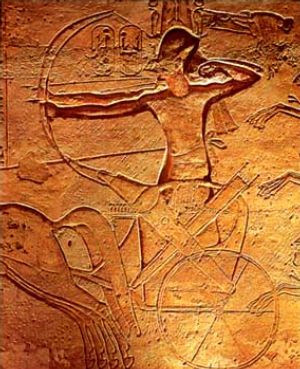
In the Egyptian account, Ramesses now found himself almost alone: “No officer was with me, no charioteer, no soldier of the army.” He prays to the god Amun, who answers him, and he charges the enemy again and again, “like Seth in his moment”. The reliefs show a gigantic Ramesses in his chariot shooting arrows into masses of falling Hittites. Behind this heroic picture lies a real event: the king and his bodyguard, with the surviving chariots, led counter-attacks against the Hittites.
The Hittite attack lost momentum inside the crowded camp, where many of the attackers stopped to plunder. Then Egyptian reinforcements arrived. The Ne’arin troops came from the direction of Amurru and hit the Hittites by surprise. Muwatalli sent a second wave of about 1,000 chariots, led by high-ranking nobles, but the Egyptians held. Later the Ptah division approached from the south. The Hittite chariots were driven back to the Orontes; the reliefs show men and horses falling into the river and being pulled out of the water, among them the prince of Aleppo, held upside down to empty him of water.
Muwatalli never committed his large infantry force, which remained on the eastern bank near Kadesh. Why he held it back is debated: perhaps it was too slow to reach the fighting, perhaps he wished to protect the city, or perhaps the river made it hard to cross. According to the Egyptian account, fighting resumed the next day, but without a decisive result.
Intermediate
Who won?
Ramesses did not besiege Kadesh. After the second day he withdrew south toward Damascus and returned to Egypt. In his inscriptions he claims a great victory and says the Hittite king wrote to him begging for peace. The Hittite side remembered the war differently. Muwatalli followed the Egyptians south and took the Egyptian province of Upi (the region of Damascus), which he placed under his brother Hattusili, the future Hattusili III. Amurru returned to the Hittite side, and its king Benteshina, who had joined Egypt, was removed and taken to the Hittite lands.
Modern historians usually conclude that the battle was tactically a draw: Ramesses escaped an ambush that could have destroyed his army, which was a real achievement, but the Hittites achieved their strategic aim of keeping Kadesh and Amurru. The historian Trevor Bryce, a specialist in Hittite history, summarizes it as an Egyptian tactical success but a Hittite strategic victory.
The human cost is hard to measure. The Egyptian texts list Hittite nobles who died, including two brothers of Muwatalli, and show many enemy dead and prisoners. Egyptian losses, especially in the routed Re division, must also have been heavy, but royal inscriptions never record them. Behind the war were also the people of the Syrian towns, whose fields and villages lay in the path of both armies and who were taken as captives in later campaigns.
Intermediate
From war to the first peace treaty
Fighting continued for years. In his eighth and ninth years Ramesses campaigned in Syria again and captured Dapur and Tunip, but these gains did not last. Meanwhile the Hittites faced a crisis at home: after Muwatalli’s death his son became king as Mursili III (Urhi-Teshub), and after several years he was overthrown by his uncle Hattusili III. Assyria was also growing more powerful in the east, which threatened both Egypt’s and Hatti’s interests.
In Ramesses’ twenty-first year, around 1259 BC, Egypt and the Hittites concluded a formal treaty. Its clauses provide for permanent peace and brotherhood, mutual non-aggression, alliance against outside enemies and rebels, and the return of fugitives, with a guarantee that returned people would not be punished. The gods of both lands are called on as witnesses. Because the treaty survives in both an Egyptian hieroglyphic version (at Karnak and the Ramesseum) and a Hittite version in Akkadian cuneiform (found at Hattusa), historians can compare the two and see how each side presented the agreement.
The peace held for the rest of Ramesses’ very long reign. Queen Puduhepa of the Hittites exchanged letters with the Egyptian court, and in Ramesses’ thirty-fourth year a Hittite princess came to Egypt as his wife. A replica of the Hittite treaty tablet now hangs at the headquarters of the United Nations in New York as a symbol of early diplomacy.
Intermediate
Memory and propaganda: how Ramesses told the story
No other battle of the ancient Near East is documented in so many texts and images. Ramesses had the story carved on the walls of at least five major temples: Abydos, Karnak, Luxor, the Ramesseum (his memorial temple at Thebes) and Abu Simbel. The account comes in two main forms. The so-called Poem (sometimes called the Poem of Pentaur, after a scribe named in a papyrus copy) is a long literary narrative centred on the king’s heroism and his prayer to Amun. The so-called Bulletin (or Report) is a shorter prose text that accompanies the reliefs. Together with many captions, they describe the camp, the spies, the fighting and the rescue.
These accounts are propaganda in the literal sense: they were meant to show that the king, by the favour of the gods, alone upheld the order of the world against chaos. Paradoxically, the story also admits serious mistakes: the king was deceived, his officers failed, his army fled. The failure of others makes the king’s personal courage shine more brightly, and the texts may also have justified punishing officials.
The Hittite view survives only indirectly, since no Hittite annals describing the battle have been found. But a letter from Ramesses to Hattusili III, found at Hattusa, responds to a Hittite complaint about his boasting: apparently Hattusili had mocked Ramesses’ claims of victory. Hattusili’s own autobiographical text, known as the Apology, mentions the campaign against Egypt as part of his career. For the Hittites, the war was a success that confirmed their hold on Syria.
In modern times, the battle has been told in different ways. Nineteenth- and early twentieth-century historians, beginning with James Henry Breasted, who published the first scholarly reconstruction in 1903, often followed the Egyptian version closely. Since the decipherment of Hittite texts, scholars have given more weight to the Hittite side. In Egypt, Ramesses remains a national symbol, while in Turkey the treaty tablet in the Istanbul Archaeology Museums is celebrated as part of the country’s ancient heritage.
Advanced
Scholarly debates
Chronology. The battle is dated to Year 5, third month of Shemu, day 9 of Ramesses II. Converting this into a modern date depends on the chronology of the New Kingdom. The widely used “low” chronology puts Ramesses’ accession in 1279 BC and the battle in May 1274 BC; a higher chronology, now less favoured, places it about twenty years earlier. Astronomical data, king lists and radiocarbon dates from Egypt continue to be used to test these systems.
Numbers and reliability. The figures of 2,500 and 1,000 Hittite chariots and the list of allies come from Egyptian sources, which had every reason to magnify the enemy. Scholars differ on how far to trust them. The composition of the Egyptian army, the size of each division, and the identity of the Ne’arin (Egyptians, Canaanites, or an elite reserve force) are all debated. Reconstructions of the exact route of the Hittite attack and the location of the Egyptian camp depend on interpreting the reliefs and the local topography around Tell Nebi Mend.
Genre of the texts. Scholars such as Alan Gardiner, who published an important edition in 1960, discussed whether the “Poem” was really poetry or a literary prose narrative, and how it relates to the Bulletin and the reliefs. Later scholars, including Anthony Spalinger, have studied how the different versions were composed and adapted for each temple. The central methodological question is how to extract military history from royal ideology.
Strategic interpretation. Some historians see Muwatalli as a skilled commander who nearly won a complete victory and then preferred to preserve his forces; others emphasize the mistakes on both sides, or argue that the Hittites’ decision to keep their infantry out of the battle shows the limits of Bronze Age command and communication. The broader question is whether Kadesh marked a turning point or simply one episode in a long struggle that ended only with mutual exhaustion and a shared fear of Assyria.
Advanced
Sources and evidence
Egyptian monuments. The inscriptions survive in eight copies of the Poem and seven of the Bulletin, together with relief scenes, on temple walls at Abydos, Karnak, Luxor, the Ramesseum and Abu Simbel. Some copies are damaged, and editors reconstruct the text by comparing versions. Papyrus copies of the Poem are also known, notably Papyrus Sallier III and Papyrus Raifé, showing that the story circulated as literature among scribes.
Hittite documents. The archives of Hattusa (modern Boğazkale in Turkey), excavated from 1906 onward, contain the treaty, the letters exchanged between the two courts, and texts such as Hattusili III’s Apology. These do not describe the battle directly but show its consequences and the Hittite interpretation of it.
Archaeology. Tell Nebi Mend, generally identified with ancient Kadesh, has been excavated, but the battlefield itself has left little physical trace, as is common for ancient battles. Chariot remains from Egyptian tombs, including those of Tutankhamun, help historians understand the technology used.
Standard translations include Miriam Lichtheim’s Ancient Egyptian Literature, volume 2 (1976), which contains the Poem and Bulletin in English, and Gardiner’s edition of the inscriptions. For the Hittite perspective, Trevor Bryce’s The Kingdom of the Hittites is a standard account.
Key ideas
- Great-power rivalry
- Egypt and the Hittite Empire competed for control of the city-states of Syria and the Levant.
- Chariot warfare
- Fast horse-drawn chariots were the elite striking force of Late Bronze Age armies; Kadesh was probably the largest chariot battle ever.
- Deception and intelligence
- False information from Hittite spies led Ramesses into an ambush, one of the first recorded uses of military deception.
- Royal propaganda
- Ramesses turned a near-disaster into a story of personal heroism carved on temple walls across Egypt.
- Tactical draw, strategic outcome
- Egypt survived the battle, but the Hittites kept Kadesh and Amurru.
- Diplomacy and treaty
- Continued stalemate led to a formal peace treaty, preserved in versions from both sides.
- Reading sources from both sides
- Comparing Egyptian and Hittite documents shows how each power shaped the memory of the same war.
Records
- c. 1350 BCE — Suppiluliuma I brings much of northern Syria, including Kadesh and Amurru, under Hittite control.
- c. 1290 BCE — Seti I campaigns in Syria and temporarily takes Kadesh.
- 1279 BCE — Ramesses II becomes king of Egypt (low chronology).
- 1275 BCE — In his fourth year Ramesses campaigns north and brings Amurru back to the Egyptian side.
- 1274 BCE — May: Battle of Kadesh between Ramesses II and Muwatalli II.
- c. 1271 BCE — Ramesses campaigns again in Syria and captures Dapur and Tunip, gains that soon prove temporary.
- c. 1267 BCE — Hattusili III overthrows his nephew Mursili III and becomes Hittite king.
- 1259 BCE — Egyptian–Hittite peace treaty concluded in Ramesses’ twenty-first year.
- c. 1245 BCE — In Ramesses’ thirty-fourth year, a Hittite princess arrives in Egypt as his wife.
- 1828 — Champollion studies the Egyptian version of the treaty at Karnak.
- 1903 — James Henry Breasted publishes the first scholarly reconstruction of the battle.
- 1906 — Hugo Winckler’s excavations at Hattusa uncover the Hittite version of the treaty.
Glossary
- Hittites
- A people of central Anatolia who built an empire (about 1650–1180 BC) with its capital at Hattusa.
- Kadesh
- A fortified city on the Orontes River in western Syria, identified with Tell Nebi Mend.
- Amurru
- A kingdom in what is now Lebanon and western Syria whose loyalty was contested by Egypt and the Hittites.
- Chariot
- A light two-wheeled vehicle pulled by horses, used as a mobile fighting platform.
- Division
- A large unit of the Egyptian army; at Kadesh there were four, named after gods.
- Ne’arin
- A body of troops, possibly Canaanite or Egyptian, whose arrival helped save the Egyptian army.
- Shasu
- An Egyptian name for semi-nomadic peoples of the Levant; two Shasu gave Ramesses false information.
- Poem and Bulletin
- Modern names for the two main Egyptian inscriptions describing the battle.
- Low chronology
- The most widely used dating system for the New Kingdom, which places the battle in 1274 BC.
- Cuneiform
- Wedge-shaped writing on clay tablets, used for the Hittite copy of the treaty, written in Akkadian.
Questions and answers
Who won the Battle of Kadesh?
Neither side won completely. Ramesses escaped a trap and drove the Hittites back, but the Hittites kept Kadesh and the surrounding land. Most historians call it a draw.
Why did they fight over Kadesh?
Kadesh and the nearby kingdom of Amurru controlled important routes through Syria. Whoever held them had power over the rich trading cities of the Levant.
How big was the battle?
Perhaps 5,000 to 6,000 chariots and tens of thousands of soldiers, making it probably the largest chariot battle ever. Exact numbers are uncertain because they come mostly from Egyptian sources.
Did Ramesses really fight alone?
His inscriptions say so, but this is royal propaganda. He probably led charges with his bodyguard and the surviving chariots until reinforcements arrived.
Why is the peace treaty so famous?
It is the oldest known peace treaty that survives in versions from both parties, one in Egyptian hieroglyphs and one in Akkadian cuneiform.
How reliable are the Egyptian accounts?
They are detailed and probably based on real events, but they were written to glorify the king. Historians compare them with Hittite letters and with later events to test their claims.
Why is the date uncertain?
The Egyptian date is given in regnal years. Converting it depends on the chronology of Egyptian kings, which can vary by a couple of decades.
Sources and further reading
- Battle of Kadesh. Wikipedia
- Egyptian–Hittite peace treaty. Wikipedia
- Muwatalli II. Wikipedia
- Hattusili III. Wikipedia
- Ramesses II. Wikipedia
- Kadesh (Syria). Wikipedia
- Miriam Lichtheim, Ancient Egyptian Literature, Vol. 2: The New Kingdom. University of California Press, 1976
- Alan Gardiner, The Kadesh Inscriptions of Ramesses II. Griffith Institute, 1960
- Trevor Bryce, The Kingdom of the Hittites (new edition). Oxford University Press, 2005
- Mark Healy, Qadesh 1300 BC: Clash of the Warrior Kings. Osprey, 1993
Related
- Mask of TutankhamunA gold funerary mask found in the tomb of the Egyptian pharaoh Tutankhamun.
- Great Pyramid of GizaA royal tomb built for the Egyptian pharaoh Khufu. It is the largest of the Giza pyramids and the only surviving Wonder of the ancient world.
- Code of HammurabiA collection of legal judgments issued under Hammurabi, king of Babylon, in the eighteenth century BCE.
- Battle of MarathonA battle in 490 BCE in which an Athenian-led Greek force defeated a Persian expedition at Marathon.
- Battle of GaugamelaA battle in 331 BCE in which Alexander of Macedon's army defeated the forces of the Persian king Darius III.
Written with AI assistance from the published sources listed above, and revised as new research appears.