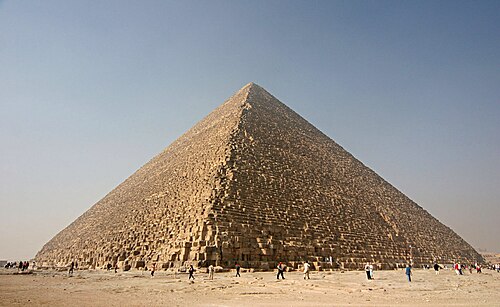
Start at the top for an easy introduction. Go further down for more detail and scholarship.
- Easy
- Intermediate
- Advanced
For young readers
Picture a mountain made by people. The Great Pyramid was built from more than two million blocks of stone, many of them heavier than a car. When it was finished it was about 146 metres tall, as high as a 45-storey building, and for thousands of years nothing built by humans was taller.
It was made as a tomb for a king of Egypt named Khufu. Egyptian kings are often called pharaohs. The Egyptians believed that after death the king would travel to the sky and live forever with the gods, and the pyramid was meant to help him on that journey and protect his body.
Long ago the pyramid did not look rough and stepped as it does today. It was covered with smooth, shining white limestone, so it would have gleamed in the desert sun. Later, people took most of those white stones away to build houses and mosques in the city of Cairo.
Who built it? Not slaves, as people once thought. Archaeologists have found the town where the workers lived, with bakeries and places to cook fish and meat, and the graves of workers who were buried with honour near the pyramid. Farmers, boatmen, stonecutters and many other skilled workers took turns working for the king.
We even have a diary written by one of the builders! A man named Merer kept a logbook on papyrus about his team carrying blocks of white limestone by boat along the Nile to Giza. It is one of the oldest written papyri ever found.
Inside the pyramid there are narrow passages, a tall sloping hallway called the Grand Gallery, and a room made of pink granite where a stone coffin still sits. Scientists are still exploring: in 2017 they used tiny particles from space, called muons, to discover a big hidden space inside.
At a glance
- Built for
- Khufu (Greek: Cheops), second king of Egypt’s Fourth Dynasty, Old Kingdom
- Date
- About 2589–2566 BCE on one common chronology (Khufu’s reign); other chronologies differ by a few decades
- Place
- Giza plateau, on the west bank of the Nile, now on the edge of greater Cairo, Egypt
- Size
- Originally about 146.6 m high (now about 138.5 m); each side about 230.3 m long
- Materials
- Local limestone core, fine white Tura limestone casing (mostly removed), Aswan granite for the King’s Chamber
- Ancient name
- Akhet Khufu, “Horizon of Khufu”
- Status
- Only surviving Wonder of the ancient world; part of the UNESCO World Heritage Site “Memphis and its Necropolis – the Pyramid Fields from Giza to Dahshur” (1979)
- Key discoveries
- Workers’ graffiti naming Khufu (1837), the Khufu ship (1954), the Diary of Merer papyri (2013), a large internal void (2017)
Easy
What is the Great Pyramid?
The Great Pyramid is the largest of the three pyramids on the Giza plateau, near modern Cairo. It was built as the tomb of Khufu, a king of Egypt’s Fourth Dynasty during the period historians call the Old Kingdom. The Greeks, who wrote about it about two thousand years later, called the king Cheops. The Egyptians called the pyramid Akhet Khufu, meaning “Horizon of Khufu”, the place where the king would rise into the sky like the sun at dawn.
Its size is still astonishing. The pyramid originally stood about 146.6 m tall; it has lost its top and outer casing and is now about 138.5 m high. Each side of its square base measures about 230 m, and the base covers more than five hectares. Estimates suggest it contains around 2.3 million blocks of stone. For thousands of years it was the tallest structure made by human hands anywhere on earth.
The Greeks later counted it among the Seven Wonders of the World, a list of famous monuments admired by travellers. All the others, such as the Hanging Gardens of Babylon and the Colossus of Rhodes, have vanished or survive only in ruins. The Great Pyramid, the oldest of them, is the only one still standing.
Easy
How to “read” the pyramid: outside, inside and all around
Outside, what we see today is the stepped core of large, roughly cut limestone blocks. Originally the whole surface was covered by finely polished white limestone quarried at Tura, across the Nile. The casing blocks were fitted so tightly that the joints between them were extremely thin. A few casing stones still remain at the base. The pyramid’s sides face almost exactly north, south, east and west; the error is only a few minutes of arc, a fraction of a degree.
Inside, the entrance is on the north face. A descending passage leads down into the bedrock to an unfinished underground chamber. An ascending passage leads upwards to a horizontal corridor and a room known as the Queen’s Chamber, a name given by later explorers; no queen was buried there. Continuing upward, the passage opens into the Grand Gallery, a tall, narrow hall with a corbelled ceiling about 8.6 m high and more than 46 m long.
At the top of the Grand Gallery lies the King’s Chamber, lined entirely with red granite brought from Aswan, about 800 km to the south. It holds a lidless granite sarcophagus, which was empty when explorers reached it. Above the chamber are five low compartments separated by huge granite beams. These “relieving chambers” helped spread the weight of the masonry above. Narrow shafts lead from the King’s and Queen’s Chambers towards the outside; their purpose, whether for air or for the king’s spirit to reach the stars, is debated.
All around, the pyramid was the centre of a larger complex. On its east side stood a mortuary temple, where offerings were made for the dead king; a causeway led down to a valley temple near the edge of the cultivated land. There were three small pyramids for queens, a small satellite pyramid, several pits for full-sized boats, and rows of stone tombs called mastabas where members of the royal family and officials were buried to stay close to their king.
Easy
Khufu and the age of the pyramids
Khufu was the son of King Sneferu, the most ambitious pyramid builder before him. Sneferu built at least three large pyramids at Meidum and Dahshur, including the Bent Pyramid, where the builders changed the angle part way up, and the Red Pyramid, the first true smooth-sided pyramid. Khufu’s builders took that experience and pushed it to its limit.
About a century before, King Djoser’s architect Imhotep had built the first large stone pyramid at Saqqara, the Step Pyramid, a stack of six stone platforms. In just a few generations, Egyptian builders moved from that step shape to the enormous, precise geometry of the Great Pyramid. This rapid progress shows how powerful and well organised the Egyptian state had become.
Surprisingly little is known about Khufu as a person. The only certainly identified complete statue of him is a tiny ivory figure about 7.5 cm tall, found by Flinders Petrie at Abydos in 1903. Much later Egyptian tales and the Greek historian Herodotus portrayed him as a harsh ruler, but those stories were written long after his death and cannot be taken as reliable history. Egyptians continued to honour him with a cult for many centuries.
Intermediate
How was it built?
Most of the core blocks were cut from a quarry on the Giza plateau itself, just south of the pyramid. Workers used copper chisels and saws, wooden wedges, stone pounders and sand as an abrasive; hard granite was shaped mainly by pounding with dolerite stones and grinding. The fine casing limestone came by boat from Tura, and the granite from Aswan was floated down the Nile.
How the blocks were raised is one of the most discussed questions in archaeology. Many Egyptologists think that ramps of mud brick, rubble and limestone chips were used, but they disagree about the form: a long straight ramp, a ramp spiralling around the pyramid, zigzag ramps on one face, or combinations. The architect Jean-Pierre Houdin has proposed an internal ramp, an idea that has not been widely accepted. Levers and sledges were certainly used. A painting from a Middle Kingdom tomb shows a colossal statue pulled on a sledge while a worker pours liquid in front of it, and experiments suggest that wetting sand greatly reduces friction.
Archaeology has recently added new evidence. In 2018 a team working at the Hatnub alabaster quarry reported a steep ramp from about the time of Khufu with post holes and stairs on each side, suggesting a system for hauling blocks up steep slopes. Studies of ancient sediments have shown that a branch of the Nile and connected basins once came much closer to Giza than today, allowing boats to deliver stone close to the building site.
Planning and accuracy were remarkable. The base is almost perfectly level and square, and the orientation to true north is precise to within a few arc-minutes. How the Egyptians achieved this is debated: proposals include sighting on stars circling the celestial pole, or using the shadow of a vertical rod to track the sun. Tradition names Hemiunu, a royal relative and vizier whose large tomb lies west of the pyramid, as overseer of the king’s works.
Intermediate
The builders: a workforce, a town and a diary
The popular picture of slaves driven by whips is not supported by the evidence. Since the late 1980s, archaeologists led by Mark Lehner have excavated a settlement south of the Giza plateau, known as Heit el-Ghurab or the “Lost City of the Pyramid Builders”. It contained bakeries, breweries, storerooms, workshops and barracks-like galleries, along with huge quantities of animal bones showing that workers received beef, sheep, goat and fish.
Nearby, Zahi Hawass excavated cemeteries of workers and overseers beginning in 1990. People were buried in small tombs with offerings, close to the king’s monument, which suggests their work was seen as honourable. Skeletons show heavy physical labour, but also healed fractures and even signs of surgery, indicating that injured workers received care.
Most scholars think the workforce combined a permanent core of skilled craftsmen and managers with larger groups of labourers who served in rotation, probably as a kind of obligatory service owed to the state. They were organised into crews and gangs with names; graffiti left inside the relieving chambers include gang names formed with the name of Khufu. Herodotus wrote that 100,000 men worked in three-month shifts for twenty years, but modern estimates of the number of workers at any one time are much lower, generally in the tens of thousands at most, and vary widely.
In 2013 a French-Egyptian mission led by Pierre Tallet discovered papyri at Wadi al-Jarf, an ancient harbour on the Red Sea. Among them is the Diary of Merer, a logbook kept by an inspector who led a team of about 40 men. It records how the team carried limestone blocks from the Tura quarries across the Nile to Giza, stopping at a harbour called She-Khufu, in about the 27th year of Khufu’s reign. It also names Ankhhaf, the king’s half-brother, as a senior official. These are among the oldest inscribed papyri known, and they give us a direct voice from the pyramid project.
Intermediate
Why a pyramid? Religion and royal power
For the Egyptians the king was a link between the gods and people. When he died, he was believed to join the gods, rising to the sky to travel with the sun god Ra and to take his place among the “imperishable” stars around the north celestial pole. The pyramid was the machine for that transformation: a place to protect his body and to support his eternal life through offerings and rituals.
The pyramid shape probably had solar meanings. It recalls the benben, the sacred stone associated with the mound that rose from the waters at creation, and it may also evoke the rays of the sun spreading down to earth. The name Akhet Khufu, “Horizon of Khufu”, connects the king with the place where the sun rises and sets. The spells called the Pyramid Texts, which describe the king’s ascent, were carved inside pyramids only from the end of the Fifth Dynasty, about two centuries later, so using them to explain Khufu’s pyramid requires caution.
The pyramid was also a statement of royal power. Building it required organising food, boats, tools, labour and knowledge across the whole country. Some historians argue that pyramid projects themselves helped create the Egyptian state’s administration, by forcing it to plan, count, record and supply resources on a vast scale.
Intermediate
After Khufu: robbers, travellers and scientists
The pyramid was probably robbed in ancient times; nothing of Khufu’s burial has been found inside. Greek and Roman writers such as Herodotus in the fifth century BCE described it and collected stories told by Egyptian guides. Medieval Arabic writers also described it, and tradition credits the Abbasid caliph al-Ma’mun, around 820 CE, with forcing the tunnel through which most visitors enter today, though the story is uncertain.
Much of the white casing was loosened by a severe earthquake in 1303 and later removed as building stone for Cairo, including for the Mosque-Madrasa of Sultan Hasan in the fourteenth century. That is why the pyramid looks rough and stepped today.
Scientific study began with the scholars of Napoleon’s expedition to Egypt (1798–1801). In 1837 Colonel Howard Vyse and John Perring used gunpowder to reach the upper relieving chambers, where they found painted marks and graffiti naming Khufu’s work gangs. Flinders Petrie’s careful survey of 1880–82 measured the pyramid with new precision. In 1954 the Egyptian archaeologist Kamal el-Mallakh discovered a pit on the south side containing a dismantled cedar boat more than 40 m long, now known as the Khufu ship. It was reassembled and later moved to the Grand Egyptian Museum.
The pyramid has also attracted many fringe theories, from nineteenth-century “pyramidology” to modern claims about lost civilisations or aliens. Archaeologists reject these: the quarries, tools, workers’ town, tombs, graffiti and papyri together show clearly that the pyramid was built by Egyptians in Khufu’s reign.
Intermediate
The pyramid today: heritage, tourism and a growing city
In 1979 the Giza pyramids were inscribed on the UNESCO World Heritage List as part of the site “Memphis and its Necropolis – the Pyramid Fields from Giza to Dahshur”. The plateau is managed by Egypt’s antiquities authorities and receives millions of visitors.
The site faces modern pressures: the expanding city of Cairo, traffic and pollution, groundwater changes, and the wear caused by large numbers of visitors. Climbing the pyramid is prohibited. The opening of the Grand Egyptian Museum near the plateau, which now houses the Khufu ship, is part of a broader effort to present Giza’s heritage to the world while protecting it.
Advanced
Scholarly debates and open questions
Dating. Khufu’s reign is placed in the early-to-mid twenty-sixth century BCE, but different Egyptian chronologies vary by several decades. Radiocarbon dates obtained from organic material in the pyramid’s mortar have tended to come out somewhat older than the historical dates; one explanation is that builders burned old wood or reused old material, which would make samples appear older. The Diary of Merer confirms that work related to the pyramid was still under way late in Khufu’s reign.
Construction methods. No single ramp theory explains all the evidence. Straight ramps would require enormous volumes of material; spiral ramps would cover the corners needed for measurement; internal ramps lack direct confirmation. Many researchers now think a combination of techniques was used at different heights. The long-standing question of how the heavy granite beams of the King’s Chamber were lifted remains unresolved.
The interior. Were changes of plan made during construction? The unfinished underground chamber and the Queen’s Chamber have been interpreted either as abandoned burial chambers from earlier stages of a changing design, or as parts of a single original plan with different ritual functions. The Queen’s Chamber shafts, explored by Rudolf Gantenbrink’s robot in 1993, end at small stone “doors” with copper fittings whose purpose is unknown.
Hidden spaces. The ScanPyramids project, using muon imaging, announced in 2017 the discovery of a large void at least 30 m long above the Grand Gallery, and in 2023 confirmed a corridor about 9 m long behind the chevron stones above the north entrance. Whether the large void is a construction feature, such as a space to relieve weight or a construction gallery, or something else, is not known.
Advanced
Evidence and methods
Written evidence from Khufu’s own time is rare but decisive: the painted gang names in the relieving chambers, the Merer papyri, and inscriptions in the tombs of officials and family members in the surrounding cemeteries. Later texts, such as Middle Kingdom tales and Herodotus, tell us how Egyptians and Greeks remembered Khufu, not what he was like.
Settlement archaeology has transformed the field. Excavations of the workers’ town and cemeteries, analysis of animal bones, bread moulds and pottery, and study of skeletons have shown how the project fed, housed and cared for its workers. Survey and mapping of the plateau, quarries and harbours reveal the logistics of stone supply.
Scientific methods now play a major role: precise laser surveys, radiocarbon dating, geology to trace the sources of stone, sediment coring to reconstruct ancient Nile channels, and non-invasive imaging such as muon tomography. Experimental archaeology tests how blocks could be cut and moved. Together these approaches show that the pyramid is best understood not only as a monument but as the product of a whole society.
Key ideas
- Royal tomb and resurrection machine
- The pyramid protected the king’s body and supported his eternal life among the gods and stars.
- Horizon
- The pyramid’s name, Akhet Khufu, links the king with the place where the sun rises and sets.
- State organisation
- Building the pyramid required planning, food supply, transport and record-keeping across Egypt.
- Precision engineering
- Level base, square plan and cardinal orientation accurate to fractions of a degree.
- Paid and organised labour
- Evidence from the workers’ town, tombs and graffiti shows organised crews, not slave gangs.
- From step to true pyramid
- Within about a century, builders moved from Djoser’s Step Pyramid to Khufu’s smooth-sided giant.
- Evidence over myth
- Quarries, tools, papyri and settlements refute fringe theories about who built the pyramid.
Records
- c. 2600 BCE — King Sneferu, Khufu’s father, builds the Bent and Red Pyramids at Dahshur.
- c. 2589 BCE — Khufu becomes king (on one common chronology) and work on the Giza pyramid begins.
- c. 2563 BCE — Around Khufu’s 27th regnal year, Merer’s team ships Tura limestone to Giza, as recorded in his diary.
- c. 440 BCE — The Greek historian Herodotus visits Egypt and records stories about Cheops and his pyramid.
- c. 820 CE — Tradition credits the caliph al-Ma’mun with tunnelling into the pyramid.
- 1303 — A major earthquake loosens casing stones; much of the casing is later reused in Cairo.
- 1837 — Howard Vyse and John Perring open the upper relieving chambers and find graffiti naming Khufu.
- 1954 — Kamal el-Mallakh discovers the Khufu ship in a pit beside the pyramid.
- 1979 — The pyramid fields from Giza to Dahshur are inscribed on the UNESCO World Heritage List.
- 2013 — Pierre Tallet’s mission finds the Diary of Merer papyri at Wadi al-Jarf.
- 2017 — The ScanPyramids project announces a large void above the Grand Gallery.
- 2023 — A hidden corridor behind the north face is confirmed with a camera probe.
Glossary
- Pharaoh
- A modern term for an ancient Egyptian king, from an Egyptian phrase meaning “great house”.
- Old Kingdom
- The period of Egyptian history, roughly 2700–2200 BCE, often called the Age of the Pyramids.
- Dynasty
- A series of rulers from the same family or line; Khufu belonged to the Fourth Dynasty.
- Mastaba
- A rectangular, flat-topped tomb for officials and royal relatives, found in rows around the pyramid.
- Casing stones
- Smooth, finely fitted outer blocks that once covered the pyramid’s surface.
- Corbelled vault
- A ceiling made of stone courses that each project slightly inward until they meet, as in the Grand Gallery.
- Sarcophagus
- A large stone coffin; the King’s Chamber still contains one made of granite.
- Relieving chambers
- The five spaces above the King’s Chamber that help distribute the weight of the stone above.
- Muon tomography
- A way of imaging the inside of large structures by measuring cosmic-ray particles that pass through them.
- Papyrus
- A writing material made from the papyrus plant, used in ancient Egypt.
- Vizier
- The highest official in the Egyptian government after the king.
Questions and answers
Did slaves build the pyramid?
No, according to the evidence. Workers lived in an organised town, were fed with bread, beer, meat and fish, and some were buried in honoured tombs near the pyramid. Many probably served in rotation as a duty to the state.
How long did it take to build?
Probably about twenty years, roughly the length of Khufu’s reign. Herodotus also gave twenty years, although his other details are less reliable.
Was Khufu’s mummy found inside?
No. The granite sarcophagus in the King’s Chamber was empty when explorers reached it; the burial was probably robbed in ancient times.
Why is it no longer smooth and white?
Most of its polished limestone casing was removed in the Middle Ages, after an earthquake in 1303, and reused in buildings in Cairo.
How were the sides aligned so precisely to north?
No one knows for certain. Scholars have proposed methods using stars around the celestial pole or the sun’s shadow, and some have been tested experimentally.
What is the “big void” found in 2017?
Muon imaging showed a large empty space at least 30 m long above the Grand Gallery. Its shape and purpose are unknown, and it has not been entered.
How reliable are the radiocarbon dates?
Radiocarbon dates from mortar broadly confirm an Old Kingdom date but tend to be somewhat older than the historical chronology, possibly because of old wood or reused material. They are used together with written and archaeological evidence.
Is the Great Pyramid the oldest pyramid?
No. Djoser’s Step Pyramid at Saqqara and Sneferu’s pyramids are older. The Great Pyramid is the largest, not the first.
Sources and further reading
- Memphis and its Necropolis – the Pyramid Fields from Giza to Dahshur. UNESCO World Heritage Centre
- Great Pyramid of Giza. Wikipedia
- Khufu. Wikipedia
- Giza pyramid complex. Wikipedia
- Diary of Merer. Wikipedia
- Egyptian pyramid construction techniques. Wikipedia
- ScanPyramids. Wikipedia
- Hemiunu. Wikipedia
- Mark Lehner, Zahi Hawass, Giza and the Pyramids. Thames & Hudson, 2017
- Pierre Tallet, Mark Lehner, The Red Sea Scrolls: How Ancient Papyri Reveal the Secrets of the Pyramids. Thames & Hudson, 2021
Related
- Mask of TutankhamunA gold funerary mask found in the tomb of the Egyptian pharaoh Tutankhamun.
- StonehengeA prehistoric monument of earthworks and standing stones in southern Britain, built and altered over many centuries.
- Battle of KadeshA battle between Egyptian forces under Ramesses II and Hittite forces under Muwatalli II near Kadesh in Syria.
- PantheonA Roman temple rebuilt under Hadrian, celebrated for its vast concrete dome and central opening.
- PersepolisA ceremonial and administrative center of the Achaemenid Empire in southwestern Iran, begun under Darius I.
Written with AI assistance from the published sources listed above, and revised as new research appears.