Start at the top for an easy introduction. Go further down for more detail and scholarship.
- Easy
- Intermediate
- Advanced
For young readers
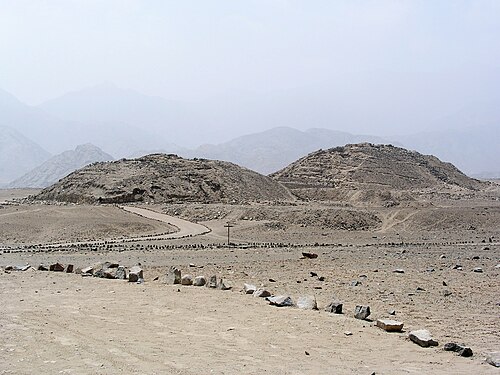
Imagine a dry, sandy valley in Peru, with green fields along a river and brown mountains all around. About 5,000 years ago, people here built big flat-topped pyramids out of stone, wide open squares, and round plazas sunk into the ground like giant bowls. That place is called Caral.
Caral is very, very old. People were building it at about the same time as the Egyptians were building their famous pyramids, and long before the Maya or the Inca. It is one of the oldest cities anyone has found in North or South America.
The builders had a clever trick. They filled bags woven from plant fibres with stones and piled them inside their walls. Scientists call these bags shicras. When the ground shook in an earthquake, the bags could shift a little without the whole building falling down, a bit like a beanbag that squishes and then settles.
The people of Caral did not make pottery, but they were great at other things. They grew cotton and wove it into cloth and fishing nets. They traded with fishermen on the coast, who gave them anchovies and shellfish. They also played music: archaeologists found flutes made from the bones of pelicans and condors.
One of the most surprising things about Caral is what has not been found. There are no city walls for defence, no piles of weapons and no signs of big battles. Many archaeologists think that the people of Caral held their society together with religion, festivals and trade rather than with armies.
At a glance
- Period
- Main construction c. 2600–2000 BC (Late Archaic, preceramic); the wider Caral–Supe (Norte Chico) tradition c. 3000–1800 BC
- Place
- Supe River valley, Barranca Province, Lima Region, Peru; about 23 km inland from the Pacific and roughly 180 km north of Lima
- Size
- Monumental core of about 65–66 hectares, with six large pyramids, many smaller mounds, plazas and residential areas
- Largest building
- Pirámide Mayor (Great Pyramid), a stepped platform mound roughly 150 × 110 m at its base (published heights vary)
- Society
- Principal centre of the Caral–Supe or Norte Chico civilization, one of the world’s independent cradles of civilization
- Main researcher
- Ruth Shady Solís and the Caral archaeological project (since 1994)
- Status
- UNESCO World Heritage Site as the “Sacred City of Caral-Supe”, 2009
- Known for
- Very early monumental architecture, sunken circular plazas, bone flutes, a possible early quipu, and no evidence of warfare
Easy
What is Caral?
Caral is an archaeological site in the valley of the Supe River on the north-central coast of Peru. It sits on a dry terrace above the green valley floor, about 23 km from the Pacific Ocean. Here, between about 2600 and 2000 BC, people built a planned settlement of stone and earth platform mounds, open plazas, sunken circular courts and houses. Peruvian archaeologists call it the Sacred City of Caral (Ciudad Sagrada de Caral).
Caral matters because of its age. When its first pyramids were going up, Egypt’s Old Kingdom was building pyramids at Giza, Sumerian cities flourished in Mesopotamia, and the Indus cities were growing in South Asia. In the Americas, nothing of comparable scale was built for many centuries: Caral is older than the Olmec centres of Mexico by well over a thousand years. For this reason it is often described as the oldest known city in the Americas.
Caral was not alone. It was the largest of a whole cluster of early sites in the Supe valley and in the neighbouring Pativilca and Fortaleza valleys. Archaeologists call this cluster the Norte Chico (“Little North”) civilization, and Peruvian scholars increasingly use the name Caral–Supe civilization. The people who built it left no writing that we can read, and we do not know what they called themselves or their city.
In 2009 UNESCO inscribed the site on the World Heritage List as the Sacred City of Caral-Supe, recognizing it as an exceptionally early and well-preserved example of a complex society in the Americas.
Easy
How to “read” the city: pyramids, plazas and houses
The site is usually described in two parts. In the upper zone (Caral Alto) stand the largest buildings: the Pirámide Mayor (Great Pyramid), the Central Pyramid, the Quarry Pyramid (La Cantera), the Gallery Pyramid (La Galería), the Lesser Pyramid and the Pyramid of the Huanca. The lower zone (Caral Bajo) contains the Temple of the Amphitheatre, smaller mounds and many houses. In all, the monumental core covers about 65 hectares and includes around thirty public buildings.
The “pyramids” of Caral are not pointed like those of Egypt. They are stepped platform mounds: massive terraced blocks with a flat top, climbed by a central staircase. On top were rooms, courtyards and altars, some with a small central hearth where offerings were burned. The Pirámide Mayor, the biggest, measures roughly 150 by 110 m at its base; published figures for its height differ (from about 18 m to about 28 m) depending on where it is measured, because it rises over a natural slope.
In front of several pyramids lies a sunken circular plaza: a round court dug into the ground and lined with stone, reached by steps. The Temple of the Amphitheatre in the lower zone has an especially large one, about 29 m across. These round, sunken spaces were probably used for gatherings and ceremonies, perhaps with music and dancing. Sunken circular plazas later became a recurring feature of Andean religious architecture.
Around the public buildings were residential areas. Larger, well-built house compounds stand close to the pyramids, while simpler dwellings of cane and mud lie further out. Archaeologists read this difference as a sign of social ranking: some families lived near the temples and ate better food, while others lived in humbler homes. A tall standing stone, the Huanca, about 2 m high, stands near one of the pyramids and may have been a sacred marker.
Easy
Life in Caral: cotton, fish, music
Caral belongs to what archaeologists call the Late Archaic or preceramic period: the people had not yet begun to make fired pottery. Instead they used gourds, baskets, textiles and stone and bone tools. Their most important crop was probably cotton, grown with the help of simple irrigation channels from the Supe River. Cotton gave them cloth for clothing and bags, and above all the string for fishing nets.
Food came from both farming and the sea. People grew squash, beans, sweet potato, guava, lúcuma, avocado and other plants, and they ate large amounts of fish and shellfish, especially anchovies and sardines, brought up from the coast. The coastal site of Áspero, about 25 km downriver at the mouth of the Supe, was a fishing community closely linked with Caral. A simple exchange is often imagined: inland farmers sent cotton for nets and plant foods; coastal fishers sent back dried fish and shellfish.
Music seems to have been important. At Caral archaeologists found 32 transverse flutes carved from the wing bones of pelicans and condors, and more than thirty horn-like instruments (cornetts) made of deer and llama bone. One set of flutes has been radiocarbon dated to about 2170 BC. These instruments hint at public ceremonies in the plazas.
The people of Caral also traded far beyond their valley. Shady has suggested that images of monkeys, animals of the tropical forest, point to exchange with communities on the Amazon side of the Andes.
Intermediate
Building Caral: shicras, labour and rebuilding
The platform mounds were built in stages over many generations. Builders raised retaining walls of stone set in clay mortar and filled the space inside with rubble. A distinctive part of this fill is the shicra: a net bag woven from plant fibre, filled with stones and laid in place as a unit. Excavators have found thousands of them inside the mounds. The reeds from such bags were used to date the construction of the Great Pyramid by radiocarbon; the results pointed to building activity around 2600 BC.
Shicras had practical advantages. A worker, or a small team, could fill a bag at a quarry and carry it to the building site, so the work could be divided into standard units. Ruth Shady’s team has argued that the bags also made the structures more resistant to earthquakes, a constant danger on the Peruvian coast, because the stone-filled bags could shift and settle rather than crack. This “anti-seismic” interpretation is widely repeated, though it is a hypothesis based on engineering reasoning rather than direct observation of an ancient earthquake.
The mounds were periodically remodelled. Old rooms and staircases were filled in and buried, and new, larger structures built on top, a practice sometimes called ritual burial of buildings. Each renewal would have required organized labour on a large scale, which is one reason archaeologists think Caral had some form of central leadership able to plan and coordinate collective work.
The planning is visible in the layout. The large pyramids are arranged around a great open space, and many buildings share orientations. Whether this reflects astronomical alignments, as some researchers have suggested, or simply a shared design tradition, is still under study.
Intermediate
Who ruled Caral? Religion, trade and the absence of war
Caral was a hierarchical society. Differences in housing, food and burial point to an elite who lived near the pyramids and enjoyed foods such as sea lion meat, and to ordinary people who lived in simpler houses. Shady describes a society of leaders who combined political and religious roles, specialists such as builders and musicians, and farmers and fishers who provided labour.
Strikingly, the site shows no clear signs of organized warfare. There are no defensive walls, no weapons stockpiles, and no mass burials of people killed in battle. The anthropologist Jonathan Haas has pointed out that rulers usually draw power from three sources: economic control, religious ideology and physical force. At Caral, force seems to have played little role; control over cotton, irrigation and exchange, together with religious authority and large festive gatherings, probably mattered more.
Not everything was peaceful in the modern sense. Excavations at Caral and Áspero have found human remains in ceremonial contexts that some archaeologists interpret as sacrifices, including infants buried beneath buildings. These finds are few and their interpretation varies, but they remind us that religion in early complex societies could involve violence even without war.
Caral’s power probably extended over the rest of the Supe valley. Archaeologists have identified around eighteen or more large contemporary settlements with monumental architecture in the valley, and perhaps thirty across the Norte Chico region. Whether these formed a single state with Caral as its capital, a loose network of allied centres, or competing communities that shared a culture is one of the central questions of Andean archaeology.
Intermediate
Religion and ritual
Because the people of Caral left no texts, their religion must be reconstructed from buildings and objects. The pyramids clearly had ceremonial functions: their summits held rooms with altars and hearths where offerings, including food, cotton, shells and small figurines, were burned. Several buildings had hearths fed by underground ventilation ducts that drew air to the fire, a feature shared with other early Andean temples.
The pairing of a pyramid with a sunken circular plaza suggests a sequence of ritual movement: people gathered below ground level in the round court, then climbed the staircase toward the sacred rooms above. The same basic combination appears later at many Andean sites, including Chavín de Huántar in the highlands, which suggests long-lasting religious traditions.
A gourd fragment found in 2003 at a Norte Chico site in the neighbouring Pativilca valley carries a painted figure holding staffs, dated to about 2250 BC. Some scholars have linked it to the “Staff God”, a figure central to much later Andean religion, from Chavín to Tiwanaku. If this link is correct, some Andean religious ideas may have roots going back to the Caral–Supe period, but the interpretation of a single image across nearly two thousand years remains cautious.
In 2000 a large geoglyph, a figure scraped on the desert surface, was found west of Caral, showing a face with streaming hair and an open mouth. Its date and meaning are uncertain.
Intermediate
Discovery and excavation
The mounds of Caral were never hidden. Local people knew them, and the German archaeologist Max Uhle passed through the area in 1905 without recognizing their importance. In 1948 the American geographer and historian Paul Kosok, who studied ancient irrigation on the Peruvian coast, visited and described the site, but because no pottery was found, most archaeologists assumed it was relatively late and did not investigate further.
In 1994 the Peruvian archaeologist Ruth Shady Solís of the National University of San Marcos began a survey of the Supe valley, re-identifying about eighteen large sites. From 1996 her team excavated at Caral. In 2001 Shady, together with the American archaeologists Jonathan Haas and Winifred Creamer, published radiocarbon dates in the journal Science showing that Caral’s monumental architecture was built during the Late Archaic, centuries before pottery appeared in the region. The paper made Caral internationally famous.
Shady’s work grew into a large state-supported project, now the Zona Arqueológica Caral, which studies and conserves Caral and several other Supe valley sites, including Áspero and the later site of Vichama near the coast. The project has restored parts of the pyramids and opened the site to visitors, and Shady became one of Peru’s best-known scientists.
The collaboration between Shady and the Haas–Creamer team later broke down. Disagreements arose over credit for the discoveries and over interpretation, especially about how large and centralized Caral’s society was. Shady has emphasized Caral as the capital of a state; Haas and Creamer, working in the neighbouring Pativilca and Fortaleza valleys, have stressed the size of the wider Norte Chico region.
Intermediate
Decline, legacy and threats today
Caral was gradually abandoned around 2000–1800 BC. Proposed causes include earthquakes, El Niño floods, the spread of sand dunes over fields, and a prolonged drought. Recent research has linked the decline to the global climate shift known as the 4.2-kiloyear event, a period of drier conditions around 2200 BC. Many archaeologists stress that the population moved rather than disappeared: settlement shifted, for example toward the coast at Vichama, where later friezes have been interpreted as images of famine and renewal.
The Caral–Supe tradition had lasting influence. Platform mounds with sunken circular plazas, the ritual burial and rebuilding of temples, and possibly aspects of religious imagery continued in later Andean cultures. Caral shows that Andean civilization began on the coast, in river valleys fed by the mountains and sea, long before the famous empires of the Wari and the Inca.
Today the site faces pressures. Farming, road building and informal settlement press on the protected zone. In early 2021 squatters claiming land rights began building on the edges of the protected area, and archaeologists, including Shady herself, reported receiving death threats. These conflicts reflect deeper tensions in Peru between heritage protection, poverty and the need for land.
Caral is also a source of national pride. It has changed how Peruvians tell their own history: the story of civilization in Peru now begins some five thousand years ago.
Advanced
Scholarly debates: maritime foundations, maize and the meaning of “city”
The maritime foundations hypothesis. In 1975 the archaeologist Michael E. Moseley argued in The Maritime Foundations of Andean Civilization that the rich anchovy fisheries of the Peruvian coast, rather than agriculture, supplied the surplus that made the first complex societies possible. Áspero was his key example. The discovery that large inland sites like Caral were contemporary with, or older than, the coastal sites complicated this model. A widely cited compromise sees an interdependent economy of inland cotton and plant foods and coastal fish. A 2022 isotopic study found that plant foods dominated the diet at both Áspero and Caral, suggesting agriculture mattered more than Moseley proposed, though marine protein was clearly important.
The maize question. Whether maize (corn) was a staple has been debated. Early reports found little maize and emphasized its absence as a distinctive feature of Norte Chico. Later work in the Fortaleza and Pativilca valleys by Haas, Creamer and colleagues, based on pollen, stone-tool residues and human coprolites (preserved faeces), argued that maize was a significant food throughout 3000–1800 BC. Critics question how representative these samples are. The issue matters because maize is often considered essential for early states in the Americas.
Was Caral a city, and was it a state? Estimates of Caral’s population vary: around 3,000 people in the city itself is often cited, with perhaps 20,000 across the valley, but such figures depend on assumptions about how many houses were occupied at once. Shady interprets Caral as the capital of a state; others prefer terms such as “chiefdom” or see a network of competing corporate groups building monuments to attract followers. The debate turns on definitions as much as evidence: a society can build monuments without a bureaucracy, and a “city” may be a ceremonial centre with a modest resident population.
Dating and chronology. More than a hundred radiocarbon dates from Caral have been published, placing its main construction between about 2600 and 2000 BC. Dates from other Norte Chico sites, including Áspero and sites in the Fortaleza valley, reach back before 3000 BC. Radiocarbon dates must be calibrated and read in context; samples from reused or old materials can give misleadingly early results, which is why dating from short-lived plant materials such as shicra reeds has been important.
Advanced
Evidence and methods: reading a society without writing
Architecture and stratigraphy. The core evidence at Caral is the sequence of building phases inside the mounds, revealed by excavation. Each rebuilding sealed earlier floors, offerings and fills, allowing archaeologists to date and compare phases. Because much of the site has been restored, researchers and visitors must distinguish original masonry from modern consolidation.
Organic preservation. The extreme dryness of the Peruvian coast preserves materials that decay elsewhere: plant remains, textiles, cordage, gourds and food waste. These allow reconstruction of diet, crafts and trade in unusual detail and provide ideal samples for radiocarbon dating.
The quipu question. Shady’s team reported a knotted cord from Caral interpreted as a quipu, the knotted-string recording device used much later by the Inca. If confirmed, it would push the history of Andean record-keeping back thousands of years. However, the claim has not been fully published or evaluated, and many specialists treat it with caution; the earliest undisputed quipus date to the Wari period (c. 600–1000 AD). Even the Inca quipu is understood mainly as a numerical system, and whether quipus could record language remains debated.
Comparative framing. Caral is often placed among the world’s independent “cradles of civilization” alongside Mesopotamia, Egypt, the Indus valley, China and Mesoamerica. Such lists are useful but can mislead: Caral had monumental architecture and social hierarchy but no pottery, no metalwork and no known writing. Studying it forces archaeologists to reconsider which features truly define early civilization.
Key ideas
- Preceramic monumentality
- Caral shows that large-scale architecture and social hierarchy arose before pottery, overturning older assumptions about the order in which features of civilization appear.
- Platform mound and sunken plaza
- The pairing of a stepped, flat-topped pyramid with a round sunken court, which became a long-lasting Andean ceremonial pattern.
- Shicra construction
- Stone-filled fibre bags used as building fill, allowing standardized labour and possibly improving earthquake resistance.
- Cotton–fish exchange
- An interdependent economy in which inland farmers supplied cotton and plants and coastal communities supplied fish and shellfish.
- Power without war
- The lack of evidence for warfare suggests that religion, feasting and control of resources held Caral’s society together.
- Independent cradle of civilization
- The Caral–Supe tradition developed complex society in the Andes without influence from the Old World.
- Heritage under pressure
- Land invasions, farming and threats to archaeologists show the modern struggle to protect Caral.
Records
- c. 3000 BCE — Monumental building begins at several sites of the Norte Chico region, including Áspero on the coast.
- c. 2627 BCE — Radiocarbon dates from shicra reeds indicate construction at Caral’s Great Pyramid.
- c. 2250 BCE — A gourd painted with a staff-holding figure, found in the Pativilca valley, is made about this time.
- c. 2170 BCE — Bone flutes found at Caral are dated to about this time.
- c. 2000 BCE — Caral is gradually abandoned; settlement shifts elsewhere in the valley and toward the coast.
- 1905 — Max Uhle passes through the area but does not recognize the mounds as ancient pyramids.
- 1948 — Paul Kosok visits and describes the site.
- 1994 — Ruth Shady begins surveying the Supe valley; excavations at Caral follow from 1996.
- 2001 — Shady, Haas and Creamer publish radiocarbon dates in Science, making Caral internationally known.
- 2009 — The Sacred City of Caral-Supe is inscribed on the UNESCO World Heritage List.
- 2021 — Squatter settlement and death threats against archaeologists draw attention to the site’s vulnerability.
Glossary
- Norte Chico / Caral–Supe
- The early complex society of the Supe, Pativilca and Fortaleza valleys of coastal Peru, c. 3000–1800 BC.
- Preceramic
- The period before people made fired pottery; in the Andes the Late Archaic, before about 1800 BC.
- Platform mound
- A large, flat-topped, often stepped structure of earth and stone used as a base for temples or elite buildings.
- Sunken circular plaza
- A round court dug below ground level, used for gatherings and ceremonies.
- Shicra
- A net bag of plant fibre filled with stones, used as construction fill.
- Quipu
- A device of knotted strings used in the Andes to record numbers and possibly other information.
- Radiocarbon dating
- A method of dating organic material by measuring the decay of carbon-14.
- Huanca
- A standing stone regarded as sacred in Andean tradition.
- Geoglyph
- A large figure made on the ground by moving stones or scraping the surface.
- 4.2-kiloyear event
- A period of widespread drought and climate change around 2200 BC.
Questions and answers
Is Caral really older than the Egyptian pyramids?
Caral’s main buildings date from about 2600 BC, roughly the same time as the pyramids at Giza. It is not older than all Egyptian monuments, but it is contemporary with the great pyramid age.
Why didn’t the people of Caral make pottery?
Pottery had not yet been adopted in the region. They used gourds, baskets and textiles instead, which worked well in the dry climate.
Did Caral have a king?
We do not know. There were clearly leaders and elites, but no royal tombs, palaces with thrones or written names of rulers have been found.
Why are there no weapons at Caral?
Excavations have found no fortifications or weapons. This may mean that leaders held power through religion, trade and feasting rather than war, though absence of evidence always needs cautious interpretation.
Was the knotted string from Caral a quipu?
The excavators interpret it as an early quipu, but it has not been fully evaluated, and most specialists place the first certain quipus much later, in the Wari period.
How reliable are population estimates for Caral?
Not very. Figures like 3,000 people in the city depend on assumptions about how many houses were occupied simultaneously and how many people lived in each.
Can I visit Caral?
Yes. The site is open to visitors, with paths and viewpoints; it lies a few hours’ drive north of Lima.
Sources and further reading
- Caral. Wikipedia
- Caral. Wikipedia (Spanish)
- Norte Chico civilization. Wikipedia
- Aspero. Wikipedia
- Ruth Shady. Wikipedia
- Quipu. Wikipedia
- Ruth Shady Solis, Jonathan Haas, Winifred Creamer, Dating Caral, a Preceramic Site in the Supe Valley on the Central Coast of Peru. Science 292, 2001
- Michael E. Moseley, The Maritime Foundations of Andean Civilization. Cummings, 1975
Related
- Chavín de HuántarHighland Peruvian temple complex of the first millennium BC whose dark stone galleries lead to the Lanzón, a fanged granite deity; centre of the first art style shared across much of the Andes.
- Great Pyramid of GizaA royal tomb built for the Egyptian pharaoh Khufu. It is the largest of the Giza pyramids and the only surviving Wonder of the ancient world.
- StonehengeA prehistoric monument of earthworks and standing stones in southern Britain, built and altered over many centuries.
- Mohenjo-daroOne of the largest cities of the Bronze Age Indus Civilisation, known for its planned streets, fired-brick houses, wells, drains and the Great Bath.
- Nazca LinesLarge ground drawings and lines made by ancient communities in the desert of southern Peru.
- Machu PicchuInca settlement in the Andes, probably established in the fifteenth century.
Written with AI assistance from the published sources listed above, and revised as new research appears.