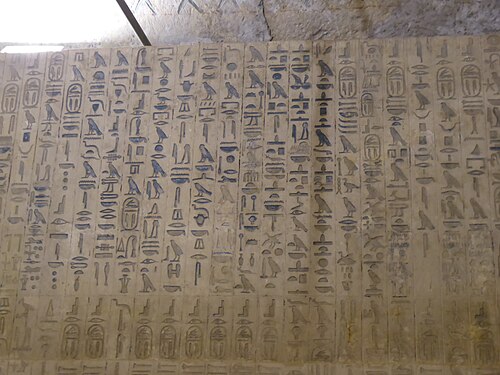
Start at the top for an easy introduction. Go further down for more detail and scholarship.
- Easy
- Intermediate
- Advanced
For young readers
More than 4,000 years ago, the kings of Egypt were buried inside pyramids. Most people know the pyramids from the outside, as huge stone mountains. But inside some of them, deep underground, there are rooms whose walls are covered from top to bottom with rows of carved picture-writing called hieroglyphs.
These writings are called the Pyramid Texts. They are not stories about the king’s life. They are spells, a bit like prayers or magic words, that priests chanted out loud at the king’s funeral and that were carved into stone so they would keep working forever.
The spells tell the king what to do after he dies: wake up, shake off the earth, gather his bones and climb up to the sky. They describe many ways to get there: up a ladder, on a ferry boat, on the wings of a bird, or by flying like a falcon. Up in the sky he would join the sun god and the stars that never set.
Some spells ask the gods for bread and beer so the king will never be hungry. Others protect his body and his tomb from snakes, scorpions and robbers. A few are surprising, like one where the king seems to hunt and eat the gods to take their power.
The first pyramid with these texts belonged to a king called Unas, who lived about 4,350 years ago. For a long time, experts thought pyramids had no writing inside at all. Then, in 1880 and 1881, a French archaeologist named Gaston Maspero crawled into several pyramids at a place called Saqqara and found the walls covered with spells.
Today the Pyramid Texts help us understand what ancient Egyptians believed about death, the gods and the afterlife. Later Egyptians copied and changed many of these spells, and some of them ended up in the famous Book of the Dead.
At a glance
- Date inscribed
- From the end of the Fifth Dynasty (pyramid of Unas, c. 24th century BC) through the Sixth Dynasty and into the Eighth Dynasty; some spells are probably much older in origin
- Where
- Burial chambers, antechambers and corridors of royal pyramids at Saqqara, near Memphis in Lower Egypt
- For whom
- Kings (Unas, Teti, Pepi I, Merenre, Pepi II, Qakare Ibi) and several queens (including Neith, Iput II, Wedjebetni and Behenu)
- Language and script
- Old Egyptian, written in hieroglyphs in vertical columns, usually filled with blue or green pigment
- Size
- Sethe’s edition counts 714 spells (utterances); later finds raise the total to about 759; Unas alone has 283
- Rediscovery
- Gaston Maspero, 1880–81; first edition 1894; standard edition by Kurt Sethe (1908–1922)
- Successors
- Adapted in the Coffin Texts (Middle Kingdom) and in the Book of the Dead (New Kingdom and later)
Easy
What are the Pyramid Texts?
The Pyramid Texts are a large collection of spells, prayers and ritual speeches carved on the walls of the underground rooms of Egyptian royal pyramids. They are written in Old Egyptian, the earliest stage of the Egyptian language, and are the oldest large group of religious texts known from ancient Egypt, and among the oldest religious writings anywhere in the world.
They first appear in the pyramid of Unas, the last king of the Fifth Dynasty, who ruled around the 24th century BC. Kings of the Sixth Dynasty and a king of the Eighth Dynasty, as well as several queens, also had them carved in their pyramids, all at Saqqara, the great royal cemetery of the ancient capital Memphis, near modern Cairo.
The texts had one main purpose: to make sure that the dead king would overcome death, be transformed into an akh, a glorified and effective spirit, and take his place among the gods in the sky. Unlike later funerary texts, they were not illustrated and, in the Old Kingdom, they were reserved for royalty.
Easy
Writing hidden inside the pyramids
The earliest great pyramids, such as those at Giza, have no writing in their chambers. Around 2350 BC this changed. In the small pyramid of Unas, the walls of the burial chamber, the antechamber and part of the corridor were covered with columns of hieroglyphs, carved in stone and filled with colour. The ceiling of the burial chamber was painted blue with stars, like the night sky.
The pyramid of Unas is the smallest pyramid of the Old Kingdom, only about 43 metres high, but its texts are the best preserved. It contains 283 spells. The walls around the stone sarcophagus were decorated to look like a reed-mat shrine, and the rest was filled with writing. Later pyramids of the Sixth Dynasty contain more texts and a greater variety of spells.
The placement of the texts was not random. Different rooms held different kinds of spells: rituals of offering near the sarcophagus, protective spells on the gables, and texts about leaving the tomb and rising to the sky in the antechamber and corridor. The architecture of the tomb and the words on its walls worked together.
Pyramid Texts were not only for kings. Three queens of Pepi II, Neith, Iput II and Wedjebetni, had texts carved in their own smaller pyramids, and in 2010 more were found in the tomb of another queen, Behenu. The queens’ tombs are simpler, and Neith’s pyramid has no antechamber, so spells that would normally be placed there were carved on other walls. Even so, the texts follow the same general plan as in the kings’ pyramids. Neith’s name is written throughout to make the spells her own, though many pronouns remain masculine, a sign that the texts were adapted from royal models.
Easy
The king’s journey to the sky
Many spells tell the dead king to wake and rise. In one famous spell for Unas, the priest assures him that he has not departed dead but departed alive, and tells him to sit on the throne of Osiris and rule. Another spell, for King Teti, calls on him to lift his head, gather his bones, shake the earth from his flesh and take the bread that never goes stale and the beer that never turns sour.
The spells describe many ways to reach the sky. The king may climb a ladder held by the gods, go up a ramp or a stairway, ride a ferry across the waters of the sky, or fly as a falcon or on the wing of the god Thoth. If a ferryman refuses to carry him, the king threatens to find another way.
In the sky the king joins the sun god Ra on his daily voyage and becomes one of the “imperishable stars,” the circumpolar stars in the northern sky that never set below the horizon. He is also identified with Osiris, the god who was killed and brought back to life, and his son Horus acts for him. These different images of the afterlife, solar, stellar and Osirian, sit side by side in the texts.
Intermediate
Kinds of spells
Egyptologists divide the Pyramid Texts into two broad groups. The first are ritual or “sacerdotal” texts, spoken by a lector priest to the dead king in the second person (“you”). They include offering spells recited as each item of food, drink, cloth or incense was presented, and texts from rituals such as the Opening of the Mouth, which was believed to restore the dead person’s ability to eat, speak and see.
The second group are “personal” texts, which the king himself may speak or which concern his own transformation. These include provisioning spells, in which the king demands food from the gods; transition spells, also called glorifications (sakhu), about becoming an akh and ascending to the sky; and apotropaic spells, short protective charms against snakes, scorpions and other dangers.
The protective spells are written in an especially archaic style and are thought to be among the oldest material. The transition texts, which make up the largest part of the corpus, seem to be younger, composed in the Fifth and perhaps Sixth Dynasties. Some ritual texts may go back to the Second or Third Dynasty.
Intermediate
Gods and ideas in the texts
The Pyramid Texts are one of our main sources for early Egyptian mythology. They mention the creator god Atum, who produced the first divine couple, and the family of gods known as the Ennead of Heliopolis: Shu and Tefnut, the earth god Geb and the sky goddess Nut, and their children Osiris, Isis, Seth and Nephthys. Many later myths appear here for the first time, though often only in allusions.
The texts rely on ideas about the parts of a person. The ka was the life force that needed food offerings; the ba was a mobile aspect of the person, often imagined as a human-headed bird; the akh was the effective, transfigured spirit that the king hoped to become. The body, the name and the shadow were also important. Death was seen not as an end but as a dangerous transition that could be managed with the right words and rituals.
Language itself had power. Egyptians believed that correctly spoken or written words could make things happen. Some spells therefore address the gods boldly, even threatening them if they do not help the king. Priests occasionally altered signs of dangerous animals, such as snakes, or cut them in half in the inscriptions, so that the written creatures could not harm the king.
Intermediate
The “Cannibal Hymn” and other surprising spells
Spells 273–274, found only in the pyramids of Unas and Teti, are known in modern times as the “Cannibal Hymn.” In them the king, helped by the god Shezmu, hunts, butchers, cooks and eats the gods like sacrificial bulls, absorbing their magical power so that he becomes the greatest power in the sky.
Scholars read this text not as evidence of real cannibalism but as a mythological and ritual image. It echoes a butchery ritual and uses vivid metaphor and wordplay. The Victorian Egyptologist Peter le Page Renouf already warned against explaining such myths simply as memories of “savage” practices. Some connect the image with the sky goddess Nut, pictured as swallowing the stars at dawn.
Another unusual text, Spell 534 in the pyramid of Pepi I, is a curse against anyone who harms the pyramid. It is a reminder that the texts had practical aims too: to protect the royal tomb and its offerings as well as to guide the king’s spirit.
Intermediate
Rediscovery and editions
For centuries no one knew the texts existed. In 1880 the French Egyptologist Gaston Maspero began digging at South Saqqara and entered a pyramid, which proved to be that of Pepi I, whose underground walls were covered in hieroglyphs. The leading Egyptologist in Egypt at the time, Auguste Mariette, refused to believe it was a pyramid, because no inscribed pyramid chamber had ever been found. Maspero found similar texts in the pyramid of Merenre and, in 1881, in those of Unas, Teti and Pepi II.
Maspero published the texts from 1882 onwards and brought them together in 1894 as Les inscriptions des pyramides de Saqqarah. The German Egyptologist Kurt Sethe then produced a standard edition, Die altägyptischen Pyramidentexte (1908–1922), which numbered the spells and arranged parallel versions from different pyramids; his numbering is still used. Samuel Mercer (1952), Raymond Faulkner (1969) and James P. Allen (2005) published English translations.
Excavations continued in the twentieth century. Gustave Jéquier studied the pyramids of Pepi II, his queens and King Ibi between 1926 and 1932. From 1958 a French mission under Jean-Philippe Lauer, Jean Sainte-Fare Garnot and Jean Leclant restored the pyramids of Unas, Teti, Pepi I and Merenre and reassembled thousands of fallen inscribed fragments. More texts were found in the tomb of Queen Behenu in 2010.
Intermediate
From Pyramid Texts to Coffin Texts and the Book of the Dead
After the Old Kingdom, royal pyramids stopped carrying these inscriptions, but the spells did not disappear. During the First Intermediate Period and the Middle Kingdom, many of them, together with new compositions, were written inside the wooden coffins of officials and wealthier people. This collection, called the Coffin Texts, contains about 1,185 spells and places more emphasis on the underworld ruled by Osiris.
In the New Kingdom and later, a new collection developed, written mostly on papyrus rolls placed in tombs: the Book of the Dead. It includes descendants of some Pyramid Text spells, alongside illustrations such as the famous scene of the weighing of the heart. Pyramid Text spells were also copied in the tombs of officials, and in the Late Period there was a revival of interest in them.
One remarkable copy is in the tomb of Senwosretankh, a high priest of the Twelfth Dynasty at el-Lisht, which reproduces almost all of the Unas texts. This shows that the texts were preserved in temple or archive copies long after the pyramids were closed.
Advanced
How old are the texts? Oral origins and composition
Although the texts were first carved in the 24th century BC, most Egyptologists believe many were composed earlier and transmitted orally or in writing on papyrus. The archaic grammar and spelling of some spells, references to practices of earlier periods, and the variety of their styles all suggest that the corpus is an anthology built up over a long time.
Scholars have tried to date individual spells by their language and content. The protective spells are usually seen as the oldest; the dramatic ritual texts may go back to the early dynasties; the large group of ascension spells seems to belong to the Fifth Dynasty, when the solar cult of Ra was especially important. Some spells mention burial practices or kinds of tombs that do not match the pyramids they were carved in, supporting the idea that they were adapted from older sources.
Why the texts suddenly began to be carved under Unas is still debated. Explanations include changes in religious ideas, especially the growing importance of Osiris; a wish to guarantee the rituals permanently in stone in case the funerary cult stopped; and developments in royal ideology at the end of the Fifth Dynasty. None of these is certain, and they are not mutually exclusive.
Advanced
Reading the texts as a system
Early editions, including Sethe’s, treated the Pyramid Texts as a list of separate spells. Later research, especially from the 1970s onwards, has emphasised that each pyramid presents a carefully arranged programme. Scholars such as James P. Allen have argued that the texts should be read in relation to the architecture: the burial chamber represented the underworld (Duat), the antechamber the horizon (Akhet), and the corridor the way out into the sky.
On this view the texts trace the king’s journey from the sarcophagus, through the antechamber and corridor, towards the northern sky, matching the path along which his spirit was imagined to leave the pyramid. Other scholars have proposed different reading orders, starting at the entrance and moving inwards, following the funeral procession. Both approaches agree that the texts must be studied in their physical setting, not only as abstract texts.
The comparison of versions in different pyramids also shows how the texts were edited. Spells were selected, rearranged, adapted for queens (sometimes keeping masculine pronouns), and changed from first to third person. The texts of Queen Neith, for example, adapt the royal programme to a smaller tomb without an antechamber. This evidence helps scholars understand how Egyptian priests worked with a traditional body of religious knowledge.
Advanced
Significance and debates about the afterlife
The Pyramid Texts are a key source for the history of religion, language and kingship in Egypt. They show a king who is both a human ruler and a being destined to join the gods, whose afterlife is secured by ritual action. They preserve the oldest continuous texts in the Egyptian language and are essential for the study of Old Egyptian grammar.
A long-standing idea held that the afterlife was at first a royal privilege, and that the spread of funerary spells to non-royal people in the Coffin Texts represented a “democratisation of the afterlife.” Scholars such as Harco Willems and Mark Smith have criticised this model. They point out that non-royal people already had hopes and rituals for the afterlife in the Old Kingdom, and that the change was more about who could use certain written texts and royal symbols than about a sudden opening of eternity to all.
The texts also raise questions about how we translate and understand ancient religion. Their language is often allusive and full of wordplay, and the gods and places they mention can be interpreted in several ways. Different translations can differ considerably. This makes the Pyramid Texts both a treasure and a challenge for modern readers.
Key ideas
- Akh
- The transfigured, effective spirit that the dead king hoped to become, able to live among the gods.
- Ascension
- The king rises to the sky by ladder, ramp, ferry or flight to join Ra and the imperishable stars.
- Osiris and renewal
- The king is identified with Osiris, the god who died and was restored to life, and is cared for by Horus.
- Power of words
- Correctly spoken and written words were believed to act in the world, protecting and transforming the king.
- Ritual in stone
- Carving the spells made the funerary rituals permanent, independent of priests continuing to perform them.
- Offering and provision
- The dead needed food and drink; spells guaranteed a lasting supply for the king’s ka.
- Tradition and adaptation
- The texts were an anthology of older material, selected and arranged for each pyramid and later adapted for non-royal people.
Records
- c. 2550 BCE — Great pyramids at Giza are built without inscriptions in their chambers.
- c. 2350 BCE — Reign of Unas: the Pyramid Texts first appear in his pyramid at Saqqara.
- c. 2300 BCE — Sixth Dynasty kings Teti, Pepi I and Merenre expand the corpus.
- c. 2200 BCE — Pyramid Texts in the pyramids of Pepi II and his queens Neith, Iput II and Wedjebetni.
- c. 2150 BCE — Eighth Dynasty: the small pyramid of King Qakare Ibi carries the last royal Pyramid Texts.
- c. 2000 BCE — Middle Kingdom: many spells are adapted into the Coffin Texts; a near-complete Unas copy is made for Senwosretankh.
- 1880 — Gaston Maspero finds inscribed chambers in the pyramid of Pepi I at South Saqqara.
- 1881 — Texts are found in the pyramids of Unas, Teti and Pepi II.
- 1894 — Maspero publishes Les inscriptions des pyramides de Saqqarah.
- 1908 — Kurt Sethe begins publishing the standard edition, Die altägyptischen Pyramidentexte.
- 1958 — French mission begins restoring the inscribed pyramids and reassembling fragments.
- 2010 — Pyramid Texts are found in the tomb of Queen Behenu.
Glossary
- Utterance / spell
- A single unit of the Pyramid Texts, numbered in Sethe’s edition (e.g., PT 213).
- Akh
- The glorified, effective spirit of a dead person who has successfully passed into the afterlife.
- Ka
- The life force of a person, sustained by food offerings after death.
- Ba
- A mobile aspect of the person, often shown as a bird with a human head.
- Lector priest
- The priest who read the ritual texts aloud during ceremonies.
- Opening of the Mouth
- A ritual to restore the senses and abilities of the dead or of a statue.
- Imperishable stars
- Stars near the celestial pole that never set, seen as a home of the blessed dead.
- Saqqara
- The royal necropolis of ancient Memphis, where all the inscribed pyramids stand.
- Coffin Texts
- Middle Kingdom funerary spells written on coffins, many derived from the Pyramid Texts.
- Book of the Dead
- Later collection of funerary spells, usually on papyrus, with illustrations.
Questions and answers
Are the Pyramid Texts stories?
No. They are spells and ritual speeches, meant to be spoken aloud, to help the king pass through death and live among the gods.
Are there Pyramid Texts in the Great Pyramid of Giza?
No. The Giza pyramids have no inscriptions in their chambers. The texts appear about two centuries later, beginning with Unas at Saqqara.
Who could read them?
Once the tomb was sealed, no living person was expected to read them. They were for the king’s spirit and for magical effect. Before burial, priests recited them during the funeral rituals.
Did the king really eat the gods in the ‘Cannibal Hymn’?
No. The text uses a vivid ritual image of butchery and eating to express the king absorbing divine power; it is mythological language, not a record of practice.
How old are the spells really?
They were carved from the 24th century BC, but many spells were probably composed earlier. Their exact age is debated and varies from spell to spell.
Is it true that only kings could have an afterlife in the Old Kingdom?
The texts themselves were reserved for royalty then, but other evidence shows that non-royal people also expected an afterlife. The idea of a later ‘democratisation’ is now debated.
Which edition do scholars use?
Kurt Sethe’s edition (1908–1922) provides the standard numbering; modern translations include those of Faulkner (1969) and Allen (2005), which take into account later finds.
Sources and further reading
- Pyramid Texts. Wikipedia
- Pyramid of Unas. Wikipedia
- Coffin Texts. Wikipedia
- 피라미드 텍스트. Wikipedia (Korean)
- Kurt Sethe, Die altägyptischen Pyramidentexte. J. C. Hinrichs, 1908–1922
- R. O. Faulkner, The Ancient Egyptian Pyramid Texts. Clarendon Press, 1969
- James P. Allen, The Ancient Egyptian Pyramid Texts. Society of Biblical Literature, 2005
Related
- Great Pyramid of GizaA royal tomb built for the Egyptian pharaoh Khufu. It is the largest of the Giza pyramids and the only surviving Wonder of the ancient world.
- Narmer PaletteA shield-shaped ceremonial palette of dark siltstone, about 63 cm tall, showing King Narmer in the crowns of both Upper and Lower Egypt defeating his enemies.
- Epic of GilgameshA king's friendship with Enkidu and his search for immortality, assembled from earlier Sumerian poems into a Babylonian epic.
- Mask of TutankhamunA gold funerary mask found in the tomb of the Egyptian pharaoh Tutankhamun.
- RigvedaThe oldest collection of Vedic Sanskrit hymns, handed down orally for centuries before it was written down.
- Instructions of ShuruppakOne of the oldest surviving works of literature: a Sumerian father's advice to his son, preserved on clay tablets.
Written with AI assistance from the published sources listed above, and revised as new research appears.