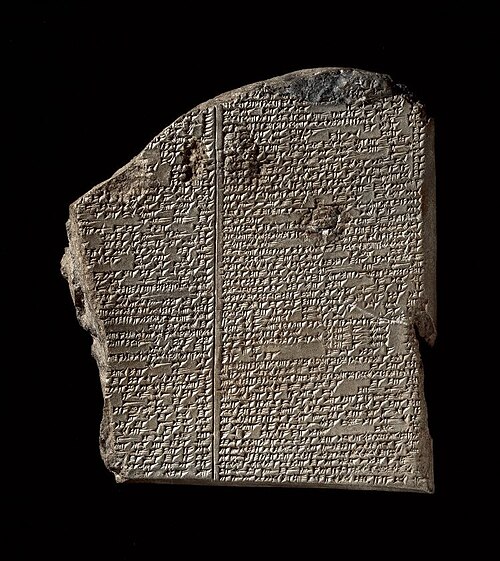
Start at the top for an easy introduction. Go further down for more detail and scholarship.
- Easy
- Intermediate
- Advanced
For young readers
Almost four thousand years ago, in the land between two big rivers that we now call Iraq, people pressed little wedge-shaped marks into wet clay to write. One of the stories they wrote down this way is about a king named Gilgamesh. It is one of the oldest long stories in the world.
Gilgamesh was the king of a city called Uruk. He was very strong, but he was also a bully, and his people were unhappy. So the gods made a wild man named Enkidu, who lived with the animals. When Enkidu came to the city, he and Gilgamesh had a huge wrestling match. Neither could beat the other, and after the fight they became best friends.
Together the two friends went on adventures. They travelled to a faraway forest of giant cedar trees and fought its fierce guardian, Humbaba. They even fought a giant bull sent down from the sky. But the gods decided that Enkidu had to die, and Gilgamesh was heartbroken. For the first time, he became afraid of dying himself.
So Gilgamesh walked to the edge of the world, through a tunnel of total darkness and across the Waters of Death, to meet an old man named Utnapishtim, who had survived a great flood and been given everlasting life. Gilgamesh found a magic plant that could make old people young again, but while he was bathing, a snake slipped up and ate it!
Gilgamesh went home without living forever. But when he looked at the strong walls of his city, he seemed to understand something: people do not live forever, but the good things they build and the stories people tell about them can last a very long time. And here we are, still telling his story.
At a glance
- Type
- Epic poem (narrative poetry), written in cuneiform on clay tablets
- Language
- Akkadian (a Semitic language); earlier separate poems in Sumerian
- Earliest integrated epic
- Old Babylonian period, c. 1800–1700 BCE
- Best-known version
- Standard Babylonian version in 12 tablets, c. 1200–1000 BCE, attributed to Sîn-lēqi-unninni
- Place
- Mesopotamia (Babylonia and Assyria, modern Iraq); copies also found in Syria, Turkey and Israel
- Main characters
- Gilgamesh, king of Uruk; Enkidu; Shamhat; Humbaba; Ishtar; Utnapishtim; Siduri; Urshanabi
- Key find
- Tablets from the library of Ashurbanipal at Nineveh (7th century BCE), excavated 1849–1853
- Why it matters
- One of the oldest surviving works of literature; a meditation on friendship, death and human limits; contains a flood story closely parallel to Genesis
Easy
What is the Epic of Gilgamesh?
The Epic of Gilgamesh is a long poem from ancient Mesopotamia, the region between the Tigris and Euphrates rivers in what is now Iraq. It tells the story of Gilgamesh, a king of the city of Uruk, his friendship with the wild man Enkidu, their heroic adventures, Enkidu’s death, and Gilgamesh’s desperate search for a way to escape death himself. It is often called the oldest great work of world literature, although it was preceded by shorter literary texts, including the poems of the priestess Enheduanna and wisdom texts such as the Instructions of Shuruppak.
The poem was written in cuneiform, a script made of wedge-shaped marks pressed into damp clay with a cut reed. Its language is Akkadian, a Semitic language related to later Hebrew, Aramaic and Arabic, which was the everyday and diplomatic language of Babylonia and Assyria. The best-known version is spread across twelve clay tablets, each holding roughly 200 to 300 lines of verse.
The epic did not appear all at once. It grew over more than a thousand years: first as separate Sumerian poems about Gilgamesh, then as an Akkadian epic in the Old Babylonian period (about 1800–1700 BCE), and finally as the polished twelve-tablet Standard Babylonian version that later scribes copied. When people today say “the Epic of Gilgamesh,” they usually mean this last version, filled in with passages from older ones where the tablets are broken.
Easy
The story, tablet by tablet
Tablets I–II: The poem opens by praising Gilgamesh, “two-thirds divine and one-third human,” and the great walls of Uruk, inviting the reader to climb them and find the tablet-box that holds his story. Gilgamesh oppresses his people, so the gods have the goddess Aruru shape Enkidu from clay. Enkidu roams with gazelles until the hunter’s plan brings Shamhat, a temple woman, to him; after a week with her he is changed—animals flee him, and he learns to eat bread, drink beer and live as a human. He comes to Uruk, blocks Gilgamesh’s way, and the two wrestle until they become inseparable friends.
Tablets III–VI: Seeking lasting fame, the friends travel to the Cedar Forest, guarded by the monster Humbaba (Huwawa), whom the god Enlil appointed. With the help of the sun god Shamash they defeat and kill Humbaba and cut down the cedars. Back in Uruk, the goddess Ishtar proposes marriage to Gilgamesh; he insults her by listing the terrible fates of her former lovers. Furious, she obtains the Bull of Heaven from her father Anu, but the heroes kill it, and Enkidu hurls the bull’s thigh at her.
Tablets VII–VIII: The gods decide that one of the two must die for these deeds, and Enkidu falls ill. He dreams of the underworld as a “house of dust,” curses and then blesses Shamhat, and dies. Gilgamesh mourns him for seven days and nights, until a worm falls from his friend’s nose, and then gives him a magnificent funeral.
Tablets IX–XI: Terrified of death, Gilgamesh wanders the wilderness. He passes the scorpion-people guarding the twin mountain Mashu and runs through the sun’s dark tunnel. He meets the tavern-keeper Siduri by the sea, and the boatman Urshanabi takes him across the Waters of Death to Utnapishtim, the survivor of the Flood. Utnapishtim tells how the god Ea warned him to build a boat, how the storm destroyed humankind, how he released a dove, a swallow and a raven, and how the gods then granted him immortality. He challenges Gilgamesh to stay awake for a week; Gilgamesh falls asleep at once. As a parting gift he learns of a plant that makes the old young again. He dives for it, but a snake steals it while he bathes in a pool, shedding its skin as it goes. Gilgamesh returns to Uruk and shows Urshanabi the city walls—the same image that opened the poem.
Tablet XII: The last tablet is an Akkadian translation of the second half of an older Sumerian poem. In it Enkidu, still alive, goes down into the underworld to retrieve objects Gilgamesh has lost and cannot return; his ghost then rises to describe the fates of the dead. Because it does not fit the storyline of Tablets I–XI, many scholars regard it as an appendix.
Intermediate
Was Gilgamesh a real king?
Gilgamesh (Sumerian Bilgames) appears in the Sumerian King List, a later ancient document that lists rulers of Mesopotamian cities. It places him as the fifth king of the First Dynasty of Uruk and gives him a reign of 126 years—a legendary figure, but one set among names that may reflect real rulers of the Early Dynastic period (roughly 2900–2350 BCE).
Many historians think a real king of Uruk named Gilgamesh probably lived around 2700 BCE, but there is no inscription from his own lifetime that names him. A Sumerian poem, Gilgamesh and Aga, links him with Aga (Akka) of Kish, whose father Enmebaragesi is known from a very early inscription; this is suggestive but not proof. Honestly stated, Gilgamesh’s historical existence is plausible but unconfirmed.
What is certain is that he became a hero and later a god of the underworld in Mesopotamian religion. Around 2100 BCE the kings of the Third Dynasty of Ur (Ur III), especially Shulgi, called Gilgamesh their “brother,” using his fame to strengthen their own legitimacy. This royal interest is probably why the Sumerian Gilgamesh poems were composed or written down in that era.
Intermediate
The world that produced the epic
Mesopotamia was home to some of the world’s first cities, such as Uruk, which by about 3000 BCE may have held tens of thousands of people. Writing itself was invented there around 3300–3100 BCE, first for accounting. By the time the Gilgamesh stories were composed, scribes trained in schools called the eduba (“tablet house”), where they copied Sumerian literature to learn their craft. That is why so many Sumerian poems survive in Old Babylonian school copies.
By the Old Babylonian period (about 2000–1600 BCE), Sumerian was no longer a spoken language, but it was still studied, much as Latin was in medieval Europe. Akkadian was the living language, and the era of Hammurabi of Babylon (reigned c. 1792–1750 BCE) saw a flowering of Akkadian literature. The first integrated Gilgamesh epic belongs to this creative moment, and it drew on an older Mesopotamian flood story also found in the epic of Atrahasis.
Later, Mesopotamian culture spread along trade and diplomatic networks across the ancient Near East. During the Late Bronze Age (about 1600–1200 BCE), Akkadian was the international language of diplomacy, and scribes as far away as the Hittite capital Hattusa in Anatolia, Emar and Ugarit in Syria, and Megiddo in the Levant copied or translated Gilgamesh. In the first millennium BCE, the Assyrian empire collected the texts in great palace and temple libraries.
Intermediate
Themes: friendship, fame, death and wisdom
Friendship is the emotional heart of the poem. Gilgamesh and Enkidu begin as opposites—city and wilderness, king and wild man—and become equals. Enkidu’s humanization through Shamhat, food, drink and clothing has been read as a reflection on what civilization means, and on its gains and losses; Enkidu himself later regrets leaving the wild.
Death and the limits of human life drive the second half. Early on, Gilgamesh dismisses death: only the gods live forever, so a man should win a name that will last. Enkidu’s death turns this abstract idea into personal terror. In the Old Babylonian version Siduri gives famous advice—fill your belly, dance, wash, cherish the child who holds your hand and the wife in your embrace, for this is the lot of humankind. This speech does not appear in the Standard version, which gives a different, longer speech to Utnapishtim about the inevitability of death.
Wisdom and knowledge frame the later version. Its opening line, “He who saw the Deep,” presents Gilgamesh as a man who gained secret knowledge from before the Flood and brought it back. The ring structure—beginning and ending with Uruk’s walls—suggests that his real achievement is the city and the story itself: mortality accepted, but meaning found in human works and memory.
The gods are powerful and often unpredictable. Ishtar’s anger, Enlil’s decision to destroy humanity with the Flood, and the gods crowding like flies around Utnapishtim’s sacrifice show divine beings who are neither simply good nor evil. Humans must live within limits set by forces beyond their control.
Intermediate
The Flood story and its parallels
Tablet XI contains one of the most famous passages in ancient literature: Utnapishtim’s account of the Flood. Warned by the god Ea, who speaks to him through the reed wall of his house, he tears down his house to build a great boat, loads it with his family, craftsmen, animals and wealth, and survives a storm that lasts six days and seven nights. When the boat comes to rest on Mount Nimush, he sends out birds to find dry land and then offers a sacrifice.
The parallels with the story of Noah in the Book of Genesis are striking: a divine warning, a boat of specified dimensions sealed with pitch, animals saved, the boat landing on a mountain, birds sent out, and a sacrifice whose pleasing smell reaches the divine. When these lines were read aloud in London in 1872, they caused a public sensation.
Scholars generally explain the similarity as a shared Mesopotamian flood tradition that is older than both texts. The flood story appears earlier in the Akkadian Atrahasis epic (whose flood hero is also called Atrahasis in some Gilgamesh passages) and in a Sumerian flood narrative featuring Ziusudra. The editors of the Standard Babylonian Gilgamesh appear to have adapted the Atrahasis flood into Tablet XI; the Old Babylonian Gilgamesh may not have included the full flood narrative.
Intermediate
How the epic grew: Sumerian poems to Standard version
Five Sumerian poems about Bilgames survive, mostly in Old Babylonian copies: Gilgamesh and Aga, Gilgamesh and Huwawa (in two versions), Gilgamesh and the Bull of Heaven, Gilgamesh, Enkidu and the Netherworld, and The Death of Gilgamesh. They are separate episodes, not one connected story. In them Enkidu is Gilgamesh’s servant rather than his equal friend.
Around 1800–1700 BCE an Akkadian poet created a single epic from this material, reshaping it around the theme of friendship and death. This Old Babylonian version survives only in pieces, such as the Pennsylvania and Yale tablets and a tablet sometimes attributed to Sippar. Its opening words were “Surpassing all other kings” (Šūtur eli šarrī).
In the late second millennium BCE, the epic was revised into the Standard Babylonian version. Mesopotamian tradition attributed it to Sîn-lēqi-unninni, an exorcist-priest of Uruk; later scholarly families of Uruk claimed descent from him. He is best thought of as an editor or redactor rather than an original author. This version added the prologue, the new opening line “He who saw the Deep,” the full Flood narrative, and probably Tablet XII.
The American scholar Jeffrey Tigay’s study The Evolution of the Gilgamesh Epic (1982) is a classic analysis of this process, and it is often used as a case study of how ancient texts, including parts of the Hebrew Bible, may have developed through editing and combining older sources.
Intermediate
Lost and found: Nineveh, George Smith and new tablets
After the fall of Nineveh in 612 BCE and the end of the cuneiform tradition in the early centuries CE, the epic was forgotten. Only faint echoes survived, such as the name of Gilgamesh among the giants in the Aramaic Book of Giants found at Qumran, and a garbled story about a “Gilgamos” in the Roman-era Greek writer Aelian.
In 1849–1851 the British archaeologist Austen Henry Layard excavated the Southwest Palace at Kuyunjik (Nineveh), and in 1853 Hormuzd Rassam found the North Palace. Together these yielded tens of thousands of tablets and fragments from the libraries of the Assyrian king Ashurbanipal (reigned 668–c. 631 BCE), which were shipped to the British Museum.
In 1872, George Smith, a self-taught Assyriologist working at the British Museum, recognized a fragment of Tablet XI describing a ship resting on a mountain and a bird being sent out. He announced his discovery to the Society of Biblical Archaeology on 3 December 1872. The Daily Telegraph paid for him to return to Nineveh in 1873, where he found more fragments of the flood story.
The recovery continues today. Andrew George’s 2003 critical edition gathered the known manuscripts. In 2014 George and Farouk al-Rawi published a newly identified fragment of Tablet V in the Sulaymaniyah Museum in Iraq, which adds vivid lines about the noisy Cedar Forest full of birds, cicadas and monkeys. In 2021 the so-called Gilgamesh Dream Tablet, which had been illegally exported, was returned to Iraq from the United States.
Intermediate
Influence and legacy
In antiquity, Gilgamesh was widely known across the Near East. Scholars have argued for connections between the epic and Homer’s poems—especially the friendship of Achilles and Patroclus, and Odysseus’ wanderings—though whether this reflects direct borrowing or shared storytelling traditions is debated. The motifs of the flood, the lost plant of life and the snake that sheds its skin also recur in later traditions.
Since its rediscovery, the epic has become a world classic. It has been translated into dozens of languages, adapted into operas, novels, plays, poetry, comics and children’s books, and it is taught in schools around the world. Writers such as Rainer Maria Rilke praised it enthusiastically in the early twentieth century.
For modern Iraq, Gilgamesh is part of national heritage. The destruction and looting of Iraqi museums and sites in recent decades has made the story of how the tablets are preserved, stolen and returned part of the epic’s modern life. Its central question—how to live meaningfully knowing that we will die—still speaks to readers of every culture.
Advanced
Scholarly debates and open questions
Dating and authorship: The Old Babylonian epic is usually dated to about 1800–1700 BCE on the basis of its manuscripts and language, but the date of its first composition cannot be fixed precisely. The Standard version is conventionally dated to about 1200–1000 BCE, and its attribution to Sîn-lēqi-unninni rests on a first-millennium catalogue of texts and authors; how much he actually wrote or revised is unknowable with current evidence. The Mesopotamian idea of “authorship” itself differed from modern notions.
Unity and Tablet XII: Whether Tablet XII belongs to the epic is disputed. Some scholars treat it as an appendix mechanically attached because it concerned Gilgamesh; others argue that it has a thematic purpose, completing the poem’s exploration of death with a view of the afterlife. Its contradictions with the storyline (Enkidu alive again) are clear, but its presence in Ashurbanipal’s series is also clear.
Interpretation: Readers have interpreted the poem as a story of maturation (from tyrant to wise king), as a critique or celebration of civilization, as a meditation on grief, and as royal ideology. The nature of the bond between Gilgamesh and Enkidu—whether it should be read as having a romantic or erotic dimension—has been discussed extensively; the text uses language of love and marriage imagery in places (Gilgamesh’s dreams of a meteor and an axe that he loves “like a wife”), but ancient categories of love and sexuality do not map neatly onto modern ones.
Relations with other literatures: The extent of influence on the Hebrew Bible (the flood; Ecclesiastes’ carpe diem passage, which resembles Siduri’s advice) and on Greek epic remains debated. Most specialists accept a shared Near Eastern background, while arguments for direct literary dependence vary in strength from case to case.
Advanced
Primary sources and the state of the text
No single complete manuscript of the epic exists. The Standard version is reconstructed from dozens of manuscripts, most of them fragments, found mainly at Nineveh but also at Ashur, Nimrud, Sultantepe (Huzirina), Babylon, Uruk and other sites, dating from about the ninth to the second century BCE. Scribes copied it into the Seleucid and possibly early Parthian periods. Even so, significant portions remain broken or missing, and new fragments continue to change our understanding.
The Old Babylonian and Middle Babylonian evidence is even more scattered: individual tablets of different versions from southern Mesopotamia and, in the Late Bronze Age, from Hattusa (including Hittite and Hurrian adaptations), Emar, Ugarit and Megiddo. These do not form one text but show that the story circulated in multiple forms.
The standard scholarly edition is Andrew George’s The Babylonian Gilgamesh Epic (Oxford University Press, 2003), which presents the cuneiform texts, transliteration and translation with commentary. The Sumerian poems are available in transliteration and translation through the Electronic Text Corpus of Sumerian Literature (ETCSL) at Oxford. Several reliable English translations exist, including George’s Penguin translation (1999).
Advanced
Methodological notes: reading a broken, layered text
Translations mark gaps with brackets and ellipses and often restore missing lines from parallel manuscripts or other versions. A reader should be aware that a “complete” modern translation may combine lines separated by centuries. Responsible editions indicate which version each passage comes from; popular retellings often do not.
Cuneiform signs can be read in multiple ways (a sign may represent a syllable, a word, or a classifier), and Akkadian poetry depends on parallelism and line structure rather than rhyme. Translators must make choices about how to render repetition, formulae and wordplay; different translations can differ significantly in tone.
Finally, much of the textual record comes from looted or unprovenanced tablets, especially in recent decades. Scholars debate the ethics of publishing such objects, which may add knowledge but can also encourage the illicit antiquities trade. The Dream Tablet repatriation in 2021 is a reminder that the study of Gilgamesh is tied to questions of cultural heritage and ownership.
Key ideas
- Friendship between equals
- Gilgamesh and Enkidu begin as rivals and become inseparable companions; losing Enkidu is what transforms Gilgamesh.
- Mortality
- The poem’s central problem: humans must die, while only the gods live forever. Gilgamesh’s quest to escape death fails.
- Lasting fame
- Early in the poem, heroic deeds and an enduring name are Gilgamesh’s answer to death; later the city walls and the story itself take on this role.
- Civilization and wilderness
- Enkidu’s change from a wild man to a city-dweller explores what humans gain and lose through civilization.
- Wisdom from before the Flood
- The Standard version presents Gilgamesh as one who “saw the Deep” and brought back ancient knowledge from Utnapishtim.
- Ring composition
- The poem begins and ends with the walls of Uruk, framing the story and pointing to what humans can leave behind.
- Unpredictable gods
- Divine beings such as Ishtar and Enlil act from anger or whim, and humans must live within limits they do not control.
Records
- c. 2700 BCE — A king of Uruk named Gilgamesh may have ruled around this time (not confirmed by contemporary inscriptions).
- c. 2100 BCE — Kings of the Third Dynasty of Ur honour Gilgamesh; Sumerian poems about him are composed or written down.
- c. 1800 BCE — Old Babylonian period: an Akkadian poet combines the stories into a single epic (“Surpassing all other kings”).
- c. 1400 BCE — Late Bronze Age: Gilgamesh is copied or translated at Hattusa, Emar, Ugarit and Megiddo.
- c. 1200 BCE — The Standard Babylonian version (“He who saw the Deep”) takes shape, traditionally attributed to Sîn-lēqi-unninni.
- 668 BCE — Ashurbanipal becomes king of Assyria; his libraries at Nineveh will preserve many Gilgamesh tablets.
- 612 BCE — Nineveh is destroyed; the library tablets lie buried in the ruins.
- 1849 — Layard begins excavating at Kuyunjik (Nineveh); Rassam finds the North Palace in 1853.
- 1872 — George Smith announces the discovery of the Flood tablet in London.
- 2003 — Andrew George publishes the standard critical edition of the Babylonian epic.
- 2014 — A newly identified fragment of Tablet V from the Sulaymaniyah Museum is published.
- 2021 — The Gilgamesh Dream Tablet is returned to Iraq from the United States.
Glossary
- Cuneiform
- A writing system of wedge-shaped marks pressed into clay, used in the ancient Near East from about 3300 BCE to the first century CE.
- Akkadian
- A Semitic language of ancient Mesopotamia, with Babylonian and Assyrian dialects; the language of the epic.
- Sumerian
- The oldest written language of Mesopotamia, unrelated to any known language; used for the earliest Gilgamesh poems.
- Mesopotamia
- Greek for “between the rivers”: the land of the Tigris and Euphrates, mostly modern Iraq and parts of Syria and Turkey.
- Old Babylonian period
- The era of about 2000–1600 BCE, including the reign of Hammurabi, when the first Gilgamesh epic was composed.
- Standard Babylonian version
- The later twelve-tablet version of the epic, copied in the first millennium BCE.
- Tablet
- A clay slab on which cuneiform was written; the epic is divided into ‘Tablets’ much like chapters.
- Assyriology
- The academic study of ancient Mesopotamia, its languages, texts and cultures.
- Colophon
- A note at the end of a tablet giving information such as the title, tablet number, scribe or owner.
- Redactor
- An editor who revises and combines existing texts into a new version.
Questions and answers
How old is the Epic of Gilgamesh?
Sumerian poems about Gilgamesh date to around 2100 BCE, the first combined Akkadian epic to around 1800–1700 BCE, and the best-known twelve-tablet version to around 1200–1000 BCE.
Is the Epic of Gilgamesh the oldest story in the world?
It is one of the oldest surviving long literary works, but not the oldest writing. Some Sumerian literary texts, such as the Instructions of Shuruppak and the hymns of Enheduanna, are older.
Did Gilgamesh really exist?
Possibly. He is listed as a king of Uruk around 2700 BCE, and many historians think a real king lay behind the legend, but no inscription from his lifetime has been found.
Is Gilgamesh’s flood the same as Noah’s flood?
The stories share many details. Most scholars think both draw on an older Mesopotamian flood tradition, which also appears in the Atrahasis epic and a Sumerian flood story.
Why did the snake eat the plant?
In the story, the snake smells the plant and takes it while Gilgamesh bathes, then sheds its skin—an ancient explanation for why snakes seem to renew themselves while humans cannot.
What does Gilgamesh learn at the end?
The poem does not say directly. It ends with Gilgamesh showing off the walls of Uruk, which many readers understand as accepting mortality and valuing lasting human achievements.
Is the whole epic preserved?
No. It is reconstructed from many fragments, and parts are still missing. New pieces continue to be identified.
Which translation should I read?
Andrew George’s Penguin translation (1999) is widely respected for accuracy and clearly marks which version each passage comes from.
Sources and further reading
- Epic of Gilgamesh. Wikipedia
- Gilgamesh. Wikipedia
- Gilgamesh, Enkidu, and the Netherworld. Wikipedia
- Gilgamesh flood myth. Wikipedia
- Library of Ashurbanipal. Wikipedia
- George Smith (Assyriologist). Wikipedia
- Sîn-lēqi-unninni. Wikipedia
- Andrew R. George, The Babylonian Gilgamesh Epic: Introduction, Critical Edition and Cuneiform Texts. Oxford University Press, 2003
- Andrew George, The Epic of Gilgamesh: A New Translation. Penguin Books, 1999
- Jeffrey H. Tigay, The Evolution of the Gilgamesh Epic. University of Pennsylvania Press, 1982
Related
- EnheduannaHigh priestess of the moon god at Ur and daughter of Sargon of Akkad, often called the earliest author known by name.
- Instructions of ShuruppakOne of the oldest surviving works of literature: a Sumerian father's advice to his son, preserved on clay tablets.
- Code of HammurabiA collection of legal judgments issued under Hammurabi, king of Babylon, in the eighteenth century BCE.
- HomerThe poet tradition credits with the Iliad and the Odyssey, the founding epics of Greek literature. Whether one person composed both is debated.
- RigvedaThe oldest collection of Vedic Sanskrit hymns, handed down orally for centuries before it was written down.
Written with AI assistance from the published sources listed above, and revised as new research appears.