Start at the top for an easy introduction. Go further down for more detail and scholarship.
- Easy
- Intermediate
- Advanced
For young readers
Imagine your grandparent sitting you down and saying: “Listen, I am going to tell you the most important things I have learned in my life.” That is exactly what this old text is. A wise father named Shuruppak gives his son a long list of advice.
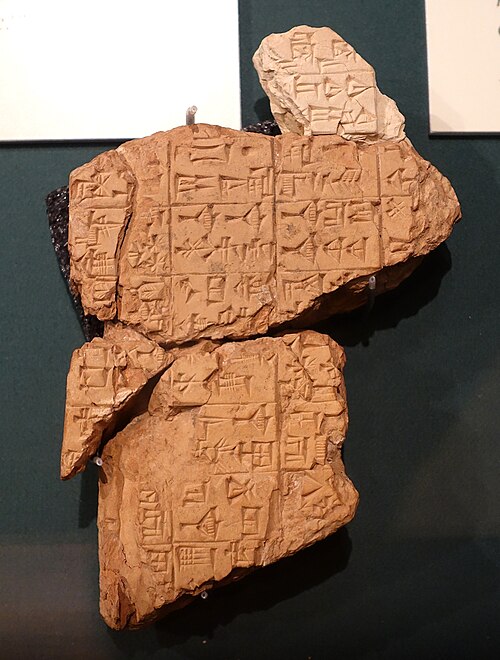
It was written in Sumer, a land in what is now southern Iraq, where people invented one of the first ways of writing. They did not use paper. They pressed a cut reed into soft, wet clay to make little wedge-shaped marks, and then let the clay dry into a hard tablet. This kind of writing is called cuneiform, which means “wedge-shaped”.
Some of the advice is very practical, like a farmer talking: do not put your field right next to a road, because people will walk all over it; do not dig a well in the middle of your field, because others will come and damage it; do not buy a donkey that brays too much.
Some of the advice is about being a good person: do not steal, do not break into other people’s houses, do not be rude to your mother, be careful what you say, and do not promise to pay someone else’s debts.
The son in the story is Ziusudra. In another Sumerian story, Ziusudra is the man who builds a big boat and survives a great flood, a bit like Noah in the Bible. So this list of advice is imagined as coming from a time long, long ago, “before the flood”.
The oldest copies are about 4,500 years old, and students kept copying the text for many hundreds of years afterwards. That means children in ancient schools learned to write by copying the very same advice you can read today.
At a glance
- Type
- Wisdom literature: a collection of proverbs and precepts framed as a father’s instructions to his son
- Language
- Sumerian, written in cuneiform on clay tablets; later also rendered in Akkadian
- Oldest copies
- Early Dynastic III period, about 2600–2500 BCE, from Abu Salabikh and Adab in southern Iraq
- Best-known version
- Old Babylonian period (about 1900–1700 BCE), copied in scribal schools; a little under 300 lines in modern reconstructions
- Speakers
- Shuruppak, son of Ubara-Tutu, instructs his son Ziusudra, the Sumerian flood hero
- Contents
- Practical advice on farming, property and neighbours, alongside moral rules on theft, speech, family and sexual conduct
- Significance
- One of the oldest surviving literary works in the world and the earliest known example of the ‘instruction’ genre
Easy
What is the Instructions of Shuruppak?
The Instructions of Shuruppak is a Sumerian composition made up of short pieces of advice. It is framed as a speech: a wise old man called Shuruppak speaks to his son Ziusudra, telling him how to farm, how to manage his household, how to treat his neighbours and how to behave. Modern scholars classify it as wisdom literature, a type of writing that passes on practical and moral knowledge rather than telling a story about gods or heroes.
What makes the text famous is its age. The earliest copies were written in the Early Dynastic III period, roughly 2600–2500 BCE, in the land of Sumer in southern Mesopotamia (today southern Iraq). This puts it among the very oldest works of literature that survive anywhere in the world, several centuries older than the earliest surviving versions of the Epic of Gilgamesh and close to a thousand years older than the Code of Hammurabi.
The work had a long life. After its first appearance it was copied again and again, and a revised, longer Sumerian version became a standard text in the scribal schools of the Old Babylonian period, around 1900–1700 BCE. Fragments of versions in Akkadian, the main Semitic language of Mesopotamia, show that it was still known in the later second millennium BCE.
Easy
What does it say? Advice for fields, homes and hearts
The text opens in a solemn, storytelling voice that places it in the distant past. In the Old Babylonian version it begins roughly: “In those days, in those far-off days; in those nights, in those far-off nights; in those years, in those far-off years…”. Then it introduces the wise Shuruppak, who “gave instructions to his son Ziusudra”, and he begins: “My son, let me give you instructions; let my instructions be taken.”
Much of the advice is practical and rooted in village and farm life. The father warns his son not to buy a donkey that brays, not to place his field beside a road, not to dig a well in his own field because other people will damage it, and not to build his house next to a public square where crowds gather. These lines show what people worried about: property, water, animals and the risks of living close to others.
Other lines are about behaviour and morality. The son is told not to steal or break into a house, not to commit violence, not to stand as guarantor for another person’s debt, not to speak arrogantly to his mother, not to pass judgement while drinking beer, and to be careful with his words. Some lines warn against sexual misconduct, for example with a married woman. There is also advice about the family, such as the saying that a loving heart keeps a household together while a hateful heart destroys it.
Most individual pieces of advice take up only one to three lines. They are not arranged by topic like a modern self-help book; one line about farming may be followed by one about speech and another about a slave or a neighbour. Reading it feels a little like listening to a grandparent who jumps from subject to subject, but always with the same seriousness.
Many pieces of advice come with a reason attached. Instead of simply saying “do not do this”, the father often explains what will happen if you do: people will damage your field, the man you vouched for will have a hold over you, your words will be used against you. This habit of giving reasons makes the text feel less like a list of orders and more like the voice of experience.
Easy
Who were Shuruppak and Ziusudra?
Shuruppak was also the name of a real Sumerian city, known today as Tell Fara, on an old course of the Euphrates. In Mesopotamian tradition the city was one of the places that had kings before the Great Flood. The father in the text is named after the city, and the text calls him the son of Ubara-Tutu, who appears in the Sumerian King List as the last king to rule before the flood.
His son Ziusudra is the Sumerian flood hero. In a separate Sumerian story, the gods decide to send a flood to destroy humankind, but Ziusudra is warned, builds a boat and survives. Later Akkadian literature knows the same figure as Atrahasis and as Utnapishtim; in the Standard Babylonian Epic of Gilgamesh, Utnapishtim is called the son of Ubara-Tutu and a man of Shuruppak.
By putting the advice in the mouths of these figures, the text gains enormous authority. It presents itself as wisdom from before the flood, passed from the last generation of the old world to the man who would carry it into the new one. Some modern summaries call Shuruppak a king, and later tradition does link him with kingship, but the text itself mainly presents him as a wise and knowledgeable man. Whether any of these figures was a real historical person is unknown.
Intermediate
The world that produced it: Early Dynastic Sumer
In the mid-third millennium BCE, southern Mesopotamia was divided among independent city-states such as Ur, Uruk, Lagash, Umma, Nippur, Kish and Shuruppak. Each had its own patron god, temple households and rulers, and they competed, sometimes violently, over land and water from the Tigris and Euphrates. Agriculture depended on irrigation canals, which is why rights to fields, wells and water appear so often in the text.
Writing had been invented in Mesopotamia a few centuries earlier, around 3400–3200 BCE, mainly for accounting. By the Early Dynastic III period it was being used for much more: royal inscriptions, contracts, lists of words, and the first literary compositions. The Instructions of Shuruppak belongs to this first wave of written literature, together with works such as the Kesh Temple Hymn and a series of hymns to the gods known from the same sites.
Scribes were trained in schools, and literature was part of their curriculum. Copying wise sayings taught vocabulary and grammar at the same time as it passed on values. The Instructions of Shuruppak thus sits at the meeting point of education, morality and the craft of writing.
Intermediate
How the text survived: tablets from Abu Salabikh to Babylon
The oldest manuscripts come from two Early Dynastic sites. At Abu Salabikh, a small mound about 20 km northwest of Nippur whose ancient name may have been Eresh, American excavations of the Oriental Institute of the University of Chicago in 1963–65 recovered about 500 cuneiform tablets and fragments, among them some of the earliest literary texts ever found, including a copy of the Instructions. The Abu Salabikh texts were published by Robert D. Biggs in 1974. Fragments of another early copy are known from Adab.
Reading these early tablets is extremely difficult. The spelling of Early Dynastic Sumerian is sparse; signs are not always written in the order in which they were read, and many grammatical elements are left out. Scholars often rely on the later, fuller version to understand the older one, while being careful not to assume that the two were identical.
Around 1900–1700 BCE, in the Old Babylonian period, the text was copied widely in scribal schools, especially at Nippur. This version is longer and more polished, and it is the basis of most modern translations. It is organised in three main parts, each opening with a version of the same introduction about Shuruppak instructing Ziusudra, and it ends with a line praising Nisaba, the goddess of writing and scribal learning.
Later fragments show the text in Akkadian or in bilingual form, dating to the late second millennium BCE. Across roughly a thousand years, then, the wording changed: some maxims were lost, others were added, and the language was modernised. The Instructions of Shuruppak is therefore not one fixed text but a living tradition preserved in many different copies.
Intermediate
Main themes: prudence, speech and social order
Prudence is the backbone of the text. Much of the advice is about avoiding trouble: do not put yourself where others can harm your property, do not take on another person’s debts, do not get involved in quarrels, and do not trust too easily. The ideal person is careful, sensible and self-controlled rather than heroic.
Speech receives special attention. Many lines warn against careless, boastful or slanderous words and against giving testimony lightly. In a society where contracts, disputes and reputations depended heavily on spoken oaths and witnesses, controlling one’s tongue was a practical as well as a moral virtue.
The text also reflects the social order of its time. It assumes a household with fields, animals and slaves; it takes for granted differences between rich and poor, free and unfree; and it speaks from the point of view of a male head of household addressing his male heir. Readers today can learn from it both about shared human concerns, such as family harmony and honesty, and about values that are very different from modern ones.
Religion is present but not dominant. The gods appear in some lines, and the text closes by praising the goddess Nisaba, but most of the advice is justified by its practical consequences rather than by divine command. This down-to-earth tone is typical of Mesopotamian wisdom literature.
Intermediate
A genre is born: instructions across the ancient world
The Instructions of Shuruppak is the earliest known example of a form that became widespread in the ancient Near East: advice presented as a father’s (or teacher’s) instructions to his son (or pupil). Mesopotamia produced other examples, such as the Instructions of Ur-Ninurta and the Akkadian Counsels of Wisdom, as well as large collections of Sumerian proverbs used in schools.
Egypt developed a parallel tradition of “teachings” (sebayt), such as the Instruction of Ptahhotep, framed as the advice of an old official to his son. In the Hebrew Bible, the Book of Proverbs uses the same address, “my son”, and some of its concerns, such as warnings against standing surety for others and against adultery, resemble those in the Sumerian text. Scholars have also compared it with Hesiod’s Works and Days, a Greek poem of practical and moral advice addressed to the poet’s brother.
These resemblances do not necessarily mean that one text copied another. They show how similar social worlds, built on farming, households, law courts and scribal schools, produced similar ways of passing on wisdom. The Sumerian text matters because it shows that this way of teaching was already fully formed in the third millennium BCE.
Intermediate
Rediscovery and modern reception
Like the rest of Sumerian literature, the Instructions were entirely forgotten for more than two thousand years after cuneiform went out of use in the early centuries CE. They were recovered only through modern excavations in Iraq and the decipherment of Sumerian in the late nineteenth and twentieth centuries.
Bendt Alster’s edition of 1974 was the first full scholarly study, and his later book Wisdom of Ancient Sumer (2005) remains a standard reference. English translations are freely available through the Electronic Text Corpus of Sumerian Literature (ETCSL) at the University of Oxford, which made the text widely accessible to students and general readers.
Today the Instructions are regularly quoted in books and classrooms as “the oldest advice in the world”. Many of the original tablets from Iraqi sites were kept in the Iraq Museum in Baghdad; the looting and damage to Iraqi heritage in recent decades have made the careful documentation and publication of such tablets all the more important.
Advanced
Scholarly questions: dating, versions and interpretation
Dating the earliest version. The Abu Salabikh and Adab manuscripts are dated by archaeological context and palaeography to the Early Dynastic III period. Absolute dates for this period depend on which Mesopotamian chronology is used and on radiocarbon evidence, so “about 2600–2500 BCE” is an approximation. The composition itself may be older than its earliest surviving copy, but there is no direct evidence for this.
One text or many? Comparison of the Early Dynastic and Old Babylonian versions shows substantial differences in wording, order and content. Scholars debate how best to describe this: as a single work that was revised, as a family of related collections sharing a frame and many maxims, or as a flexible stock of sayings that scribes arranged in different ways. Editors reconstruct a “composite text” from many manuscripts, but no ancient reader ever saw exactly that version.
Understanding the language. Many maxims remain obscure because of rare words, broken passages and the elliptical style of proverbs. Translations can differ considerably from one another, and some lines are rendered with question marks even in the best editions. Readers should treat confident modern paraphrases of individual lines with caution.
The frame and the flood. Why the text is attributed to Shuruppak and Ziusudra is also debated. The frame connects it with the flood tradition, which is otherwise best known from later sources. Whether the flood frame was present from the beginning or became more prominent in later versions, and how it relates to the development of the flood story, are open questions.
Advanced
Evidence and methods
The evidence consists entirely of clay tablets, most of them broken. Assyriologists identify fragments belonging to the same composition, join them where possible, and establish a composite text line by line, noting variants among manuscripts. This work has depended on museum collections in Baghdad, Philadelphia, Chicago and elsewhere, and on the careful recording of where tablets were found.
Context matters. The Old Babylonian copies often come from school settings, which suggests the text was used in scribal education. Studying which other texts were found with it, how the tablets are shaped and whether they are exercises or finished copies helps scholars understand how the text was used and why it was preserved.
Comparative study is another method. Placing the Instructions alongside Sumerian proverb collections, later Akkadian wisdom texts, Egyptian teachings and biblical Proverbs helps reveal shared forms and themes, but scholars caution against assuming direct borrowing without clear evidence. Digital corpora such as ETCSL now allow systematic searches of vocabulary and phrasing across the whole of Sumerian literature.
Key ideas
- Wisdom literature
- Writing that passes on practical and moral knowledge, often as proverbs or advice, rather than telling a myth or epic.
- Father-to-son instruction
- The frame in which an older man advises his son; it became a common form in Mesopotamia, Egypt and ancient Israel.
- Prudence
- Careful, sensible behaviour that avoids unnecessary risk; the central value of the text.
- Guarding one’s speech
- A recurring warning against careless, boastful or false words, which could cause disputes and ruin reputations.
- Wisdom from before the flood
- By naming the flood hero Ziusudra as the listener, the text presents its advice as ancient and authoritative.
- A living text
- The work was revised and recopied over roughly a thousand years, so it survives in several different versions.
- Learning by copying
- Scribal students learned to write by copying texts like this one, absorbing moral lessons and language skills at the same time.
Records
- c. 3300 BCE — Writing develops in southern Mesopotamia, first for accounting.
- c. 2600 BCE — Early Dynastic III period: the first literary texts appear in Sumerian cities.
- c. 2500 BCE — Scribes at Abu Salabikh and Adab write the oldest surviving copies of the Instructions of Shuruppak.
- c. 1800 BCE — Old Babylonian period: a longer standard Sumerian version is copied in scribal schools, especially at Nippur.
- c. 1200 BCE — Late second millennium BCE: fragments of Akkadian and bilingual versions show the text is still being copied.
- 1963 — Excavations by the Oriental Institute at Abu Salabikh (to 1965) recover about 500 early tablets, including a copy of the Instructions.
- 1974 — Robert D. Biggs publishes the Abu Salabikh tablets; Bendt Alster publishes a full edition of the Instructions.
- 2005 — Alster’s Wisdom of Ancient Sumer presents a revised edition and translation.
Glossary
- Sumer
- The southernmost part of ancient Mesopotamia, in today’s southern Iraq, home to some of the earliest cities.
- Sumerian
- The language of Sumer; it is not related to any other known language.
- Akkadian
- A Semitic language of Mesopotamia, written in cuneiform, which gradually replaced Sumerian in everyday use.
- Cuneiform
- Writing made by pressing a reed stylus into clay to form wedge-shaped marks.
- Clay tablet
- A flat piece of clay used as a writing surface; once dry or baked it can last for thousands of years.
- Early Dynastic period
- The era of competing Sumerian city-states, roughly 2900–2350 BCE.
- Old Babylonian period
- Roughly 2000–1600 BCE, when much Sumerian literature was copied in schools.
- Maxim
- A short saying that expresses a rule of conduct or a general truth.
- Assyriology
- The academic study of ancient Mesopotamia, its languages and its texts.
- Composite text
- A modern reconstruction of a work made by combining many fragmentary manuscripts.
Questions and answers
Is this really the oldest book in the world?
It is one of the oldest literary works that survive, with copies from about 2600–2500 BCE. A few other Sumerian works from the same period, such as the Kesh Temple Hymn, are similarly old, so it is safer to call it one of the oldest.
Who wrote it?
We do not know. The text presents itself as the words of Shuruppak, a figure from before the flood, but the real authors were anonymous scribes, and the text was revised over many centuries.
What is the funniest piece of advice?
Many readers enjoy the warning not to buy a donkey that brays, and the advice not to pass judgement while drinking beer. They show that people 4,500 years ago worried about very ordinary things.
Is Ziusudra the same as Noah?
No, but they are related figures in a shared tradition. Ziusudra is the hero of the Sumerian flood story; later Mesopotamian versions call him Atrahasis or Utnapishtim, and scholars have long compared these stories with the biblical account of Noah.
Why do translations of the same line differ so much?
Early Sumerian spelling is very sparse, many tablets are broken, and proverbs are short and allusive. Translators must reconstruct meaning from fragments, so some lines remain uncertain.
How is the Early Dynastic version related to the Old Babylonian one?
They share the frame and many maxims, but they differ in length, wording and order. The later version is fuller and is used as a key to reading the earlier one, though the two should not be treated as identical.
Where can I read it?
An English translation is available through the Electronic Text Corpus of Sumerian Literature (ETCSL) at Oxford, and scholarly editions and translations appear in Bendt Alster’s Wisdom of Ancient Sumer.
Sources and further reading
- Instructions of Shuruppak. Wikipedia
- Abu Salabikh. Wikipedia
- Shuruppak. Wikipedia
- Ziusudra. Wikipedia
- Sumerian literature. Wikipedia
- Wisdom literature. Wikipedia
- The instructions of Šuruppag (ETCSL 5.6.1). The Electronic Text Corpus of Sumerian Literature, University of Oxford
- Bendt Alster, Wisdom of Ancient Sumer. CDL Press, 2005
- Jeremy Black, Graham Cunningham, Eleanor Robson, Gábor Zólyomi, The Literature of Ancient Sumer. Oxford University Press, 2004
- Robert D. Biggs, Inscriptions from Tell Abū Ṣalābīkh (Oriental Institute Publications 99). University of Chicago Press, 1974
Related
- Epic of GilgameshA king's friendship with Enkidu and his search for immortality, assembled from earlier Sumerian poems into a Babylonian epic.
- EnheduannaHigh priestess of the moon god at Ur and daughter of Sargon of Akkad, often called the earliest author known by name.
- Code of HammurabiA collection of legal judgments issued under Hammurabi, king of Babylon, in the eighteenth century BCE.
- ConfuciusTeacher from the state of Lu whose sayings, gathered in the Analects, shaped ethics and government across East Asia.
Written with AI assistance from the published sources listed above, and revised as new research appears.