Start at the top for an easy introduction. Go further down for more detail and scholarship.
- Easy
- Intermediate
- Advanced
For young readers
Long, long ago, in the land that is now Iraq, a king named Sargon built one of the first empires in the world. He had a daughter, and he sent her to the great city of Ur to become the most important priestess of the moon god, Nanna.
We know her by her title-name, Enheduanna. It is usually translated as “high priestess, ornament of heaven”. She lived in a special house next to the temple, led ceremonies, and looked after the god’s temple and its lands.
Enheduanna is famous because poems were written down under her name. In one of them she even says “I” and talks about herself: how she was thrown out of her temple by a rebel and how she begged the goddess Inanna for help. That makes her one of the earliest writers in history whose name and voice we know.
Inanna was the goddess of love and war, and the brightest star in the evening and morning sky, which we now know is the planet Venus. Enheduanna’s poems praise her as fierce, dazzling and more powerful than all the other gods.
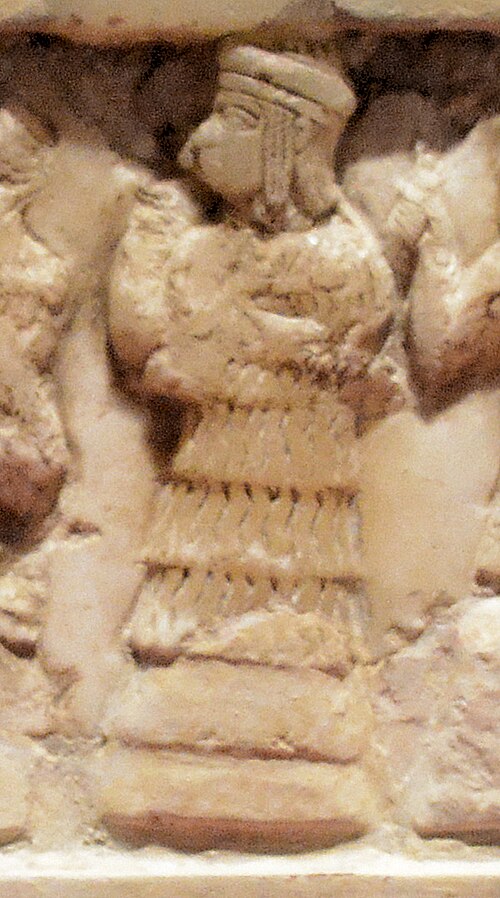
In 1927 archaeologists digging at Ur found a round stone plaque, broken into pieces. When they put it back together, they saw a carving of a priestess leading a ceremony, and writing on the back that says she was Enheduanna, the daughter of Sargon. It is like finding a photo of her 4,300 years later.
Her poems were copied by students in scribal schools for hundreds of years. Today people around the world read them in translation, and she has become a symbol of women’s voices in the earliest history of writing.
At a glance
- Lived
- Late 24th–23rd century BCE (dates uncertain; she served under Sargon of Akkad and into the reign of his grandson Naram-Sin)
- Place
- Ur, in southern Mesopotamia (Tell el-Muqayyar, southern Iraq)
- Role
- En (high priestess) of the moon god Nanna at Ur; daughter of Sargon, founder of the Akkadian Empire
- Language of works
- Sumerian, written in cuneiform, though her family spoke Akkadian
- Works attributed
- The Exaltation of Inanna (Nin-me-šara), the hymns In-nin ša-gur-ra and Inanna and Ebih, and the collection of Sumerian Temple Hymns
- Key artefact
- The Disk of Enheduanna, found at Ur in 1927, now in the Penn Museum, Philadelphia
- Significance
- Often described as the earliest known named author; her authorship is debated by scholars
Easy
Who was Enheduanna?
Enheduanna was the daughter of Sargon of Akkad, the king who, in the twenty-fourth century BCE, united the city-states of Mesopotamia under one rule for the first time and founded what historians call the Akkadian Empire. Sargon appointed his daughter as the en, or high priestess, of Nanna, the moon god, at Ur, one of the oldest and most important religious centres of southern Mesopotamia.
The name Enheduanna is a Sumerian title-name, usually translated as “en-priestess, ornament of heaven”. It was probably given to her when she took office; her birth name is unknown. As en, she was regarded as the earthly spouse of the moon god. She lived in the giparu, a large building beside the temple at Ur, where she presided over rituals and managed the estates of the god.
Enheduanna is remembered today above all as a poet. Ancient tradition attributes to her a group of hymns in the Sumerian language, including passages in which the poet speaks in the first person and names herself. If the attribution is correct, she is the earliest author in the world known by name, about a thousand years before Homer and several centuries before the earliest surviving versions of the Epic of Gilgamesh.
Easy
The Disk of Enheduanna: a portrait in stone
In 1927 the British archaeologist Leonard Woolley, excavating the giparu at Ur, found fragments of a round alabaster (calcite) disk. Reassembled, it shows a scene of worship carved in relief. A naked male priest pours a libation, a liquid offering, before an altar or a stepped structure. Behind him stands a woman in a long flounced robe and a distinctive headdress, raising her hand in a gesture of reverence, followed by two attendants.
The inscription on the back identifies her as Enheduanna, wife of Nanna and daughter of Sargon. The disk is thus one of the very few ancient images of a named woman from the third millennium BCE. Parts of the face and inscription were damaged and have been restored. The disk is now in the Penn Museum (University of Pennsylvania Museum of Archaeology and Anthropology) in Philadelphia.
Other finds confirm that Enheduanna was a real person. Seals bearing her name and belonging to members of her household, dating to the Sargonic period, were also found at Ur. These objects show that she held an important office with her own staff and administration.
Easy
Life at Ur: the city of the moon god
Ur lay near the Euphrates in the far south of Mesopotamia, close to the marshes and the head of the Persian Gulf. It was already an ancient and wealthy city when Enheduanna arrived. A few centuries earlier its rulers had been buried in the famous Royal Tombs, filled with gold, lyres and jewellery, which Woolley also excavated in the 1920s.
The city’s patron god was Nanna, the moon god, whom the Akkadians called Sin. His temple complex stood in the heart of the city. The great ziggurat of Ur that visitors see today was built later, around 2100 BCE, by King Ur-Namma, but a temple of the moon god stood on the site long before.
As en-priestess, Enheduanna was not only a religious leader but also the head of a large household. The god’s temple owned fields, flocks and workshops, and employed many people, from farmers and weavers to scribes. Her seals and the staff named on them show that she managed this organisation. Her life thus combined ritual, administration and, according to tradition, literary composition.
Easy
Her poems
Four major compositions are most often attributed to Enheduanna. The best known is Nin-me-šara, “Lady of all the divine powers”, usually called in English The Exaltation of Inanna, a hymn of about 150 lines. The second, In-nin ša-gur-ra, “Stout-hearted lady”, praises Inanna’s terrifying power in battle. The third, In-nin me-huš-a, known as Inanna and Ebih, tells how the goddess destroys a mountain that refused to honour her.
The fourth is a collection of 42 short hymns to temples across Sumer and Akkad, known as the Sumerian Temple Hymns. Each hymn addresses a temple as if it were a living being, praising its beauty and its god. Near the end, two lines name Enheduanna as the compiler of the tablet and declare that something has been created that no one had created before.
These poems are full of powerful images. Inanna rides on beasts, rains fire on the land, and is praised as greater than the sky god An. The poet also speaks of her own suffering: she has been driven from her temple, her beauty has turned to dust, and she calls on Inanna to rescue her. This mixture of praise, pleading and personal voice is what has made the poems so admired.
Intermediate
The Exaltation of Inanna: a poem of exile and return
The Exaltation of Inanna begins by celebrating Inanna as queen of all the me, the divine powers that make up civilisation, and as a warrior goddess whose fury no one can withstand. It then turns to a crisis. A man named Lugal-Ane has seized power in Ur. The poet says she has been expelled from her temple and her office, and that her own god Nanna has not come to her aid.
In the central section, the poet appeals directly to Inanna, asking her to judge the case and punish the rebel. Some scholars, notably Annette Zgoll, have read the poem as structured like a legal petition, in which the priestess brings her case before a divine court. At the climax, the poet says she has composed the hymn during the night and offers it to the goddess; in the final lines Inanna accepts the prayer and the priestess is restored.
The historical background seems to be the revolts that broke out against the Akkadian kings, especially against Sargon’s grandson Naram-Sin, when several Sumerian cities rose against Akkadian rule. Naram-Sin crushed the rebellions. The poem may thus reflect real events in which Enheduanna, as a representative of the Akkadian dynasty in Ur, was driven out and later returned. Scholars disagree about how precisely the poem can be connected with specific historical events.
Intermediate
Reading the poems: images, voice and structure
Enheduanna’s hymns use the full resources of Sumerian poetry. Lines are often built in parallel pairs, in which the second half repeats or intensifies the first. Lists of epithets pile up to overwhelm the listener with the goddess’s greatness. Images come from nature and warfare: Inanna is compared to a storm, a flood, a lion and a raging fire, and she is shown riding on beasts and scattering enemies.
What stands out is the poet’s own presence. In The Exaltation of Inanna the speaker moves from third-person praise to first-person lament and then to direct address, telling the goddess what has happened to her and what she wants. She describes the hymn itself as something she has “given birth to” during the night, making the act of composition part of the poem. This self-awareness about creating a text is rare in the literature of the time.
The Temple Hymns work differently. Each short hymn follows a similar pattern: it names a temple, praises its splendour, and ends by naming the god who dwells there. Together they form a sacred map of the land, from Eridu in the far south to cities in the north. Read as a collection, they present Sumer and Akkad as a single religious landscape, which fits well with the political project of the Akkadian kings.
For modern readers, the poems can be difficult. Many lines are broken or obscure, and translators must make choices about difficult words. Comparing several translations is a good way to see both the power of the poems and the uncertainties behind any single version.
Intermediate
Religion and politics: why a princess became a priestess
Sargon was an Akkadian, a speaker of a Semitic language, from the north of Mesopotamia. His empire brought together the ancient Sumerian cities of the south, each with its own gods and traditions. Placing his daughter as high priestess in Ur, the city of the moon god, was a political act: it tied a prestigious Sumerian religious institution to the new dynasty and gave the Akkadian royal family a presence at the heart of Sumerian religion.
Enheduanna’s poems also seem to bring together different religious traditions. The Sumerian goddess Inanna is closely identified with the Akkadian goddess Ishtar, and the hymns praise Inanna as supreme over other gods. Some scholars have suggested that her poetry served to promote a unified religious outlook for a unified empire, although it is difficult to prove such an intention.
The office of en-priestess of Nanna became a lasting tradition. Later Mesopotamian kings continued to appoint their daughters to the post for centuries. As late as the sixth century BCE, King Nabonidus of Babylon revived the office for his own daughter, drawing on ancient inscriptions about earlier priestesses. Enheduanna stood at the beginning of this long line.
Intermediate
How her poems survived
Almost all the manuscripts of Enheduanna’s poems date from the Old Babylonian period, roughly 1900–1700 BCE, several centuries after her lifetime. They come from scribal schools at Nippur, Ur and other cities, where students copied Sumerian literature as part of their education, even though Sumerian was no longer a spoken language by then.
The Exaltation of Inanna was one of the most frequently copied works in the Old Babylonian schools, which shows that it was considered a classic. Later still, some of the hymns were copied with Akkadian translations.
After cuneiform went out of use in the early centuries CE, the poems were forgotten. They were rediscovered in the twentieth century from tablets found in excavations. William W. Hallo and J. J. A. van Dijk published an edition and English translation of The Exaltation of Inanna in 1968, and Åke Sjöberg and others edited the Temple Hymns. Today translations are also available through the Electronic Text Corpus of Sumerian Literature at Oxford.
Intermediate
Legacy and modern reception
In the late twentieth century Enheduanna became an important figure beyond Assyriology. In 1976 the folklorist and anthropologist Marta Weigle introduced her to a wider feminist readership as the first known author in world literature. Since then she has been widely celebrated as a pioneering woman writer, and her poems have been translated and adapted by poets and scholars.
Scholars of rhetoric have studied The Exaltation of Inanna as an early example of persuasive composition, and Hallo compared the poem’s persuasive strategies with later literature, including the biblical prophets. Her poems have also been compared with later traditions of hymns and prayers throughout the ancient Near East.
In 2023 Sophus Helle published a complete English translation of the poems attributed to her, with essays, bringing her work to a broad audience. At the same time, many specialists urge caution: celebrating her as the “first author” should not obscure the real uncertainties about who composed the poems and how the idea of an author worked in ancient Mesopotamia.
Advanced
Evidence and methods
Three kinds of evidence meet in Enheduanna. First, contemporary archaeological evidence: the disk and seals from Ur, which establish her historical existence, title and family. Second, the literary manuscripts, which require philological study: establishing composite texts from many Old Babylonian copies, analysing language, spelling and variants, and asking what features might point to an earlier original. Third, the historical context of the Akkadian Empire, known from royal inscriptions and later traditions.
Interpretation depends heavily on how these kinds of evidence are combined. Linguistic analysis alone cannot easily date a composition that was modernised during centuries of copying. Historical readings of The Exaltation of Inanna depend on identifying Lugal-Ane and dating the revolt. Feminist and literary approaches ask how authorship, gender and voice were constructed in the poems and their reception.
Recent work emphasises that the concept of an “author” in ancient Mesopotamia differs from the modern idea of an individual creator. Studying Enheduanna therefore raises broader questions about authorship, anonymity, authority and canon formation in the world’s earliest literature.
Key ideas
- En-priestess
- The highest priestly office of a city god; at Ur the en of Nanna was regarded as the god’s earthly spouse.
- Named author
- Enheduanna is often called the earliest author known by name, though the attribution is debated.
- Personal voice
- The Exaltation of Inanna speaks in the first person about the poet’s exile and plea, unusual in early literature.
- Religion and empire
- Her appointment tied the Akkadian dynasty to the ancient Sumerian cult of the moon god.
- Inanna’s supremacy
- Her hymns exalt Inanna as queen of the divine powers and greater than the other gods.
- Transmission through schools
- Her poems survive mainly in Old Babylonian school copies made centuries after her time.
- Authorship as authority
- Attaching a famous name to a text could give it prestige, whether or not she wrote every line.
- Self-aware composition
- The poet describes creating the hymn itself, making the act of writing part of the poem — a striking feature in the world’s earliest literature.
Records
- c. 2334 BCE — Sargon of Akkad comes to power (middle chronology) and begins to build his empire.
- c. 2285 BCE — Enheduanna serves as en-priestess of Nanna at Ur (dates approximate).
- c. 2254 BCE — Naram-Sin, Sargon’s grandson, becomes king; rebellions later break out against Akkadian rule.
- c. 2250 BCE — Around this time or later in Naram-Sin’s reign, Lugal-Ane’s revolt in Ur drives Enheduanna into exile.
- c. 1800 BCE — Old Babylonian scribal schools copy her hymns widely; most surviving manuscripts date from this period.
- c. 554 BCE — King Nabonidus of Babylon revives the office of en-priestess at Ur for his daughter.
- 1927 — Leonard Woolley finds the Disk of Enheduanna at Ur.
- 1968 — Hallo and van Dijk publish The Exaltation of Inanna.
- 1976 — Marta Weigle introduces Enheduanna to feminist scholarship as the first known author.
- 2023 — Sophus Helle publishes a complete translation of her poems.
Glossary
- Akkadian Empire
- The empire founded by Sargon of Akkad in the 24th century BCE, uniting much of Mesopotamia.
- Sumerian
- The language of ancient Sumer, used for religious and literary texts long after it stopped being spoken.
- Ur
- An ancient Sumerian city in southern Iraq, centre of the moon god Nanna’s worship.
- Nanna
- The Sumerian moon god (Sin in Akkadian), patron god of Ur.
- Inanna
- Sumerian goddess of love, war and the planet Venus, identified with the Akkadian Ishtar.
- Giparu
- The residence and cult building of the en-priestess at Ur.
- Me
- The divine powers or decrees that make up civilisation in Sumerian thought.
- Libation
- A ritual offering of liquid poured out for a god.
- Colophon
- A note at the end of a text giving information about its writing or authorship.
- Old Babylonian period
- Roughly 2000–1600 BCE, when much Sumerian literature was copied in schools.
- Ziggurat
- A massive stepped temple platform of mud brick in Mesopotamian cities; Ur’s great ziggurat was built around 2100 BCE, after Enheduanna’s time.
- Cylinder seal
- A small carved stone cylinder rolled on clay to leave an impression, used as a signature by officials and households.
Questions and answers
Was Enheduanna really the first author?
She is the earliest person known by name to whom literary works are attributed. Whether she actually composed them herself is debated, because the copies we have were made centuries later.
Why did a princess become a priestess?
Her father Sargon used her appointment to connect his new Akkadian dynasty with Ur, an ancient centre of Sumerian religion. It was both a religious honour and a political move.
What does her name mean?
It is a Sumerian title-name usually translated as “en-priestess, ornament of heaven”. Her birth name is unknown.
Is Inanna the same as Ishtar?
They were closely identified. Inanna is the Sumerian name and Ishtar the Akkadian name; over time their myths and cults merged, and Enheduanna’s hymns helped shape the image of this powerful goddess.
What happened to her during the rebellion?
According to The Exaltation of Inanna, a rebel named Lugal-Ane took over Ur and drove her from her temple. She appealed to Inanna and was eventually restored.
Where is the Disk of Enheduanna now?
In the Penn Museum in Philadelphia. It was found at Ur in 1927 during a joint excavation of the British Museum and the University of Pennsylvania.
Why do scholars doubt her authorship?
All substantial copies are from the Old Babylonian period, the language shows no clear signs of the older Akkadian-period Sumerian, and attributing texts to famous names was a way of giving them authority.
Did she write in her own language?
Her family spoke Akkadian, but the poems are in Sumerian, the prestigious language of religion and literature in southern Mesopotamia.
Sources and further reading
- Enheduanna. Wikipedia
- Sargon of Akkad. Wikipedia
- Inanna. Wikipedia
- Ur. Wikipedia
- The Electronic Text Corpus of Sumerian Literature (ETCSL): hymns to Inana and the temple hymns. University of Oxford
- William W. Hallo, J. J. A. van Dijk, The Exaltation of Inanna. Yale University Press, 1968
- Annette Zgoll, Der Rechtsfall der En-ḫedu-Ana im Lied nin-me-šara. Ugarit-Verlag, 1997
- Jeremy Black, Graham Cunningham, Eleanor Robson, Gábor Zólyomi, The Literature of Ancient Sumer. Oxford University Press, 2004
- Sophus Helle, Enheduana: The Complete Poems of the World’s First Author. Yale University Press, 2023
Related
- Instructions of ShuruppakOne of the oldest surviving works of literature: a Sumerian father's advice to his son, preserved on clay tablets.
- Epic of GilgameshA king's friendship with Enkidu and his search for immortality, assembled from earlier Sumerian poems into a Babylonian epic.
- Code of HammurabiA collection of legal judgments issued under Hammurabi, king of Babylon, in the eighteenth century BCE.
- HomerThe poet tradition credits with the Iliad and the Odyssey, the founding epics of Greek literature. Whether one person composed both is debated.
Written with AI assistance from the published sources listed above, and revised as new research appears.